This is one of the things that pisses me off about the Star Trek "fans" who point to the Replicator tech (which wasn't introduced until the Next Generation series) as the reason humanity was able to end scarcity. No, it absolutely was not what ended scarcity in the Star Trek universe. What ended scarcity was the absolute end of capitalism. We have now and have had for over a century, the capability to end world hunger and provide housing for every man woman and child on the planet. We don't do it because it would remove the overinflated value of those things as well as the obscene wealth of the rich.
post
Most of the 8 billon people are living in the third world and which less resources waste, most recources a wasted by less than 10% of the world population.
The design choices of people who make memes out of their political opinions are so random and funny to me sometimes. Like why is one of them a Russian gopnik? Why is the other one a blushing gamer femboy who paints his nails??
Does this assume instant, frictionless transportation of goods?
Transportation of goods is mostly a capitalist issue. You don't need to cover a cucumber with plastic and ship it half way across the world, while selling the local ones to richer countries. The same goes for the vast majority of "goods". Remove all of that greedy, superfluous shit, and you're left with minimal shipping needs.
I mean, I get that you don’t like how they talk on Lemmy about it, but the quote from the study even talks about how the surplus could be used for additional consumption and everything. Study is here
I think we all have different things we want in life and with such a big surplus there is room for most of us to regularly enjoy that. I do not believe that they argue that we will NEVER be able to enjoy different food. That is as you have mentioned not functional or good for people to work together and live together. Disregarding the many people with different cultures that have moved somewhere else.
I think the study more clearly argues that we can afford to take care of everyone on the world if we wanted to. That there is a viable way and that that way is not as you are implying necessarily a deprived space with tight margins. Because living is about more than slaving away like a 12th century peasant to accumulate more wealth for a king somewhere far off.
Most of what the study is proposing would be a modest decrease in living standards in developed countries, for a drastic increase in living standards everywhere else. It's not asking you to give up luxury, only for the rate of new luxury to decrease slightly as surplus is more evenly distributed.
It's wild how you went from shipping plastic wrapped cucumbers across the world while exporting local ones, to your bougie bs...
We get it, you're a spoiled first worlder
Not everyone has equally arable land.
Edit: Beyond that, have you talked to anyone performative driving one of those child-killing tall pickups? We are a people that lost their shit about straws, and the kind of changes being talked about here are just… [waves arms at all of this]
And bunch of other sacrifices. One of the points was also about everyone living in a city close by. The study is not applicable to real life, it's utopia scenario. One of the biggest problems isn't even resources, but co2 production.
I dunno, I think it would be perfectly doable with good public transit.
Don't have many big cities, but have mid-sized cities near-ish, and smaller towns near the mid-sized ones. A sort of 'web' of cities, if you will.
what you're describing is called "multigrid" system.
you have grids of varying size, all overlapping each other.
examples:


notice the streets make some kind of "grid" on the landscape
Yes, exactly this was what I was thinking about.
now you also know the name :)
There was 3.7 billion people when I was born. Since I'm still alive we can guess that's within a human lifetime.
Since I was born, 73% of the animals on Earth are gone. Our ecosystems are already crashed, and no one notices.
Remember COVID? When everyone stayed home and quit buying shit, laid low? Remember Venice seeing dolphins in the streets and Asians seeing mountains you couldn't see before? Remember how quiet it was?
SOCIETY can provide, EARTH cannot. Y'all gonna have to die. But hey, between global warming and tanking birth rates fucking our economies in both holes, win, win! The contraction will be of Biblical proportions. I won't live it, my kids will. Good luck kids!
Good riddance, those animals would only get in the way of any future, cyberpunk dystopia or venus cloud city dnb compilation thumbnail luxury space communism.
I won't live it, my kids will. Good luck kids!
One of the many reasons I didn't have kids.
I don't think really that a majority of the population is going to die. I do think significant numbers of deaths will happen around the equator at some point in the near future and spark a functionally unstoppable wave of immigration towards the earth's poles. This will result in its own strife but again will only cause a small percentage of more of the population to die.
Thing's will eventually stabilize as human civilization adapts and green energy and carbon capture take off. Most of the population will survive but almost everyone's QoL will be NOTABLY worse by various conventional metrics. Though likely better in specific ways due to certain medical and automation advancements.
Expect birthrates to continue to drop globally however and the earth's eco system will drastically change and become much less healthy. Most of existing humanity will cling to life though.
And what makes you think society is suddenly going to change (any moment now?) and your kids would have a better life, would just everyone keep having kids?🤔
I think the thing you have to ask yourself is "would i want to be born today" that will tell you whether you should have kids.
Define 'decent living standards'.
I'm sure they define that in the study if you read it
Well would you look at that, it sure does.
https://www.sciencedirect.com/science/article/pii/S2452292924000493
Recent empirical studies have established the minimum set of specific goods and services that are necessary for people to achieve decent-living standards (DLS), including nutritious food, modern housing, healthcare, education, electricity, clean-cooking stoves, sanitation systems, clothing, washing machines, refrigeration, heating/cooling, computers, mobile phones, internet, transit, etc. This basket of goods and services has been developed through an extensive literature (e.g., Rao and Min, 2017, Rao et al., 2019) and is summarized in Table 1, following Millward-Hopkins (2022).
The study does, in fact. Or actually, bare minimum living standards:

Quoting from the article:
"It is important to understand that the DLS represents a minimum floor for decent living. It does not represent a an aspirational standard and certainly does not represent a ceiling. However, it is also a level of welfare not currently achieved by the vast majority of people. A new paper by Hoffman et al finds that 96.5 percent of people in low- and middle-income countries are deprived of at least one DLS dimension."
I think Maslow's pyramid of needs would be a good starter. But let's be more concrete.
-
House (60 m2, +20 m2 per extra person in household), with electrification, and which can withstand severe weather events (heatwaves, blizzards, heavy rain and wind, etc.).
-
Clean air and environment without fine dust, microplastics, PFAS, asbestos, etc.
-
Clean, potable and heatable water available anytime
-
Healthy and clean food free from animal suffering made available for all
-
Everyday and affordable clothes available for all
-
Bodily integrity: only the person themselves can decide over their own body, with the exception of vaccination (because everyone ought to be vaccinated!)
-
Labour rights, such as automatic unionisation, workplace democracy and self-governance, no vertical hierarchy (so no CEO, overreaching holdings, trusts, etc). And ideally, a wageless gift economy system based on needs. If not that, then this: any company lacking one of the above/being too big, may never get bailed out.
-
Protection of personal property, with private property becoming communal property instead.
-
Encouragement of meeting people at sport, hobbies, reading (helps finding friendship)
-
Bicycle and public transit infrastructure being widely available.
-
Free and high-quality public education available for all
-
Same with healthcare. No artificial limit mandating that there be max x amount of doctors or teachers.
I know the world has more than enough resources and productivity for everyone on it to live comfortably without overworking, but 30% is the lowest figure I’ve ever seen. Would like to know where that came from. I’ve seen so many widely varying estimates of everything.
There is a source where the text was taken from at the bottom.
Thank you, dumb me missed it. Their paper talks a lot about measuring poverty. Earlier research showed poverty in China being high in the 80s under socialism and decreasing in the 90s when they became more capitalist. But the formulas for calculating that involved the prices of all consumer goods, including things like airline tickets, cars, big TVs, etc. But If you take these authors' approach and ignore the prices of things poor people never buy, the math shows poverty being very low in the 80s and rising dramatically in the 90s, because introducing more capitalism brought down the cost of middle-class and luxury goods but increased the cost of the basics.
Someone else posted what it means. It means 10m² living space per person, 4 people share 20m² for bathroom and kitchen, you don't eat meat, you wash tops every ~3 days and bottoms every ~14 days(laundry is shared with ~20 people). Something like 4 people are expected to share a laptop with specs that were cutting edge 15 years ago(a "gaming pc" would only be able to be used for ~150 hours per year).
It is a MAJOR downgrade from how most people live, even those in poverty, and is just not appealing to all but the most minimalist of people. It's more akin to living in an RV or "van life"(except you're not supposed to have a car in this situation either - public transportation only).
It's also ignoring the fact that we have already surpassed the limitations of what the nitrogen cycle could normally provide. So we would still be relying on fertilizers produced with fossil fuels.
Absolutely.
Also, whenever I see "humans only really need X" I always think of Bill Gates saying no one will ever need more than 640kb of RAM. Sure, today no one will, but tomorrow someone who was held back by that previous number will see the new number and be able to complete a new task and suddenly that will be the new "baseline". A 1.4mb floppy used to store dozens/hundreds of text files. Now a .jpeg takes up more space. You can't just settle on some number without commiting to becoming left behind as things progress.
Well, thanks for sharing misinformation.
Meanwhile, in the actual study (provided free via any search engine of your choice):

Also directly from the study you didn't read:
"It is important to understand that the DLS represents a minimum floor for decent living. It does not represent a an aspirational standard and certainly does not represent a ceiling. However, it is also a level of welfare not currently achieved by the vast majority of people. A new paper by Hoffman et al finds that 96.5 percent of people in low- and middle-income countries are deprived of at least one DLS dimension."
So no, nobody is coming to take your gaming rig, and no, the majority of people on Earth would get an UPGRADE in living conditions, not a downgrade.
Here is a link if you cannot access a search engine.
I agree that we can support everyone on earth if we change our social, economic, and political systems.
I also think it is good that voluntary population decline is already happening and seems likely to continue in many industrialized nations.
From what i've heard, with the aging population in developed countries and the birthrate getting lower due to longer life expectancy, population should soon stabilise itself around 10 billions. Seems viable.
It is true there are too many billionaires. We can provide everyone, if some of them also need 10 private jets.
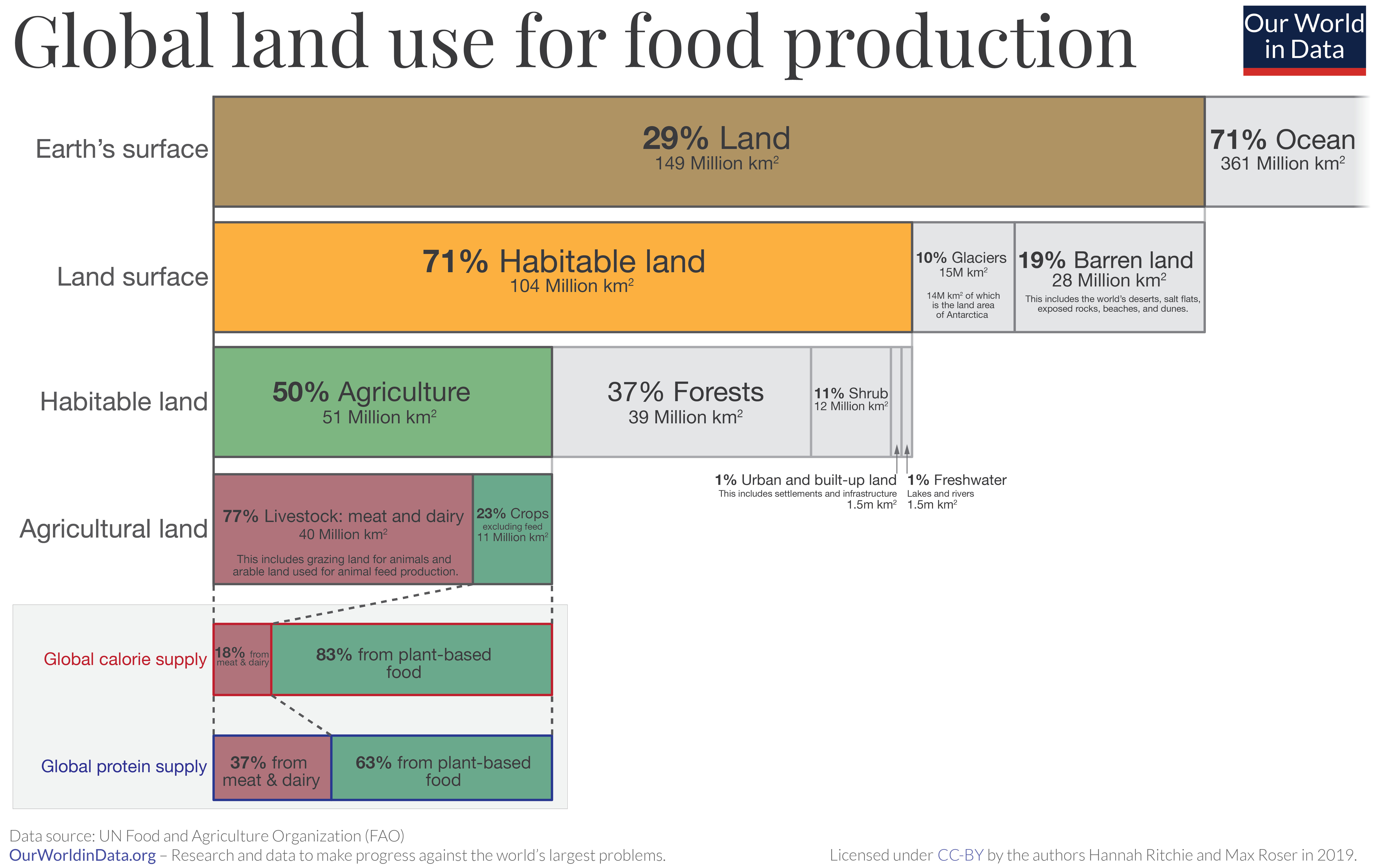
Technically, earth's land area is big enough to sustain around 24 billion people. Consider this diagram:

It shows that we're using around 50% of all habitable land for agriculture. Most of the land that we aren't using is either high up in the mountains (where terrain isn't flat and you can't use heavy machinery) or in the tropical regions on Earth close to the equator (south america, central africa, indonesia), or in areas where it's too cold for agriculture (sibiria, canada). so you can't really use more agricultural land than we're already using without cutting down the rainforest.
In the diagram it also says that we're using only 23% of agricultural land for crops which produce 83% of all calories. If we used close to 100% of agricultural land for crops, it would produce approximately 320% of calories currently being produced, so yes, we could feed 3x the population this way.
However, it must be noted that there's significant fluctuation in food production per km², for example due to volcanic eruptions. So it's better to leave a certain buffer to the maximum amount of people you could feed in one year, because food shortages in another year would otherwise lead to bad famines.
Did you know 90% of Earth’s topsoil is at risk of depletion by 2050? It might throw a wrench into this perfect utopia being planned here.
Why can’t we just have fewer people too? Instead of finding ways to support 50 billion people, how about we have good birth control facilities, education, and economies not based on constant never ending growth? The reality is unending growth WILL end whether people like it or not- wouldn’t it be better to do it on our own terms rather than in a global catastrophe?
Why can’t we just have fewer people too?
Won't somebody think of the ECONOMY?
A lot of countries around the world are living a so called "underpopulation crisis" even though the population is still growing frighteningly fast. Population going down is only a problem for capitalism, and it's going to doom us all
Most of the world is far from replacement levels of population and the global trend is a decrease in fertility. Overall, we are at 2.4 kids per woman, the replacement level being estimated between 2.1 and 2.3 (depending how likely you think it is to die from wars). This data has been (mostly) decreasing since the 60s.
wouldn’t it be better to do it on our own terms rather than in a global catastrophe?
The catastrophy is inevitable, it's just a question of whether any humans will survive.
For example CO2 has a delayed effect of ~40years (if I remember correctly). The effects of global warming are very much obvious now, but the yearly output hasn't at any point dropped to those levels since.
The best way to control population growth is to actually give them a high standard of living and education. One of the most consistent trends in a developing nation is it's birth rate slowing down as people become more prosperous
Why can’t we just have fewer people too? Instead of finding ways to support 50 billion people
line must go up (/s)
Anyone have a good pdf source on this research?
Oh, I know!
wE sHoULd KiLl HalF oF ThEm
I was going to say "No one is saying that", but there are many going down that road.
The preferable approach is degrowth. A lower birthrate leading to a smaller population with no deaths required, just vastly fewer births and lower consumption until human civilization can not only fit with our planetary boundaries, but restore a lot of wildlife and wildlands, then stabilize at a population and consumption that is healthy and comfortable.
This is already happening, but i don’t think it’s fast enough: with the exceeded life expectancy, we are first seeing an increase and aging of population. Only after the wave of now 50-60 year olds will be dead will we see a stable degrowth. Is that soon enough? Sure it’s preferable to extermination?
I'm not keen on a society were seniors are the majority of the population, it would be a disaster.
I'm not keen on a society dominated by resource exhaustion, grossly exceeded planetary boundaries leading to ecological overshoot and collapse and billions of early deaths due to climate change, pollution and conflict as everyone fights for whatever is left.
An againg society is a necessary step towards a sustainable population. Anything other than a sustainable population (number of people x consumption amount) will, by definition, not be sustained. A collapse will be chaotic and devastating. A managed descent of degrowth will have difficulties but could save humanity and the biosphere as we know it.
The number of people basically advocating for this in the comments is honestly depressing
How did they calculate that? I don't believe it.
Ah hes a degrowther, makes sense. I read through his paper and I really don't think its realistic or thought provoking. It lacks humanity and applies a utilitarian solution. Its the same as saying we have x humans producing co2 lets reduce the number of humans but instead of humans its goods he deems to be unnecessary.
His entire premise is based on what he thinks a person needs to live a good life. But lifes just not that simple and people all around the world NEED different things this type of strict partitioning fails when applied to the entire world. Part of what makes our current system work is that its dynamic, people create goods they want and those who also want those goods buy them.
What on Earth are you on about?
Quoting from the study:
"It is important to understand that the DLS represents a minimum floor for decent living. It does not represent a an aspirational standard and certainly does not represent a ceiling. However, it is also a level of welfare not currently achieved by the vast majority of people. A new paper by Hoffman et al finds that 96.5 percent of people in low- and middle-income countries are deprived of at least one DLS dimension...we can conclude that 6.4 billion people, more than 80% of the world's population, are deprived of DLS."
The authors are not suggesting that everyone be forced on DLS at gunpoint. They are suggesting an absolute bare minimum standard that the overwhelming majority of people on Earth do not yet even have.
How the hell do you get from that to some sort of paranoid fantasy where everyone gets exactly the same thing?
Uh I disagree. The author is suggesting we could cut 70% of the worlds industry because he thinks that represents a good enough standard of living. If he was suggesting that everyone be brought up to the minimum standard then he wouldnt be suggesting large scale degrowth.
Which paper are you getting this from?
No, his argument is that the average human needs this standard. also, it is a model, it is by definition simplified.
Besides, what is the alternative? First world countries living like they own the place, third world countries starving, and we're all getting killed in the climate war of 2040?
No, his argument is that the average human needs this standard. also, it is a model, it is by definition simplified.
His argument is the average hmuan needs this standard.. so we can cut "unnecessary production" and it will be fine. I'm arguing that he cant label things unnecessary because hes found a standard wealth level he thinks is good enough. It wont work as an approach because humans require a diverse range of inputs to live happy lives and that requires a diverse and dynamic production economy.
Reading the study I get the following remarks:
Living space, not great. 60m2 for a 4 person family. That's tight. I live alone in a 90m2 house and I could use more space, do they want me to live in a 15m2 house or do they want to force to share living space? Sorry but I won't compromise there. I prefer people having less children that me having to live as ants in a colony.
That is just a personal pick with the DLS minimum requirements chosen.
But still forgetting that. The reasoning is extremely faulty. Most of their argumentation heavy lifting is just relied to Millward-Hopkins (2022) paper establishing that 14.7 GJ per person anually is enough. That paper is just a work of fantasy. For reference, and taking the same paper numbers. Current energy usage (with all the exiting poverty) is 80 GJ/cap. Paleolitic use of energy was 5 GJ. Author is proposing that we could live ok with just triple paleolitic energy. That paper just oversees a lot of what people need to live in a function society to get completely irrational numbers on what energy cap we could assume to produce a good life.
Then on materials used. The paper assumes all the world shifting to vegetarian diet, everyone living on multiresidential buildings, somehow wood as the main building material (I don't know how they even reconcile that with multiresidential buildings...). And half of cars usage shifting to public transport How to achieve this in rural areas it's not mentioned at all).
A big notice needs to be done that both papers what are actually doing is basically taking China economy (greatly praised in the introduction) and assuming that all the world should live like that. And yes, probably the world could have 30 billion inhabitants if we accept to be all like China, who would we export to achieve that economic model if we all have a export based economy? who knows, probably the martians. And even then, while a lot of "ticks" on what a decent level of life quality apparently seems to be ticked, many people in western countries would not consider that quality life, but a very restrictive and deprived life standard.
I'm still on the boat the people having less children is a better approach to great lives without destroying the planet. At some point a cap on world population need to be made, it really add that much that the cap is 30 billion instead of maybe 5 billion? It's certainly not a cap in the number of social iterations a person can have, but numbers give for plenty of friends. And at the end it's not even a cap on "how many children" can people have, as once the cap is reach the number of children will be needed to cap the same to achieve stability. It's just a cap on "when people can still be having lots of kids". Boomer approach to "let's have children now" and expect that my kids won't want to have as many children as I have now.
Also another big pick I have with the article is that it blames the current level of inefficiency to private jets, suvs, and industrial meat. But instead of making the rational approach of taking thise appart from the current economy and calculate what the results will be. Parts from zero building the requirements out of their list. Making the previous complaint about those luxury items out of place completely. On a personal note I would reduce or completely eliminate many of those listed "super luxury" items. But I have the feel (just a feel because neither me not the author have studied this) that the results of global energy and material usage won't drop that much, certainly not at the levels proposed by the authors with their approach.
It's a minimum to bring the impoverished up to. The paper makes no suggestion that the rest are to be brought down to that standard except by changing production practices.
How do you need more than 90m² when living alone?? I live in a 60m² apartment and literally only use like 30-40m² and idk what I'd use the rest for.
I have a kitchen, a living room and two bedrooms. I do remote work so one of the bedrooms have a double purpose as guess room and office.
I would love to have at least, another room dedicated to storage. And second room so I could have a hobby/office room and a guess room separately.
Also I would love to have a garden.
I spent a lot of time at home, between remote work and hobbies, so I would like to have a more spacious living space. The more time you spent on a place the bigger it probably needs to be.
Gonna quote the study again:
"It is important to understand that the DLS represents a minimum floor for decent living. It does not represent a an aspirational standard and certainly does not represent a ceiling. However, it is also a level of welfare not currently achieved by the vast majority of people. A new paper by Hoffman et al finds that 96.5 percent of people in low- and middle-income countries are deprived of at least one DLS dimension."
Firstly- Are you so selfish that you refuse to change anything about your lifestyle in order to provide people with an absolute minimum standard of life - a standard that you have identified as abhorently poor by your standards?
Secondly- Change on your part may not even be required. Tax on production (i.e. corporations) would cover the majority of it, and the rerouting of production from useless things like casinos and yachts would cover the rest.
Finally- additional taxes and such would not even be required for many changes, just spending more efficiently. As an example- Very rural places all over the world have train and bus service. It's a matter of choice that the US doesn't, not a matter of practicality. We spend all of our money on highways instead, which are far more expensive per person per mile. Investing in rail, like Europe and China have done, provides far more use for far more people.
I said in other comment. I'm not in the US, I'm in europe we have one of the best train networks of the world. Public transport is funded by the government so is cheaper, even completely free in some cases.
People living in rural areas still chose cars while they have the free will to do so.
If as a species we cannot find the way to make that work there's no incentive for us to keep trying. Luckily I'm sure it's possible, that people say it's not just because propaganda (as I said mostly because the voting split rural/urban). We have achieve harder things as a species. Surely we can have people in rural areas still using cars (electric cars for instance) without dooming humankind to extinction.
could you link us the dls standards and the study itself?
You mad?
Yes, to support everyone on what our economy outputs today will involve the quality of life decreasing for a lot of people. And the economy will have to change, to build the things that people need but are currently unable to pay for. This is unsurprising.
Probably the living space is more to show this is feasible over it being the expected/desired solution. It would be very counterproductive to tear down good houses, but small apartments work well for "house single unhoused people".
Rural transport is a rounding error compared to the number of private cars that could be converted with minimal fuss in cities.
Why would an export economy be a bad model? They literally have a surplus; all you need to do to fix it is.... Make less?
I'm not mad. I will just not allow anyone to reduce my living standards because they don't want to use a rubber.
A export model is not bad. I just said that's unreasonable to think that all the world could follow that model. Because then "who would we export to?". It's like liberals thinking that the tax rate in a tax heaven are proof that every country could have those tax haven rates. Good for them, that the model worked, but for some country to export other country needs to import, that's all. Chinese economic growth have been very linked to being the world factory. That's great, but it could not be assumed that all the world could just do the same.
Who said anything about using a rubber? Or not? Let's properly support the people that exist now.
And do you think that's likely to happen any time soon in the real world?
It's all well and good coming up with theories on paper but if your theories only work on paper, then don't count them as solved.
They’re not mad, they’re just a bad person. Don’t use empathy in argument with someone who has none.
Also, those numbers are like averages. Some places would have high rises to accommodate the sheer numbers of people, working or non-working.
But yeah, I’d tear down my own fucking home right meow if it was for equality on a massive scale.
Definitely use empathy on someone who has none. That's how they practice.
Even seeing somebody else do it neurologically strengthens those circuits in the brain. This is the actual front line, the human brain, and saying not to USE EMPATHY ON PEOPLE WHO HAVE NONE is a command to retreat in the very moment it is your turn to act.
A bad person? For what? For not wanting to live in a tiny bedsit just so the world can accommodate more theoretical people that don't exist and need not exist?
But image if we can provide so much for 8.5 billion, it means we can provid double for 4 billion. There is no reasonable excuse to keep increasing the human population.
Those 8.5 billion are producing all of that 100%. If you had 4 billion, it would be 45%.
what about food and place to live? seems to me we are stealing too much land from nature.
How detailed is this calculation? Does it take into account where these resources are produced and costs of logistics (nvm difficulty of getting every country on board with this, lets assume we did)?
Imposing such a drastic change in living conditions for the the whole population of this planet is impossible. The rich will not allow it and everybody who isn't worse off than the conditions suggested here will fight it. Most people won't even consider going vegetarian, for fucks sake.
Using this study as proof that there are enough resources to support billions more people is beyond stupid. Humans are not an altruistic species. We already have the money and resources to adequately support everyone already existing, but just flat out refuse to, and always have.
Adding more people to this hellworld because some naive study assumes that at the last second of the eleventh hour before we hit 3c warming and run out of fresh water and arable land, we will evolve into a species capable of physics defing magic and perfect communism... is really, really, REALLY fucking stupid.
If we had less people companies would dump twice the amount of plastics in the ocean
Do you think plastic waste ending up in the ocean, is some kind of industry sanctioned punishment for falling birthrate or something? Or were you being sarcastic?

top 98 comments