[–] 11 points 22 hours ago

I happen to be the first one passing by, so I will attempt an answer even if I am unqualified.

Rough days will happen and it is natural to want a pick me up after one such days. What you need is a different type of comfort. So, thinking ahead, start visualizing what type of comfort would help you in the long run.

Drinking one evening is overall bad for you - for whichever reason you decided to stop drinking, they are still all valid even after a rough day. So hold those thoughts in your head.

On the other hand, explore what would help you destress. A warn bath/shower? A silly comedy show? Reading a book and disconnecting from reality? Crafting anything? Cooking something? Doing yoga? Eating chocolate?

Focus on: what would make you feel good tomorrow that is manageable today?

Once you have your solution, “rehearse”, think about it, remind yourself over and over that that’s what you do to chill. Look forward to it over the day. Make it a habit you can be proud of, such that you can then say “yesterday was a rough day, but that warm bath really settled the score and today I feel better for it”

  • source
  • [–] 17 points 22 hours ago

    I take a small issue with “people/parents that care”, I would rather replace it with “unavailable”. In an economic that requires people to work insane hours for little pay, where depression and anxiety are rampant, it might not be the parents’ fault for not being there. They might care but be stuck at work. Let’s extend grace to our fellow humans

  • source
  • parent
  • context
  • [–] 9 points 22 hours ago

    Agreed. I don’t have the time nor interest to be appropriately informed on all judicial matters. I would like though to vote in someone that is and that shares my ideals, so they can represent me appropriately. What we should get is corporations and lobbying out of politics

  • source
  • parent
  • context
  • [–] 22 points 23 hours ago (3 children)

    Snarky comment incoming:

    And this is how jargon is used to exclude an out group from the in group.

    While being interested in the topic, I understood nothing of this post.

  • source
  • [–] 8 points 1 day ago

    I would add some depth to this take. How long have you known each others? It might be that she is trying to lighten the mood and, in a misplaced effort to make you happy, strikes the wrong note. This is a crappy excuse an only works if you have been dating very shortly (a couple of months max) and only if, when pointed out, she makes obvious attempts at redirecting. I would not go as far as couples counseling, not worth it if she can’t see the problem and fix it herself.

  • source
  • parent
  • context
  • [–] 5 points 1 day ago

    I’m working on not getting annoyed at my kid for kid things. He is overall a good kid, but he is pushing boundaries a lot, usually around dinner time when he feels the tiredness of the day. I am seeing improvements in how much grace I can extend him while also upholding rules and order. The line is so thin to walk! But seeing him react positively is rewarding and slowly the massive tantrums are changing into small, manageable rebellions while we are all keeping our cool (mostly).

  • source
  •  

    Mathematical academia is usually a peaceful place, where controversy happens in the span of months, or longer. Debates take place one conference at a time. The last year has not been so. The use of LLMs in research has both sped up the pace of progress but also opened up many questions, including what it means to research mathematics and what is its goal (Leiden declaration).

    The latest, most dramatic and highest stakes of this program has developed over mere hours. Little more than 24 hours ago, Tristan Buckmaster published a post on Mastodon comprising of three papers and a statement. The papers show a way towards proving the Navier-Stokes millennium price. I am not an expert in the field and I have had absolutely not enough time to even look at it, but my understanding is that proving a blow up in finite time of a forced solution of NS would be a counter-example of the millenium problem as stated. Buckmaster was a step behind, proving it for two other “stepping stone” equations (Euler 3D and Bussinesq). Not only this would be incredible news in and of itself, but there is way more to it. Buckmaster states that he is forced to publish ahead of his intended schedule because the result could be snatched from under him. Indeed, in his statement, he explains how the papers are a result of a collaboration with Levent Alpöge, an Anthropic employee, and have been developed with “significant help” from a variety of LLMs [edit: including OpenAI’s Codex]. Recently, OpenAI contacted Buckmaster following rumors that he had a proof. OpenAI stated they had a full proof, that they reached to with “minimal human input” and that happened to follow exactly Buckmaster’s technique. After prodding, the limited human input seemed to be false. OpenAI then admitted that a full team had been working on the matter and that their team started working on it after Buckmaster had his own main result. OpenAI, according to Buckmaster, refused to answer if the LLM they used had been trained on Buckmaster’s proof itself. They seem to have proposed to either publish “together” but excluding Alpöge in two different ways. Taking directly from Buckmaster’s statement because wording is of the essence: “Two proposals were offered to me [Buckmaster]. The first was that we post our Euler result, and that OpenAI post its Navier-Stokes result the next day. The second was that, after posting Euler, I alone write a paper presenting the Navier-Stokes result, acknowledging that an internal OpenAI model had resolved it. Sebastien twice asserted that he wanted Levent removed from authorship, and said it would all be simple if only it were not the case that, and it was so annoying that, Levent works at Anthropic. It was also said that if OpenAI posted after us, they would say that we deserved the Clay Prize, and that we were the “closest humans to the problem”. I declined both offers.”

    After declining and stating he would go public, it seems OpenAI asked “Why would you ruin your career?”

    He then went public with both the proofs “as is”, and the statement. By the end of day, OpenAI made their announcement, with a declaration on their LLM based, Lean certified proof of Navier Stokes: post in X .


    I just got my hands on a small garden! But I have no idea where to start…

    There are quite some plants already planted: an olive tree, some small palm trees (that I don’t like), a Japanese maple (?), a raspberry bush and some others I don’t recognize (mostly decorative). Most of the floor is lawn (that I am letting grow wilder). Unfortunately I am not able to include a photo, it’s not loading.

    I am in a 9a/9b zone (I think: mild winters rarely if ever freezing, mild summers, quite wet the whole year, continental Europe).

    My questions:

    • what can I do to maintain the lawn walkable but let it get more diverse?

    • what tools do I need for every-day maintenance of a small garden?

    • do you have any advice on plants both perennial and annual for newbies? I’m in particular interested in small plants that produce something edible. Ideally would like to start with a small apple tree? And a pumpkin/zucchini plant next year?


    I have been thinking more and more about how our personal lives impact our access to literature and information in general.

    For example, I am reading a book I am rather enjoying, but it's in French with no translation in any other languages. It's also from a local small publishing company. At the moment, I am not aware if it has been published as an e-book, that would make it more available, but for what I know this one book is accessible only to people in a rough 100km radius from where I am, and has a language requirement.

    In a similar way, news is highly language based, and new outlets will differ significantly in what news they are distributing depend ing on language and geographical location (have you heard about the Serbian protests in the last weeks? I wouldn't if it hadn't been for a Serbian friend - and I have very limited first hand access to news about it).

    How conscious are you that you live - necessarily - in a bubble? When do you notice it most?

    Related, check out this website: novelty-insights.com where you can analyse your goodreads book data to see what sort of categories you read most from - a sort of "filter" we apply to ourselves, sometimes willingly, sometimes unconsciously.


    Overview: 3.5/5 stars

    This book talks about difficult themes in the history of Africa and then US, centered around discrimination and exploitation. The book follows a variety if people along the last three centuries that dealt with various elements of discrimination, with slavery being a central theme.

    While the topic in interesting, the writing style felt mostly flat to me. The characters were human, but it felt most of them were objects of their own lives instead of subjects. It seems they suffered not only from the outside world but also a lack of inner development. That was true not only of the characters that had limited to no agency, but also of the ones that had freedom and took revolutionary actions: they all felt limited and fairly unengaging.

    From the more academic perspective, it gives glimpses of philosophical debates in the history of African Americans. This was the but I personally enjoyed the most.

    All in all, an okay book about an interesting and well-researched topic.


    Plot (minimal spoilers)

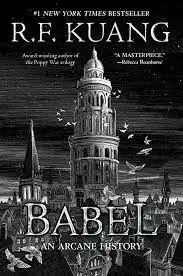
    In the 1800, at the hight of the English colonial empire, a Chinese boy called Robin is taken away from his motherland to study translation at Oxford, where translation is the key to the magical silver works. At Oxford, he is confronted with deep-rooted discrimination. There, he finds friendship and, after all, a sense of belonging. But the Empire's greed knows no bounds, and Robin will have to make difficult choices.

    Commentary

    This book is a masterpiece, a tapestry of words woven with many theme, each complementing and expanding the others. The recurring theme is language, but that’s just the beginning. This book talks about friendship, about happy days, dedication and success, it talks about exploitation, capitalism, colonisation and deep-seated rage. It uses an empathic, charming writing to talk about harsh truths that are hard to confront. As a reader, you get lulled in, starting the story with a fairly standard beginning for a coming of age story with a steam punk setting, but you soon find yourself in a very different literary landscape, a landscape rarely explored with this much talent.
     

    I’ve rarely seen the term “speculative fiction” being used, so I don’t really have an idea of what it encompasses. Would someone care to explain? I remember “Anathem” being described as such - and by the way: what an amazing book! I recommend it to all nerds, in particular those into history/philosophy/scifi.

    view more: next ›