1
posts
2
Kevin Abourezk
ICT
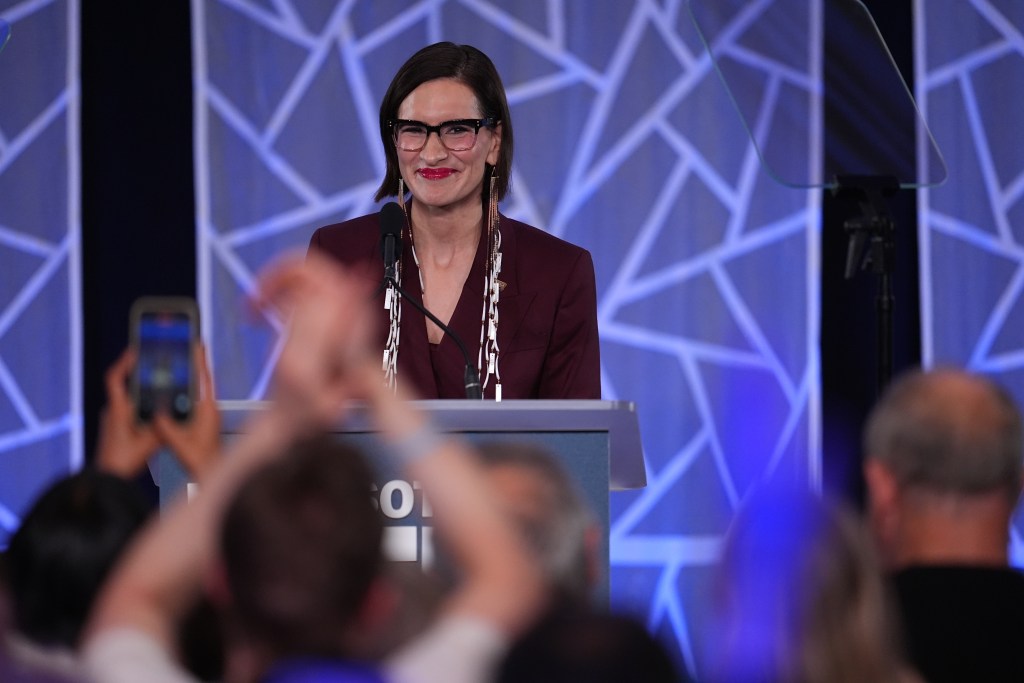
Newly elected Minnesota U.S. Sen. Peggy Flanagan, the first Native woman to serve in the upper chamber, said Wednesday that she looks forward to restoring Medicaid funding cuts, ending the Iran War and ensuring Indigenous people have quality healthcare as promised to them by the federal government.
“I am running on caffeine and adrenaline and tremendous amounts of gratitude to the people of Minnesota,” she said Wednesday during a virtual press conference. “I think we had a tremendous result last night in Minnesota but also all across the country.”
“I am thrilled that my sister Deb Haaland was elected governor of New Mexico last night,” she said, noting that Haaland, Pueblo of Laguna, is the first Native woman elected governor of a state. “I’m just very hopeful about the future as we head into 2027: holding the Trump administration accountable and also working hard to make sure that people can afford the lives they want to live. … I am honored and so very humbled to be the first Native American woman elected to the United States Senate.”
Flanagan – an Anishinaabe Kwe or Ojibwe woman – said her first priority would be to restore Medicaid funding that President Donald Trump’s administration cut, as well as banning prior authorization, which is a practice employed by many insurance companies in which they require customers to get permission before getting healthcare procedures done or risk not having those procedures covered. Flanagan said she also supports Medicare for all.
She said ending the war in Iran will be a priority and working to reduce the rising cost of gasoline, a problem she attributes to the war. She offered stern words about the Trump administration’s decision to send thousands of ICE agents into Minnesota earlier this year.
“We have been impacted so deeply here in Minnesota by the chaos, the terrorization, the scooping people up simply based on the color of their skin, including members of the Native community here in Minnesota, and the fact that they’ve been allowed to kill two Minnesotans with zero accountability whatsoever,” she said. “I think that is the message that I will be bringing to Washington, D.C. – that people want accountability.”
Flanagan said she was honored to see Michael Fairbanks, chairman of the White Earth Nation of which she is a citizen, and a drum group perform an honoring song for her prior to her victory speech Tuesday night.
“I absolutely understand the responsibility that I have as an Anishinaabe Kwe, as a member of the United States Senate, to ensure that we are working to make sure that the federal government upholds treaty rights and trust responsibilities, and frankly, that should be the floor,” she said.
“The significance of this moment is not lost on me, and I’m really hopeful for what we can do.”
She said she also looks forward to working with Wab Kinew, premier of Manitoba and Canada’s first First Nations provincial premier, to renew ties with Canada following the political turmoil that she said Trump’s tariffs and aggressive rhetoric have caused.
Kinew congratulated Flanagan on her win early Wednesday morning in a social media post:
“Congratulations MN Senator-Elect Peggy Flanagan and all the Democrats for absolutely dominating Trump in the midterms! I look forward to working together to lower costs on both sides of the border by ending the war in Iran (gas & diesel prices) and the Trump tariffs (the price of everything else).”
“The American people have delivered a resounding rejection of the President’s actions over the past two years,” Kinew wrote. “Canadians are ready to rebuild the relationship and strengthen our economies.”
Flanagan said she’s hopeful that her win would inspire other future Native leaders who can now see the possibility of fulfilling their own political ambitions.
“Although it took 250 years for a native woman to become a United States senator, I certainly know that the next Native woman … elected to the US Senate, it will happen much faster,” she said. “We won’t have to wait for 250 years, and it gives me a lot of hope.”
Looking forward, she said she plans to seek a seat on the Senate Indian Affairs Committee and will work to ensure the Indian Health Service is fully funded, and she offered some words of comfort for Mary Peltola, who is Yupʼik and the Democratic candidate for U.S. Senate in Alaska, whose tight race with incumbent Sen. Dan Sullivan, has yet to be called.
“The election night in Alaska lasts a little bit longer than it does in other states,” Flanagan said, referring to the challenges in counting votes in Alaska, where rural villages, including many Native villages, struggle to transport ballots, often by airplane, to the state capital of Juneau. “I know that she has run a really strong campaign and I look forward to that outcome, and I’m excited about the possibility of having two Indigenous women serving in the U.S. Senate together.”
She encouraged Native people all over the country to celebrate her win with her in whatever way they choose, and she thanked the many Indigenous women who have supported her throughout her life and political career.
“I would encourage all the aunties to wear your biggest earrings possible today,” she said. “Everyone should feel like they are a part of this. I exist because of the love and support of the Native community here in Minnesota, and I’d say even more specifically, the urban Native community here, and yeah, rock your ribbon skirt. Wear your big earrings. Let out your loudest lili and let’s go.”
The post ‘Wear your big earrings. Let out your loudest lili and let’s go’ appeared first on ICT.
From ICT via This RSS Feed.
3
4
5
6
7
Beginning in January, three of the five officials on the Georgia Public Service Commission will be Democrats. It will be the first time the party has controlled the powerful energy regulation board in 30 years. The commission, which regulates utilities including the state’s largest electric provider, Georgia Power, has come under more scrutiny in recent years due to rising power bills and the high energy demands of data centers.
Now, Democrats plan to focus on affordability, clean energy, and closer scrutiny of Georgia Power.
“There’s a long laundry list of things that need to be looked into,” said Democratic commissioner Peter Hubbard, who won his reelection bid this week. “And so we’ll have to triage, in fact, and decide how best to move forward.”
One of his first priorities will be launching an affordability docket, he said — a series of hearings that would delve into the reasons for high power bills and ways to save customers money. Hubbard said he and his fellow Democrats also plan to bring close scrutiny to upcoming Georgia Power requests around making more energy and adjusting customer rates. Shelia Edwards and Alicia Johnson are the other two Democrats on the PSC.
But any changes, especially to power bills, will likely take time.
“We may not be able to expect immediate effects on our wallets,” said Emory University associate professor Kristin Phillips, who studies energy burden and the PSC. “But I think we can expect immediate change in the types of decisions that are made.”
Affordability and high energy bills were driving issues in the campaigns both this year and last year, the two elections that together resulted in the new Democratic majority on the commission.
“We knew that we had to connect the dots between energy and affordability,” said Brionté McCorkle of Georgia Conservation Voters, a group that campaigned for the Democratic candidates and worked to draw attention to the PSC elections. “It’s not just this obscure regulatory body like it used to be treated. Its decisions directly affect household budgets, communities, health, and our energy future.”
Chris Womack, the CEO of Southern Company, Georgia Power’s parent company, also acknowledged the central importance of affordability during the company’s third-quarter earnings call on Thursday. But Womack said he’s confident the utility can address those concerns with the new commissioners.
“If you look at what we have been doing with rate freezes, with benefits, with how we are providing benefits from growth to customers — existing customers — as well as to the communities, we think that’s a strong platform to stand on,” he said.
Read Next
How the midterms could unleash a new era for clean energy in these 3 states
Since the data center boom in Georgia began, Georgia Power has maintained that the increased revenue would more than pay for the new infrastructure to serve them, which the utility argues would keep rates lower for residential and small business customers. The utility calls this “downward pressure.” It doesn’t mean rates will go down, but rather that any increases would be offset by the influx of revenue from data centers.
The utility recently doubled down on that promise as part of its deal to serve a massive new OpenAI data center. The deal, Georgia Power said, would bring $15 of not savings but downward pressure per month for what Georgia Power calls the “typical” residential customer.
Separately, Georgia Power also credited the increased revenue from data centers for the temporary rate freeze approved last year. But the rate freeze received criticism from some advocacy groups. Instead of first holding a PSC hearing to give advocates a chance to verify the utility’s financial claims, Georgia Power announced the temporary rate freeze. Advocates feel that the backward process left them unable to confirm whether the company was delivering on its promises and fully shielding ordinary customers from data center costs.
It’s part of a broader criticism often leveled at the PSC and Georgia Power: lack of transparency. The OpenAI contract was entirely redacted, and only a summary provided to the public after it was approved. Specific details involved in service contracts, deals to buy energy, and construction costs are often redacted from the utility’s public filings under the auspices of trade secrecy.
“I absolutely think transparency is potentially one of the biggest impacts here,” said Phillips of the election results. “It has been often on advocates to push on the way that the PSC communicates about the decisions that it’s making, and I’m hoping that there will be more clarity and transparency.”
The Democrats on the commission have promised to bring increased scrutiny to the next rate-setting process, due in 2028, along with Georgia Power’s long-term plans to make and deliver energy, its forecasts about rising demand, and other issues. Hubbard has also proposed conducting a rate case for the state’s natural gas utilities, which he said hasn’t been done in over a decade. And he said they’ll push for other changes going forward.
“We’ll continue with an agenda next year and the year after that to take advantage of this four-year period when we have the majority and can push for long-lasting reforms and shifting the direction of the state in terms of energy,” Hubbard said.
This story was originally published by Grist with the headline Democrats take control of Georgia’s powerful utility regulator on Nov 6, 2026.
From Grist via This RSS Feed.
8
9
10
11
Nika Bartoo-Smith
Underscore Native News + ICT
OLYMPIA, WA — Since Oct. 2, the Coast Salish Museum of Fine Arts has “taken over” the Thurston County Museum of Fine Arts for a two month exhibition.
Through Dec. 11, “Temporal: Stories of Indigenous Present, Re-imagining Indigenous Futures” features work by 14 Indigenous artists interpreting their own ideas of Indigenous futures through mediums including performance art, digital art, paintings, sculpture and traditional Indigenous art forms such as beading and weaving.
Now in its fourth year, the Coast Salish Museum of Fine Arts is an annual takeover in which the Thurston County Museum of Fine Arts hands the keys over to Indigenous Creatives Collective for a two month show.
Exhibition curator, Mikaela Shafer, Hopi, was inspired by thinking about how Indigenous people are often perceived as “relics” or “artifacts” of a past rather than looking at the present and future in today’s gallery and museum spaces.
“We wanted to create a space that showed that Indigenous people are here in the present, and we have ideas for the future, and we create all kinds of art beyond just traditional art,” said Shafer.
An artist herself, Shafer wanted to curate an exhibit that encouraged Indigenous artists to take up space and have full creative control.
The theme, “Temporal,” came to her after seeing a beadwork sculpture by Tammie Dupuis.
“I saw a picture of the “Long Walk” on our Indigenous Creatives roster, and it made me so excited thinking about a future where all of the public art and all of the decor was all Indigenous, and people’s furniture was Indigenous-made, and this idea of a future where we are fully represented in the lands that we are from,” Shafer said. Indigenous Creatives is a woman-led nonprofit based in the Pacific Northwest focused on land stewardship and amplifying Indigenous artists’ voices.
With the exhibit, Shafer sought to hold space for each artist to express their ideas of the Indigenous future they envision.
Underscore Native News + ICT interviewed seven of the 14 featured artists.
Tammie Dupuis: ‘No longer a craft’
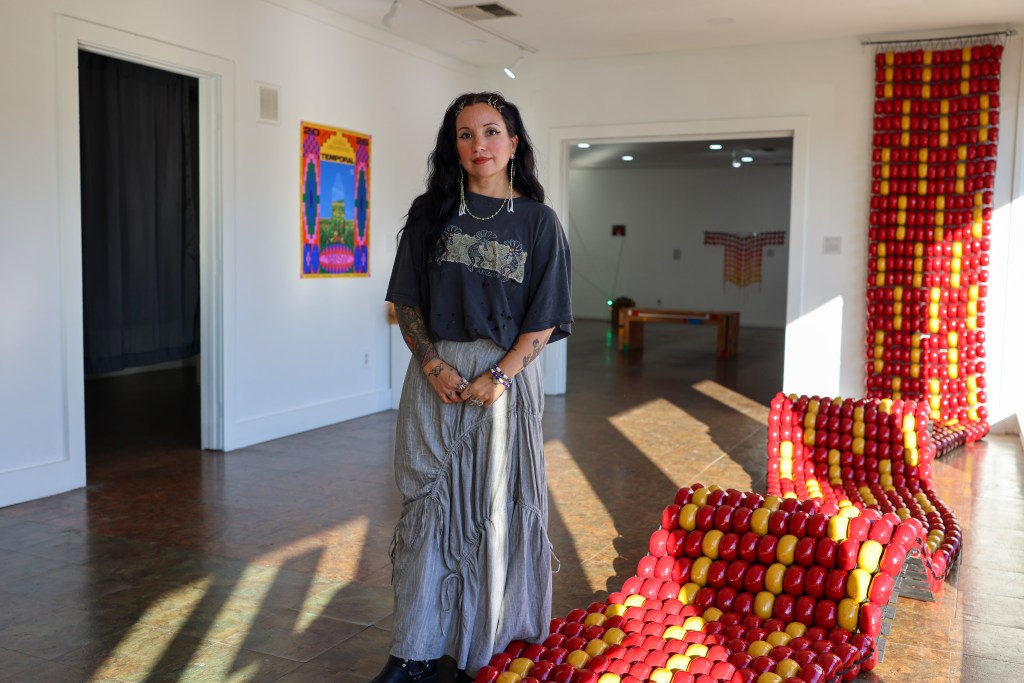
Tammie Dupuis, Confederated Salish and Kootenai Tribes of the Flathead Reservation, makes her own beads, the size of a fist, out of resin, cast foam and paper clay in order to turn beadwork into sculpture.
Tammie Dupuis, Confederated Salish and Kootenai Tribes of the Flathead Reservation, is one of 14 Indigenous artists whose work is part of an exhibit at the Thurston County Museum of Fine Arts. She poses for a photo on October 15, 2026. (Photo by Nika Bartoo-Smith, Underscore Native News / ICT)
“It dominates the space,” Dupuis said, speaking about her piece “Long Walk” that commemorates the forced removal of the Bitterroot Salish people to the Flathead reservation. “I think the statement behind that is that this is no longer a craft. I mean, it’s beadwork, but it’s no longer a craft. It’s actually a sculpture. Because my personal feeling is that craft is a word used by fine art to keep women and minorities out.”
Each year, Dupuis adds another row of beads to her living art piece, commemorating the 1891 removal and marking its passage of time.
In her other piece on display at the exhibit, Dupuis created a war shirt out of resin beads, each face sculpted in the beads representing an ancestor giving her strength.
The colors in the beads, ranging from deep red to yellow, also represent the passage of time and a reflection of herself — the yellow at the bottom representing herself as a white-presenting Indigenous person.
“Time is a huge thing for me because I look a lot at the assimilationist systems that produced me,” Dupuis said. “I am, for all intents and purposes, exactly what the reservation system was designed to produce — an Indian so white as to be unrecognizable. And it took me a while to really make peace with the fact that whatever this voice is inside of me, it is Indigenous, and if I silenced it, I would be doing the work of the colonizer.”
Ash Frantz: ‘Imagining this other space’
Weaving cedar in new ways, Ash Frantz, Makah Tribe, brought the idea of Indigenous futures to life by playing with what’s possible.
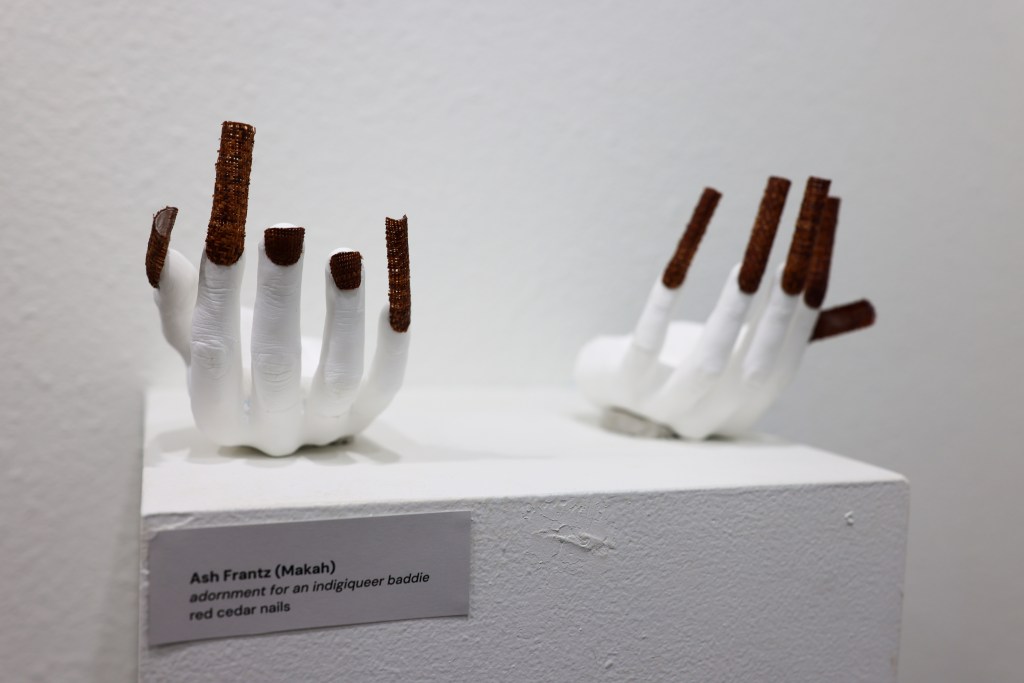
Woven red cedar nails, made by Ash Frantz, Makah Tribe, are displayed at the Thurston Museum of Fine Arts on October 15, 2026. (Photo by Nika Bartoo-Smith, Underscore Native News / ICT)
One of their pieces features a mold of their own hands with intricately woven red cedar nails “for an Indigiqueer baddie.” In this piece, Frantz thought about bodies as an extension of the land and wanted to find a way to decorate queer bodies with the land as well.
“All three of my works that are in this show, but also throughout my whole practice, kind of speak to me imagining this other space or like what the world would look like or could look like,” Frantz said.
In another room, Frantz has installed an obsolete desktop computer from the early 2000s displaying a loading screen with the words “Indigenous Futures Loading,” inviting viewers to contemplate what that means to them.
Next to this piece, a stack of old TVs are placed, as if woven together. They each loop a digital weaving made up of videos of Frantz processing cedar and a video tutorial they watched in the learning process.
“It’s really speaking to the fact that I’ve had to rely on what’s available in the digital realm in our current society to reconnect to my own community cultural practice of working with cedar,” Frantz said.
“This is one of my favorite pieces I’ve made because I’m taking these feelings of not belonging and feeling disconnected and unsure, and I’m turning them into something that feels really comforting and beautiful for me,” they continued.
Cynthia Masterson: ‘The game of Telephone’
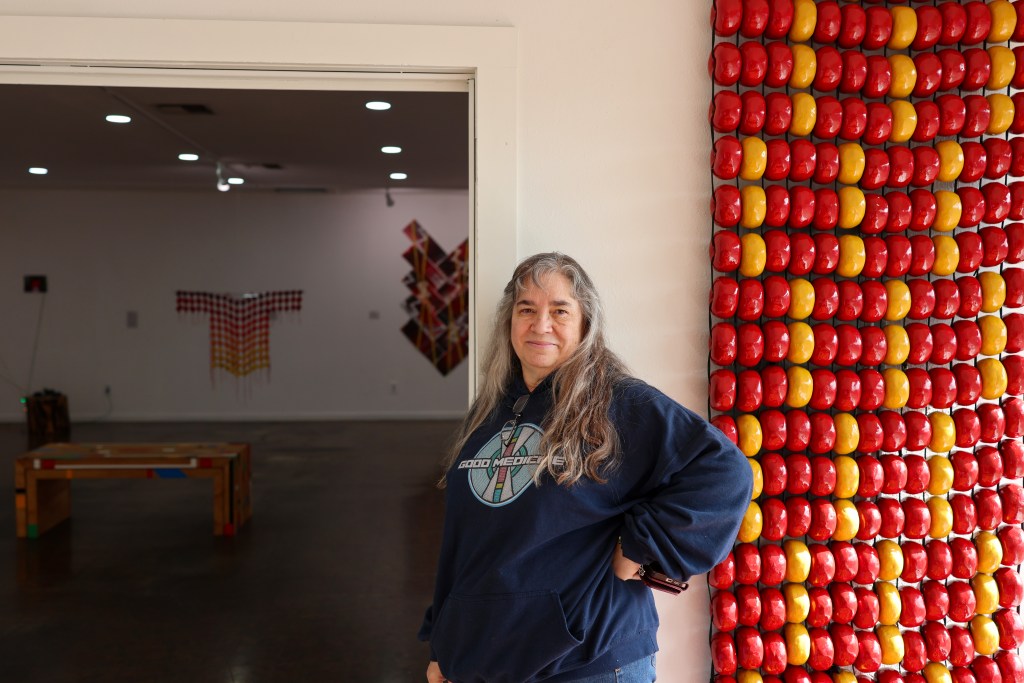
Cynthia Masterson, Comanche, has spent nearly the last two decades studying the delicate intricacies of different forms of beadwork — namely, the different styles that often all get called ”peyote stitch” or “gourd stitch”. Her work centers the three-drop stitch, which is unique to Southern Plains tribes.
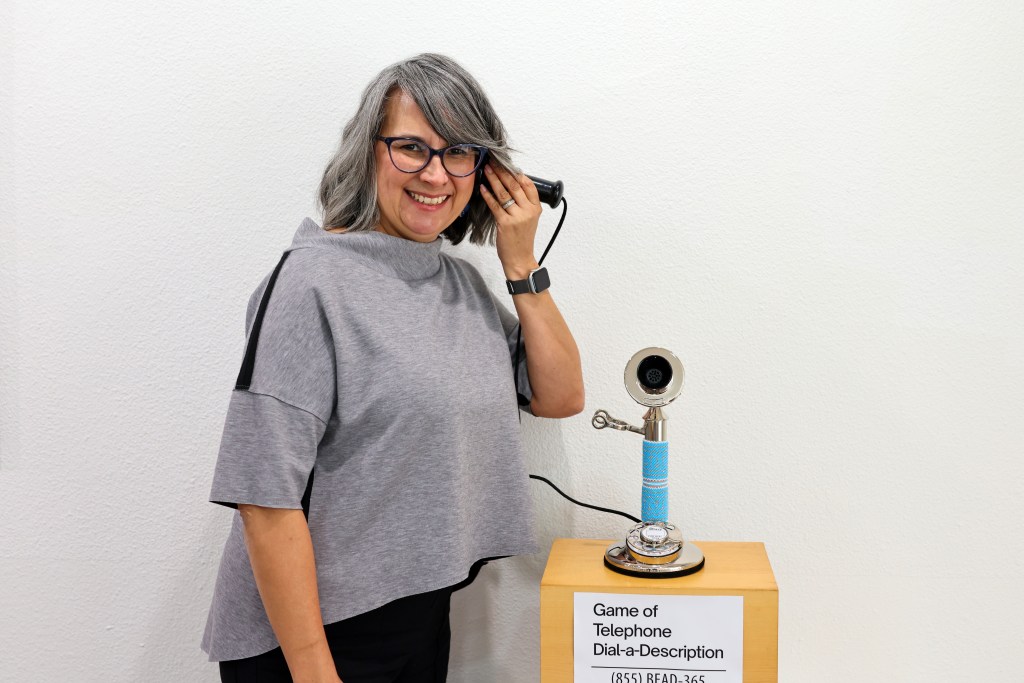
Cynthia Masterson, Comanche, is one of 14 Indigenous artists whose work is part of an exhibit at the Thurston County Museum of Fine Arts. She poses for a photo with her piece, “Game of Telephone,” on October 15, 2026. (Photo by Nika Bartoo-Smith, Underscore Native News / ICT)
As a teacher, much of her artwork is interactive. At the exhibit in Olympia, one piece invites viewers to dial an antique candlestick phone to hear a recording about the beadwork that adorns the phone itself.
“I wanted to do the telephone because it feels like the game of Telephone, like these stitches started and it’s been passed down, and the message has gotten muddled through time,” Masterson said.
Another of her pieces, a vintage gumball machine, encourages viewers to pop in a coin and get back a tray full of beads. She wanted to encourage people to touch the beadwork and have a chance to be creative on their own.
“Growing up, you’re always touching beadwork. It was never in a museum,” Masterson said, thinking about regalia and other forms of beadwork she grew up with. “It’s kind of meant to be interacted with, played with.”
Inanna kʷaɁowišč tyee McCarty: An inside joke turned political commentary
Ever heard of a whale slider? What about an Ozette potato fry? The pop art inspired paintings by Inanna kʷaɁowišč tyee McCarty, a citizen of the Makah Tribe and a descendant of the Tsawout First Nation, depict playful images of each.
McCarty comes from a long line of whalers on her father’s side. The Makah Tribe is the only Native nation in the Lower 48 that has an exclusive treaty right to whaling, but has been blocked from exercising those rights for close to three decades.
Though McCarty’s idea of a whale slider started off as a family joke, it soon became an artistic political statement.
“It was a response to the anti-whaling comics that were in a lot of the local papers in Port Angeles and around the area that were pretty degrading, too, and derogatory,” McCarty said.
Living in Neah Bay, it’s an hour and a half to the nearest grocery store, according to McCarty. This series for her is a part of the conversation about food sovereignty — from whale meat to Ozette potatoes, some of the only foods that can be harvested in the area she said.
“I hope that this makes people think a little bit more about, for one, the land that they’re on, and for two, just the foods that they eat,” McCarty said. “And maybe hopefully taking a little bit better care of each other, the water, seeing people who are different from them as human rather than this monstrous other thing.”
Liz Chikayaasix̂ Morrow: ‘What an Indigenous story can be’
Liz Chikayaasix̂ Morrow is an Unangax̂ storyteller. A citizen of the Naknek Native Village, much of her work is inspired by stories from ancestors and family members of hers that have been passed down.
Reflecting on Indigenous futurisms, Morrow also created a story of her own for the exhibit at the Thurston County Museum of Fine Arts. “Raven Daughter” explores themes of parenthood and choosing to have children.
“The artwork that I make is Native. It is Unangax̂ because I am Unangax̂. So anything that I create is a part of that heritage and is a part of that ancestry,” Morrow said. “I think that’s the story of this exhibit is that idea of ‘this is Native art,’ whether or not you recognize that as an outsider, as a non-Indigenous person.”
She hopes people walk away from her work with an expanded idea of what an Indigenous story and Indigenous artwork can be.
Justin Olmstead: ‘She’s waiting for us to remember’
Justin Olmstead, Santa Ynez and Barbareño Band of Chumash Indians, started painting after he had a dream in which an elder came to him and said he needed to paint sun wheels. Now, sun wheels are a part of every piece he makes.
He said the sun wheels represent confusion, different realities and memories for Chumash people.
Olmstead’s acrylic painting, “Hutash: She’s Waiting for Us to Remember,” depicts Mother Earth gazing into the horizon surrounded by pictographs and sun wheels. It represents a critique of a world that “weaponizes time” with little room to sit, reflect and remember.
“She’s just waiting,” Olmstead said. “She’s sitting here gazing at us, looking at us playing, making these make-believe civilizations and illusions of reality and just waiting for us to come back to her.”
He describes that his work is also a form of storytelling and teaching to pass on to his daughter.
“I started creating all these pieces that’s connected to generational wisdom to give her, almost like generational clarity through the traumas and triumphs,” Olmstead said.
Taylor White: ‘Everything I do is Indigenous futurism’
Taylor White, Skokomish Indian Tribe and Squaxin Island Tribe, lives her life with a love for all things monochromatic. From her own outfits to her home with an olive green living room and baby blue bedroom.
Her latest collection features a skateboard deck, an adorned “Final Fantasy” gunblade, a chair, a breastplate, a bra, deer hoof nunchucks and a medieval mace all covered in purple leather with sparkles of dentalium, pearls and glass beads.
White’s collection feels both fantastical and fierce — created “for the NDN princess.”
“I’ve always been in the belief that modesty was something that was brought over to us [through colonization],” White said. “I’ve never been afraid of my body or shameful of it. I feel like in my family, I don’t think we’ve ever felt shame or felt like modesty was something we lived by, and so when I make things, I just make them for how I was born.”
For White, creating is a form of healing.
“I think inherently everything I do is Indigenous futurism,” White said. “From making new things and decking them out in dentalium and shells or using old things.”
The exhibition runs through Dec. 11 with an artist talk on Nov. 27. For information on the exhibit and open hours visit the Thurston County Museum of Fine Arts website.
This story is co-published by Underscore Native News and ICT, a news partnership that covers Indigenous communities in the Pacific Northwest.
The post Olympia museum takeover explores Indigenous futures appeared first on ICT.
From ICT via This RSS Feed.
12
13
14
15
16
17
18
19
20
21
22
23
24
25
view more:
next ›