1
2


By doubling their entire genome, organisms can evolve extremely rapidly — or they can lose it all. New studies reveal how to survive the high-risk, high-reward evolutionary event.

3


bloomberg.com Talking to Animals Is AI’s Next Ethical Minefield Morgan Meaker 11–13 minutes

Biologist Vittorio Baglione has spent his career obsessing over a bird that doesn’t want him around. “They don’t like you,” he says of the carrion crow, a cautious creature considered one of western Europe’s cleverest birds. “They don’t like your company.”

For the past 30 years, Baglione has pursued them anyway. As a young researcher, he studied the way carrion crows reared their chicks and patrolled their territory for threats. More recently, in 2018, he began trying to understand what they were saying, attaching tiny microphones to the tail feathers of 43 birds. But when Baglione and Daniela Canestrari, his wife and research partner, opened the audio files, they found thousands of hours of hard-to-define sound: the crows themselves, their chicks begging for food and even the call of their brood parasite, the great spotted cuckoo. Analyzing the vast dataset felt nearly impossible. That’s when they turned to artificial intelligence for help.

That decision catapulted the two biologists into a futuristic world. They borrowed a machine learning model from Earth Species Project, a group describing itself as “the new frontier of interspecies understanding.” The model could differentiate between sounds made by the bird wearing the microphone, its companion crows and other sources entirely. Baglione’s favorite call was the soft burst of sound the crows would make when their nest was under attack by a buzzard. It was always followed by the arrival of others to defend the nest, so he interpreted it as something like, “Hey! Come help!” Today, Baglione and Canestrari have a vast catalog of 150,000 recordings, one of the largest bird datasets in existence.

As rapid advances in AI promise to transform industries from healthcare to education and to shake up the world of work, researchers see the potential for humanity’s relationship with animals to change radically too. The technology could transform our understanding of other species — and put them at greater risk than ever before. Technology vs. Animals

Humans have been trying to communicate with animals for thousands of years. Bone flutes discovered in Israel and dated at 12,000 years old were probably used to commune with falcons, say researchers. More recently, animal psychologist Irene Pepperberg carried out a 30-year experiment with Alex the African grey parrot, who died in 2007. British anthropologist Jane Goodall became famous, in part, for her claims to speak chimpanzee.

Today’s generation of animal interlocutors believe that simultaneous advances in AI and biologgers — small electronic tags that can be attached to different species to record their noises — are accelerating our understanding in ways not previously possible, potentially enabling humans to talk back. Private equity billionaire Jeremy Coller, a major donor in the field, suggests genuine two-way communication could be achieved within four years. “Because AI is so fast, I have absolute conviction we will crack the code by 2030,” he said in a speech in June.

Most researchers doing this work cite the same motivation: that if humans better understand the interior world of other species, they are less likely to shrug at climate change, endorse industrial farming or participate in habitat loss. Many in the field believe that if AI can be fed giant datasets of animal calls, it will eventually identify patterns that will demystify their meaning. Long before AI, Irene Pepperberg achieved international acclaim for her 30-year experiment with Alex the parrot (pictured in the middle).Photographer: Rick Friedman/Corbis Historical/Getty Images

Yet human innovation also has a long track record of using technology against animals, says César Rodríguez-Garavito, director of the More-Than-Human Life (MOTH) Program at New York University. Twentieth century whalers used advances in sonar to drive panicked whales to the surface to be killed. Poachers have copied the tribal practice of mimicking bird calls during hunting, using automated and looped recordings to lure birds into traps. Baglione himself acknowledges that his research could be co-opted by hunters to communicate to a crow, “Come, it’s safe.”

“AI has potential for greater harm at scale,” says Rodríguez-Garavito. In a 2025 report, he and his co-authors presented a dystopian vision of how “nonhuman animal communication technologies (NACTs)” could expose animals to mobs of humans wanting to chat, leverage them for military purposes like sea mine detection or even be used to capture and kill them.

Concern is also growing about the harm humans can cause even by simply pursuing greater interspecies understanding. The promise of AI-enabled animal translation is already creating a rush for data, alarming animal-rights activists. Researchers are dropping hydrophones into water to listen to whales, attaching biologgers to wolves and designing backpack microphones for birds. It’s enough for some to call for a version of privacy rights for animals. The AI Risk

There will never be an exact equivalent of Google Translate for animals. Where humans largely rely on words, animal language stretches across smell, color, movement and sonar. In 1973, Austrian zoologist Karl von Frisch won a Nobel Prize for his work documenting how bees direct each other to nectar using dance. For that reason, some researchers need video as well as audio to understand their animal subjects.

This summer, Baglione and Canestrari spent 14-hour days monitoring carrion crows in their own territory in the farmlands of northern Spain. From a small, camouflaged tent they recorded video and narrated for the AI’s benefit, documenting exactly what was happening around the nest. The hope was that this would enable algorithms to later establish correlations between sounds and their context. Before that, the biologists, both based at Spain’s University of León, spent nine months annotating 7,000 crow sounds to teach their AI model how to differentiate between the birds’ subtly different noises. “It costs a lot of effort,” Baglione says of trying to satisfy AI’s appetite for information. In three decades of research, Baglione’s fieldwork regime has never been so intense.

As the couple work toward turning their dataset into a type of crow dictionary, eventually they will have to test whether their assumptions about the calls’ meanings are correct. In the world of animal communications, the most common way to do this is by using a controversial technique called “playback” — the practice of broadcasting recorded animal calls to another animal. A listening station off the coast of Dominica operated by Project CETI, an organization that uses machine learning and robotics to study sperm whale communication.Source: Project CETI

Like others, Baglione is worried about how playback experiments affect their subjects. “You can stress the animals. You can disrupt their social environment. You can pose conflicts between them, especially if you don’t really understand the meaning of the call,” he says. Notable examples include the zoologist Katy Payne’s admission on a 2007 podcast that she played the voice of a dead elephant to the elephant’s granddaughter, only to see her respond with “paroxysms of groaning and roaring.” Others have cautioned that playing recordings of an individual animal repeatedly to its group has the same effect as releasing a deepfake in its likeness, possibly prompting other members to ignore its genuine attempts to communicate.

“I’m worried about playback,” says Rodríguez-Garavito, noting that he doesn’t believe its advocates have done enough to prove it doesn’t distress their subjects. Existing ethical guidelines feel out of date in a world with AI, he adds. “No one really envisaged the intensive use of playback that AI could potentially enable.”

Among those working toward interspecies communication, there is a divide between those who say we should be exclusively listening to the animals and those who argue we should be striving to talk back. “It matters because if we’re talking back, we’re introducing ourselves into the animals’ lives,” says Kristin Andrews, a philosophy professor and specialist in animal minds at the CUNY Graduate Center in New York. In South Africa, researchers have been carrying out playback experiments with wild African striped mice.Source: Léo Perrier and Nicolas Mathevon

In June, finalists for the Coller Doolittle Challenge, an annual $100,000 prize funded by Jeremy Coller, showed off photos and videos of their research at the award’s annual ceremony. Playback featured heavily. Wild mice were surrounded by speakers broadcasting sounds inaudible to humans. There was the chimpanzee who jumped, startled, when he heard the call of another chimpanzee played from a speaker hidden in the long grass. Then there was the zebra finch, jumping around frantically on its perch, ostensibly communicating with the cheeping animation projected onto a screen in its cage.

The prize is incentivizing an evolution of playback that is more automated and capable of interacting with animals. “One of the things the Coller Doolittle challenge is trying to do is the idea that there will be an automatic machine maybe that can have a kind of conversation with some animals,” explains Yossi Yovel, chair of the challenge and a zoologist at Tel Aviv University. (Through his foundation, Coller declined multiple requests to be interviewed for this story.)

Alongside the yearly prize for significant progress, the Challenge is also offering a $10 million reward for a project that enables an animal to communicate with researchers without recognizing it is communicating with humans — a criterion inspired by the Turing test. “We don’t know exactly what we want there,” says Yovel, whose own work involves sedating bats, putting them in an MRI machine and playing them recordings of other bats as they come back into consciousness. “The idea is to give a big prize to somebody who really goes far, maybe somebody who develops this fully autonomous device.”

Yovel is aware of the ethical concerns around playback and the direction interspecies communication research is taking. Yet he says that in the two years since its inception, the challenge has yet to receive any entries using research techniques he finds ethically troubling. “There’s more potential benefit than harm, and that’s what we should think about,” he says.

Back in Spain, Baglione doesn’t know where exactly his research will take him or what the long-term impact will be on his beloved birds. “Any advance will be great,” he says, “unless people will start using this knowledge against the animal.” Despite that concern, he plans to continue.

Andrews similarly believes conversation via playback will be necessary to really understand what and how animals think, not just whether the sounds they make refer to predators or food.

“I don’t think you’re going to do any decoding without engaging in two-way communication — or what’s going to be perceived as two-way communication from the perspective of the animals,” she says.

For that reason, Andrews suggests playback experiments should be limited to animals that enjoy human company, such as bottlenose dolphins that are free to swim away but voluntarily spend time with researchers. “They have chosen a bicultural life.”
4
submitted 2 months ago by to c/biology@mander.xyz
5


Introduction:

Birds are facing a crisis — nearly three billion birds have been lost across North America since 1970 as a result of human activities impacting birds and their habitats.

Each year, billions of birds migrate across vast ranges spanning the Americas. For many, the journey is fatal. In Canada, tens of millions of birds are killed annually by crashing into glass on buildings, most of which are low-rise or residential. This makes collisions with glass a leading direct cause of bird fatalities.

Yet governments lack momentum to address the causes. Nearly two decades after Toronto became the first city in the world to consider bird safety in its planning process, Canadian cities are now trailing behind global peers in protecting birds from colliding with buildings.

The Ontario government recently passed legislation that prohibits municipalities from enforcing green building standards, including bird-safe design, through their local planning process.

This change appears to conflict with federal laws protecting birds that apply to building owners. Canada’s Migratory Bird Regulations and Species at Risk Act prohibit killing birds by causing collisions, even unintentionally. Fines can range up to $1 million per animal for killing a listed Species at Risk.

Our new research explores strategies for designing bird-safe cities. Using Toronto as a case study, we examined how collaborative planning can balance development with ecological sustainability, reducing bird collisions with buildings.

6


Newborn Whale Sharks Are Almost Impossible to Find, But Scientists May Finally Know Where They Hide Luis Prada ~2 minutes

Whale sharks, as the name implies, are huge, and aren’t particularly elusive creatures. So why is it that it’s historically been so difficult to catch a glimpse of a baby whale shark? A new report suggests whale shark babies may be hiding in places where almost nobody else wants to go.

As reported by the BBC, researchers studying a roughly 5-foot-long neonatal whale shark caught in Indonesia’s Saleh Bay in September 2024 think the four-month-old could finally give us some clues about where these gigantic fish babies begin their lives, as this was the first newborn whale shark documented in Indonesian waters and only one ever recorded by scientists. Finding Whale Shark Nurseries Could Be the Key to Preserving Them

Adult whale sharks can get pretty large, about 40 feet long, yet scientists have never actually watched one mate or give birth. Saleh Bay itself may be a part of the answer. It has sheltered waters that are loaded with plankton and other food, making it an excellent feasting spot for baby whale sharks to get all the nutrients they need for their growing bodies. It also helps that the day is an “oxygen minimum zone,” which, as the name implies, is a part of the ocean with lower oxygen levels and, as such, is avoided by predators.

Whale sharks are endangered, with their populations having fallen by more than half since the 80s. Finding what essentially amounts to their nurseries could be just a missing piece conservationists have been looking for. The mystery of where exactly whale sharks are born persists, but by playing detective, sussing out the location of baby whale shark nurseries, we’re one step closer to pinpointing their maternity wards.

7


The photos are great, it's a cute bird. An excerpt:

Scrambling through dense salal in the dark, weaving between the majestic western red cedars of northern Haida Gwaii, I could barely imagine where we were just days before — crossing Dixon Entrance off the coast in an open skiff, pushing head-on through ocean swells and salt spray.

These were two vastly different worlds, connected by one strange little bird: the marbled murrelet.

My PhD research aims to better understand the connections between the marine and terrestrial environments that marbled murrelets depend on. Working in partnership with the Council of the Haida Nation and Environment and Climate Change Canada, I am combining GPS tracking, diet analysis, environmental DNA and nest searches to better understand where murrelets forage, what they eat and where they nest.

This summer, we discovered the first marbled murrelet nest recorded on Haida Gwaii in more than 30 years — the second one ever confirmed on the island.

8


cross-posted from: https://news.abolish.capital/post/72649

All living cells need energy, and most generate it through respiration, a series of chemical reactions normally confined to the cell membrane. Because this machinery takes up space, a cell's energy-generating capacity has long been thought to depend on how much membrane it can build. Complex cells solve this problem using mitochondria packed with folded membranes, while some bacteria enlarge or reshape their own membranes. In each case, producing more energy requires changing the cell's internal architecture.


From Biology News - Evolution, Cell theory, Gene theory, Microbiology, Biotechnology via This RSS Feed.

link to open access paper https://www.nature.com/articles/s41564-026-02450-z

9
10
11


“The majority of this knowledge was established after its disappearance in the late-17th century because, despite surviving the arrival of humans on Mauritius for several decades, only limited and often inaccurate information on its behavior and ecology were recorded when the species was still alive, and no skins were preserved.”

“With respect to its behavior, it is inferred that it nested on the ground and showed little fear of humans. The latter is a common trait in island-dwelling species with no mammalian predators, and contributed to the unfair portrayal of the dodo as ‘stupid’.”

...

“We are quite confident that dodos were active at dawn, dusk or night-time, which would make it the only nocturnal pigeon in the world.”

“Perhaps this gave it an advantage over the many strictly day-active turtles that lived on Mauritius.”

12


A study published in Science(opens a new tab) in May 2026 provides new insight into how organisms with no brain or musculoskeletal system can generate and regulate this process — and what happens when the water around them warms up. Warmer water naturally carries less oxygen, which prompts corals to move their cilia faster and faster, as if gasping for breath. Above a certain temperature, the system starts to work against itself; the furious beating of cilia uses up any oxygen the coral’s tissues can absorb, and then the polyps can suffocate in the less oxygenated water. Biophysicists, marine biologists, mathematicians, and modelers are now collaborating to better understand the physiological and hydrodynamic forces at work, and how they correlate with bleaching patterns, coral disease, and mass die-offs.

link to open access paper https://www.science.org/doi/10.1126/sciadv.aeg0950

We found that the dynamics of ciliary transport are closely linked to the spatial scale of the vortices generated by the coral. As the CBF increased with temperature, the resulting vortices became larger and more vigorous, amplifying both the rate and spatial extent of local flow. This temperature-dependent scaling highlights ciliary hydrodynamics as a finely tuned mechanism capable of modulating mass transport across the coral tissue-water interface. However, the overall pattern of mass transport revealed a more complex and unexpected response to warming. In our experiments conducted under dark conditions with coral respiration consuming O2, moderate warming initially stimulated ciliary activity and enhanced advective O2 transport across the CBL. This transient increase in exchange efficiency likely extended the functional reach of coral microenvironments (30), suggesting that ciliary motion can temporarily buffer corals against mild environmental stress. This benefit, however, appears short-lived

13
14


But recent research uncovered much larger magnetofossils. Sediments dating back as far as 56 million years ago revealed ‘giant’ magnetofossils thought to be biomineralised by an (unknown) organism that lived during that era.

“We’re not talking about simple bacteria here, rather about more complex organisms. Something that benefited from being able to navigate over large distances and is also common enough that they leave a fossil record,” says Richard J. Harrison, professor at the Department of Earth Sciences, University of Cambridge; the leading author of the study on giant magnetofossils, published last year.

“Organisms originally developed the ability to grow small magnetite crystals, but then over time, they learned that actually, these larger ones are much better suited to navigational magnetoreception,” says Harrison, and adds, “to me, it’s not a giant crazy leap to say that maybe some organisms just grow those crystals in one giant crystal rather than trying to build it out of lots of tiny little magnetite bricks.”

link to the Nano Paleo Magnetism project website https://nanopaleomag.esc.cam.ac.uk/about-us/

15
16


Avoiding AI code in the homelab not a big issue, but if peeps are serious about this anti-vax and related bio-tech issue could become an issue

17
18


Don’t Get Too Attached to Jimothy Miles Klee 4–5 minutes

On July 14, internet history was made. After capturing video of a cryptid-like raccoon with a hunched spine and stumpy tail in Seattle's Ballard neighborhood, Kiana Hall uploaded the footage to her Instagram account, referring to the sprightly little furball as “Jimothy.” (Later, asked in the comments where this name had come from, Hall replied that the animal “looked like a Jimothy to me.”)

Within days, the clip had been viewed millions of times, spawning memes, fan art, plushie toys, and more. City leaders proclaimed a “Jimothy Summer” in honor of the local mascot, and next week, the Seattle Mariners will host a “Jimothy Night” at T-Mobile Park, with ticketholders receiving Jimothy T-shirts. Another Seattelite, Ben Trammell, produced a year-old backyard video of Jimothy as a tiny baby raccoon with his mother and siblings, adding to his lore and celebrity status.

Jimothy’s congenital spine condition—the exact kind remains unverified—has endeared him to people the world over. But it has also raised questions about whether he’s thriving in his urban habitat. Even without the disadvantage of an unusual skeleton (in Trammell’s footage, you can see Jimothy struggle with his footing on a fence), wild raccoons have a life expectancy of just two to three years—and we know from the baby footage that he’s at least a year old. Are his admirers setting themselves up for heartbreak in the near future?

“Without examining the animal, we simply don't know how much his spinal condition affects his daily function,” says Rebecca Calisi-Rodríguez, a wildlife biologist at UC Davis who studies animal behavior and stress. She adds that not every congenital abnormality substantially reduces an animal’s odds of survival or quality of life. “The fact that Jimothy appears mobile, alert, and successful at navigating an urban environment suggests he has adapted well enough to meet the challenges of everyday life,” Calisi-Rodríguez says, “but that’s very different from saying we can predict how long he'll live.”

It’s likely that Jimothy made it this far in part due to the sophisticated intellect of raccoons. The species’ maternal habits also must have played a role. As many as half of young kits die before leaving the den where they were born, but those who do make it out are safeguarded by their mothers long after they’ve weaned, unlike the young of many small mammal species.

According to Jessica Castillo-Vardaro, whose lab at San José State University is devoted to molecular ecology and urban wildlife, Jimothy is likely already past the “most vulnerable” period of his life. Now, she says, “he doesn't have many predators, and his greatest risk is being hit by a car.” While his physical form may diminish his chances against an attacking dog or coyote, Castillo-Vardaro says, Jimothy has “probably figured out how to avoid those situations, otherwise he wouldn't still be here.”

Humans’ strong affection for animals that become internet stars can often run up against the harsh realities of life in the wild, particularly in species with much shorter lifespans than ours. Castillo-Vardaro points to popular livestreams of bird nests that show predators swooping in to eat eggs or hatchlings. “It's sad, but it is a part of nature, and we shouldn't shy away from it,” she says.

Factor in the harmful ways content creators and influencers use animals for clout—including by staging “rescues” and intrusive selfies, or even attempting to domesticate them as pets—and the cause for concern ratchets up. Indeed, the wildlife biologists who spoke to WIRED agree that Jimothy’s fame could be the biggest threat to his well-being right now.

Castillo-Vardaro says urban raccoons have small “home ranges” and that locals tracking Jimothy down to film him “can be really disruptive and may stress him out.” If he ends up moving to an unfamiliar place to avoid the attention, that can present its own new dangers. Unhealthy dependence on humans, disease exposure, conflict with pets, and increased chance of vehicle strikes may follow.

“Best-case scenario is we lose track of Jimothy in a few months,” Castillo-Vardaro says, “and we can look back on this summer, remember him fondly, and hope that he is still out there living his best little life somewhere safe.”

19
20
submitted 3 months ago by to c/biology@mander.xyz
21
22
23
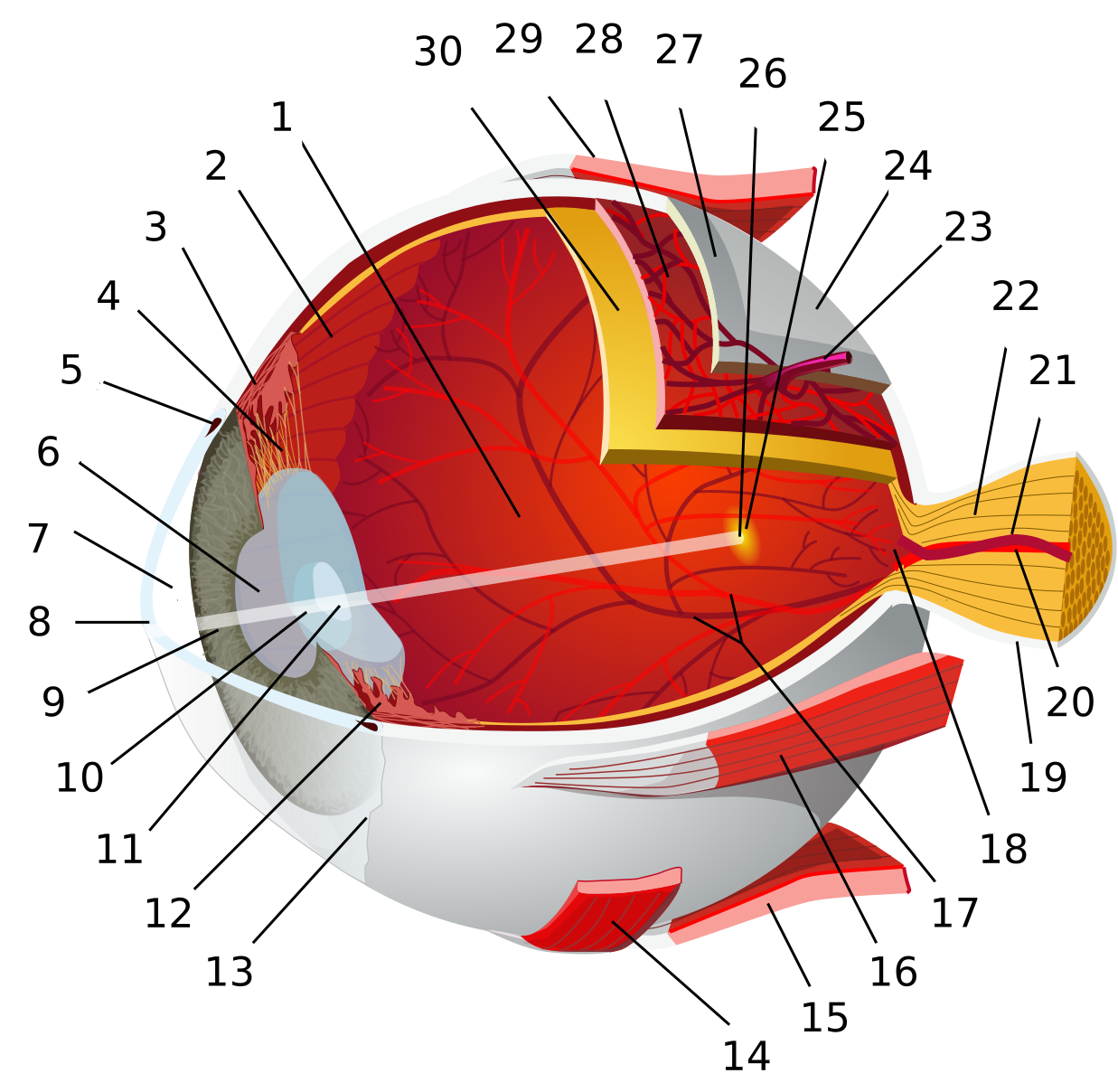
The Eye (2007) (upload.wikimedia.org)
submitted 4 months ago by to c/biology@mander.xyz
 
 
  1. Posterior segment of eyeball
  2. Ora serrata
  3. Ciliary muscle
  4. Ciliary zonules
  5. Canal of Schlemm
  6. Pupil
  7. Anterior chamber
  8. Cornea
  9. Iris
  10. Lens cortex
  11. Lens nucleus
  12. Ciliary process
  13. Conjunctiva
  14. Inferior oblique muscle
  15. Inferior rectus muscle
  16. Medial rectus muscle
  17. Retinal arteries and veins
  18. Optic disc
  19. Dura mater
  20. Central retinal artery
  21. Central retinal vein
  22. Optic nerve
  23. Vorticose vein
  24. Bulbar sheath
  25. Macula
  26. Fovea
  27. Sclera
  28. Choroid
  29. Superior rectus muscle
  30. Retina

Author: Chabacano

CC BY-SA 3.0

24
The Heart (2006) (upload.wikimedia.org)
submitted 4 months ago by to c/biology@mander.xyz
 
 
  1. Right atrium (Atrium dextra)
  2. Left atrium (Atrium sinistrum)
  3. Superior Vena Cave (Venea cava Superior)
  4. Aorta
  5. Pulmonary artery
  6. Pulmonary vein
  7. Mitral valve
  8. Aortic valve
  9. Left ventricle
  10. Right ventricle
  11. Inferior Vena Cave (Venea cava Inferior)
  12. Tricuspid valve
  13. Pulmonary valve

Author: Wapcaplet

CC BY-SA 3.0

25
The Respiratory System (2007) (upload.wikimedia.org)
submitted 4 months ago by to c/biology@mander.xyz


The respiratory system consists of the airways, the lungs, and the respiratory muscles that mediate the movement of air into and out of the body.

Author: Mariana Ruiz, Jmarchn

view more: next ›