1


Around a decade ago, Semyon Dyatlov(opens a new tab), a mathematician at the Massachusetts Institute of Technology, was studying whether quantum particles behave differently than ordinary particles when put into the same chaotic situations. Sometimes, an object moving chaotically can become trapped into following a fractal-like path forever. Could quantum particles do the same?

Quantum particles tend to spread out like waves, which blurs their exact location. To figure out whether quantum particles blur too much to take on these intricate trapped paths, Dyatlov needed a new uncertainty principle — one that could tackle fractals.

In 2016, with key ideas from Jean Bourgain — a renowned mathematician who died shortly after this work — Dyatlov proved the fractal uncertainty principle for one-dimensional fractals, which look like jagged lines. These lines can represent the paths taken by objects moving in two dimensions, like balls traveling around a billiard table. That fall, Dyatlov and Bourgain gathered mathematicians from around the world in New Jersey for a workshop, hoping to extend the proof to higher dimensions. An extended proof could be used to study the three-dimensional world and would become a universal mathematical tool in its own right.

...

It wasn’t until years later that Alex Cohen(opens a new tab), while a doctoral student at MIT, finally made a breakthrough. In a paper(opens a new tab) published in 2025 in the Annals of Mathematics, widely considered to be the field’s top journal, he extended the fractal uncertainty principle to all higher dimensions. The result became Cohen’s thesis and earned him an assistant professorship at New York University at the age of 25.

2
3


link to open access paper https://royalsocietypublishing.org/rsif/article/23/240/20260129/482563/Disruption-of-magnetic-orientation-in-migratory?searchresult=1

Multiple experiments, performed by three independent research groups, have demonstrated disruption of the magnetic orientation of birds by oscillating magnetic fields (OMFs) in the megahertz frequency range [10–14]. The reality of this phenomenon is beyond reasonable doubt. To date, there are two alternative explanations of this effect. One hypothesis assumes that OMFs directly affect the compass magnetoreceptor based on radical pair reactions in cryptochrome by destroying the spin correlation between electrons that form the radical pair. The sensitivity to radiofrequency OMFs was therefore suggested as a key distinctive feature of the radical-pair mechanism of magnetoreception [9,10]. The second hypothesis suggests the detection of OMFs by a separate sensory system, by a signal from which the central nervous system blocks the magnetic compass—for example, to avoid orientation errors under the conditions of a perturbed geomagnetic field as a result of solar activity or atmospheric electromagnetism (thunderstorms) [15,16].

4


"This technology could one day enable satellites to create secure encryption keys using the sunlight already abundant in space, reducing the need for onboard lasers and much of the supporting hardware," said Li, first author of the paper. "Sunlight-driven entanglement generation could also provide the crucial ingredient needed to scale up quantum computing without adding to the energy burden."

Scientists have traditionally believed that producing the strong correlations needed for photon entanglement requires coherent light. In coherent light, the waves remain synchronized so that their peaks and valleys follow a predictable pattern. Lasers are commonly used for this purpose because they generate highly coherent light concentrated at a single color.

https://en.wikipedia.org/wiki/Fresnel_lens

https://en.wikipedia.org/wiki/Catadioptric_system

link to open access article https://opg.optica.org/optica/fulltext.cfm?uri=optica-13-8-1508

Studies have proposed using solar concentration technology to directly drive optical amplification and build a solar laser [40–43]. On the other hand, large-scale solar-powered space infrastructure, such as space-based solar power platforms [44] and orbital data centers [45], is rapidly advancing, driving interest in photonic technologies capable of operating directly on abundant, incoherent solar radiation without dependence on power-intensive laser or electrical subsystems.

Within this landscape, solar-driven photonic quantum technologies represent a promising route toward energy-autonomous quantum photonic functionality, naturally aligned with the requirements of future space power and information architectures. Here, we demonstrate, for the first time, that sunlight, a ubiquitous and environmentally friendly light source, can produce entangled-photon pairs via SPDC despite its lack of optical coherence.

...

These results are not simply a proof of principle that polarization entanglement is generated from SPDC pumped by sunlight; they are a quantitative demonstration that these photon pairs have entanglement close to that of many recent results on polarization entanglement generated from SPDC pumped by coherence laser sources [50–53].

5
6


link to open access paper

https://link.springer.com/article/10.1186/s43074-026-00255-1

Self-healing effect (SHE) was first demonstrated in conventional diffraction-free systems [3], where light fields recover their spatial profiles after encountering an obstacle because the diffracted fields decrease inversely with propagation distance z. Longhi later extended this concept to non-Hermitian systems, where the lattice typically exhibits the non-Hermitian skin effect (NHSE) [4,5,6,7,8,9,10,11,12,13,14,15,16,17,18], predicting infinitely many self-healing skin modes that are exponentially localized at the lattice boundary [19]. This extension builds on key principles of non-Hermitian physics [20,21,22,23,24,25], including biorthogonal eigenstates [21, 26, 27] and non-Bloch Band theory [28,29,30,31,32]. The exploration of non-Hermitian phenomena has been experimentally realized in various platforms, including photonics [2, 33,34,35,36,37,38,39,40], electrical circuits [41, 42], ultracold atoms [43, 44], acoustic systems [45,46,47,48] and mechanical lattices [49, 50].

A key characteristic of non-Hermitian systems is their high spectral sensitivity to boundary conditions [30, 51]. The boundary modification enabling transition between periodic boundary conditions (PBC) and open boundary conditions (OBC) in non-Hermitian systems reshapes the entire spectral and spatial characteristics of skin modes [52,53,54,55,56]. Unlike in Hermitian lattices, where defects induce localized states around the perturbation [57], recent studies have further shown that by engineering edge terms under OBC, one can selectively excite the quasi-edge states under semi-infinite boundary conditions [19, 58], and realize counter skin effect [59]. However, in systems under OBC, the response of the energy spectrum to boundary perturbations and the feasible experimental routes for achieving SHE remain unclear.

Here, we propose and demonstrate skin mode tunability (SMT), a mechanism for tuning the spectrum of skin modes by applying boundary modifications at the edge opposite to their localization. While skin modes exhibit strong spatial confinement under OBC, the biorthogonal nature of non-Hermitian systems enables precise spectral tuning through remote end perturbations. By adjusting boundary potentials, a specific skin mode can be spectrally isolated from the other states, turning it into a self-healing state (SHS). Unlike typical skin modes, the SHS reconstructs its profile after encountering an obstacle, as it acquires the largest imaginary energy and thus dominates during propagation. This mechanism enables the realization of SHE for skin modes, and we further propose and numerically demonstrate an experimentally feasible implementation using photonic Floquet lattices with currently accessible parameters.

7


These extreme asymmetries mean that the interaction between Uranus’s magnetic field and the solar wind—charged particles constantly streaming out from the Sun in all directions—is also quirky. At Earth and other planets, the boundary where the solar wind slams into the planetary magnetic field and abruptly slows to form a turbulent shock wave, known as the bow shock, is relatively stable. But at Uranus, the bow shock is highly dynamic, changing shape and size throughout each Uranian day, like the expansion and contraction of breathing lungs.

link to open access paper https://agupubs.onlinelibrary.wiley.com/doi/10.1029/2026AV002307

https://en.wikipedia.org/wiki/Bow_shock

8


The idea of transmitting power by laser is not a new one, but a major challenge is that blasting a receiver with high-intensity light causes it to rapidly heat up. This can cause conversion efficiency to plummet and ultimately damage the receiver, and so the researchers set out to create a receiver robust enough for long duration power transmission.

The team turned to cesium lead bromide perovskite, which is particularly stable, making it suitable for high temperatures and prolonged irradiation. Perovskites generally are lower cost and easier to manufacture compared to other photovoltaic materials. They also have high absorption rates.

The researchers stacked the perovskite layer on top of a carbon electrode that collects the current generated by the perovskite, with a thermoelectric layer below that generates electricity from waste heat produced when the laser is trained on the receiver. The work was detailed in a paper published 29 July in Matter & Light.

9


cross-posted from: https://lemmy.world/post/50273814

How the Navy learned to hear submarines from 3,000 miles away—and how submarines learned to vanish. This video explores the physics of underwater acoustic warfare, from the discovery of the SOFAR channel to the evolution of modern stealth engineering. Discover how wave refraction, deep-ocean mathematics, and fluid dynamics completely rewrote the rules of submarine detection.

Time stamps: 0:00 The 3,200-Mile Explosion 3:05 The Physics of Underwater Sound (Transmission Loss) 7:00 The SOFAR Channel & Snell's Law 12:33 How Modern Submarines Actually Hide

10


warning this is cool as hell! I should really make this NSFW for nerds but this is by definition Safe For Whales so?...

“The main challenge in detecting these low frequency signals is that they decay very fast with distance. A big ship is easy to detect as it moves a lot of water, but a whale is much smaller, so that it moves a lot less water. This means that they need to dive into the water column to be detected,” said Robin Andre Rørstadbotnen, the first author of the paper, and a postdoc at the Centre for Geophysical Forecasting.

One of the many advantages to the fibre-optic cable network in the waters around Svalbard is that there are a number of ships, both small and large, that cruise these same waters.

And if you think about, the shape of a ship’s hull isn’t that different from the shape of a whale’s body.

But unlike whales, all ships are required to have what’s called an Automatic Identification System [seems unfair to me], or AIS. That identifies both the ship itself and where it is travelling, allowing researchers to track the ships as they sail along or across the fibre-optic cables.

The researchers could detect the actual sound – the acoustic signal – of the different ships in the data from the fibre-optic cables, of course. They could also detect how fast the ships were travelling.

...

A pressure wave from water movement is much lower frequency than a whale vocalization. It’s also information that the researchers hadn’t looked at before.

“The big surprise was that this fiber could detect this,” Landrø said.

Suddenly they had a way to interpret the low-frequency data because they already had so much information about the different ships.

link to open access paper https://www.pnas.org/doi/10.1073/pnas.2603077123

DAS is a fiber-optic measurement technique that uses coherent Rayleigh backscattering to record strain along the fiber with high spatial and temporal resolution. The method is based on phase measurements of the Rayleigh backscattering to capture the strain field along a fiber at timescales controlled by the kilohertz laser pulse repetition rate (12). DAS has traditionally been used to study high-frequency signals (4, 13, 14). More recent work has demonstrated that it can also resolve significantly lower-frequency variations (15–17).

In the marine environment, low-frequency strain variations (0.01 to 0.1 Hz) may arise from a range of physical mechanisms, including hydrodynamic processes associated with moving objects. The displacement of water generated by moving whales and ships induces a moving hydrodynamic pressure field that extends through the water column, dynamically loading and unloading the seafloor. This varying pressure field causes the seafloor sediments to deform both vertically and laterally.

When the fiber is buried in sediments, the DAS system primarily records the resulting lateral deformation of the surrounding material. Hydrodynamic pressure fluctuations produced by ocean waves have already been extensively studied (18–21). However, for more detailed characterization of pressure signals, dedicated pressure sensors are often employed. For example, Stenvold et al. (22) demonstrated that high-precision seabed pressure sensors can detect subtle pressure variations, highlighting their potential for hydrocarbon reservoir monitoring. Related studies have also explored acoustic and hydrodynamic signals generated by moving objects. Hegna (23) investigated how acoustic wavefields generated by moving vessels, recorded by towed streamers or ocean-bottom sensors, can be used to image the subsurface. Another study by Werner and Landrø (24) investigated the hydrodynamic pressure field generated by a buoy moving through the water column, while Scarpa et al. (25) used pressure sensors to measure ship wakes in Venice, Italy, and assess their impact on the lagoon.

The pressure field associated with ship-generated Kelvin wakes typically contains frequencies between 0.1 and 0.4 Hz (26–28). Buisman and Thiem (29) investigate hydrodynamic signals from ships recorded with different DAS configurations in both very shallow and deeper water settings, down to 58 m. In very shallow water, they report low-frequency signals attributed to ship wakes, including contributions from bow and stern waves within the Kelvin wake system. In deeper water, they observe even lower-frequency signals, which they describe more generally as “ship-induced water waves,” without drawing a firm conclusion on whether these arise from the Kelvin wake or from other displacement-driven processes. In this study, we present observations of ship- and whale-generated signals from a DAS installation in Svalbard, where the recorded signatures fall within the same low-frequency band as those observed in the deeper-water setting of Buisman and Thiem. Building on these earlier observations, we introduce a theoretical framework that explains the origin of these signals.

...

DAS is topical across many scientific fields, including geophysics and marine biology (4, 30, 31). It has been labeled a ‘game-changer’ across many disciplines, especially in remote sensing and ocean monitoring. There are different reasons for this. 1) The instrumentation is placed on land or on a platform; 2) No DAS sensor components are exposed to the harsh underwater environment; 3) DAS can use the existing telecommunication infrastructure; 4) The interrogator signal can reach up to 140 km (12). New steps have been taken to increase the DAS range to exceed 1,000 km (32, 33), opening new possibilities for monitoring ships and whales over vast areas.

Most studies on whales using DAS and PAM have so far focused on the mammals’ acoustic signatures. The hydrodynamic pressure field signatures are independent of acoustic pressure signatures and can track and monitor silent whales as long as they are sufficiently close to the fiber.

11


Bulk semiconductors routinely used in IR detectors have continuous energy bands, which means they absorb a broad, undifferentiated swath of the infrared spectrum. This doesn’t preserve much information about which specific wavelength arrived. The mercury telluride colloidal quantum dots the Chinese team picked for their device behave differently. Due to their tiny size, roughly 4 nanometers across, quantum confinement breaks their energy levels into discrete steps rather than a continuous chunk. Photons of different infrared wavelengths and intensities excite different electronic transitions, moving an electron between discrete energy levels within the dot, rather than just producing more or less of a single signal.

At wavelengths of around 2 micrometers, the longest the team tested, incoming photons have just enough energy to bump an electron across the dot’s fundamental bandgap, producing a modest number of charge carriers, either negatively charged electrons or positively charged holes that move around the dot.

At shorter infrared wavelengths, photons carry more energy per particle, and they can access additional, higher-energy electronic transitions inside the dot. In some cases the excess energy in a carrier can be enough to kick loose more than one electron-hole pair per photon. These processes open extra channels for generating charge carriers. The effect is that shorter infrared wavelengths and more intense infrared light push more positively charged holes out of the quantum dot layer and toward the OLED side of the device.

12


Can we demonstrate the promise of quantum computers on today’s noisy, limited hardware?

That’s a more difficult question than it may first appear. If you generate a result that’s out of reach of today’s regular computers, it may not be possible to verify that you got the right result. And given that today’s quantum computers are somewhat error-prone, getting the wrong result is a distinct possibility. Further, in the absence of a mathematical proof of the capabilities of quantum hardware, it’s possible that a better classical algorithm could outperform the quantum hardware.

13
14


Generally whenever I am packing objects for moving or storage, I ensure that the smooth side of one item faces the smooth side of the other. E.g. if I have a box of old smartphones or tablet PCs, putting the faces together to have screen against screen (and no debris of course) works well. No need for individual wrapping.

Ceramic tiles from the shop are always boxed facing the same direction. It seems every single factory is doing this without exception. The rough ceramic bottom is stacked against the smooth glazed side.

So when storing excess spare tiles for future repairs, I restack them smooth side against smooth side. But for one batch of tiles the stack was a bit rocky - less stable. Whereas the original stack of all facing the same direction does not rock. Apparently they are less flat or less symetric than they appear.

Is glass harder than ceramic? Or did they decide that compromise is better than a risk of fractures due to the lack of flatness?

IIUC, the bottom of a tile is 6.5—7 Mohs and glass is softer. But different kinds of glass are different and I don’t know where the glaze of a ceramic tile stands on that scale. IIRC, glaze on ceramics is a kind of glass, or at least glass-like.

15


I've been looking for some good simulations of spring-mass networks with customizable parameters. Those I find are usually fairly simple, with uniform masses and springs, each connected at right angles to adjacent masses (i.e. six connections from each face in a cube setting, which is the most complex simulation I could find). I would like to explore the dynamics of a less uniform system, i.e. the effect of a large mass with many connections to smaller masses, how those smaller masses respond if they are more interconnected, etc. So I was wondering if anyone has some suggestions for a good simulation tool that they may have stumbled upon during some coursework or similar? I am in particular interested in the visual representation of the time evolution of such a system, so some kind of tool that generates an animation would be ideal.

Is my best bet perhaps to use the physics engine of e.g. the Godot game engine (Jolt physics) or whatever solver is used in Blender?

16


The authors found that peak water levels in both floods occurred around 1 to 2 weeks after peak river discharge during perigean spring tides when both the Sun and Moon are in optimal positions to create high tides. They hypothesize that peak river discharge rates suppress subharmonic tidal amplitudes, while intermediate rates of discharge allow for greater amplitudes and therefore higher water levels. Additionally, river water takes some time to fully move downstream, meaning that water levels are higher in the days following floods, adding to the effects of tidal inflows.

17
18
19
20


A representation of the evolution of the universe over 13.77 billion years. The far left depicts the earliest moment we can now probe, when a period of "inflation" produced a burst of exponential growth in the universe. (Size is depicted by the vertical extent of the grid in this graphic.) For the next several billion years, the expansion of the universe gradually slowed down as the matter in the universe pulled on itself via gravity. More recently, the expansion has begun to speed up again as the repulsive effects of dark energy have come to dominate the expansion of the universe. The afterglow light seen by WMAP was emitted about 375,000 years after inflation and has traversed the universe largely unimpeded since then. The conditions of earlier times are imprinted on this light; it also forms a backlight for later developments of the universe.

Author: NASA/WMAP Science Team

21
The Formation of a Rainbow (upload.wikimedia.org)
submitted 4 months ago by to c/physics@mander.xyz


Diagram showing how primary and secondary rainbows are formed due to the light propagation in spherical droplets.

  1. Spherical droplet
  2. Places where internal reflection of the light occurs
  3. Primary rainbow
  4. Places where refraction of the light occurs
  5. Secondary rainbow
  6. Incoming beams of white light
  7. Path of light contributing to primary rainbow
  8. Path of light contributing to secondary rainbow
  9. Observer
  10. Region forming the primary rainbow
  11. Region forming the secondary raimbow
  12. Zone in the atmosphere holding countless tiny spherical droplets

Author: Peo

CC BY-SA 3.0

22


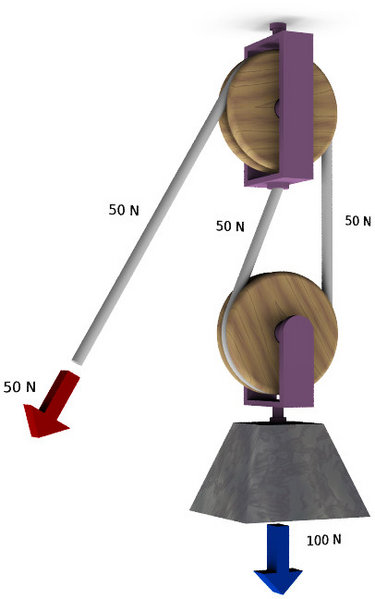
A gun tackle has a single pulley in both the fixed and moving blocks with 2 rope parts dividing the load of 100N. The mechanical advantage is 2, requiring a force of only 50N to lift the load.

Author: César Rincón

CC BY-SA 3.0

23
submitted 4 months ago by to c/physics@mander.xyz
 
 
24


This illustration shows abstracted "slices" of space at different points in time. It is simplified as it shows only two of three spatial dimensions, to allow for the time axis to be displayed conveniently.

Author: Fredrik

CC BY-SA 4.0

25
 
 
  1. Objective lens
  2. Oocular (eyepiece)
  3. Eye
  4. Object (at a large distance)
  5. Real Image of the object at the focal plane of the objective lens (here, a film or CCD detector could be placed for photographing the object)
  6. Virtual Image of the object (as it appears to the eye)
  7. Tube

Author: Michael Schmid

CC BY-SA 2.0 at

view more: next ›