all 88 comments

sorted by: hot top controversial new old
[–] 133 points 1 year ago
[–] 61 points 1 year ago (18 children)

One of our bioinformatics has a sign at his desk that says "taxonomy is a social construct".

  • source
  • hideshow 18 child comments
  • [–] [S] 11 points 1 year ago (14 children)

    “taxonomy is a social construct”

    i mean for bacteria it actually is because bacteria can exchange genes across "species" so it's not really a species... at least not in the sense of eukaryotes (where species are defined such that different species cannot exchange genes with each other)

  • source
  • parent
  • hideshow 14 child comments
  • [–] 8 points 1 year ago (13 children)

    Even for anything else, it actually is. Taxonomy is our construct that we came up with as a society to classify life. We cannot ever be "right" about it, it can just be more or less useful for us to understand life.

  • source
  • parent
  • hideshow 13 child comments
  • [–] [S] 3 points 1 year ago (2 children)

    in that case we cannot ever be "right" about anything, as any thought we have is just a model that helps us get through life?

  • source
  • parent
  • hideshow 2 child comments
  • [–] 5 points 1 year ago (1 child)

    Yes and it is very important to constantly remind ourselves that all our abstractions and classifications are just that. Helpful tools for us to view and understand the world. People tend to forget that and over time see their categorization as essential and natural. For example, sex and gender are both socially constructed but people forget that and then create a whole set of rules around it to reinforce that categorization including social stigmatization and infant mutilation.

  • source
  • parent
  • hideshow 1 child comment
  • [–] [S] 1 point 1 year ago

    ok then two comments:

    • if nothing is strictly true, then that implies that the statement that "nothing is strictly true" is also not strictly true, i.e. there are exceptions which are strictly true ...

    • jokes aside, your comment reminds me of a funny story i once read where a biologist does research on clover (you might know this one). he investigates all clover he can find and finds that they all have 3 leaves. so he calls it a law of nature that clover has three leaves.

    one faithful morning, he walks out of door and finds a 4-leaved clover in the garden (which is symbol of good luck in some cultures). however, he rebukes at that and tries to sue the clover for violating the law of nature ...

    kinda the same spirit as what you said above. people make observations, then make these observations into laws, and if somebody breaks them, that's their fault. instead, the model was conceived inappropriately .

  • source
  • parent
  • [–] 3 points 1 year ago (9 children)

    We don't decide the baskets, if any, that this primordial soup decides to branch into.

    Real "taxonomy" probably looks more like a web with nodes.

  • source
  • parent
  • hideshow 9 child comments
  • [–] [S] 4 points 1 year ago

    fun fact: i have the conspiracy theory that the USB symbol:

    represents the phylogenetic tree of live. there's a big node right at the beginning which are all the bacteria that aren't really species (as i explained in another comment in this thread) but groups that can all exchange genes with each other and are therefore "one big species" and a lot of eukaryotic species that a long time ago developed out of them which only branch out, but don't come back.

  • source
  • parent
  • [–] 3 points 1 year ago* (7 children)

    Is there such a thing as real taxonomy or are there just different ways to classify life with their own pros, cons, and use cases?

  • source
  • parent
  • hideshow 7 child comments
  • [–] [S] 3 points 1 year ago (5 children)

    Is there such a thing as real taxonomy

    in the unlikely case that this is a serious question: yes, there is, at least for eukaryotes.

    for eukaryotes (things that have a cellular nucleus) there are "species" which are groups of organisms that can't produce offspring with each other. The reasons are typically (i think?) that the genetic differences between two species are too great and any offspring would therefore have such a self-incompatible set of genes that they cannot live with.

    for prokaryotes (bacteria) the situation is a bit different. due to horizontal gene transfer, they can exchange genes with practically ever other strain of bacteria, as long as the environmental circumstances are right. (and the result is often viable, i.e. the resulting bacteria can live that way). as a consequence, there are not so clearly defined "species" for bacteria. however, there are still groups of bacteria that have a higher similarity to each other, so we still group them together and give them names.

  • source
  • parent
  • hideshow 5 child comments
  • [–] 3 points 1 year ago (1 child)

    This isn't generally true for eukaryotes either. In plants, hybridization is a huge thing and also polyploidy. So for some groups of plants we struggle to put them in neat boxes as well.

    And zooming out to a larger view on taxonomy, plant taxonomy has seen some huge changes in the last decades with the various APG (angiosperm phylogeny group) publishings rearranging many if not most orders, families and genera of angiosperm plants.

  • source
  • parent
  • hideshow 1 child comment
  • [–] 2 points 1 year ago* (2 children)

    Are there not worthwhile distinctions between sepcies that can interbreed? I remember learning from an anthro professor there are horses for examples that literally have different amounts of chromosomes that can interbreed fine. I still don't see how ability to have viable offspring isn't also just an arbitrary distinction I guess, especially when there's whole classifications of life that break that rule into pieces.

  • source
  • parent
  • hideshow 2 child comments
  • [–] 3 points 1 year ago (1 child)

    While a little arbitrary, we use "ability to produce viable offspring" as a metric of speciation. Two animals can bone and create an offspring, but that offspring has to have live gametes (egg/sperm) for the parents to be considered the same species.

  • source
  • parent
  • hideshow 1 child comment
  • [–] [S] 2 points 1 year ago

    While a little arbitrary

    it's not that arbitrary as you might think. genetics is literally all about mutating, mixing and recombining genes, and producing viable offspring together is a huge part of that. that is why the concept of species is so important.

  • source
  • parent
  • [–] 35 points 1 year ago (11 children)

    BEHOLD! THE MAMMAL! IT GIVES MILK AND HAS HAIR!

    (And has venomous claws, lays eggs, has electroreceptors, glows under UV, has 10 sex chromosomes, genetically it’s a mix of reptiles and mammals…)

  • source
  • hideshow 11 child comments
  • [–] 13 points 1 year ago (5 children)

    sounds like average republican

  • source
  • parent
  • hideshow 5 child comments
  • [–] 21 points 1 year ago (4 children)

    Please do not insult the platypus like that!

  • source
  • parent
  • hideshow 4 child comments
  • [–] 11 points 1 year ago (3 children)

    Proof that God is fucking with us

  • source
  • parent
  • hideshow 3 child comments
  • [–] 7 points 1 year ago (2 children)

    I tell you it’s just an Echidna that made love to a Lizard and that’s how we got the Platypus.

  • source
  • parent
  • hideshow 2 child comments
  • [–] 1 point 1 year ago

    It's one of twoish (one species of platypus, three of echidnas) mammals on its order (the other order which has all the more normal mammals — placental mammals) it's so different to the other mammals that really all monotremes have in common with placentals is hair and milk

  • source
  • parent
  • [–] 13 points 1 year ago* (2 children)

    Ok, but chickens produce milk too, just like coconuts:
    wiki/Crop_milk

    Also dis:

  • source
  • hideshow 2 child comments
  • [–] 54 points 1 year ago* (last edited 1 year ago) (35 children)

    I wonder how many people think that this;

    is what a coconut actually looks like.

    EDIT:

    Coconut as it looks on the palm tree

  • source
  • hideshow 35 child comments
  • [–] 21 points 1 year ago (6 children)

    To be honest, I've noticed that with lots of foods. I know what the thing looks like in stores, but I have no idea what it's like in nature.

    Cashews were another recent one, where I never would have guessed what they look like:

    Yellow cashew apple hanging on a tree. It looks almost like a bell pepper. There's a green bit at the end, which contains the cashew nut.

  • source
  • parent
  • hideshow 6 child comments
  • [–] 9 points 1 year ago* (last edited 1 year ago) (5 children)
  • [–] 2 points 1 year ago (1 child)

    I guess I assumed 'sprout' meant directly out of the ground instead of a "Brussels tree".

    I don't recognize a few of the other ones.

  • source
  • parent
  • hideshow 1 child comment
  • [–] 5 points 1 year ago* (last edited 1 year ago)

    They occasionally sell the Brussels sprouts on the stalk like that at the farmers market. I feel like some kind of vegetable wizard walking around with it.

    Brussels sprouts, pineapple, asparagus, rice, peanuts, chocolate.

  • source
  • parent
  • [–] 21 points 1 year ago* (last edited 1 year ago) (2 children)

    If that's not a coconut, what the fuck have I been eating?

    Edit: Ok. The edit makes it make sense lol.

  • source
  • parent
  • hideshow 2 child comments
  • [+] 8 points 1 year ago* (3 children)
  • [–] 8 points 1 year ago

    I lived in the US Virgin Islands as a kid. Our back yard had a seemingly endless supply of mangoes, bananas, avocado, lime, oranges (the real stuff, not the engineered shit we eat in the mainland), grapefruit, bread fruit, acerola, plantains, and pigeon peas. It wasn't even that big a yard. Shit just grows.

  • source
  • parent
  • [–] 2 points 1 year ago

    They exist in FL and I've climbed trees to get em. I like em when they're yellow. Delicious coconut water and basically a coconut "jelly" lining. I also lived in the Caribbean my early life (2-7) so had a lot down there too, plus fresh sugarcane, guava, mangoes, and a thing we called a plum but was a small tree fruit that I also loved yellow ripeness. After a quick Google evidently called a June Plum or a hog plum. Used to eat em straight from the tree.

  • source
  • parent
  • [–] 8 points 1 year ago (3 children)
  • [–] 8 points 1 year ago (2 children)

    On related news, the salmon fish is not salmon color... And beef comes in larger packages on nature.

  • source
  • parent
  • hideshow 2 child comments
  • [–] 3 points 1 year ago

    Maybe we just disagree on what color "salmon" is, but the meat is what I would call that color. They're like flamingos in that they take on pigment from their diet. For this reason, farmed salmon will not be "salmon" color unless their diet has been supplemented with the pigment.

  • source
  • parent
  • [–] 7 points 1 year ago (3 children)

    that looks underripe to me

    (from researchgate), Maturity stages of coconut: a) young; b) early ripening; c) ripe

  • source
  • parent
  • hideshow 3 child comments
  • [+] 12 points 1 year ago (7 children)
  • [–] 20 points 1 year ago* (4 children)

    Processed by extracting the liquid from the pulp of the coconut...

    Am I just too tired to get the joke?

  • source
  • parent
  • hideshow 4 child comments
  • [+] 1 point 1 year ago* (4 children)
  • [–] 6 points 1 year ago (3 children)

    This is not an equivalent process to extracting juice...

    It literally is the same process. 🤦‍♂️

  • source
  • parent
  • hideshow 3 child comments
  • [+] -4 points 1 year ago* (last edited 1 year ago) (3 children)
  • [–] 3 points 1 year ago* (2 children)

    Seriously you bucket of derps, the answer to this is the simplest of internet searches away

    You're right, it is. And guess what it says?

    https://en.wikipedia.org/wiki/Coconut_milk

    coconut milk is a plant milk extracted from the grated pulp of mature coconuts.

    dry and juiceless

    Have you ever had a fresh coconut? They have water in them.

  • source
  • parent
  • hideshow 2 child comments
  • [+] -1 points 1 year ago* (last edited 1 year ago) (2 children)
  • [–] 2 points 1 year ago

    I'm so sorry that you have chosen to argue with people who have little knowledge but have decided they do.

    Coconut milk and coconut water are distinct products. Coconut water is just the liquid from the center of a (usually green) coconut, its unprocessed. Coconut milk is more an analogue to to soy milk than fruit juice, it is heavily processed by blending the pulp of the fruit with coconut water and added ingredients.

  • source
  • parent
  • load more comments (-1 replies)
  • load more comments (-1 replies)
  • load more comments (-1 replies)
  • load more comments (-1 replies)
    [–] 11 points 1 year ago

    Hmm... I am a quack, therefore I duck?

  • source
  • [–] 4 points 1 year ago (1 child)
  • [–] 4 points 1 year ago (1 child)

    Actually, it's about the teeth.

  • source
  • hideshow 1 child comment
  • [–] 2 points 1 year ago (7 children)

    I think a rabbit would be more accurate. Seeing as how a chicken has a beak. Also something cloaca

  • source
  • hideshow 7 child comments
  • [–] 10 points 1 year ago (3 children)

    It's in reference to Diogenes being a dick to Plato.

  • source
  • parent
  • hideshow 3 child comments
  • [–] 2 points 1 year ago (2 children)
  • [–] 8 points 1 year ago (2 children)

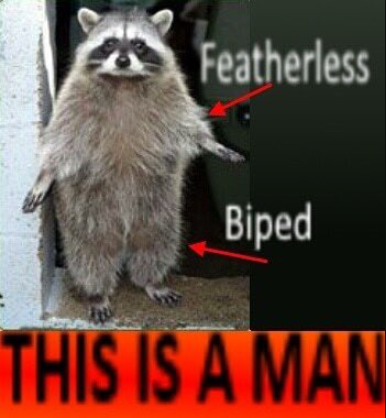
    in ancient greece, they asked a philosopher, "what is a man?". he said "a featherless, bipedal creature". and then diogenes entered the scene

  • source
  • parent
  • hideshow 2 child comments
  • 5 comments in c/Tumblr@lemmy.dbzer0.com view that post
    [–] 9 points 1 year ago* (last edited 1 year ago)

    For example, humans were considered to be distinct from chimpanzees and gorillas which were put in a group together. This was done mainly on the basis of morphology. Then it turned out that chimpanzees are far more closely related to humans than to gorillas.

  • source
  • [–] 8 points 1 year ago* (last edited 1 year ago)

    Apparently our primary morphologically distinct feature is a chin?

    For the curious: https://www.youtube.com/watch?v=VkYITGZccMs

  • source
  • [–] 3 points 1 year ago (2 children)

    I don't really know tumbler's comment structure. How does Julia Louis Dreyfus fit in?

  • source
  • hideshow 2 child comments
  • [–] 4 points 1 year ago

    I think the culture of not cropping out the person who reblogged this chain (i.e. Julia Louis Dreyfus) is sort of like an informal citation system. It's analogous to if I said "oh man, let me tell you this joke that my friend Julia told me". Whoever made this screenshot likely only saw this thread because they were following Julia Louis Dreyfus

  • source
  • parent