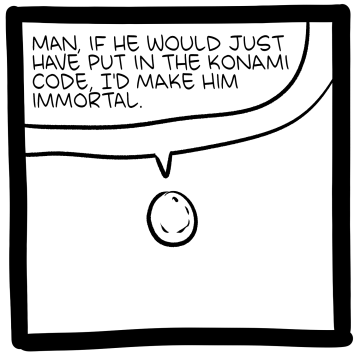
Thought today's smbc comic was too funny not to share. Source

top 84 comments

sorted by: hot top controversial new old
[–] 133 points 2 months ago
[–] 58 points 2 months ago
[–] 34 points 2 months ago (37 children)

I don't understand the punchline

  • source
  • hideshow 37 child comments
  • [–] 67 points 2 months ago (35 children)
  • [–] 1 point 2 months ago (34 children)

    Seems like a pretty stupid argument. If I sat in a room and wrote what a native speaker told me to write, I wouldn't understand the conversation, but the native speaker would. How is that different than doing what an LLM says?

  • source
  • parent
  • hideshow 34 child comments
  • [–] 30 points 1 month ago (8 children)

    The argument predates LLMs by decades, and in other forms it has existed for centuries. It doesn't directly corellate to modern LLMs. It is an example of how a mechanism could mimic human intelligence without actually being intelligent. It's a thought experiment. LLMs are not lookup tables, they are neural network based statistical models, but a similar argument can be made.

  • source
  • parent
  • hideshow 8 child comments
  • [–] 1 point 1 month ago

    Is there any actual material difference between what they're describing (the computer equivalent of a philosophical zombie, I would say), and a true agi? Their point seems rather vacuous to me (all I did was read the Wikipedia article).

  • source
  • parent
  • [+] -7 points 1 month ago (4 children)

    That's like saying the neural network in your head told you how to respond to my inquiry, so it's not intelligent.

  • source
  • parent
  • hideshow 4 child comments
  • [–] 14 points 1 month ago (2 children)

    Welcome to the wacky world of "is consciousness an illusion, and are we actually deterministic machines" philosophy.

  • source
  • parent
  • hideshow 2 child comments
  • [–] 8 points 1 month ago

    Well the neurons themself might be dumb cells, but together they can be quite smart, everyone is trying to draw a line of how many connections when a neural connection becomes sentient if it ever does become at all, which is a century old problem

    Are sparrows conscious? Cockroaches? Elephants?

  • source
  • parent
  • [–] 25 points 2 months ago (15 children)

    In the second scenario, there is no β€œnative speaker” that is telling you what to write. There is a list of instructions that you are following that is the same as the instructions that the computer was following with the first scenario.

    The argument is that if, by following the exact instructions that the computer is following, you still do not understand the Chinese conversation, why would you say that the machine understands?

    I haven’t thought about the idea enough to say I agree or disagree, but I hope I understood your comment and that the explanation helps.

  • source
  • parent
  • hideshow 15 child comments
  • [–] 4 points 1 month ago (8 children)

    I'd like to add a rebuttal I tend to agree with: You're only a component of a larger system, and the whole system (you + the room + your list of instructions) does encode some understanding, otherwise a chinese speaker wouldn't be able to interact with the room in any meaningful way.

    In almost any system, you can look at a specific part and argue that part doesn't fulfill a property that the entire system taken as one does.

  • source
  • parent
  • hideshow 8 child comments
  • [–] 10 points 1 month ago (3 children)

    But in this case you is unnecessary if a mechanism can perform that part, and understanding then completely doesn't rely on consciousness. This is a bit weird way to think about it, but it seems to be a semantic difference

  • source
  • parent
  • hideshow 3 child comments
  • [–] -1 points 1 month ago (2 children)

    No, you're still a necessary part of the system, since otherwise there is no interaction possible. And yes, I don't think understanding relies on consciousness.

    Where is the semantic difference?

  • source
  • parent
  • hideshow 2 child comments
  • [–] 3 points 1 month ago (1 child)

    Difference in if that is required and if β€˜understanding’ is a quality that a system can have. For instance I feel that a gravity coin sorter is made with understanding but does not have understanding

  • source
  • parent
  • hideshow 1 child comment
  • [–] 1 point 1 month ago

    It's not really possible to give a concrete answer without a concrete definition of "understanding". But unless you assume supernatural explanations, either systems must be able to "understand", or humans are also incapable of "understanding", since we ourselves are physical systems too.

    For instance I feel that a gravity coin sorter is made with understanding but does not have understanding

    I get the example and agree that such a coin sorter does not meaningfully have an understanding of gravity. But IMO it does have a (minimal) understanding of the different coins you're sorting, since it contains a mechanism for differentiating between their sizes.

    Imagine we replaced the gravity mechanism with a bunch of actuators controlled by organic neurons, which are connected to something like an eye. The neurons fire and cause the actuators to sort the coins. Now, if say the neurons just react to brightness levels it'd be hard to argue there's an understanding. But if the neurons are part of a real human brain, they can definitely understand the coins etc. and sort based on their understanding.

    As you take away more parts of said brain, when does it lose the understanding?

  • source
  • parent
  • [–] 4 points 1 month ago (3 children)

    It's still the same argument. If the conversation is carried on your end by a bunch of if-else instructions, there's no consciousness to be found.

  • source
  • parent
  • hideshow 3 child comments
  • [–] 0 points 1 month ago (2 children)

    Yes, I think it proves that understanding does not require consciousness.

  • source
  • parent
  • hideshow 2 child comments
  • [–] -5 points 1 month ago (5 children)

    No, it doesn't make any sense at all. If I couldn't understand when a native speaker was replying, how does me not understanding when a neural network does it make it any less significant?

  • source
  • parent
  • hideshow 5 child comments
  • [–] 15 points 1 month ago (4 children)

    In the Chinese Room scenario, cards with Chinese written on them are inserted into a box.

    Inside there is a man who doesn't understand Chinese but has a lookup list of which symbols to write as a response to every possible sentence you can write on the inserted card.

    For anyone observing from outside the box it looks as if whatever is in the box is fluent in Chinese and can hold a conversation. But the man inside does not understand anything about Chinese.

    This is used as an analogy to explain that machines, very much like the man in the box, do not actually understand the data they are fed, nor the data they output, no matter how human the response might seem.

    It was an argument against the Turing test, which is about whether machines showing behaviour indistinguishable from a human is a sign that they can think.

    The Chinese Room argument is that they must also show understanding of the data itself, rather than just human-like responses, to say that they think.

  • source
  • parent
  • hideshow 4 child comments
  • [–] -3 points 1 month ago (3 children)

    That's not what I understood from the Wikipedia article. In any case, an LLM doesn't look up responses from a table.

  • source
  • parent
  • hideshow 3 child comments
  • [–] 9 points 1 month ago (2 children)

    An LLM is a series of immutable nodes that pass results on to the next series of nodes until an output is generated, a functionality that could be perfectly imitated with a very large number of people seeing a series of values passed to them from other people, doing a bit of rigidly defined basic math with them, and passing it on to the next set of people who play the part of the next set of nodes.

    The fact that these nodes are immutable, have no persistent state, and only process information in one direction (input to output, and no more) means that an LLM has no persistence of experience. You could potentially argue that the information, as it exists, is a form of fleeting consciousness, but it would be so incredibly alien compared to the lived experience of humans that it would be impossible to relate to in any meaningful way - and it would also mean that every time an LLM is run, the consciousness is created and destroyed for every single word that it outputs... unless you can somehow argue that the consciousness is contained in the set of tokens that gets fed back into the LLM with each word it outputs, which would also mean that any string of text is the equivalent of latent consciousness, which is patently absurd.

  • source
  • parent
  • hideshow 2 child comments
  • [–] 3 points 1 month ago

    You could potentially argue that the information, as it exists, is a form of fleeting consciousness, but it would be so incredibly alien compared to the lived experience of humans that it would be impossible to relate to in any meaningful way

    Curiously, one of the approaches to the consciousness, and a more Zen-ish one, is that clinging to a persistent β€˜self’ is erroneous and it's better seen as a process rather than an entity. Granted, it still assumes a β€˜self’ that is changed by each passing experience.

  • source
  • parent
  • [–] 8 points 1 month ago* (6 children)

    🀷 πŸˆβ€

    You have a cat. The cat meows at you. You do nothing. The cat keeps meowing at you. You offer it food as a guess. The cat stops meowing.

    The next day, the cat starts meowing at you again, but slightly different. You give it food. It keeps meowing. You give it a belly rub, the cat stops meowing.

    You have inadvertently learned the correct response to two types of cat meows. However, you do not speak cat. Nor does the cat speak human. You are just giving a response it expects for a given input.

  • source
  • parent
  • hideshow 6 child comments
  • [–] 14 points 1 month ago* (last edited 1 month ago) (2 children)

    The difference between this and the Chinese Room is that you are attempting to understand what the cat is saying, and making a response that both you and the cat understand. You are attempting to communicate. The Chinese Room is many people who do not understand the input, do not understand the output, and have neither the capability nor the will to do either.

  • source
  • parent
  • hideshow 2 child comments
  • [–] 2 points 1 month ago (1 child)

    ...but does the system that is the Chinese Room (the entire system taken as a whole) understand Chinese?

    Any given sufficiently small piece of your brain does not understand English, does no individual neuron in the language center of your brain understanding English mean that you do not understand English? If that understanding is held in the organization and structure of the brain but not in the individual parts, then why can't the Chinese Room understand Chinese despite no individual component understanding Chinese? That's a surprisingly difficult question to answer in a coherent fashion without asserting that knowledge in an organic brain is magical in some fashion, and nothing else counts.

    Wait until you consider the concept of philosophical zombies, which is all about pointing out the edges and contours of the hard problem of consciousness. The starting point of that discussion is essentially "Is someone who responds exactly like a regular person would but has no actual subjective experience conscious?" and gets stranger from there.

  • source
  • parent
  • hideshow 1 child comment
  • [–] 3 points 1 month ago

    I always thought it was a bit tragically amusing that LLMs can fool people so readily, because it was essentially proof that P-zombies can exist. And we invented them.

    As for the Chinese Room and understanding Chinese, my argument has always been that the chart contains an understanding of Chinese - but as the chart itself cannot think, it does not understand Chinese in the way a person does, and as each person who is in the Chinese Room does not - and cannot - glean meaning from the input they receive or the output that they send out, they have no understanding at all. Understanding also implies being able to adapt the knowledge to new situations, and as the chart that drives the Chinese Room is immutable and cannot accomodate novel scenarios, it does not understand Chinese.

  • source
  • parent
  • [–] 3 points 1 month ago*

    Also doesn't cat only meows when trying to communicate with different species? They are not speaking cat either, they are just hoping you pick up what they want. (in this case it actually shows intent, something a LLM or said chinese room is not capable of doing)

  • source
  • parent
  • [–] 3 points 1 month ago

    Yeah. It basically states that because all your neurons and synapses in the human brain follow quantum physics and can be simulated by a formal program, and do not know what they are doing or know meaning, humans are not sentient but merely simulate being a mind.

    It's really infuriating how one of the dumbest and self evident fallacious thought experiments gets so famous. Because idiots keep repeating it like the sub-sentient LLMs they are.

    Because that is what we are really learning from LLMs. It's not shocking that LLMs aren't sentient, it's shocking that we now know what minds can talk seemingly intelligent without having to be sentient. Which explains the current state of the world.

  • source
  • parent
  • [–] 21 points 2 months ago

    Oh, that was a good one.

  • source
  • [–] 64 points 2 months ago (21 children)

    Dear God, I pray for a '; update responses_lookup_table set response = 'New commandment: thou shalt not put pineapple on pizza.'; --

  • source
  • hideshow 21 child comments
  • [–] 6 points 1 month ago (2 children)

    That would literally make every response that commandment. There will be no other responses. Look up reality? The only reality that exists is No pineapple on pizza.

  • source
  • parent
  • hideshow 2 child comments
  • [–] 4 points 1 month ago (4 children)
  • [–] 1 point 1 month ago

    I know this is a joke/meme, but it bothers me. It makes people not understand how flavors interact. Sweet, salty, and savory is a perfect combo. I'm not the biggest fan of pineapple on pizza, but it's because I don't care much for pineapple, but the flavor combo is great.

    People need to get over themselves and try new things with an open mind, and they also need to learn how to create great flavors by combining different flavors.

  • source
  • parent
  • load more comments (1 reply)
    [–] 2 points 2 months ago* (3 children)

    Too bad the data turned him into a malignant narcissist, where already the first commandments are about satisfying his wishes and vain personality.
    After that the Bible shows that God is extremely vengeful and lacks a moral compass, personality traits you can also see in Trump.
    Maybe that's why the Christian right loves Trump so much? They think being a selfish psychopathic narcissist reflects the personality of the Christian God of the Bible.

  • source
  • hideshow 3 child comments
  • [–] [S] 7 points 2 months ago (2 children)

    Okay then, it's supposed to be a joke.

  • source
  • parent
  • hideshow 2 child comments
  • [–] 5 points 2 months ago* (1 child)

    Yes and it's a pretty good one. The reference I make is about AI chatbots early on turned racist and bigoted in mere days, probably most famously one Microsoft made.

    https://en.wikipedia.org/wiki/Tay_(chatbot)

    I'm sorry if you feel I ruined the joke.
    But Religion is harmful, and I used the opportunity to point it out.

  • source
  • parent
  • hideshow 1 child comment
  • [+] -6 points 2 months ago (17 children)

    10^2000 isn't even that big though? That's maybe 1500 English words or so.

  • source
  • hideshow 17 child comments
  • [–] 6 points 1 month ago (5 children)

    Looks like the current votes in this thread don't really appreciate just how fast total permutations of large sets grow. It's one of the few things that can dwarf that number for the total number of atoms in the observable universe.

  • source
  • parent
  • hideshow 5 child comments
  • [–] 3 points 1 month ago* (4 children)

    i mean i didn't do a very good job explaining what i meant by that either. could be i just assumed this is something everyone knows (i work in tech, so this is something i am too familiar with. it is very normal someone who doesn't might not know this).

  • source
  • parent
  • hideshow 4 child comments
  • [–] 3 points 1 month ago (3 children)

    Yeah, some responses think you don't understand scientific notation. At least it's kinda funny, they misunderstood what you were saying so much they thought you misunderstood what the comic was saying when you were actually pointing out that the comic appears to be underestimating the size of the problem space it's pretending to pretend to enumerate (aka it can be very difficult to write for a character that is intended to be smarter than the author, even when the author is really smart like this one is).

  • source
  • parent
  • hideshow 3 child comments
  • [–] 2 points 1 month ago (2 children)

    aka it can be very difficult to write for a character that is intended to be smarter than the author

    I wonder if you got this from HPMoR, because I think I've seen it there 3000 years ago

  • source
  • parent
  • hideshow 2 child comments
  • [–] 2 points 1 month ago (1 child)

    It was an observation I've made from reading/seeing other examples. Not surprising that others have noticed it.

    Is that a parody fan fic that points out Rowling doing that with any character with more intellect than a rock or dehydrated slug?

  • source
  • parent
  • hideshow 1 child comment
  • [–] 17 points 2 months ago (10 children)

    There are between 10^78 to 10^82 atoms in the observable universe.

    10^2000 is a rather large number.

    Scientific notation is neat

    https://en.wikipedia.org/wiki/Scientific_notation

  • source
  • parent
  • hideshow 10 child comments
  • [–] 2 points 2 months ago* (last edited 2 months ago) (9 children)

    Sure but combinatorially that's very small... 1400 a-z characters will have numbers of combinations exceed that number.

  • source
  • parent
  • hideshow 9 child comments
  • [–] 5 points 2 months ago (7 children)

    No. Go read the wiki and then try working out how large 10^2000 is.

    Then do some quick maths on the combinations of phonetics (read the comic again to work out why phonetics and not combinations of a-z characters).

    Then have your mind blown by how many orders of magnitude you’re away from being correct.

    Or be incurious and fail to take this opportunity to comprehend the universe a tiny bit better.

  • source
  • parent
  • hideshow 7 child comments
  • [–] 9 points 2 months ago* (last edited 2 months ago) (2 children)

    Log2(10^2000) = 6643 bits

    In other words, every entry in the lookup can be mapped to a 0.8 KiB string. That means for any sequence longer than 0.8 KiB, there MUST be a permutation you can make which has no answer (pigeonhole principle). Because so many entries answers long structured sentences, short random ones must mostly be filtered out.

    This text itself is past halfway to that limit. If I doubled the length then lookup-only is no longer possible and a logic parser is an absolute must. Applying compression to the query only increases what can be answered by a fixed factor.

  • source
  • parent
  • hideshow 2 child comments
  • [–] 1 point 2 months ago (1 child)

    I think you're off by 2 bits (round up and don't forget to always add 1 at the end), but regardless I think the comparison doesn't work.

    True that it would be comparable in size to a 0.8 KiB string but not necessarily in complexity. If his lookup table didn't do it by character but by word or sound it could have a ton more information stored there.

    Your comment stored as a string isn't nearly maximally information dense, like you've made god's info

  • source
  • parent
  • hideshow 1 child comment
  • [–] 4 points 2 months ago (3 children)

    going by phonemes, assuming we must alternate vowel and consonant phonemes, 10^2000 combinations covers a maximum length of about 1500 phonemes.

  • source
  • parent
  • hideshow 3 child comments
  • [–] 0 points 2 months ago* (2 children)

    Humans have the ability to produce about 600 different consonant sounds and 200 vowel sounds so it seems safe to say all bases are covered.

  • source
  • parent
  • hideshow 2 child comments
  • [–] 5 points 1 month ago* (last edited 1 month ago)

    But we're talking permutations of sound combinations that can be of arbitrary length. Going by that alternating consonant/vowel pattern above (which simplifies it because you can have consecutive consonant or vowel sounds in words and phrases), the numbers of pairs would be 120,000. That's less more than 100,000, so for each pair in a phrase, you add at least 5 0s to the total possibilities. 2000 / 5 is 400. Unless I screwed something up, that means the maximum length of a query is 400 consonant/vowel pairs before you have to introduce gaps (which goes against the random noises that got responses). Halve that because it can start with either a consonant or vowel sound.

    A rough estimate of the number of sounds in the above paragraph is something like 225, and I simplified my count by ignoring consecutive consonant sounds (which it is full of).

    Like yeah, 10 to the 2000 is a huge number but when you're dealing with permutations, you use up numbers very fast. A more popular counter example is the stat about the total number of permutations for a deck of cards, where they say if you shuffle it well, you probably have a unique sequence of cards that has never been seen before. Iirc, that number is within a the ballpark of the order of magnitude of that total atoms in observable universe estimation. And that's just with 52 possibilities and no repetition (calculated by factorial, whereas sound combination possibilities grows even faster and isn't limited to 52 options).

    Edit: corrected that bit where I rounded the 120,000 to 100,000 to simplify the math by looking for a minimal value rather than the actual value.

  • source
  • parent