https://jabde.com/2024/08/10/should-neutron-stars-be-added-to-the-periodic-table/
I say yes, entirely because it's hilarious

https://jabde.com/2024/08/10/should-neutron-stars-be-added-to-the-periodic-table/
I say yes, entirely because it's hilarious
After reading I realised that this proposal isn't a single new element for all neutron stars, but a separate new entry on the table for every individual neutron star in existence, unless there are two that happen to have the exact same number of protons which is unlikely. Sounds good to me
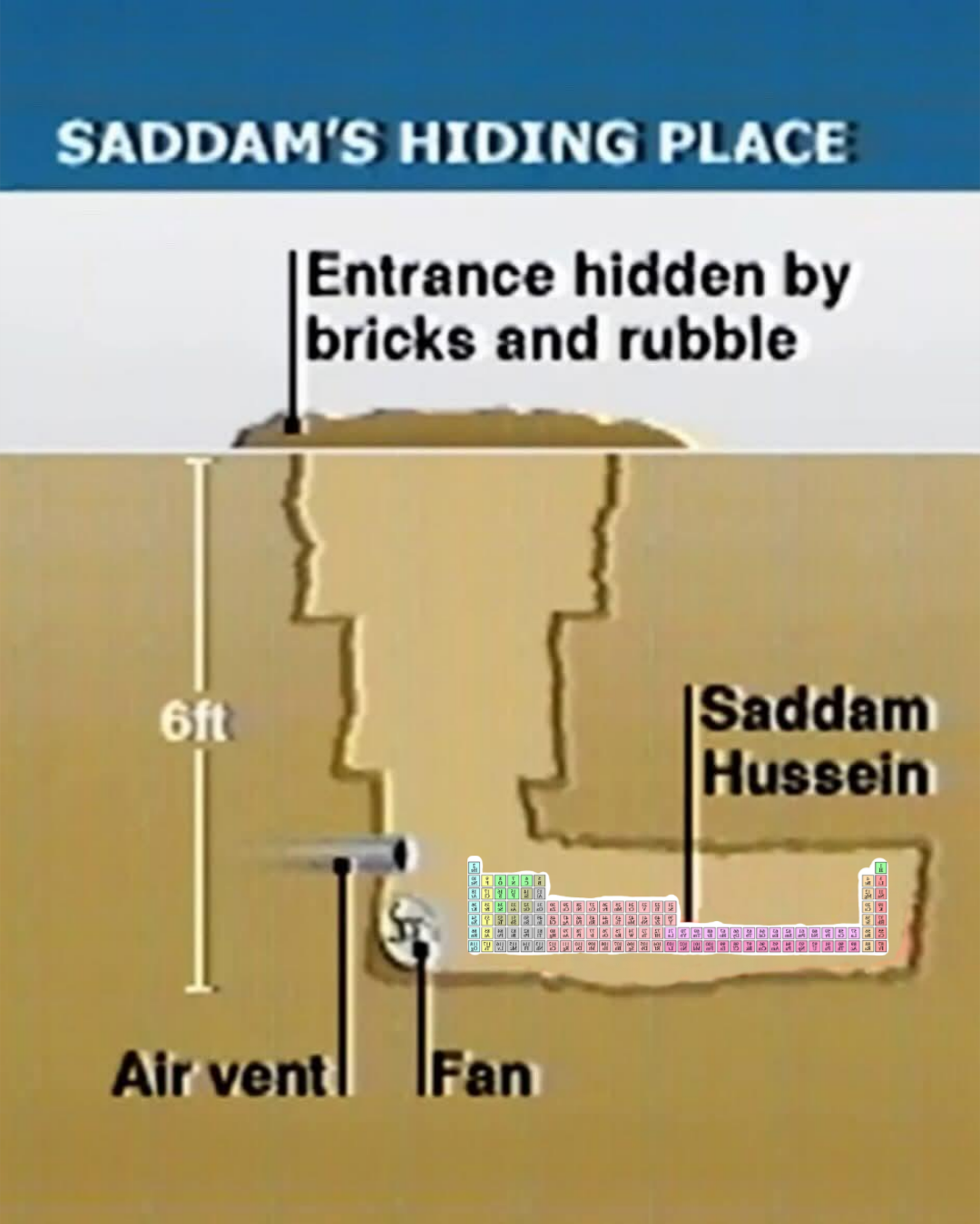
The rare reverse-Saddam.
"It is a truth universally acknowledged that no physics problem is complete unless some major component of reality is excluded to simplify the numbers."
I'll save this quote for my students. Amazing.
Are they elements? 🤨
Personally, I think it's high time we went back to just 4 of 'em. Earth, Wind, Water, Fire. It's so much easier to remember them all.
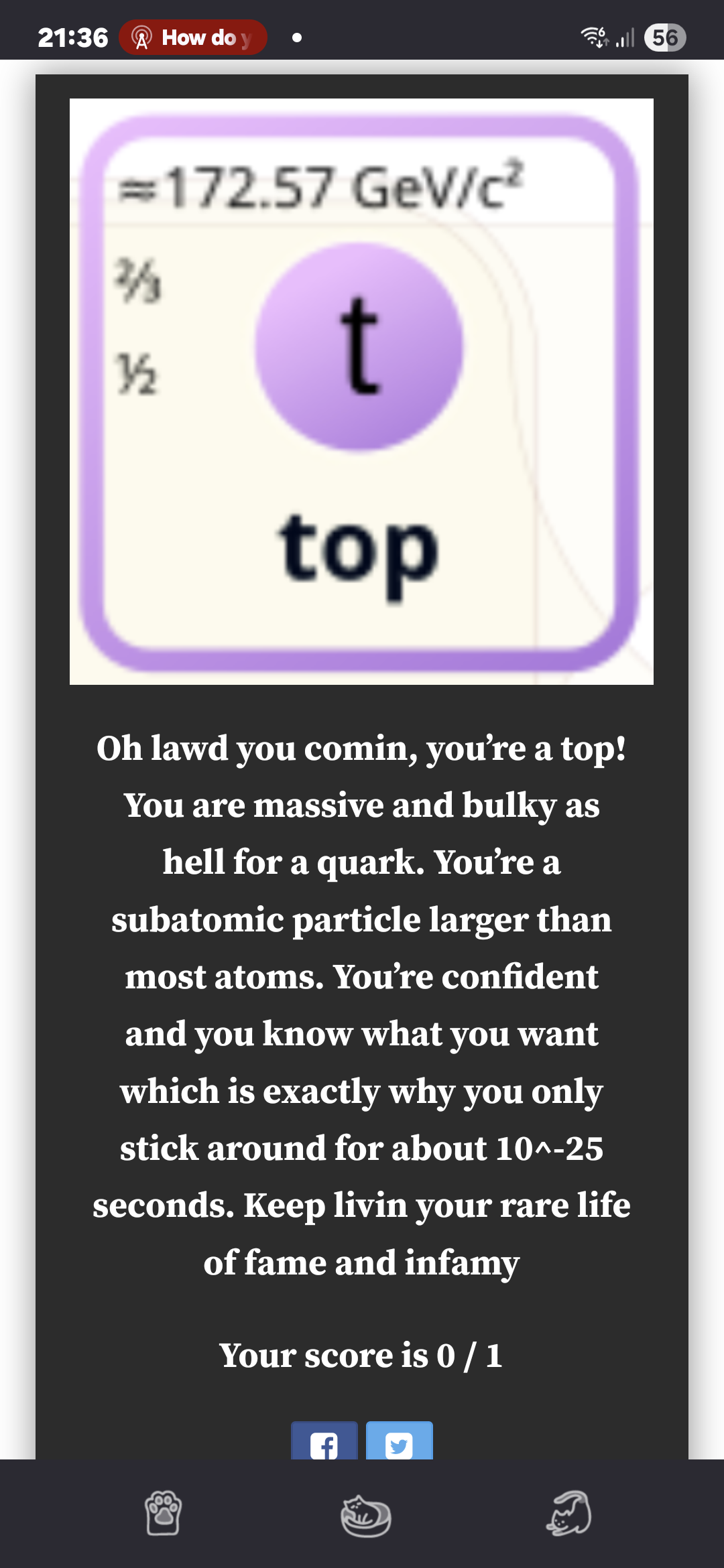
Apparently, I am a top. Link to a quiz
(not to scale) is my favorite part
Do they have protons or only neutrons? because if there are no protons then it is technically just neutronium and not an element,
If they do have protons, then it is safe to assume it is a ridiculous number like 10^40. in which case I would count it as an element. And given how unlikely is for 2 neutron stars to share the number of protons, then every single neutron star is its own element,
And also, because they do not react with other atom, and if 2 collide then they merge their nucleus, we can agree that they are non reactive, and therefore we can consider them noble gasses...
Wait, are they gas?
YES, they are, if there is a single atom floating in space I think that counts as a gas
Astronomical levels of snark
A representation of a binuclear compound of element 10^(56) with an average bond length of 100 quintillion angstroms.
Okay that was funny.
Okay this is good
Hum... The width of each row increases exponentially with their number.
It's probably just some ~1m away from the small elements. At least on the vertical.
Shouldn't they be element 0 as they dont have any protons?
No, seriously, stuff like electron metal and strange matter.
If we were to expand the periodic table to include them. would the poster fit within the planet? solar system?universe?
Would neutron stars "decay" into black holes? and would that be its own element with even higher atomic number?
all 52 comments