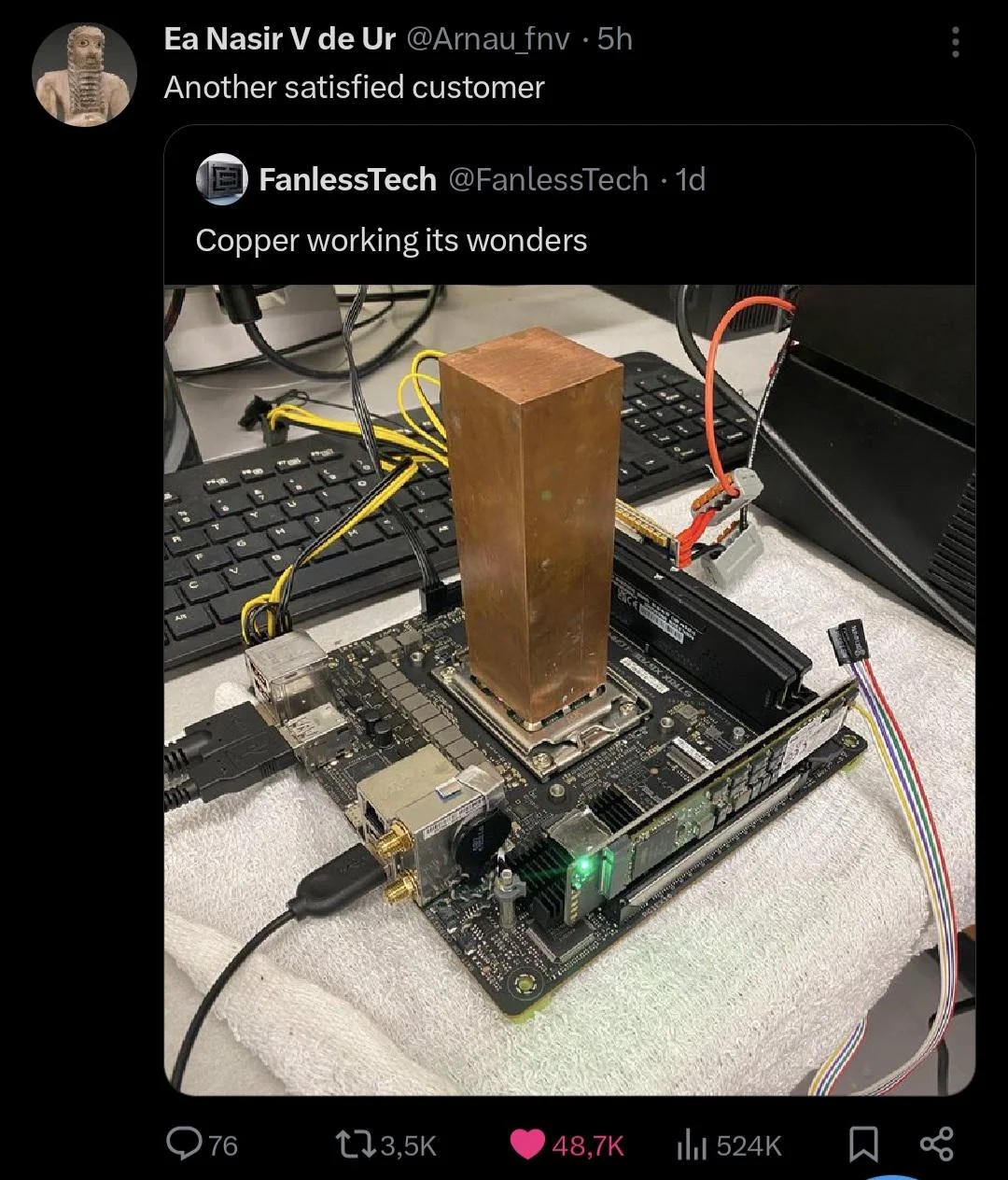
Copper is actually ~25-250X leas efficient at transferring heat than a heat pipe and convection is hundreds of times more efficient than radiation at transferring heat and the fins on a heat sink would have hundreds of times more surface area for dissipating heat all that is to say this might work but it would be orders of magnitude less efficient than a standard heat sink.
post
Well someone's gotta link !reallyshittycopper@lemmy.world
Looks nice. Why they don't sell PCs with cooling like that? What are the downsides?
Do you have any idea how expensive a solid block of copper that big is?
If that block is roughly 4.5cm x 4.5cm x 25cm then the volume of it is about 500cm³ which translates to 4.5kg of copper. At 11€/kg that makes about 50 euros.
Copper isn't that bad. It's not cheap exactly, but it's probably going to cost what an expensive CPU cooler already would.
Probably around $150 worth of copper there, but you'll have to spend about twice that to get it because it comes in a larger size you'll have to cut down.
but a CPU cooler will work better because it is active.
I have a micro ATX case that itself is the cooler. Heatpipes transport the heat to the case walls and they have fins to increase surface area. It can handle up to 65 watt CPUs.
It's not produced anymore. But with all the talk of the Gabecube I've been itching to make a new build with it. Unfortunately I have neither the money or the energy.
Weight, cost, and it's probably not effective for the long haul. The mass of a copper ingot like that will work like a heatsink, but it has a very low surface area for the energy it can absorb. So it'll heat up to a point that is uncomfortable for the CPU, then fail to radiate that energy out to the air effectively.
As a test-bench temporary heatsink, this is actually kind of inspired. No fans, to fussy clips, just stack a copper brick on the CPU, run some benchmarks, and then turn it all off.
Incredibly unwieldy. Real quick estimate of volume puts that at around 1.75kg of copper, so it wouldn't be possible to mount in a vertical PC case orientation (ie the majority of consumer PC cases) without significant (expensive) modifications to both the mobo socket mount and the case, else its weight would snap the motherboard, or just slowly flex it until traces failed.
It may not even be able to be used vertically like that for very long or it will compress and damage the CPU / socket / mobo. Just as an example, the weight limit of the thermal solution (HSF/water chamber heatsink/etc) for socket LGA 1700 is 950g.
My guess is that will only work until it saturates with heat. Some liquid cooling setups are also like that, where the rad isn't capable of dissipating heat fast enough to prevent the whole thing from overheating, but it'll work fine for a while because the loop itself can absorb a bunch of heat before it stops being able to take any more. Then they probably blame the chip maker for running too hot even with liquid cooling when their liquid cooling setup is actually less effective than the stock cooler or their case has horrible airflow and would choke any size or number of rads. But their reservoir acts as a heat buffer, so it takes 30 mins to even realize that, but they've already concluded it works.
Copper is actually ~25-250X leas efficient at transferring heat than a heat pipe and convection is hundreds of times more efficient than radiation at transferring heat and the fins on a heat sink would have hundreds of times more surface area for dissipating heat all that is to say this might work but it would be orders of magnitude less efficient than a standard heat sink.
Despite the size i would be very surprised if this was even equivalent to a moderate performing air cooler. The reason normal coolers have all the fins is for more surface area and youre able to easily and effectively push lots of air through, pullung heat off those surfaces.
I hear this is what the inside of those flock cameras contain.
Am I blind? What's that card in the PCIE slot?
Looks like a PCIE to NVMe. You can see a short M.2 slot on the board, but that drive is wayyyy too big for it
This poor jpeg has aliased edges it's so scuffed. I can't tell if it's an old SSD, an old photo..or none of the above.
Why is the motherboard resting on a towel??
When I work on stuff with tiny parts, it helps to do it on a towel. If you drop something, it tends not to bounce too far, things don't roll as much, etc., and it's easy to see stuff on a white towel.
They don't want to scratch up their desk with the solder joints on the back of it? I'd normally use cardboard, but a towel probably works too 🤷
Or maybe it just has muddy paws that need toweling off 😜
Why copper? Aluminum works way better as a dissipation surface.
Copper has more mass, heat capacity, and thermal conductivity per litre.
Is aluminium actually more effective as a dissipation surface? I hadn't heard that.
Copper is better conductor but it's worse at dissipation. Do the experience yourself, heat a block of each and then touch them afterwards.
Is that not because the copper holds more heat, so stays hot for longer at the same dissipation?
Maybe you're right, but I remember than in the 2000s I've had identical cpu heatsinks in both copper/aluminum versions, and the aluminum one had better performance. And then they started to make hybrid ones, stating that the copper part was to allow rapid heat transference and the aluminum parts to improve dissipation. But maybe it was all marketing.
I just thought of another reason for using Al this way.
Since the heat is being transferred to air, which would be much slower than the 2, using larger fins with lesser thermal conductivity might be more desirable than smaller fins with higher conductivity.
This would also be accompanied with other design changes like greater fin-fin gap, which is better for use with lower pressure fans.
So overall cheaper design and lesser noise.
Of course one could still use Copper fins with the same design for marginal performance increase, at the cost of more weight.
Aluminium is cheaper and lighter.
This seems to suggest that the metal-air transmission is virtually identical between the two, and cites some sources: https://electronics.stackexchange.com/questions/255731/copper-or-aluminum-heatsink
Dissipation = thermal conductivity. Copper is better in both, it's just heavier and far more expensive. Are you sure you put the same amount of energy into both blocks there? A copper heatsink can generally be much smaller than an aluminium one.
The problems and complications with your method:
- Suppose Cu is much faster at heat transfer and you only briefly touched it. Your skin does not actually sense temperature, but rate of heat transfer, which depends not only upon the material temperature but also upon how well it will transfer heat. Better use a thermometer.
- As explained in https://lemmy.nz/comment/20463232, you need to make sure both have been given the same amount of thermal energy and not just heated upto the same temperature. The best way to do so, is by embedding a heat generator right in the middle of the block and transferring a measured amount of energy. e.g. You can embed an electric heater wire (you will require insulation too. That's your headache (ceramic, perhaps)) and pass current using a power source that gives a measurement of the total energy.
Technically, copper is better at heat dissipation. Aluminum is prefered because it's cheaper and lighter. For an aluminum heat sink, you could have an smaller equally performing copper heat sink. In fact, this is the case for when weight and cost isn't a priority. Some heatsinks even use a copper core to wick away heat to the rest of the aluminum heat sink.
From what I have always understood, copper is technically better, but it isn't dramatically better and it is heavier and more expensive. You likely couldn't make a heatsink like the full sized Noctua's and just mount them the way we do because of the weight alone. The price would also likely be double to triple.
O nice, nog 'n Suid-Afrikaner. Ek sien daar's baie van ons op Piefed. Hoe het jy van Piefed uitgevind?

all 70 comments