cross-posted from: https://lemmy.world/post/48430055

Can I take a moment to appreciate you as the only person so far to meaningful engage on this. It's extremely late here so I won't respond now (other than in-short saying things like Stuxnet still make me sceptical about the validity of verifying the software running is actually what you think it is, and no, supervision requirements aren't the same because we don't have to indefinitely supervise our paper ballots, but you absolutely do with voting machines if you plan on using them again).
I will respond in full over the next day or two, but just wanted to send you thanks for actually making solid, reasoned arguments, unlike others who seem to be pretending like the existence of badly run paper elections somehow proves me wrong, which is very frustrating!
Night mate
Just from the table of contents, this was an absolutely cluster fuck of a terribly run election. I beg you please stop misrepresenting the argument.
The best paper elections possible are more secure than the best electronic elections possible.
You keep describing terribly run paper elections and pretending it's an argument in your favour.
If you refuse to address this point I'm kinda done with this.
Bush v Gore
https://en.wikipedia.org/wiki/Bush_v._Gore
You mean the classic example of once again fucking around with something not just pencil and paper, in a country with a history of laughably bad voting systems?
Very easy to point to historical moments where the paper ballot systems were distrusted. That's pretty much the whole history of their use.
You are also just lumping in bad election procedure and declaring electronic voting better.
I'm not saying paper elections are secure just by the virtue that they're on paper, and you framing it that way is pretty dishonest. I'm saying that the most secure electronic election can never be as secure as the most secure paper election.
You've just ignored all I've said about invilators from all parties, adequate supervision of all ballots at all times. Do errors happen? Sure, but in far, far smaller fraction that what you could achieve by compromising election machines.
The fact that machines are un-networked is a laughable defence. Ever heard of Stuxnet? https://en.wikipedia.org/wiki/Stuxnet
This is ABSOLUTELY within the capabilities of state actors. Like not just theoretically. It's already happened in multiple cases.
I'm sorry, but everyone could learn a thing or two from the Australian system. We certainly don't have a fair democracy because we live under capitalism, and the wealthy will always use their influence to get their way, but at least our election procedures are probably one of the best, if not the best in the world.
If you want to just pretend like electronic voting is secure, then have fun I guess. But you're literally just sticking your fingers in your ears.
Hand marked paper ballots are notoriously prone to failure. Nothing about them is materially more secure than a printed ballot. And yet...
There is something inherantly more secure about physical ballots. They exist in the physical world and need to be physically counted, and can't be just erased by the flip of a bit.
I can fully wipe a harddrive fairly trivially, I can't fully erase a pencil mark without some serious chemicals, an iron and probably a bunch else.
It isn't easily solved, as the number of venues and volume of votes leave ample opportunities for shenanigans (or, at least, alleged shenanigans).
The Ohio Recount in 2004 is a classic example.
First of all, the USA in general has terrible voting practices. Second you're right, no system can ever fully defend against people making shit up and getting voters to distrust an election, however:
An average person can fully comprehend how a paper voting system is kept secure. An average person cannot do the same for electronic voting because inherantly it gets into software and hardware security.
I really encourage you to watch those videos I sent, Tom Scott lays out the arguments very well.
stop being stubborn when the facts point elsewhere.
How?
paper votes are part of their strategy to manipulate elections by stealing ballots and more. paper is much easier to fuck with than encrypted electronics.
No, it isn't easier to fuck with. It can be fucked with easily if you don't put the necessary protections in place to stop it. Which from what I'm being told is what was happening in Brazil.
I'm pointing out why electronic voting is stupid precisely because it gives them something to point at. This is precisely why it's so important to not have electronic voting. We wouldn't be having this conversation if the election were beyond reproach (which is the case in countries like Australia).
You're clinging on to electronic voting because your side won, and that voting securitu was even worse before, and I'm very happy Lula did win, but it doesn't stop the fact that elections are less secure if you do them with electronic voting.
Seriously, go watch those videos, they lay it out much better than me.
Wrong, Brazil is proof of that.
How? Because elections were conducted insecurely before? This isn't a point against paper voting, is a point against how paper voting was administered in Brazil before. By what what you're telling me, poorly.
This doesn't discount from the fact that you can never reliably verify a voting machine hasn't been tampered with, unless you're going to have invigilators from all parties in all elections supervise everything from the hardware manufacture, to the writing of the software, to the installation of the software and supervised by all parties while they are in storage. In practice this a near impossibility.
Whereas you absolute can do it for the limited period in which voting occurs with paper ballots.
using a pencil lead under the nail to mark something on blank votes;
having the urn start out with a bunch of votes before voting even begins;
corrupt poll workers filling some of the reserve voting papers before closing the booth.
So, don't do the necessary adminstrative mitigations against these???
You need all parts of the process to be sufficiently supervised by all parties.
Like, I get this situation was worse before, but that isn't an argument for electronic voting.
Please go watch these videos: https://m.youtube.com/watch?v=w3_0x6oaDmI https://m.youtube.com/watch?v=LkH2r-sNjQs
No please you listen
listen though: the voting machines are already secure
Reliably verifying this is a near impossibility.
Tom Scott lays it out well in these videos:
https://m.youtube.com/watch?v=w3_0x6oaDmI https://m.youtube.com/watch?v=LkH2r-sNjQs
paper can be messed with. they have to be manually counted by people every time. that's why the literal nazis in brazil wanted to revert to paper.
They want to revert to paper without any of the procedural steps needed to make it secure. You are absolutely conflating the fact that they want paper voting (so they can cheat) with how proper secure paper voting actually works.
Yes, they need to be manually counted. This works incredibly well where I'm from (Australia), and other countries.
You need the votes to be counted, by hand, in the presence of many people, and with invigilators from all parties/candidates making sure no one is cheating.
We even have preferential voting, which is even more laborious, and yet we still do it.
With such a set up you'd have to have a conspiracy of literally thousands of people in order to affect the vote. And if people are just letting a vote be rigged if it's an open secret, well the only solution to that is mass action and you have far greater societal issues. All election systems rely on people fighting to keep it fair.
Sorry, but voting machines are a band aid that do not make elections secure, and give people a false sense of security, while also allowing bad actors to throw doubt over results (because of aforementioned impossibility of verification).
Like, sorry. I'm glad Lula won, but electronic voting is still shit.
There was a saying in Brazil, up to the 90s, that "elections are won in the counting" - fraud was rampant, especially at municipal/state level and the electronic urns got rid of that.
Paper can only be considered more secure if you have special paper and special printing like money bills, otherwise they can be falsified much more easily.
Skill issue.
(Edit: realising this may be received by non-first-language English speakers, it's a meme. I'm not actually implying people in Brazil don't have skill haha. Just that it's definitely possible to have secure physical ballot elections, and just because it wasn't in Brazil, doesn't mean voting machines are better)
https://m.youtube.com/watch?v=pFD5npXRYi8
Paper is more secure, but only if you pair it with procedural mitigations against bad actors.
For example, one thing we do in Australia is having representatives from all parties invigilate the vote counting to ensure it's correct.
Just because it was worse in Brazil before, isn't an argument for electronic voting.
Compromising a machine is much more likely than creating a conspiracy of hundreds if not thousands of people that would be required to steal a paper and pencil election in Australia.
Exactly, electronic voting is so dumb and I don't know why people defend it.
It's almost like they're offended and think I'm saying that Lula shouldn't have won, which I'm not saying at all.
Electronic voting is just stupid regardless of whether I agree with the result or not
No it can't, and that's the point.
You have cast ballots always under multiple eyes, and have invigilators from all parties that supervise the vote counting.
To pull off falsification would require a massive conspiracy that would almost 100% be leaked.
Two great videos on the topic:
https://m.youtube.com/watch?v=w3_0x6oaDmI https://m.youtube.com/watch?v=LkH2r-sNjQs
In conclusion you're incorrect in my opinion.
cross-posted from: https://lemmy.world/post/48430055
cross-posted from: https://lemmy.world/post/37503290
Young Republican kids
The Jabbamensch

The only numbers I will ever spell are one and zero, and only when using them as a pronoun, or for emphasis, respectively.
Is there ever a reason to not to use symbols when dealing with numbers? Why would "fourteen whatevers" ever be preferable to "14 whatevers". It's just so much easier to read numbers as symbols, not spelled out.
(Caveat, not including multipliers, like "273 billion").
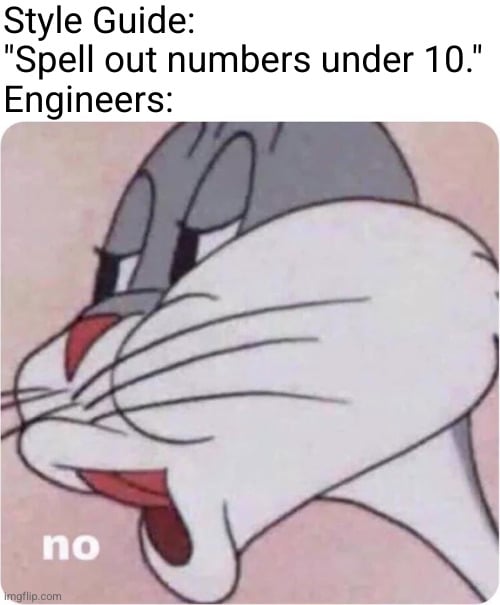
Its just easier

Especially when there's some mad person with a folder where they put ALL their markups, correspondence and revisions in the same folder, with no sub folders 🤢.

