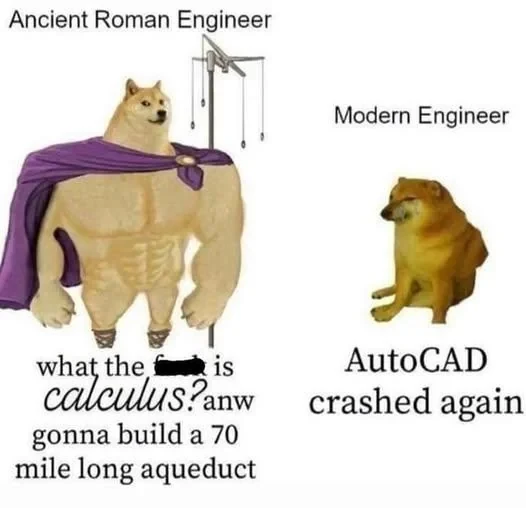
You can say "fuck" on the Internet 🙄
post
there's a difference.
their engineering was amazing, but to compensate for lack of modern maths, they build with a much larger margin of safety and strength.
that's why some of those aqueducts last 2000 years.
no one wants to build infrastructure that lasts so long. we could build a bridge designed to last thousands of years, but it'll cost way way more, and the budget isn't unlimited.
And even if we could, Autocad crashed again so I can't
just use msPaint, more reliable
I like the way someone described a similar retort:
Anyone can build a bridge that stays up and lasts a long time, but it takes a skilled engineer to build a bridge that just barely stays up a long time and minimizes costs and materials.
Also our bridges are subjected to the insane forces of truck freight transportation. Who know how long they would last otherwise.
They were designed for that (usually), if you want a bridge to last multiple millenia you can design it for that. but it will probably add a couple zeroes at the end of the bill.
Romans had the 'advantage' of slave labour,
Interestingly enough, construction wasn't a usual avenue for applying slave labor in Ancient Rome.
really?
Did they paid professionals to do that? I understand masons, but not the actual putting a big brick on top of another
Wage labor, usually.
Despite the widespread use of slave labor in Roman society, unskilled slaves were overwhelmingly used for tasks that were either considered 'demeaning' (like domestic servants), did not require any real precision (like mill grinding and monocrop farm labor) or needed a constant application of labor (like mines). The Romans recognized that people work better when offered carrots rather than sticks - some slave who only barely cares if he lives or dies isn't going to put much effort into aligning the brick with the mortar properly unless you watch him like a hawk - which is more labor you have to put in. Manual labor for construction is not a task that requires a doctorate, but it is a task where you have to do it right the first time, or you waste everyone's labor and effort.
Construction, furthermore, is only intermittent work in most places. If you own a bunch of slaves, you don't stop paying for their food and shelter when they aren't working - if you want them to be profitable, you'll have to find other work for them to do the rest of the year. And at that point, it's probably not less profitable to just have them do that year-round instead. You could, potentially, have your slaves as a traveling construction crew, but travel is not only uncertain and expensive, but offers opportunities for unmotivated workers (like slaves) to simply... slip away, and choose to no longer be one of your workers. Even if you try to hunt them down. Even just transporting building materials from Point A to Point B includes a lot of very dangerous unsupervised time - perhaps something you'd trust a household slave with, but not one of the faceless slave numbers on your business ledger!
Funny enough, it would be more likely, if anyone was a slave on the job, that it would be potentially a few of the skilled positions. Skilled slaves were often given more trust and responsibilities precisely because they were offered more 'carrot' than 'stick' - payment, privileges, and the possibility of freedom for a decade or two of labor were on the table. Skilled slaves were thus less likely to run away - and unlike free wage laborers, especially skilled ones, wouldn't (or rather, couldn't) demand more pay at the prospect of being dragged from one of the empire to another - very handy if you're a small construction firm going from place to place, and hiring local labor for most tasks!
like musical instruments, bridges are meant to be stressed. gotta drive over em with trucks or they'll shoot off into space
It's also worth pointing out those structures aren't subjected to a lot of freeze thaw cycles, not to mention almost no salt.
but it'll cost way way more, and the budget isn't unlimited.
I wish things weren't always so short-sighted by default. I mean sometimes things evolve so maybe it's better to leave room for teardown and improvement or whatnot.
But it seems if you're not thinking in "quarterlies", infrastructure that's built once and simply maintained should cost a lot less in the long run.
But then I guess the contractors would dry up if they didn't have to come rebuild it a dozen times a decade. :p
Modern engineer would built an aquaduct in kilometers, not miles 😅
Roman engineers most probably never heard about miles too.
millia pasuum, literally "1,000 paces," was a common unit of measure in the empire, and the basis of various modern miles. It was slightly shorter than the modern statute mile.
Interesting. Never realised that "mile" just means "thousand" (though it is kinda obvious in retrospect). And since the modern mile is 1760 yards, a kilometre is more of a mile than the actual mile.
Yeah, assuming that a yard is meant to approximate the stride of an adult human, who's the Goliath-sized motherfucker with the 5' 3" stride who took a thousand steps and called that a mile?
Edit: Okay, I checked.
The furlong (meaning furrow length) was the distance a team of oxen could plough without resting. This was standardised to be exactly 40 rods or 10 chains.
An English mile is defined as 8 furlongs, 8 presumably being chosen because it divides by 2 and 4. What a cockamamie system of measurement.
Edit Again: Okay, I checked again.
The modern English word mile derives from Middle English myle and Old English mīl, which was cognate with all other Germanic terms for miles. These derived from the nominal ellipsis form of mīlle passus 'mile' or mīlia passuum 'miles', the Roman mile of one thousand paces.
A pace is a unit of length consisting either of one normal walking step, or of a double step, returning to the same foot.
This is all still very silly.
Far be it from me to defend the imperial system- I love and daily work in metric, but you realize nearly all ancient measurement systems are created around commonplace physical measures (body parts, strides, etc.) and simple multiples thereof to make their use easy, yeah?
We've got a lot of tools at our disposal now to both standardize and make working with a decimal system a lot more doable than before.
Unless they're american, then it'll be built in freedom units.
Will be built in cheeseburgers and carrying stolen oil.
They can build it in kilometers all they want. Plenty of people will still measure it in miles.
Calculus tells you how curves work. Aqueducts are famous for their ability to be topologically flat. The math checks out
Their tools still used calculus, just indirectly and without their understanding.
Importantly, I replace dy/dx with ∆y/∆x when I need a really quick sanity check for simple calculations.
Stop censoring mens, please?
I think we should just bad images with censored parts unless the censored part is the point.
Yeah, this is the internet, you can say bad words and fuck these US tech companies that want to stop everyone saying naughty words only because it makes them more money when we don't
Yup, we're stupid, but at least we have the metric system ¯_(ツ)_/¯
Back then you used to have to have a college degree to be able to multiply.
It's simpler to over engineer an aqueduct that lasts for millennia than to make a building just strong enough that it won't fall apart for at least 30 years
Roman engineer is called to assist some locals in the province wo are having some trouble with digging a tunnel for an aquaeduct
Finds they already started digging from both ends, noting unusual to him, proceeds to measure the unfinished tunnels anyway
Finds that the combined length of both ends is significantly longer than the width of the mountain
Writes a tirade filled letter home, complaining about the provincials being a bunch of stupid barbarians who don't even know how to dig a tunnel from both ends and actually meet in the middle
Soo did the resulting aqueduct end up with a jog in the middle and a couple dead ends? Where was this?
Now let’s see the Roman double a cube.
I’ll wait.
Romans, making a scale model and just eyeballing it: "Good enough for government work"
Plato would slap them from the grave for not using pure geometry. He did the same when someone used a machine to do the work.
It’s an impossible problem using just compass and straight edge (proved impossible in the 1800s) but the greeks and romans were obsessed with trying to figure it out.
I've always found it amusing that, for all the use of advanced technology and engineering from the Romans, you don't really have much in the way of contributions to mathematics, physics, etc, from Roman writers. "Too thinky, not practical enough >:("
Hell, even the only Roman philosophers of note are all pretty orthodox thinkers of a pre-established Greek school. Yet our surviving engineering texts from Roman authors are [chef's kiss]
It's funny what results cultural priorities can produce.
The problem isn’t about getting close enough. It’s a mathematics question on figuring out cube roots. You can do it with machines but it’s impossible to do with straight edge and compass. The greeks and romans wanted to figure out if there was a general solution using straight edge and compass so a close enough guess wouldn’t work. They already had solutions like that.
This problem was a head scratcher for literally millennia along with squaring the circle and trisecting an angle. All three were proved impossible to do with just straight edge and compass.
Fun fact, nobody knows WTF they were doing with those gromae. Probably not calculus, though.
Once again repeating my petition for people to stop censoring curse words from their fucking memes (same meme as last time too). This isn't grade 3, and we're not in Sunday School, we're all adults here just fucking curse.

You're thinking of trig. Calculus is for bodies in motion. Trig is what we use for precise location. Engineers I'm sure use some calculus but trig is gonna be the workhorse, especially in CAD
Calculus isn't just for bodies in motion, its also used in mechanics. E.g calculating the strength of a beam given a load distribution is the the load curve integrated over the length of the beam, to get the load, then there's an integration of the load over the cross section of beam's shape.

all 52 comments