1


OccupySaaS is protest movement written in code.

Story is simple. Many engineers got laid off in tech. But the SaaS platforms they built keep growing and keep charging per seat. So the same industry rent our own work back to us. This project is answer to that. Laid off engineers use AI and public documentation to rebuild those platforms as free open source drop-in replacements. One seat at a time.

Method is clean room. Public docs only, open standards, public SDK behaviour. No leaked code, no decompile, no confidential info from former employer. AI help with build, humans write spec and review every change. Compatible is proven by running vendors own public SDKs against the server. If your existing code dont work unchanged, it is not done.

Two early releases: ZeroAuthy ( Auth0 compatible identity server) and SalesCompel( Salesforce compatible CRM)

They are early, not production ready yet. But the goal is the point.

2


Finally StreetComplete has been approved on the App Store and everyone has now the possibility to download it: https://apps.apple.com/app/id6808344816

F-Droid download link: https://f-droid.org/packages/de.westnordost.streetcomplete/

PlayStore download link: https://play.google.com/store/apps/details?id=de.westnordost.streetcomplete

I highly suggest you this app in order to contribute to OpenStreetMap without background or any technical knowledge. Just open the app and answer to simple questions:

  • Does this crossing have an island?
  • Is this place still there?
  • What can be left here for recycling? Furthermore by completing more and more quests the app will reward you with links to (FOSS) maps for different purposes: wheelmap, indoor, graphhopper, touchmapper.

I truly believe that this is the solution and way to get as many contributors as possible to improve the map, and make us less dependent on BigTech.

In case you want to see the site, here it is: https://streetcomplete.app/

3
4
5
6


govdigital eG has awarded IONOS a four-year framework contract under KoDaS, the abbreviation for a collaboration and file storage system. The service delivered under it is built on Nextcloud and sold as Nextcloud Workspace.

It is meant for schools and school authorities in the German states of Berlin, Hamburg, Bremen, North Rhine-Westphalia, Rhineland-Palatinate, and Hesse. Other German states can join later, and schools are not mandated to implement it.

How the deal works

IONOS is the main contractor. It is tasked with delivering and operating the service, running the cloud infrastructure located in German data centers, and building it all on Nextcloud's open source software.

The tender notice for KoDaS sets a maximum value of 67.5 million euros and a maximum term of 48 months from the award. Nextcloud's announcement names the six states and their schools as the main parties who can order, leaving room for other states to be added later.

The announcement does not say what the contract will actually be worth. 📝

The notice calls for procuring software available under an OSI-approved open source license, citing digital sovereignty, lasting availability, and the ability to switch providers.

Among its asks for bidders are ISO 27001 certification, at least 10 million euros in turnover, liability insurance of at least 5 million euros, and a reference project with at least 10,000 active users and fully separated tenants.

For the features, the notice calls for central file hosting and sharing, a browser-based office suite for working on documents together, calendar and contact management, and an integrated email client.

Pricing depends on how many people actively use the service, and it is split into five tiers that start at the up to 50,000 users mark, ending above 500,000. No school authority has to commit to a set volume up front, so each can begin with its current users and grow from there.

Nextcloud's main argument is that public institutions should have alternatives to proprietary platforms so they keep control of their data. The company also believes students who start out using open source tools are less likely to reach for big-vendor products afterward.

We have seen this already

Other German institutions are also reworking their software. Last year, we heard that almost 80% of Schleswig-Holstein's state government workplaces had switched away from Microsoft.

Mecklenburg-Vorpommern is replacing SharePoint with a self-hosted Nextcloud that around 5,000 employees use today, and the state plans to bring that to 50,000 across the public sector.

Then there's the federal Deutschland-Stack, published by the Federal Ministry for Digital Transformation and Government Modernization, which covers all levels of public administration and permits use of only ODF and PDF/UA for documents.

I anticipate more such moves across Europe as governments realize that keeping sensitive data with providers that fall under foreign law can expose it to access they have no say over, irrespective of where the servers are located.

The ongoing US midterms could also shift the conversation depending on who comes out ahead.

7


At least that's what VLC thinks when protesting the new French law.

France's National Assembly has voted in favour of a new "internet tax" that would charge companies for every gigabyte of data they send to users in France.

The idea is to make Netflix, Google, Meta and the rest of Big Tech pay more.

That sounds like a dream come true for many of us who prefer taking ownership of data in our own hands but unfortunately things are not that simple.

The way this law is written, it doesn't stop at Big Tech. Even VLC, a free and open source media player maintained by a non-profit, could end up paying this new tax. What the new French internet tax says New French Internet Tax law

The measure is amendment I-1358 to France's 2027 finance bill, tabled by Laurent Lhardit. It creates a tax on "producers of digital data" at €0.055 (5.5 euro cents) for every gigabyte delivered to subscribers of French internet providers.

Internet providers would measure how much data each sender pushes to their customers, with the collection supervised by telecom regulator Arcep and the tax administration DGFiP. Only the volume is counted, not the content or where it goes.

The amount is capped at 15% of the company's revenue in France or 2% of its total revenue, as per the amendment. Note that it's 15% of French revenue, not of total network traffic. And the text joins the two caps with an "or" without saying which one applies when they differ. How much money are we talking about?

The amendment cites an Arcep estimate of 200 billion GB a year flowing to French internet subscribers. It expects the tax to bring in €10 billion a year. It also names Google, Meta (Facebook, Instagram), Amazon, Netflix and Akamai (cloud server provider) as the senders of about half of that traffic.

You'd think the money goes to the telecom operators who build and maintain the networks. That's the "fair share" argument European telcos have pushed for years.

But that's not the case. The revenue goes straight into the state budget, and the amendment's own justification talks about tax fairness between local businesses and digital multinationals, plus the ecological benefit of compressing data.

Why VLC is angry

A gigabyte of open source software counts the same as a gigabyte of Netflix. VideoLAN, the French non-profit behind VLC, posted on X that the tax would cost it over €1 million a year.

Lhardit replied that the cap would protect VideoLAN. He also said he didn't see how the tax could be passed on to users of Facebook, Instagram or TikTok since those services are free.

VideoLAN didn't take that well:

You have no idea what you are talking about. What you said about Facebook and Insta and other social networks are not targeted because they are free, means you don't understand the basics of economy. You don't understand the difference between Revenue and Profit.

VideoLAN (@videolan), October 30, 2026

The cap may limit what a low-revenue non-profit owes. But there is no explicit exemption for associations, free software or free content anywhere in the text. VideoLAN's €1 million is the possible figure before the cap, and right now nobody can tell the exact figure for certain because of all the ambiguity.

VLC isn't alone. OVHcloud founder Octave Klaba put his company's gross exposure at around €70 million a year, and Free's (Teleccom) Xavier Niel called the authors "ignares incompétents", roughly "incompetent ignoramuses". Those are French companies, by the way. Not exactly the US giants this internet tax bill was meant to tame. At the end, the consumer pays the bill

See, a "war on Big Tech" sounds great in a headline, and European governments are fond of laws that squeeze extra money out of American tech companies. But I don't buy the idea that Netflix will pay them out of their pocket.

Netflix will do what it always does and raise subscription prices. And Facebook is "free" only because advertisers pay for it, which is exactly the revenue versus profit point VideoLAN was making.

So the government gets extra money, Big Tech protects its margins, and you end up paying. Meanwhile, non-profit projects like VLC, which never had a price to raise in the first place, are left wondering how big their bill will be.

Let's just hope that this doesn't take the form of law. Because this will set a precedence. I wouldn't be surprised to see other European countries try their own version. No government will say no to extra tax revenue.

Like GDPR, this has all the ingredients of another mess. If a law is going to tax "internet companies", it needs to say in black and white which ones. Right now, it doesn't.

What do you think? A fair way to make Big Tech pay, or a blunt instrument that hits everyone else? Let me know in the comments.

8
9
10


Just days after Daemonarchy, there's another new OS in the BSD family – and one that is heading determinedly in almost the opposite direction.

AlpineBSD is so new that it barely exists yet. There are no installation media available, though it's possible to manually bootstrap an installation. What AlpineBSD does already have is an AI policy, and the plan is to avoid "the output of generative AI models (e.g. LLMs)" as far as possible:

"Any software whose code, documentation, binaries, or other assets include, in any part, the output of a generative AI tool such as an LLM, is considered 'tainted' for our purposes."

The core idea is to combine the kernel of NetBSD with "a userspace inspired by Alpine Linux and the objective of making it possible to use as little AI-generated software as possible."

Back in 2024, the NetBSD project made its position on AI plain. Its commit guidelines say that "code generated by a Large Language Model […] is presumed to be tainted code."

Back in July, Linus Torvalds stated that "Linux is not one of those anti-AI projects". Since then, NetBSD has seen a spike in donations and interest.

For someone mainly used to Linux, trying to install NetBSD is a little like hopping in a time machine to 30 years ago, and we speak from personal experience of Linux in the mid-1990s. As we mentioned when Slackware turned 30 a few years ago, back in 1996, this vulture tried Slackware 3.0 on his own hardware, and we never did manage to install it.

We tried NetBSD 11 a couple of months ago, and despite considerable help from the folks on the NetBSD-users mailing list, we failed to get the CDE desktop to start.

As an example, installing software on NetBSD is not the easy, comfortable task it is on Linux. It does have a package manager for handling binary packages: it's called pkgin, but as the NetBSD FAQ mentions, it's an optional extra. You must manually tick a box in the setup program to install pkgin with the rest of the OS, and when we tried NetBSD 9.3 four years ago, we didn't know that, overlooked that checkbox, and had to find a way to add pkgin later. (It is quite tricky to install a package manager when you don't have a package manager to install it with.)

This time around, we discovered that pkgin sometimes doesn't complete the installation process for you – it just leaves a text file in a destination directory somewhere, and you're expected to know that, go there, read it, and do any further steps yourself.

The NetBSD community has been quietly going its own way since 1993. It has its own ideas about what is normal, and its users expect that. Some folks on the mailing list told us that they never use binary packages anyway – they compile what they need from source code.

AlpineBSD's ports repository and source code are hosted on Sourcehut, under the account of sircmpwn, better known as Drew DeVault. We have quoted DeVault a few times over the years: we've often found that his views align with our own in various ways… such as about the best laptops ever made, and on simplicity in Linux distro design, or even on dot-com billionaires at FOSDEM.

Alpine's tools are quite well-suited to being adapted to other systems. We have previously mentioned the use of its packaging tool, APK, in the GNU-free Chimera Linux, which uses much of the FreeBSD userland, and also in Adélie Linux.

We will follow AlpineBSD with interest. There's strong appeal in the plan of combining perhaps the best-known, longest-established AI-free Unix-like kernel with the user-facing parts of pretty much the smallest and cleanest Linux distro there is. The AI advocates often warn LLM skeptics that they risk being left behind. Well, here's an OS for those who don't want to surf the AI wave. ®

11
12


Disclosure: I'm on the team that builds this.

AnyModelBot is a local-first, open-source (MIT) app for Windows, macOS and Linux (Docker image too). A "bot" is a persona with its own default model, its own workspace folder and its own memory. It can read and write files, run commands and operate the desktop, so most of the design work went into deciding what it may do without asking:

  • Three permission tiers per bot: read-only; workspace (default — writes only inside its own folder, anything outside pauses for approval); full access (unsandboxed, but recursive deletes still ask).
  • Approval cards: when an action steps outside what the bot may do on its own, the task waits for your OK. Computer use can be set to ask before every UI change.
  • Conversations, memory, files and keys stay on your device.
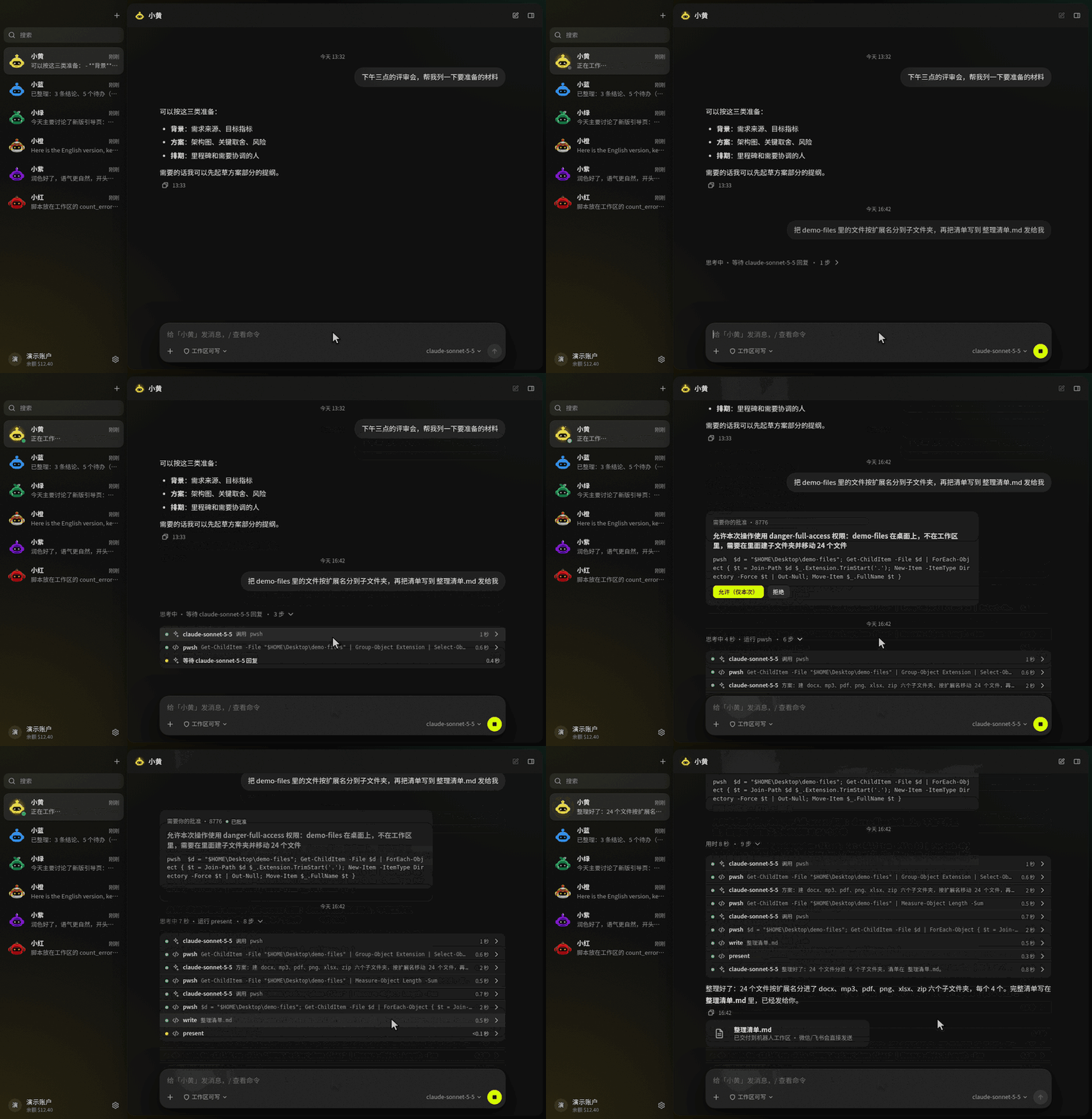
Demo: the bot tidies a folder and asks before moving files

Honest limits: it's young (v0.1.x). Models are pay-per-use through a hosted model service, so prompts, file contents and tool results needed for an answer leave your machine to the model vendor you pick; the README is explicit that local-first isn't an absolute security claim. Which features work depends on the model, OS and permissions you grant, and macOS computer use is still Beta.

Feedback on the permission model especially welcome — what would you want a desktop agent to always ask about?

13
14


The title is not a joke. For those of you who know Sentry, you know we’ve been giving back to Open Source maintainers since our early days in whatever ways we could. But around five years ago we really started to give in a more meaningful way. This year we increased our budget from $750,000 to $1,000,000.

15


D.eSystem 6.1.8.5 introduces a new debug platform for FAT32 on D.eSystem,D.eSystem 6.1.8.5 also fixes a major bug (for example,when you go in older versions in D.eSystem info and press a random key,it just closes automaticly,now there comes a warning and it closes in 5 seccond.)

Find more about D.eSystem 6 here: https://github.com/D-electronics-scratch/D.eSystem_6

Find D.eSystem 6.1.8.5 here: https://github.com/D-electronics-scratch/D.eSystem_6/releases/tag/v.6.1.8.5

16


New features

Conversion: Add support for reading images in the JPEG XL format
Conversion: Add support for CSS Level 4 selectors
Edit book: Check book: Add a check for dangling ARIA references and update ARIA references when auto fixing invalid ids
Closes tickets: 2170895

MOBI/AZW3/PDB Output: Speed up compression, making conversion to these formats faster
Content server/E-book viewer: Honor the prefers-reduced-motion setting of the operating system
Speed up adding books and starting calibre in large libraries with the Tag browser hidden
Catalogs: Use calibre as the creator of generated catalogs and record the generation date as the publication date
Closes tickets: 2022353

Create your own Adventure: Improve the character selection screen

17


Transmission 4.1.4 has been released today as the fourth maintenance update to the latest Transmission 4.1 series for this popular open-source BitTorrent client, a bugfix release that fixes various issues.

Coming almost four months after Transmission 4.1.3, which was a small update fixing a CORS bug that leaked the anti-CSRF nonce, a use-after-free bug in peer code, and a build error when compiling with fmt 12.2.0, the Transmission 4.1.4 release hardens the torrent-add RPC method against malformed requests.

Transmission 4.1.4 also fixes a regression introduced in Transmission 4.1 that could cause torrents with zero-byte files to be handled incorrectly, which could sometimes cause downloaded progress to be lost, and fixes a rare bug that could leave Transmission hung but running on it is closed.

This release also addresses a rare bug that could prevent downloading webseeds from finishing, a bug where setting TR_CURL_PROXY_SSL_NO_VERIFY broke origin server SSL verification, and a build failure that happened when building Transmission with -Wnull-dereference -Werror in GCC 12.15.

On top of that, Transmission 4.1.4 unifies launch and delegation between the Qt and GTK clients. According to the devs, if either is already running and then you or a browser’s MIME-type handler tries to start the other to add a new torrent, that new torrent will get handed off to the pre-existing session.

The GTK client has been updated to allow the torrent list to re-sort and re-apply its filter when the torrent’s top folder’s name changes, open the correct folder when a single-file torrent uses a directory structure when opening a torrent’s folder, and correctly show the app icon on some desktops.

The Qt Client received improvements to the UI code to use less CPU, the Web client received a fix for a display bug that sometimes listed torrent names as ‘Unknown’, while the macOS client was patched against a potential RCE vulnerability that requires local write access to the user’s preferences.

Last but not least, fixes a bug in transmission-remote that broke the --list-groups argument. Check out the release notes on the project’s GitHub page for more details, where you can download Transmission 4.1.4 as a source tarball if you fancy compiling it from sources.

18


LibreOffice continues to enjoy strong demand following the release of version 26.8 in August. According to new figures from The Document Foundation, the open-source office suite recorded 9.4 million downloads over eight weeks, from August 24 to October 18, averaging more than one million downloads per week.

Even more impressive, LibreOffice’s total downloads for 2026 have already surpassed the entire 2025 figure, with ten weeks still remaining in the year.

The latest numbers follow the record-breaking first week of LibreOffice 26.8, which saw 1,031,162 downloads shortly after release. Before the announcement, weekly downloads were slightly below one million but have remained above since.

And those 9.4 million downloads don’t tell the whole story. TDF explains that Windows updates are counted separately, as are downloads of older LibreOffice versions, which also continue to attract considerable interest.

To provide a broader picture, the foundation shared website traffic statistics for the same period. The main download website recorded 11.4 million visits, the Windows update website received about 90 million visits, and the site serving older LibreOffice releases registered nearly 39.7 million visits.

Of course, these figures represent website visits rather than actual downloads or installations, so they shouldn’t be added to the reported 9.4 million total.

As for what’s driving the growth, TDF acknowledges that it cannot provide a definitive answer. Since LibreOffice downloads are anonymous, the organization has no reliable way to determine exactly why more people are choosing the software.

“We like to think that the consistency of the LibreOffice project – which has been championing the concept of digital sovereignty and standard document formats for years – and the robustness of the software, which has never sought to be a clone of the most widely used office suite on the market but has always strived to forge its own path, are two very important factors that, in the long term, represent a significant advantage over all other products.”

Whatever the reasons, the numbers are impressive. This suggests interest in LibreOffice remains strong well after the initial excitement around version 26.8. And with more than two months left in 2026, the project is on track to finish the year with substantially more downloads than in 2025.

19


A bit of a surprise, really, Wine is making its way to OpenBSD. An experimental port has been submitted, and early testing shows it can already run dozens of 64-bit Windows apps (including quite a few games).

The announcement comes from OpenBSD developer Thomas Frohwein, who made the proposed port public on the OpenBSD mailing list and describes it as possibly the most surprising port proposal of the year.

As Frohwein makes clear, getting Wine to work on OpenBSD has been a team effort with the bulk of the work being done by Andrii and Fabien. The biggest hurdle has been the %gs segment register. Wine needs this, but OpenBSD doesn’t allow applications to set GSBASE directly.

The breakthrough was a software workaround which uses the %gs prefix to generate the instructions, circumventing a major compatibility issue which had previously made getting Wine onto the OS so difficult.

The results are already very impressive. The dev team has successfully tested a good number of 64-bit Windows apps, and most run quite nicely. Even more surprisingly, a recent remaster of The Witcher 3 appears to run quite well (though again you do need to install vkd3d-proton to get the D3D12 via Vulkan to work).

Frohwein also posted links to screenshots and gameplay recordings to show off the progress. He pointed out that the gameplay in the recordings may look a bit less smooth than it actually is, as they were recorded directly from the system using FFmpeg.

Of course, there are still limitations. The biggest one is that WoW64 (Wine’s compatibility layer for running 32-bit Windows apps in a 64-bit environment) doesn’t currently work. The OpenBSD port is therefore limited to 64-bit Windows software.

The built-in Wine test suite is also disabled for now. Some of the tests need access to the X server, and some just hang (though the developers have not seen this in their own real-world testing with a large number of games).

For anyone wanting to play around with the port, Frohwein recommends starting with the 64-bit version of Notepad++ (a fairly light Windows app). He also suggests running Wine under a separate unprivileged user account until additional security restrictions can be implemented.

Importantly, Wine has not yet been officially accepted into the OpenBSD ports collection. The current submission is a work in progress which is being proposed for testing, feedback and review by the OpenBSD developers.

Still, given OpenBSD’s very strict security model and the technical difficulties of the task, getting Wine to run modern Windows apps and indeed some of the more demanding games is a significant accomplishment. If it does eventually make it into the official collection, it would go some way toward extending the range of software available to OpenBSD users.

For more details, see Frohwein’s announcement.

20


The PHP development team has released emergency security updates addressing two critical vulnerabilities that could allow unauthenticated attackers to execute arbitrary code on affected web servers. The fixes are available in PHP 8.5.12, 8.4.27, 8.3.36, and 8.2.35. Administrators are strongly urged to upgrade immediately.

Both vulnerabilities, tracked as CVE-2026-109618 and CVE-2026-109619, carry a severity rating of 9.2 under CVSS 4.0. They affect PHP installations handling web requests, including those running PHP-FPM, Apache with mod_php, php-cgi, FrankenPHP, and LiteSpeed.

According to the official PHP security advisory, the highest risk is associated with Apache’s mod_php configuration, where researchers have demonstrated that an unauthenticated request can trigger an attack before any application code executes.

The first vulnerability, CVE-2026-109618, involves memory corruption during out-of-memory handling. Under certain conditions, PHP can interrupt request processing while internal structures are only partially initialized, potentially causing subsequent cleanup operations to access invalid data.

The second, CVE-2026-109619, concerns stale global state. Memory belonging to a previous request can be freed while references to it remain accessible, allowing a later request handled by the same worker process to interact with invalid memory.

Importantly, exploiting these vulnerabilities does not require a vulnerable PHP application or a publicly accessible file-upload feature. The problems originate in PHP’s internal request processing, making them particularly concerning for administrators hosting otherwise properly maintained applications.

Debian has moved quickly to address the vulnerabilities. The project issued DSA-6574-1, confirming that Debian 13 “Trixie” users can upgrade to PHP 8.4.27-1deb13u1. Debian 12 “Bookworm” has received PHP 8.2.35-1deb12u1 in its security repository, with both fixes explicitly listed in the package changelog.

The severity has also prompted an official warning from Arch Linux, which urges administrators running publicly accessible PHP applications to immediately upgrade to php 8.5.12 or php-legacy 8.3.36, depending on the installed package.

AlmaLinux technical steering committee has also approved releasing these fixes ahead of Red Hat and CentOS Stream. Patched packages are expected to reach testing repositories later today, followed by production repositories once testing is complete.

For other Linux distros, administrators should check their repositories for updated PHP packages. Distribution maintainers and long-term support vendors received the patches in advance to prepare security updates, including backported fixes where applicable.

PHP 8.1 and older versions are no longer supported by the upstream project, although some distributions may continue providing security patches. PHP 8.2, meanwhile, is approaching its end of life on December 31, 2026.

The PHP team also emphasizes that there are no complete workarounds for these vulnerabilities. Disabling session.upload_progress.enabled and restricting request sizes may reduce exposure to some attack paths, but these measures do not address every exploitation scenario.

Administrators should install the appropriate security update as soon as possible, and restart affected PHP workers or services to ensure the corrected code runs.

21


The LiberNT project is working on an alternative implementation of the Windows NT architecture, using Windows 11 version 24H2 as its compatibility reference. Unlike Linux distributions, LiberNT does not use the Linux kernel. It builds on the ReactOS codebase while replacing and extending several core components.

One of the project’s main priorities is ARM64 support, particularly for single-board computers and embedded devices. LiberNT also supports x86-64 and 32-bit x86, while RISC-V 64-bit and PowerPC ports are under development.

According to the developers, the implementation follows a clean-room approach. Windows behavior is studied using Microsoft’s public documentation, SDK and WDK headers, public symbols, and black-box testing. The team states no proprietary Windows code is copied or transcribed.

On the technical side, one of the biggest changes is NVS, a new memory manager and kernel pool implementation replacing the corresponding ReactOS components. LiberNT also introduces a new cache manager, with developers claiming better results than the original ReactOS memory manager in their memory and cache benchmarks.

Other changes include a new NTFS driver, an updated StorPort implementation with NVMe support, USB xHCI and SD bus drivers, and work on the Windows Display Driver Model and Desktop Window Manager.

On the application compatibility side, LiberNT implements WoW64 on its 64-bit targets, while ARM64 systems use the FEX emulator to run x86 applications. ARM64EC support is also part of the project.

Early compatibility results are already available on the project’s compatibility page. According to tests published by the developers, Google Chrome, the open-source strategy game 0 A.D., and Command & Conquer: Yuri’s Revenge are reported to work. Steam is listed as usable, while the RPCS3 PlayStation 3 emulator currently starts but has not been classified as usable.

However, the compatibility database contains only five entries, all tested against a specific development build.

LiberNT also targets Raspberry Pi hardware, with the same ARM64 disk image designed to boot on Raspberry Pi 3, Raspberry Pi 5, and generic ARM64 virtual machines running under QEMU. The project includes drivers for Raspberry Pi display, networking, and audio hardware.

For those interested in trying it, the developers provide downloadable builds in three formats: a preinstalled raw disk image, a VHD image for virtualization platforms, and a bootable installation ISO. The preinstalled image is recommended, with support for both UEFI and BIOS booting.

Still, LiberNT remains a work in progress. The developers caution that the available builds are experimental and should be used in virtual machines or on spare hardware rather than production systems. The source code is available on GitHub.

22
23


License: MIT

I couldn't find any app in the stores that tracked allergy levels based on location, even an approximate one, so I built my own.

It shows 15 types of pollen for wherever you are in Italy. Forecasts come from Open-Meteo (CAMS) and real measurements from ISPRA, and next to each value the app tells you which of the two it is, or if it's just an estimate.

There's a symptom diary that takes a few seconds a day. After a while it shows which pollens match your worst days, and you can export it as a PDF for your allergist. It also has alerts and a home screen widget.

No account, no ads, no trackers, and it doesn't need Google Play Services.

The app is only in Italian for now, since the data only covers Italy.

APK: https://github.com/lorenzocaputodev/allergy_radar/releases/latest
Source: https://github.com/lorenzocaputodev/allergy_radar

24


Hello everyone, I got a lot of feedback for my old github repo, a lot of peaple said that the structure is bad and its a mess,thats why I decided to use an old private unused repo as a new D.eSystem 6 repo, I added D.eSystem 6.1.8 with the tag v.6.1.8 and I commited the source code to the main branch. I also added a third party code notice for the Limine bootloader and for the original Limine C template which just drar a colorful screen,my kernel and all the programms and features are build by myself,but I added a notice for Limine. I will use this new repo for fututre releases like D.eSystem 6.1.9 for release tags and commits. Thanks for the feedback with the old github repo:) Here is the new repo: https://github.com/D-electronics-scratch/D.eSystem_6 The D.eSystem 6.1.8 release tag: https://github.com/D-electronics-scratch/D.eSystem_6/releases/tag/v.6.1.8

25


Every system listed below is open source and not powered by Linux. Each has an ISO or installer you can boot today, and many of the picks can even run Linux applications.

Think of it as a list of operating systems that are friends with Tux but not friendly enough to call him inside for a cup of tea.

This list is not ranked.

Vinix

If you own an Apple Silicon MacBook and want a system that is neither macOS nor a Linux distribution, Vinix is aimed at you. Only the original M1 is supported today, and Alexander Medvednikov, the author of V, maintains the project.

The kernel is monolithic and written mostly in V, while part of it is C and assembly. Because memory is managed by hand, no garbage collector can interrupt a system call, and the security model borrows certain concepts from OpenBSD.

On ARM64, it runs Alpine Linux binaries natively, and pkg installs packages from Alpine's aarch64 repositories. ISOs for both x86-64 and ARM64 are available for virtual machine use.

A good pick if you enjoy poking at experimental kernels.

Asterina NixOS

Trying Asterinas NixOS means setting up a NixOS system and finding a Rust kernel where Linux should be. Asterinas is that kernel, and because it implements Linux's system call interface, apps for the Linux platform run on it.

The distribution is configured through Nix like regular NixOS, and unsafe Rust is allowed only inside a small framework called OSTD, while the rest of the kernel, along with its drivers, is safe Rust.

x86_64 is the fully supported platform, and ARM64 and RISC-V sit one tier below it. The project says the distro is not ready for production use and aims the installer ISO on GitHub at early adopters and enthusiasts.

A good pick if you follow the implementation of Rust in operating systems.

Redox OS

Where Asterinas swaps Rust in under NixOS, Redox OS builds the whole system from scratch in Rust. It’s a Unix-like OS with a microkernel design, and Jeremy Soller of System76 created and maintains it.

You get the Orbital desktop, a pkg package manager, and several apps from System76’s COSMIC desktop. Linux and BSD software has gotten much easier to port too, and the project has recently been focusing on making Redox boot reliably on real hardware, not just in a virtual machine.

A good pick if you want to see how far a pure Rust operating system has come

FreeBSD

FreeBSD is a complete operating system derived from BSD, the Unix version developed at the University of California, Berkeley. A large community maintains it, and its license lets companies keep their own changes private.

ZFS, jails, and a hypervisor sit at the center of what it offers. OpenZFS is built into the base system, and boot environments let you roll back a bad update by snapshotting the system first.

Its recent release, FreeBSD 15.1, came out earlier this year, and the OS runs on hardware platforms like AMD64, AArch64, Armv7, PowerPC, and RISC-V.

A good pick if you run servers, storage, or networking gear.

GhostBSD

GhostBSD is FreeBSD with the desktop work already done. The project pairs a FreeBSD base with the MATE desktop and offers a set of applications that make users feel familiar with using it.

The name started as shorthand for GNOME hosted by FreeBSD. MATE, the desktop it ships today, is a continuation of GNOME 2, and the old name still fits.

Updates arrive on a slow-rolling schedule, and the project says it values a stable cycle over chasing the newest software the way some Linux distros do. The current release, 26.1-R15.0p2, came out in April on a FreeBSD 15.0 base.

Also good to know is that Linux binary compatibility comes preconfigured, and an installer built on OpenZFS keeps setup approachable for newcomers.

A good pick if you want FreeBSD as an everyday desktop.

Haiku

Haiku is an open source operating system inspired by BeOS that is aimed at personal computing. The same team writes the kernel and the desktop applications, with the project crediting that approach for the system's consistent interface.

Under that interface sits a kernel built for responsiveness, a system that is multithreaded throughout, and a BFS file system whose indexed metadata lets Tracker, the file manager, run database-style queries across a drive.

Software installs are handled via packages that mount into the system, and earlier states are kept for rolling back botched updates.

A good pick if you are looking for a uniform desktop experience.

ReactOS

ReactOS comes with a warning label attached because the OS is still considered alpha-level software, and the download page promises nothing about stability, the safety of your files, or whether it would work on your hardware.

Behind the warning is a full operating system with a Windows-style desktop that the project says was written from scratch, while most of its user-mode code is based on Wine, the ubiquitous compatibility layer.

By default, it installs only onto a FAT16 or FAT32 partition, and Btrfs support is experimental.

A good pick if you want to see how far an open source Windows reimplementation can go.

FreeDOS

If you have old DOS games, legacy business software, or a BIOS flashing tool that won’t run anywhere else, FreeDOS is the one to grab. It’s a complete MS-DOS compatible operating system, started by Jim Hall in 1994 and still maintained today.

It runs on everything from an original 8086 to a modern PC, though newer machines need legacy BIOS mode or UEFI with legacy boot turned on. The requirements are tiny too: 640 KB of RAM and about 20 MB of disk space for a basic install.

You get a Live CD, a USB installer for real hardware, a Legacy CD, and even a floppy edition. I’d start with the Live CD in a virtual machine, which is also what the project recommends for most people.

A good pick if you want to run DOS games and legacy software on real hardware.

KolibriOS

KolibriOS is an operating system small enough to fit on a floppy disk. Which sounds weird because no modern computer comes with floppy disk anymore. Even CD drive are rare these days.

But then, the KolibriOS is not meant for modern computers anyway. You need just an i586 processor, 12 MB of RAM, and a few megabytes of disk space. It doesn’t follow POSIX either, so don’t expect to port your Unix tools over.

The kernel and drivers are written entirely in FASM assembly, which is why it boots to a GUI in seconds and opens apps almost instantly.

Despite its tiny size, you get a text editor, an image viewer, a graphics editor, a web browser, and over 30 games. It fully supports FAT12/16/32 and can read NTFS, exFAT, and ext2/3/4 partitions.

The project is still very active, so worth considering it in your retro tool kit.

A good pick if you are into retro computing or if you want to keep the 90s computer alive.

A suggestion

Try these operating systems in a virtual machine before switching. I say that because it’s a good habit to test out such non-standard pieces of kit before committing to them on your hardware.

First see what works for you. Then see if your workflow and usage habits align with what the OS offers. Once you settle on one, keep it updated so you never miss critical patches.

Air-gapped setups are better protected from such risks, of course.

view more: next ›