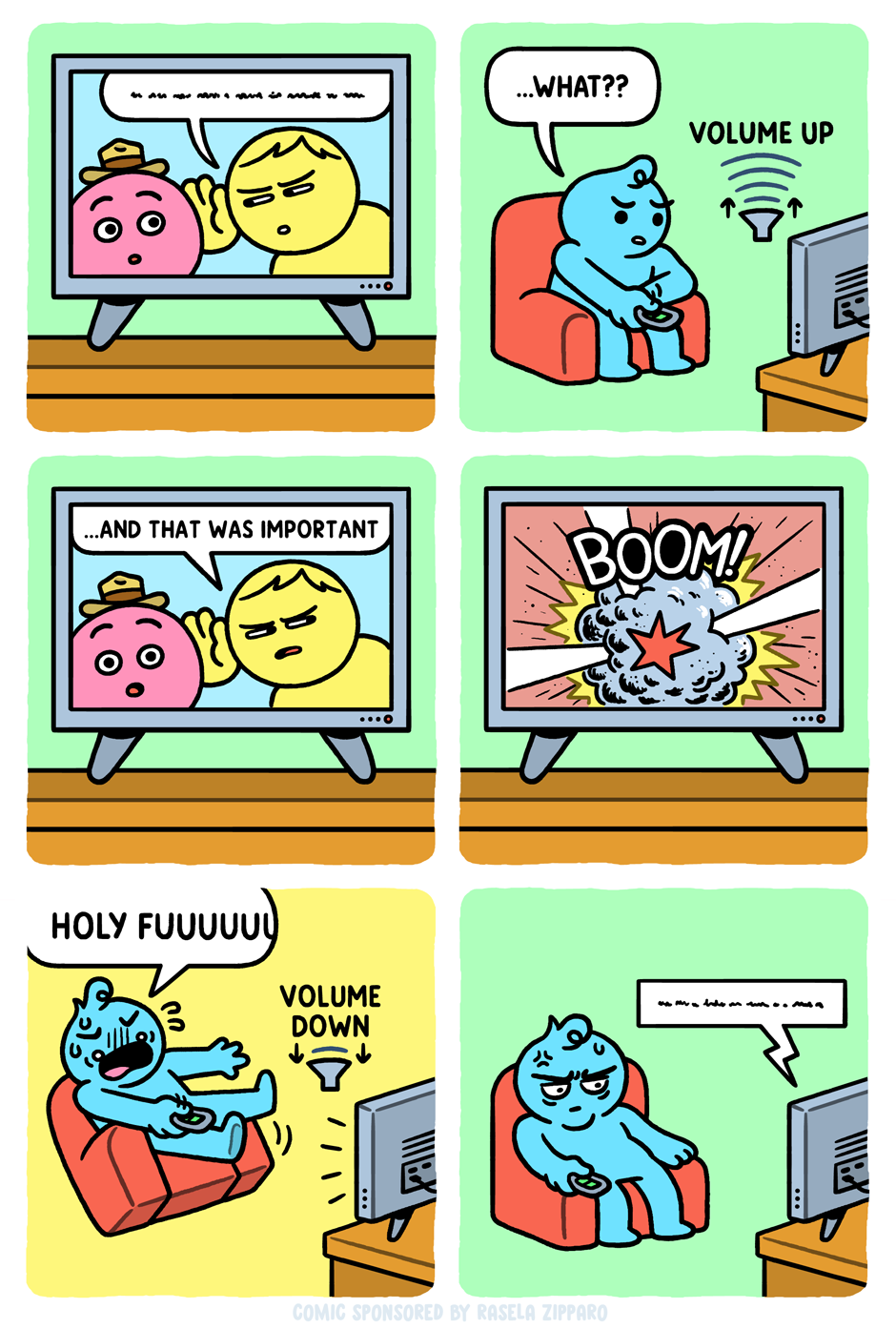
(insert lengthy explanation and complaint about compression and audio mixing here)
post
I had this with ads. It made me hate whatever product they were advertising.
This is because Reptilians don't have human ears, and can't tell how to balance audio correctly
The ad people explained that they do not mess with the volume! It's that "movies have soft and hard sound pieces and ads have more hard sound pieces." To me, that sounds like they mess with the volume and know it.
It's compression. (As in audio processing not data storage) Loudness is a perception thing. Pure decibels don't tell the whole story about how your mind perceive audio.
It's the same principle as the "loudness wars" in music.
Audio equipment still has upper limits, but music is produced to sound louder.
This is also why modern standards of measuring loudness is more complex.
But in the end this is sort of just being pedantic. Yes commercials make their stuff sound really loud and will always push up against what ever limit you put on it.
Movies and TV shows care more about quality of audio and dynamic range (that's is sort of the issue made funny in the comic above, when your equipment is unable to create audio clarity at the full dynamic range something is made for)
Actually quite a few TVs, soundbars, and audio receivers have a "night mode or quiet mode" that will compress or limit the dynamic range of what you are watching to avoid this scenario
(Yes I know... I'm ruining a perfectly good funny comic :P )
I once converted all my mp3 songs to the same loudness by scaling based on RMS, it might not be %100 accurate as you said but to me it was perfect. I believe there could be a setting to squish that range by calculating RMS chunk by chunk and scaling them each, but instead they just add all kinds of stupid modes and settings
The fucking news is now lower volume than the ads.
Yeah i guess it is indeed kind of silly of us to expect humanity from inhuman things...
Subtitles!
TBF this always ends up with a lot of misplaced blame on the consumer
TV manufacturers decided/figured out long ago that Joe public cares more about a screen being thin, at time of purchase, than it having any semblance of audio quality. And they assume anyone who cares about audio will buy a set of speakers or (increasingly) a sound bar anyway, so they just need the bare minimum included.
This has gotten to the absurd point now where the speakers included in your average TV aren't much better than a particularly loud phone speaker.
It's basically impossible to get something that sounds even audible on those speakers, without doing what adverts do and compressing the shit out of the signal, which has the bonus of sounding loud and bad for everyone, there's no bringing the detail back that was squashed out. Movie studios aren't going to mix a movie that sounds bad on a system designed remotely properly (e.g. a cinema or reviewer's TV), so we're in the current situation.
The unfortunate situation today is you basically need some kind of separate speaker(s) with a TV because the manufacturers all have cheaped out across the board and don't include anything good enough any more. The consumer shouldn't be expected to know this and have to pay extra, the TV should come with speakers capable of producing audio properly.
I donβt even understand why they bother to include speakers in high-end TVs at all. Whoβs going to buy an >80β TV and then only have stereo sound. For movies sound is at least as important for the experience as the picture quality. No built in speaker system is ever going be good enough, itβs simple physics.
How much do you need to spend on a sound bar for something decently better, how much difference does it even make with a fairly cheap one?
Honestly you shouldn't need to break the bank at all to be better than the built in speakers in most cases. I don't want to say definitively because I'm sure there's some basically scam products out there, but pretty much any sound bar will be an upgrade in 99% of cases.
A quick search shows a number of well known brands with offerings under Β£100, and one from a company I don't recognise that apparently seems to have a number of positive reviews and available for Β£40
You'll obviously get a further improvement if you go above the budget level, but that's definitely not to say you can't get a decent improvement over not having one at all.
It's very weird how many pro audio people knowingly fail at their core job in this way
Maybe we should have more anti audio people? Go back to silent movies and show?
I will make a silent movie that isn't actually silent. It's just that the characters prefer not to talk
We are kind of on our way.
Half the time when I look up how to repair my dishwasher, the best video guide turns out to also be an intentional ASMR video to maximize attention.
(Okay, not really half, but that it happens at all is hilarious.)
As an autistic with a hypersensitivity to sound, I support this cause, as a someone surrounded by people love to interrupt unless they hear a sound coming from whom they're interrupting, I need to have SOME noise in the background and if it's not fitting the TV, it breaks the immersion :(
I always wondered this is it like a TV hardware thing or sound mixing or what
Most movies are mixed for a theater surround sound system. Remixing them for tv speakers is usually not worth the effort. Dialogue usually sits on the center channel while effects and music are spread across left, right and surround channels. A tv with stereo speakers canβt do much except mix all of that together and that makes it hard to hear the quieter parts.
If you watch a lot of movies, I recommend a soundbar or even better a 5.1 system. Itβs expensive but it mostly solves those mixing problems.
Will you please stop this rumour already? Most of the video I watch in my living room have 2ch audio. If anything it is still the guy who mixed the audio who's at fault.
And I have a Yamaha 5.1 AV receiver as well. Watching new movies with original surround sound sucks all the same.
What you are describing is what is supposed to happen. What actually happens is that big film studios ignore the center channel altogether. Instead choosing to mix the voice in 3D because cinema and IMAX and Dolby, etc. which honestly sounds extraordinary in those sound system. It is mostly because they are desperate to propose something that actually brings a competitive edge to theaters against home TVs and streaming. Instead of, you know, making good films. But that's beside the point.
What ends up happening is that your system's codecs and down mixers do what they are told they are supposed to do. Mix all channels together into stereo, with a tiny boost to the center channel on both sides. Easy, that should bring forward the dialogue, whoops! there's no dialogue in the center channel, it is all mushed all over the place over the other 4 channels and drowned out by the audio FX.
This is the reason some egregiously poorly dialogue mixed movies like Tenet and The Dark Knight Rises actually also sounded bad in mid to lower tier theaters. Those theaters were calibrated for exactly the way it was supposed to sound, with a strong center channel for dialogue and what is directly in front of the camera. But the audio isn't there, it is dispersed to a side in the other two speakers (this is done automatically now in mixing software, which doesn't help). The movie came with the flaw, and even if you have a good 5.1 channel audio at home, you can check for yourself, the dialogue is also hard to hear on those movies. Because it was shit from the beginning unless you hear it in an IMAX theater or have access to one of those 3D field Dolby Atmos 64 speaker systems that Nolan mixes on.
From what I heard it can be due to the audio mix used. Most content is set to a 5.1 mix or higher, and the majority of people still just use their 2.0 tv speakers. Sometimes you can pick the audio on some services and some may have a 2.0 option but i think its rare these days.
It isn't mixed for home theatre setups is the thing.
But you can easily enable Loudness Equalization in Windows to increase low volume sounds and decrease high volume sounds.
When someone left the TV on max volume and I load up Netflix whilst everyone is in bed.

And then suddenly an advert at a volume loud enough to ablate the skin right off your face
I swear by now there should be a media player that would have auto-balance build in. Nowadays i can't watch movie without a subtitle, i just can't subject myself with them merican can't pronounce word properly and bad audio balance.
I too dislike how other people pronounce things differently than I do.
VLC calls it Volume Normalization, it's great.
I think most of the players have this.
I remember one movie I tried watching that was exceptionally bad in this department. I want to say it was Interstellar from 2014? I gave up not long into it because it was just torture to watch.
Not familiar with that word?
Sorry, I should have written an actual sentence haha, but if you don't know the word it's probably not that movie.
I meant to convey something like "Tenet could be the movie you're thinking of. I know a lot of people were complaining about the audio mix when it came out."
Cheers!
Common complaint about Christopher Nolan films, of which interstellar is one
It is nutty the skill-gap that has opened up for audio engineers since talkies existed.
Large dynamic range is a good thing, in audio and video. There are a number of ways to reduce dynamic range, if you really need to. Expanding dynamic range after capture is possible, too, but more fraught.
Shannon information theory gives us ways to perfectly reconstruct the lower range version from an expanded range version, but it also guarantees that reconstructing the higher range version from a reduced range version cannot be perfectly accurate across all inputs. (Assuming a fixed output range capability.)
Large dynamic range is a good thing, in audio and video.
a good thing for accurately reproducing the original signal.
But many people watching a show at home would like to just watch the damn movie without anything being particularly loud or resorting to subtitles. Decent range compression achieves that. Applying information theory to a Sunday night movie is stupid.
I'm also here to support dynamic range. I don't want the volume "normalized", I want loud louds and quiet quiets.
A lot of people live in apartments or have kids. While I enjoy being able to listen to loud explosions and quiet whispers, it can make movie watching experiences miserable.
Get a decent pair of headphones then.
Then how does anyone else enjoy it
You've gotta compromise somewhere dude. Sound quality, neighbors' opinions of you, cost, solitude, something but there is no perfect answer here.
But there is. Having an audio range that isn't ridiculous, that allows you to hear whispers and not get your ear blown out by the louds. Unfortunately many movies don't do this, and for some reason you would rather compromise on someone else's comfort than even consider this?
There is a perfect answer. Don't watch movies with shitty sound mixing.
I used to mix audio for my garage band's albums in the 2000s. It's not that hard to get effective dynamic range without setting the quiet parts to barely audible and the loud parts to red lining the db meter. It's obnoxious.
If I ever meet the guy who mixed Malignant, I'm going to "accidentally" spill my coffee onto to his mixing station. I couldn't watch past the first scene. The mix was downright mean. That movie still pisses me off.
Then there should be a special setting for you. The rest of us normies hate the current state of affairs. Let me hear the dialogue, for fuck's sake.
I shouldn't have to request closed caption subtitles at the cinema because movie producers are wanking each other off about how you need high dynamic range.
I really think they need to produce 2 different mixes, since most cinemas I've been to, it's been awful in recent years.
There's already a solution to this. Limiters / compressors. TVs should have them built in as software with easy to use controls. Whenever I watch movies via VLC I turn the compressor on.
Modern filmmaking. I had this issue with Minority Report many years ago alredy. Now I mostly use headphones - so this isn't as pronounced, but it's still an issue

all 98 comments