top 97 comments

sorted by: hot top controversial new old
[–] 32 points 11 months ago (10 children)

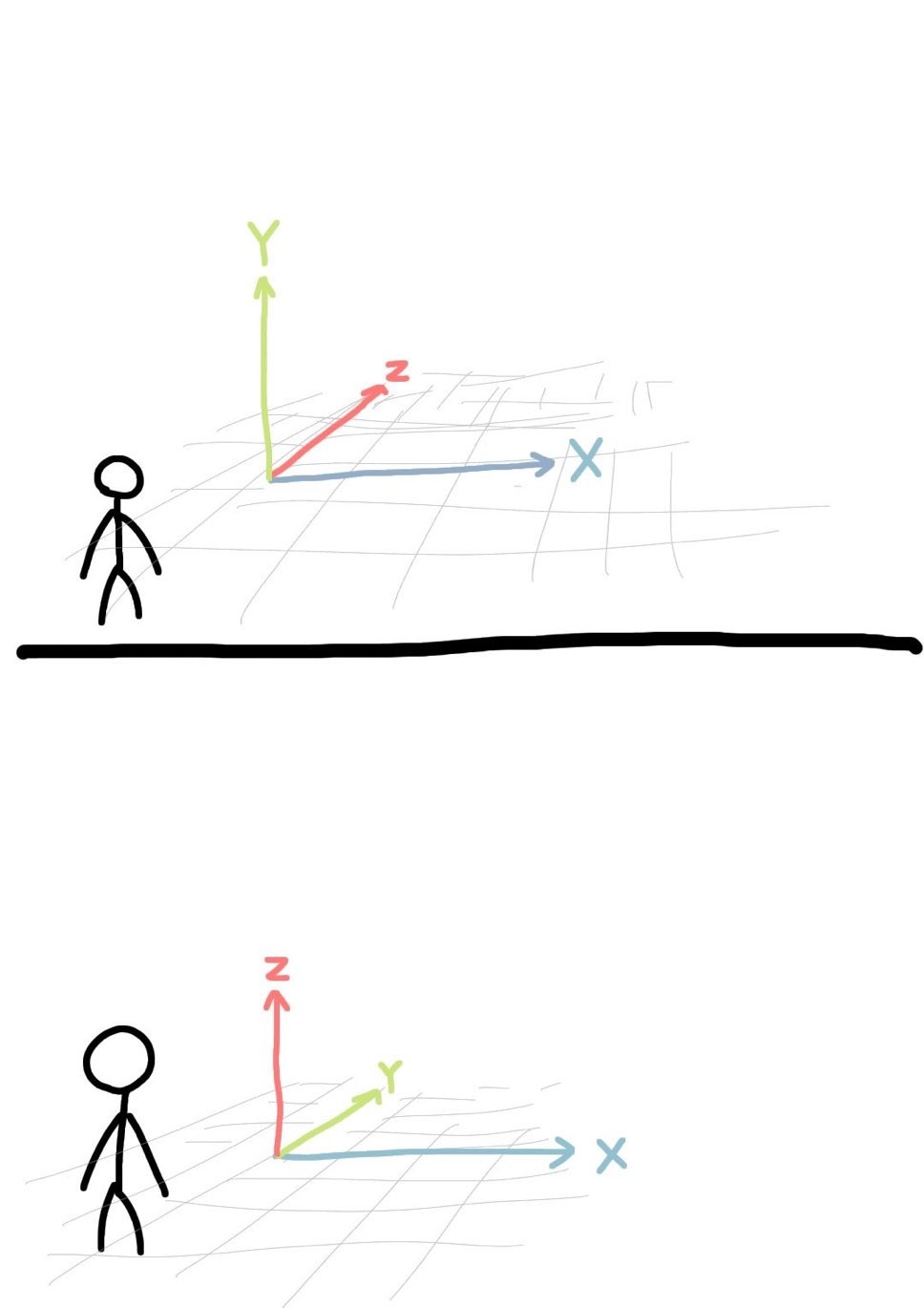
Z is elevation. Any real world application, z goes up down. 3D applications SHOULD use it for elevation. I despise that many do not. It's so fucking confusing. 2D, sure y go brrr. But once that 3rd dimension is added, y needs to take several seats and quit trying to take on dimensions it doesn't have any right to.

  • source
  • hideshow 10 child comments
  • [–] 7 points 11 months ago (4 children)

    Y-up sorta makes sense in games. Imagine a 2D platformer, Y is up and X is horizontal. Now add depth. Instead of flipping axis just use Z for depth.

  • source
  • parent
  • hideshow 4 child comments
  • [–] 5 points 11 months ago (1 child)

    But in top down 2D games you also use X and Y but now neither is up

  • source
  • parent
  • hideshow 1 child comment
  • [–] 1 point 11 months ago

    True but I think it’s also because of screen coordinates, Y is always the vertical axis in screen coordinates. So programmers translated that to 3D coordinates because in real world space the screen doesn’t lie flat but is up right. It’s probably why Y is up in OpenGL and calls the depth buffer the Z-Buffer.

  • source
  • parent
  • [–] 1 point 11 months ago (1 child)

    That's the core of my point though. Once you add depth it's not 2d space anymore (even though the screen is 2d, the represented field is 3D) and y becomes depth.

  • source
  • parent
  • hideshow 1 child comment
  • [–] 2 points 11 months ago

    It all depends how you perceive the XY plane. Like if your job involves blueprints than XY plane lies flat and horizontal then it makes sense that Z axis is height. Hence why engineering software is all Z-Up. If the XY plane is upright, like screen coordinates, then Z is depth. Hence why many software that is used to create content for the screen is Y-Up. Like Maya, Houdini, Unity, OpenGL etc.

  • source
  • parent
  • [–] 5 points 11 months ago (2 children)

    It makes more sense if you've ever drawn in CAD. Top view, x and y. Now side view, y and z or y and x. You look down on x and y, and if you are extruding you now create the z axis dimensions. For the people who draft on the side axis: you are true psychos (ok, unless you're using a lathe I suppose, or if the silhouette is more defined from the side... ok maybe not psycho, just odd)

  • source
  • parent
  • hideshow 2 child comments
  • [–] 3 points 11 months ago

    User look sideways at item on shelf. Designers look down on paper. Both viewpoints are needed for it to be a good object.

    Architects do both because they have all that math and something serious to prove.

  • source
  • parent
  • [+] 31 points 11 months ago (2 children)
  • [–] 25 points 11 months ago (2 children)

    Thanks to 3D printing Z is firmly “up” in my brain even if the modeler I use does it differently.

  • source
  • hideshow 2 child comments
  • [–] 16 points 11 months ago (1 child)

    If 2d, Y up, if 3d Z up.

    I always tough as inputs down, answer up. And usually, x is the variable y the result, or xy the variables and z the result

  • source
  • parent
  • hideshow 1 child comment
  • [–] 21 points 11 months ago

    In my brain Z is Up, Z is Height. In my job I have to deal with both all the time which is quite annoying.

  • source
  • [–] 19 points 11 months ago (5 children)

    In 2D Y is up, in 3D Z is up.
    X is always red🤷‍♂️

  • source
  • hideshow 5 child comments
  • [–] 38 points 11 months ago (7 children)

    I legit had no idea anybody actually used the upper system until now. I had to read the comments just to see whether the upper system was just some sort of joke. I am horrified.

  • source
  • hideshow 7 child comments
  • [–] 21 points 11 months ago* (last edited 11 months ago) (1 child)

    It depends on how you view 2D->3D.

    If you're thinking of a side scroller like the original Super Mario, Y is up/down and X is left/right making the new dimention Z being forward/backward.

    However if you think of 2D space like the first LoZ, then Y is North/South and X is East/West making Z up/down

  • source
  • parent
  • hideshow 1 child comment
  • [–] 37 points 11 months ago (6 children)

    The top one is wrong because it violates the right hand rule.

  • source
  • hideshow 6 child comments
  • [–] 18 points 11 months ago (3 children)

    In a 2D game Y is up. Going from 2D to 3D would make sense to add another dimension forward to account for depth.

    However if you start with a map of a 3D surface then North is Y and East is X you'd add Z to account for elevation like everybody making maps would.

    I guess it depends on how you look at it.

  • source
  • hideshow 3 child comments
  • [–] 0 points 11 months ago (2 children)

    Yes, but please just make it follow the right hand rule...

  • source
  • parent
  • hideshow 2 child comments
  • [–] 86 points 11 months ago (33 children)

    Top one is incorrect. Z needs to point outwards.

  • source
  • hideshow 33 child comments
  • [–] 63 points 11 months ago (28 children)

    There are three kinds of people…

  • source
  • parent
  • hideshow 28 child comments
  • [+] 124 points 11 months ago (27 children)
  • [–] 16 points 11 months ago (2 children)

    Z up all the way because my 3d printer but why is Minecraft y-up D:

  • source
  • parent
  • hideshow 2 child comments
  • [–] 12 points 11 months ago (8 children)
  • [–] 3 points 11 months ago (5 children)

    That's...not the problematic part there, like at all.

  • source
  • parent
  • hideshow 5 child comments
  • [–] 2 points 11 months ago (4 children)
  • [–] 4 points 11 months ago* (last edited 11 months ago) (3 children)

    A left handed coordinate system is absolute blasphemy.

  • source
  • parent
  • hideshow 3 child comments
  • [–] 1 point 11 months ago (2 children)

    ah ! well. I don't use any of the programs that are left handed so I can't say I've ever had to struggle with I/O shenanigans, if that's what you're talking about. But you're leaving me guessing, so not sure what else I can say

  • source
  • parent
  • hideshow 2 child comments
  • [+] 5 points 11 months ago* (5 children)
  • [–] 10 points 11 months ago (4 children)

    Tradition, 3d videogames started doing it like that because of how computers worked 40 years ago, then devs got used to think about 3d space that way and it stuck. Essentially videogames think about visual depth. And yes, the physics engines for videogames usually account for that and use their own transformations of formulas because they are rarely simulating anything more complex than rigid body physics. Advanced simulations aren't any harder for devs, all the transformations are abstracted away with libraries.

    In the end they are just reference frames and up is whatever you want it to be. As Wikipedia puts it eloquently: “Unlike most mathematical concepts, the meaning of a right-handed coordinate system cannot be expressed in terms of any mathematical axioms. Rather, the definition depends on chiral phenomena in the physical world, for example the culturally transmitted meaning of right and left hands, a majority human population with dominant right hand, or certain phenomena involving the weak force.”

  • source
  • parent
  • hideshow 4 child comments
  • [+] 2 points 11 months ago (4 children)
  • [–] 4 points 11 months ago* (3 children)

    Not really. Youtuber Acerola has a great series on shader programming and dealing with negative numbers is a non-factor. The advantage of working with computers is that it abstracts that complexity away. You program with high level concepts, a dev rarely deals with direct calculations, unless they are actually writing the fundamental apis for it, like DX or Vulkan. Much less copy-paste formulas. It gets complicated fast, but the abstraction keeps it simple for the developer, like, the math is perhaps the easiest part of programming computer graphics.

  • source
  • parent
  • hideshow 3 child comments
  • [+] 2 points 11 months ago (2 children)
  • [–] 2 points 11 months ago* (1 child)

    It's okay. The equations have been done since a long time ago. Devs don't have to think about it much. Essentially, computer simulations already have their own body of math that you probably were not taught in physics, because they aren't relevant for real world physics study.

  • source
  • parent
  • hideshow 1 child comment
  • load more comments (-1 replies)
  • load more comments (-1 replies)
  • load more comments (-1 replies)
  • [–] 3 points 11 months ago (5 children)

    I'm not getting left handed vs right handed. Right handed means negative values go right? Why would anyone do that?

  • source
  • parent
  • hideshow 5 child comments
  • [–] 3 points 11 months ago

    Someone else was explaining how to tell left from right handed. Buy why is it important? If you do math and physics, you almost certainly would use a right hand system. That means all formulas are derived with that in mind. If you try to use them in the left handed system, you are going to have a horrible time trying to figure out which of all terms need to have their sign flipped.

  • source
  • parent
  • load more comments (-1 replies)
  • [–] 16 points 11 months ago* (2 children)

    I know Z as upward. X and Y were always on the base plane representing length and width. Z comes in being all like, "Now we're being 3D!"

    So wherever the "floor" is, represented with gridlines, boundary, canvas, etc. that's where they live. That is Flatland where there is no up or down. It is 2D where most of my work is. If you try tell me Y is Z, I'd ask "wtf is a Z?"

  • source
  • parent
  • hideshow 2 child comments
  • [–] 3 points 11 months ago (1 child)

    But what if instead of adding a third dimension by going UP, you add a third dimension by going FORWARD. Like a computer screen, X and Y coordinates are side-to-side and up-and-down. If you made a volumetric display by adding a third dimension to that, Y would be up and Z would be forward.

    I usually think of Z as up, because that’s how stuff based on the physical world usually works. But I can understand why some think of it with Y as up.

  • source
  • parent
  • hideshow 1 child comment
  • [–] 1 point 11 months ago*

    Third dimension isn't up, it's just not X or Y. We just say "height" or synonyms for it because we say "length and width" for X and Y, even though all axis are just length between vectors proceeding in order of being able to exist, X, Y, then Z.

    If you are plotting your perspective, it will run on entirely different coordinates to an object's coordinates, i.e. Camera vs Object stricture. But in most arts and all math, we tend to model the object and it's values which we create and assign to it as attributes, not with values of how it should look from various perspectives.

    I think that's the confusion. You could get used to the Z being treated as Y, but it's incomparable with everything else and you'd have to now confirm with other's that length and width are X and Z and extrusions from 2D plane are Y. This doesn't occur much anywhere else. This is the whole premise behind the meme. Arguing between standards when one is universal, the other is niche but those that have only learned the niche one are adamant the universal one is wrong.

  • source
  • parent
  • [–] 31 points 11 months ago (3 children)

    One of my friends and I used to always have this debate because of our different backgrounds. I got used to +Y being up because of doing physics for several years and seeing side-on diagrams that needed to account for gravity. My friend has a background in geology, so he's used to top-down surveying maps where +Z is up. It all depends on your perspective.

    But my way is right. We need to have standards, people.

  • source
  • hideshow 3 child comments
  • [–] 13 points 11 months ago (1 child)

    X is up, there now no one is happy.

  • source
  • hideshow 1 child comment
  • [–] 13 points 11 months ago (2 children)

    The second fellow is a machinist, like me.

  • source
  • hideshow 2 child comments
  • [–] 12 points 11 months ago (1 child)

    I'll leave this here for context (bottom right is the only sane one)

  • source
  • hideshow 1 child comment
  • [–] 11 points 11 months ago
    [–] 22 points 11 months ago (4 children)

    Yeah... As a Blender 3D artist, Z axis has been baked into my brain as the up/down axis.

  • source
  • hideshow 4 child comments
  • load more comments
    view more: next ›