you are viewing a single comment's thread
view the rest of the comments
[–] 16 points 11 months ago* (2 children)

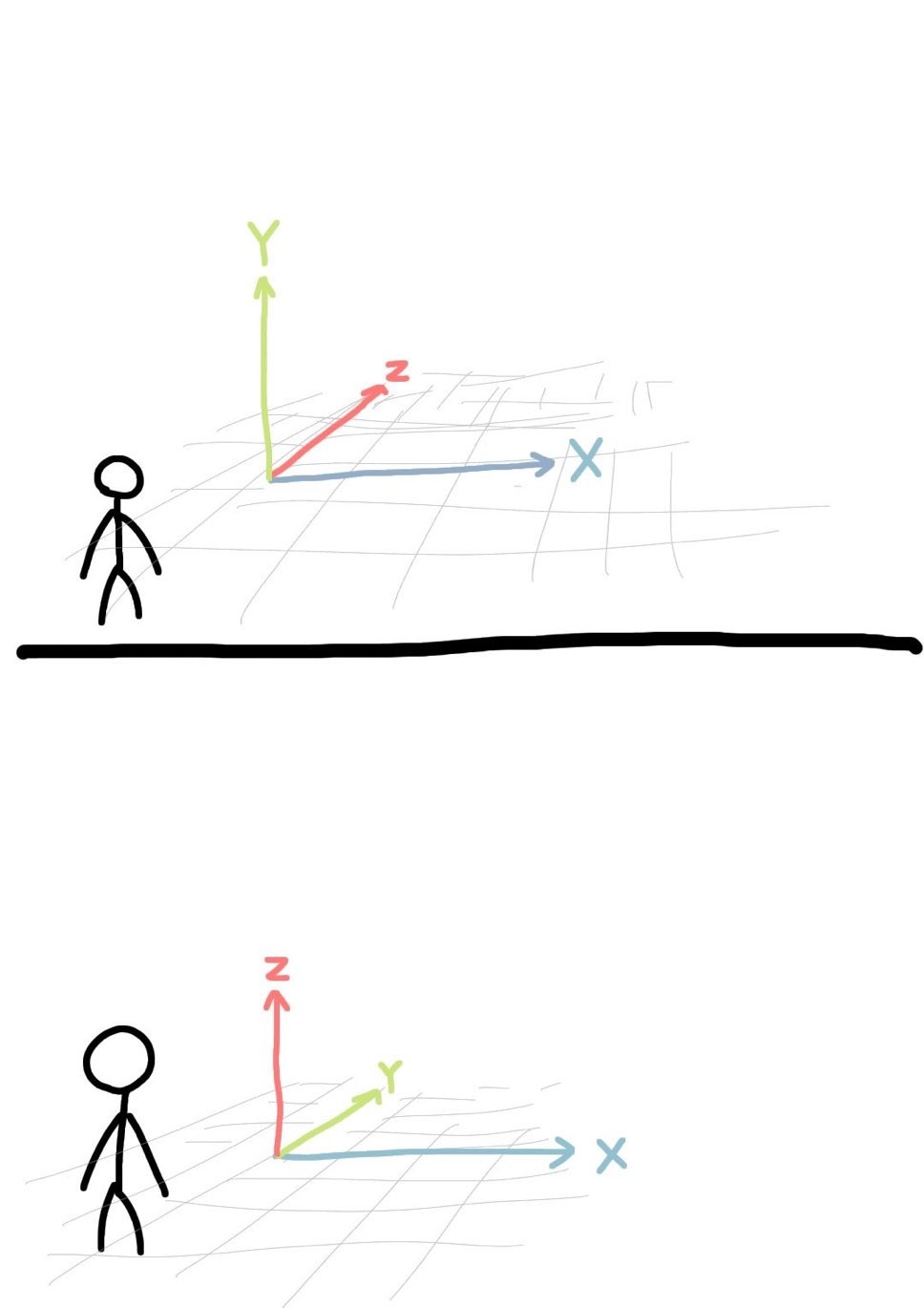
I know Z as upward. X and Y were always on the base plane representing length and width. Z comes in being all like, "Now we're being 3D!"

So wherever the "floor" is, represented with gridlines, boundary, canvas, etc. that's where they live. That is Flatland where there is no up or down. It is 2D where most of my work is. If you try tell me Y is Z, I'd ask "wtf is a Z?"

  • source
  • parent
  • hideshow 2 child comments
  • [–] 3 points 11 months ago (1 child)

    But what if instead of adding a third dimension by going UP, you add a third dimension by going FORWARD. Like a computer screen, X and Y coordinates are side-to-side and up-and-down. If you made a volumetric display by adding a third dimension to that, Y would be up and Z would be forward.

    I usually think of Z as up, because that’s how stuff based on the physical world usually works. But I can understand why some think of it with Y as up.

  • source
  • parent
  • hideshow 1 child comment
  • [–] 1 point 11 months ago*

    Third dimension isn't up, it's just not X or Y. We just say "height" or synonyms for it because we say "length and width" for X and Y, even though all axis are just length between vectors proceeding in order of being able to exist, X, Y, then Z.

    If you are plotting your perspective, it will run on entirely different coordinates to an object's coordinates, i.e. Camera vs Object stricture. But in most arts and all math, we tend to model the object and it's values which we create and assign to it as attributes, not with values of how it should look from various perspectives.

    I think that's the confusion. You could get used to the Z being treated as Y, but it's incomparable with everything else and you'd have to now confirm with other's that length and width are X and Z and extrusions from 2D plane are Y. This doesn't occur much anywhere else. This is the whole premise behind the meme. Arguing between standards when one is universal, the other is niche but those that have only learned the niche one are adamant the universal one is wrong.

  • source
  • parent