top 98 comments

sorted by: hot top controversial new old
[–] 260 points 3 months ago (24 children)
  • [–] 107 points 3 months ago (10 children)

    How am I still learning about XKCDs I've never seen especially ones in the 1000 range.

  • source
  • parent
  • hideshow 10 child comments
  • [–] 75 points 3 months ago (6 children)

    Congrats on being one of today's lucky 10,000!

  • source
  • parent
  • hideshow 6 child comments
  • [–] 43 points 3 months ago (3 children)

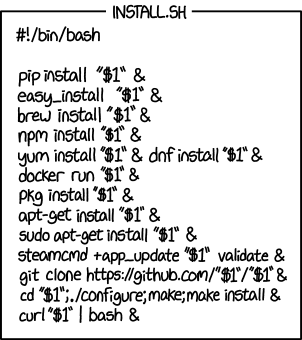
    if $1 is not installed after that, wipe your hard drive and start over

  • source
  • parent
  • hideshow 3 child comments
  • [–] 25 points 3 months ago (2 children)
  • [–] 18 points 3 months ago (1 child)

    Script needs to be updated, Rust wasn't particularly popular back then (if it existed. I don't know how old this one is, but it's pretty old)

  • source
  • parent
  • hideshow 1 child comment
  • [–] 4 points 3 months ago (5 children)

    With all those connected with & won't it skip the rest after the first failure? Or does 'no such program' or 'you don't have permission' not produce an error?

  • source
  • parent
  • hideshow 5 child comments
  • [–] 10 points 3 months ago (1 child)

    In bash, & just starts the program in the background, so all of the commands are run in parallel. You're probably thinking of &&, which runs the command on its left, checks its return code, and then decides whether run the command on the right.

    Although, in this case there are no 'commands on the right' since all the commands are on separate lines. You'd need to backslash the commands together, something like

    pip install "$1" && \
    easy_install "$1" && \
    ...
    
  • source
  • parent
  • hideshow 1 child comment
  • [–] 93 points 3 months ago (25 children)

    Is this satire or is it from a real project O_O?

  • source
  • hideshow 25 child comments
  • [–] 96 points 3 months ago (8 children)
  • [–] 38 points 3 months ago (2 children)

    This is... uh...

    It reads like the author doesn't know what containers are. Because this is actually a great use case for containers unless I'm missing something.

    Now, do I want reverse engineering software from someone who in 2026 doesn't know of a better way to manage dependencies than "tell AI to install everything"? Not particularly lol

    Also:

    Install Eclipse Adoptium 21: https://adoptium.net/temurin/releases/?version=21

    It's Eclipse Temurin not Eclipse Adoptium. And why not install from distro repo?

    Install from https://cmake.org/download/

    Also why not from distro repo?

    Install Visual Studio 2022, or apt install build-essential / xcode-select --install

    NOW distro repo is fine, but only if you use an APT based distro?

    and then 3 more dependencies it tells the agent to install from websites.

    The weirdest thing is you can get much better results from AI. I'm 99% sure this person gave the AI particularly bad instructions to generate the install instructions, or used a cheap, crappy model.

  • source
  • parent
  • hideshow 2 child comments
  • [–] 11 points 3 months ago (1 child)

    I think it's written that way because the instructions are meant to work on Windows too. But it still doesn't make much sense. I think just saying "Install CMake" and letting the agent figure it out for the current environment would be a much better approach.

    Also, I think the model they were using was working with outdated data. Why specifically require Java 21 when Java 25 is the latest LTS? And furthermore, why even link to a specific JDK implementation when it surely works with almost any implementation? Probably just makes the agent install the Temurin implementation even if the system already had a working java.

    My point being if the author's idea is to let AI handle the installation to avoid writing environment-specific instructions, it shouldn't then have these hardcoded assumptions about the environment. So yeah, it seems they (and the AI that wrote it) didn't really know what they were doing.

  • source
  • parent
  • hideshow 1 child comment
  • [–] 37 points 3 months ago (2 children)

    It is a self-contained runbook with explicit verification gates at every step — preflight checks, building libghidra, installing the LibGhidraHost Ghidra extension, building ghidrasql, and a first live query. Hand it to your agent and let it drive the install; intervene only if a gate reports a failure.

  • source
  • parent
  • hideshow 2 child comments
  • [–] 12 points 3 months ago (2 children)

    it's real, and not uncommon in AI projects. for example, in Hermes, to setup ComfyUI to work with it, you literally just prompt "setup comfyui" and it handles the install and configuration, including downloading any models you want.

  • source
  • parent
  • hideshow 2 child comments
  • [+] -61 points 3 months ago (12 children)

    I bloody hope the whole post is satire but given the anti-ai groupthink on lemmy, fuck knows!

  • source
  • parent
  • hideshow 12 child comments
  • [–] 47 points 3 months ago (10 children)

    Yes, it is the people who are against the corporate AI offerings who are guilty of groupthink, not me!

  • source
  • parent
  • hideshow 10 child comments
  • [–] -5 points 3 months ago (4 children)

    To be fair, there are local agentic models.

  • source
  • parent
  • hideshow 4 child comments
  • [–] 10 points 3 months ago (3 children)

    I dont think local agentic models address the ethical and environmental concerns I have with the training - but its better than the corporate offerings :)

  • source
  • parent
  • hideshow 3 child comments
  • [–] -2 points 3 months ago* (last edited 3 months ago) (2 children)

    Hey guy/gal/genderfluid pal, the cat is out of the bag. Either we embrace it for what it can do in a much more sustainable way, or we let corpos redefine sustainable.

    Is this a good use case? No. But most use cases, I’d rather have a local agent running on my own hardware being offset by solar, than using a corpo offering.

  • source
  • parent
  • hideshow 2 child comments
  • [–] 3 points 3 months ago (1 child)

    Please don't call me man :)

    The cat is "out of the bag" on consuming meat and dairy, plenty of people manage to survive and thrive without em, without much effort at all. I'd personally rather use no LLM than use a local agentic model with poor ethics/environmental impact of its training, even if the latter is better than corpo offerings.

    As I alluded to, I'm much happier to see people using local agentic models. Even more so if they happen to be something like Pleias' approach, with lots of transparency about the data they were trained on. There's still the environmental concerns behind the resources consumed for the training, but it is about as good as one could hope for at this point if one insists on using LLMs.

  • source
  • parent
  • hideshow 1 child comment
  • [–] 2 points 3 months ago

    As you wish, wasn’t meant as a gendered ident so apologies.

    I’m actually not familiar with how much environmental damage is done by training vs using. My initial assumption was that training would be less, by many many factors, because it “happens once” while the usage is constant and scales with the number of users. But that is admittedly an assumption made out of ignorance.

    And to be clear, I’m not really trying to tell you you’re wrong, just trying to make my position clear since Lemmy is very anti AI in general.

  • source
  • parent
  • [+] -24 points 3 months ago (3 children)
  • [–] 51 points 3 months ago (4 children)

    Completely vibe-coded project it seems, even documentation. And yet:

    Human-Origin Source License

    Also love this:

    You may not, without prior written permission from the Author:

    - ship or maintain a modified version outside the contribution-purpose
      rules;
    - maintain a divergent private or internal fork;
    - port, clone, rebrand, or recreate the Covered Software;
    - create an API-compatible replacement, behavioral clone, competing
      implementation, or Derivative Implementation; or
    - use AI-assisted implementation mining to create, improve, test,
      document, or validate a Derivative Implementation.
    

    Look, I use AI too (mostly to speed things up by working on multiple items in parallel), but I'm not gonna stuff "human-origin source license" on anything I use it for, nor do I think creating API-compatible replacements, competing implementations, etc, should reasonably be possible to block with a license... Also, quite literally, he's creating tools for reverse engineering, which in itself is generally in breach of the license of whatever software is being reverse engineered. Fuck off and use a FOSS license, whether it be permissive or copyleft...

  • source
  • hideshow 4 child comments
  • [–] 4 points 3 months ago
    - ship or maintain a modified version outside the contribution-purpose
      rules;
    - maintain a divergent private or internal fork;
    - port, clone, rebrand, or recreate the Covered Software;
    - create an API-compatible replacement, behavioral clone, competing
      implementation, or Derivative Implementation; 
    

    At that point why bother making your codebase public?

  • source
  • parent
  • [–] 49 points 3 months ago

    They saw curl | bash and were like you know what the problem with this is? It's deterministic

  • source
  • [–] 49 points 3 months ago (3 children)

    You may as well just completely replace your package manager with this one simple script.

    #!/usr/bin/env python3
    import sys
    
    exec(TrustedAgent.request(f"Write a Python statement to install {sys.argv[1]}, make no mistakes"))
    
  • source
  • hideshow 3 child comments
  • [–] 3 points 3 months ago

    I mean, you could do away with package managers altogether... Just always include "use standard library components only" in every prompt.

    Added bonus, your program will be very secure because it would very rarely be affected by any publicly known CVEs.

    /s

  • source
  • parent
  • [–] 44 points 3 months ago

    While I'm not a fan of most AI usages, this is the thing that infuriates me the most.

    I like writing scripts to automate parts of my job. I've had a few for things like build performance testing comparison and the like.

    All of it was replaced by skill.md, that does exactly the same, but burns like 3$ per run in tokens, and has also at least once generated hallucinated results, because it ran into an error, ran wrong builds, or in general fucked up in a way that was not easy to detect (and we did in fact not detect it until much later).

    But hey, at least my colleagues now don't have to open the filthy commandline and write py perf-test.py main feature/branch to run the test, and can just talk about it to a clanker.

  • source
  • [–] 42 points 3 months ago (2 children)
  • [–] 37 points 3 months ago* (3 children)

    We can do even better: just post the readme+prompts used to design the software, and let the users AI agent recode it themselves! Perfectly secure.

  • source
  • hideshow 3 child comments
  • [–] 19 points 3 months ago (2 children)
  • [–] 47 points 3 months ago (1 child)

    You may not, without prior written permission from the Author...create an API-compatible replacement, behavioral clone, competing implementation, or Derivative Implementation

    Loooooooooooooool. "You're not allowed to reverse-engineer this reverse-engineering tool."

  • source
  • hideshow 1 child comment
  • [–] 23 points 3 months ago (1 child)


    I don't know what the first one is about. Is it about how the Gemini webpage displays the output?

  • source
  • hideshow 1 child comment
  • [–] 20 points 3 months ago

    What the actual fuck. Sorry, I won't have better words for quite a while now

  • source
  • [–] 18 points 3 months ago

    "How the fuck did Doom get installed onto my smoke alarm and not my D: drive? This is the last time I ask AI to help."

  • source
  • [–] 34 points 3 months ago (13 children)

    If you trust the site, curl | sh is no worse than any other install method. If you don't trust the site, it's also no worse.

  • source
  • hideshow 13 child comments
  • [–] 7 points 3 months ago (11 children)

    yeah you can also just curl > cat and check the script yourself

  • source
  • parent
  • hideshow 11 child comments
  • [–] 13 points 3 months ago (6 children)

    Do you mean curl | cat or do you really want to create a file called cat?

    Also piping to cat seems redundant but malicious hosts can detect whether the request is getting redirected, using some clever trick, so it's not.

    Also, your chance of spotting something bad in a malicious script is probably quite small.

  • source
  • parent
  • hideshow 6 child comments
  • [–] 8 points 3 months ago

    This is my opinion on curl | sh/bash type directions. If the maintainers don't provide a hash so I can confirm that is what they intended, there ain't much I can do unless someone slapped in a function named "totallyNotMalware" into the script. I've looked through scripts, seen what they do, but I'm not good enough to recognize anything funky.

  • source
  • parent
  • [–] 6 points 3 months ago*

    Saving it to a file is actually a decent method, since you can be sure the script you're reviewing is the same one you're running.

    Personally I often will just manually run the install steps in order if the script is simple enough. Half the time it's just a bunch of OS version checks followed by a tar -xf

  • source
  • parent
  • [–] 3 points 3 months ago (1 child)

    If you just run the file you just created, it doesn't matter that they detected a redirect. I mean it would be a bit silly to download a script, check it, and then re-download it to pipe into bash.

  • source
  • parent
  • hideshow 1 child comment
  • [–] 2 points 3 months ago (1 child)

    Also piping to cat seems redundant but malicious hosts can detect whether the request is getting redirected, using some clever trick, so it’s not.

    Just so you know, servers cannot detect piping to any arbitrary process. The trick you're talking about is detecting piping to an interpreter, for the lack of a better term. Piping sleep N to bash is observable behaviour, for example. Piping anything to cat is not.

    https://web.archive.org/web/20250622061208/https://www.idontplaydarts.com/2016/04/detecting-curl-pipe-bash-server-side/

  • source
  • parent
  • hideshow 1 child comment
  • [–] 13 points 3 months ago (1 child)

    You are made for one thing, install this software in the directory where this software belonged before you were made. You can read and understand markdown. Please install everything from this markdown file. Make no mistakes. Thank you.

  • source
  • hideshow 1 child comment
  • [–] 11 points 3 months ago (3 children)

    Unfortunately not the first time I've seen this sort of thing: Screenshot of install instructions with "Option A: Let an LLM do it"
    (I don't use this project, just came across it)

  • source
  • hideshow 3 child comments
  • [–] 6 points 3 months ago (2 children)

    I'll give it a pass because it's an OpenCode plugin, meaning the typical user is not tech-savvy enough to be able to edit a simple JSON configuration file.

  • source
  • parent
  • hideshow 2 child comments
  • [–] 7 points 3 months ago* (2 children)

    This will be a goldmine for malware groups that are poisoning AIs that use web search to get them to use their malware-ridden version of software and libraries, and I'm here for it with popcorn at the ready.

    I kinda hope this will get more common, because the only people affected kind of deserve it, plus it's a great way how to filter sloprojects at a glance.

  • source
  • hideshow 2 child comments
  • I don't think that poisoning really works. They have AIs judge the answers before they incorporate them into the new AI. They can tell the best topping for pizza isn't actually mayonnaise and strawberries

  • source
  • parent
  • hideshow 1 child comment
  • load more comments
    view more: next ›