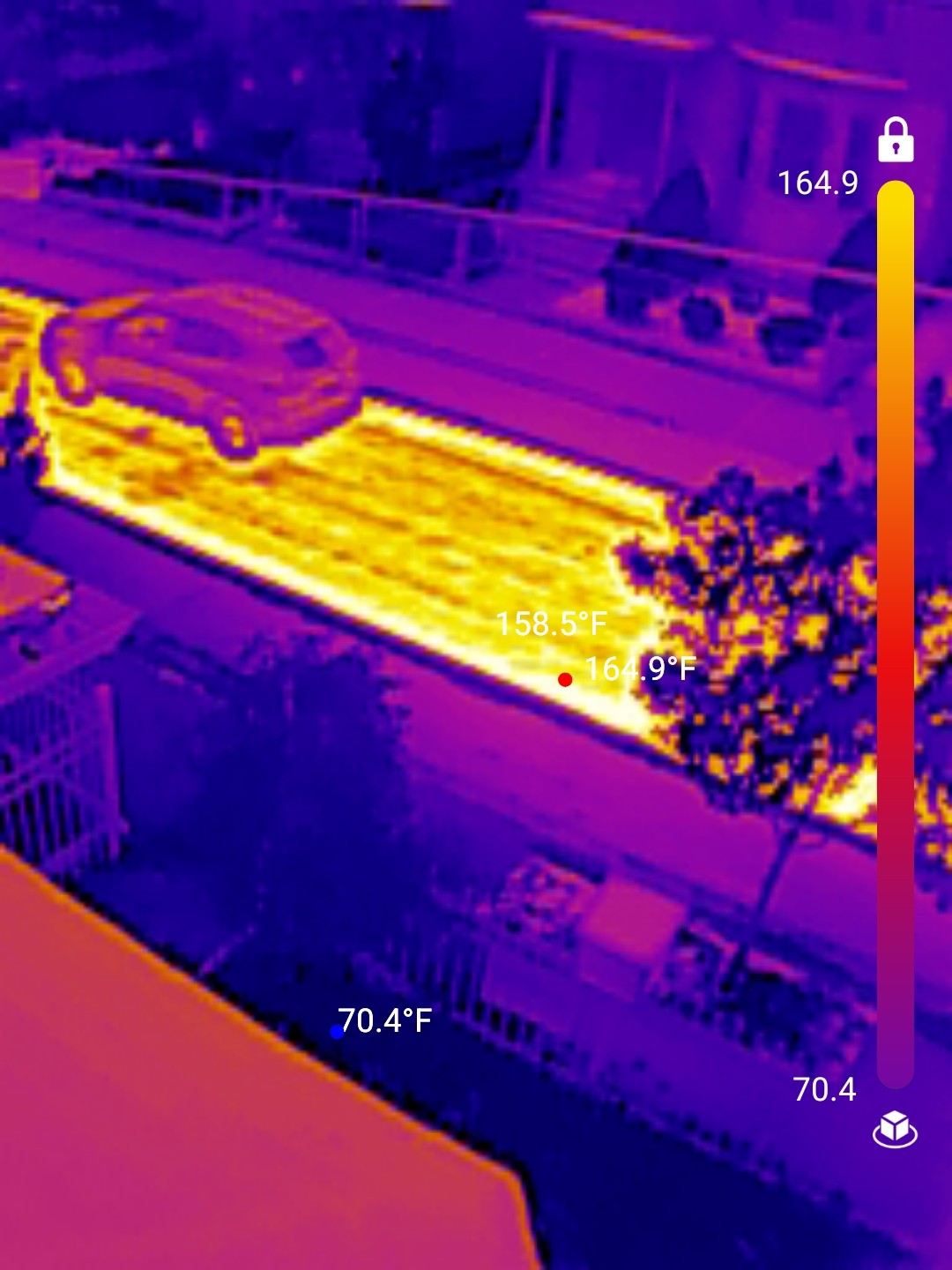
As a kid I burned the bottom of my foot (enough to cause blistering) on fresh blacktop in Palm Springs. They had just opened the repaved parking lot in the full SoCal summer heat when we pulled in to go to the bank. I took 2 steps: the first adhered my flip-flip firmly to the asphalt and the second took my foot out of said flip-flop and landed it right on crazy hot and sticky surface.
post
Geez I hope they put up no pet signs. Would hate for someone to let their dog walk on this.
Since summer is coming in many parts of the world, I'll include a psa about asphalt temps being well above air temps. Good chance if you are enough of a nerd to be on Lemmy you have a laser thermo probe somewhere. Consider bringing on your walk and checking some pavement temps. Avoid walking dog if >115f 46C
Just wait until it get twice as hot this summer.
Asphalt is laid somewhere around 300F, so if it truly got twice as hot it would melt the road and everyone’s tires.
Used to be a paver and I can confirm that shit is HOT, only gets worse once you hit it with water. The steam will give you blisters as you work it
Well, 0 is arbitrary in Celsius and especially Farenheit, so doubling that temperature isn't really doubling the heat.
Kelvin has its scale actually designed around how heat energy works. 160F is 344K. Double that and you've got 688K. Convert that back to stupid-units and you have 779°F
I think I did that right, at least. If nothing else it shows how whacky temperature math can be when doubling units gets wildly different results!
what is this in normal units
Even though this article says that tire rubber starts to break down and melt between 100⁰C to 150⁰C, depending on the rubber compound, I'd still prefer to protect my tires from such high temperatures..
https://thetirereviews.com/is-it-true-tires-can-melt-because-of-heat/
Edit: Those temperatures are also rather dangerous for electric vehicle batteries, which are located right under the vehicle in very close proximity to the road heat.
150C is over 300F
Yes, and EV batteries aren't safe over 40⁰C
There's no way that's true
It's not, many EVs intentionally heat up to over 50°C during fast charging. They also have several layers of material between the bottom of the battery and the road along with airflow across the entire area, so radiant heat isn't going to have a meaningful impact.
https://safelith.com/temperature-limits-for-safe-lithium-ion-battery-usage/
0⁰C to 45⁰C, and you act like vehicles don't get stuck on the road in traffic?
Road temperatures of ~160⁰F are around 71+⁰C.
Please do your math before declaring temps are safe for lithium batteries, 160⁰F / 71.1⁰C most certainly is NOT safe for them.
Acceptable range: 0°C to 45°C (32°F to 113°F). Below 10°C, the charging rate may be limited. It is recommended to charge the battery at 0~10°C and 0.2C rate. Above 45°C, there is a risk of battery charging.
Eh?
Above 45°C, there is a risk of battery charging.
???
Above 45⁰ Celsius, there's a high risk of lithium ion thermal runaway (aka EV explosion).
Also, temperatures as little as anything above 37⁰ Celsius are known to cause infertility in men.
Did you even read the link you sent us?
Max 60°C: Continuous high temperature use will accelerate battery aging and capacity decay. If the temperature exceeds 70°C, the risk of thermal runaway will increase dramatically.
Yes, that's exactly my point. 160⁰F = 71.11⁰C
So let's just ignore the fact that the battery generates its own heat on top of the road its cooking on at 71⁰C..
'This is fine' meme vibes here...
You're ignoring that the pavement being that temperature doesn't mean that the battery will be that temperature. There's a layer of air between the road and the car, as well as other physical barriers. The battery is also actively cooled.
Active cooling means practically nothing at those temperatures, any cooling system is just a heat transfer device, that also generates heat itself. It just moves the heat elsewhere.
So sure, it'll help cool the battery, but what power it takes for the battery to cool itself comes from the battery itself, thereby heating it up even more as it fights to cool itself.
You don't know what the fuck you're talking about.
Active cooling means practically nothing at those temperatures,
What temperatures? The 71°C of the pavement? As I said, there's air and physical barriers that keep that temperature from reaching the battery.
any cooling system is just a heat transfer device, that also generates heat itself. It just moves the heat elsewhere.
Yeah. That's the whole point. It moves the heat from the battery to the outside air, keeping the battery from reaching that 70°C number you're worried about. Which, while I'm at it, is a change from the earlier 40°C number you claimed is a problem.
So sure, it'll help cool the battery, but what power it takes for the battery to cool itself comes from the battery itself, thereby heating it up even more as it fights to cool itself.
Are you fucking serious? Think for a moment. Do you really think that the cooling system, by drawing power from the battery, heats the battery up more than it cools it? That's ridiculous.
Air only flows significantly when you're driving. Have you ever heard of stop signs, red lights, traffic, and trains? You assume the vehicle is always in motion, which isn't always the case.
The better option would have been if the road crew didn't open the road to traffic until the asphalt cooled closer to regular road temperatures.
By your logic, home air conditioning can't work because the condenser is stationary.
Oh, I should also add, that I have real world experience working with hot asphalt. That shit indeed will melt your tires and other plastic parts on your vehicle, such as mirror shells, and also burn the paint off your vehicle.
Yes, I have experience. Yes, I know what the fuck I'm talking about.
Also, look up Peltier cooling, even those generate heat from the power source. So even then, the battery is using energy to cool itself, thereby using more energy and warming itself while delivering energy to cool itself. Catch 22, at those temps, the battery is fighting itself.
A quick lesson on logical reasoning:
If you want to show that a piece of technology A is inefficient and you know that another piece of tech B is more efficient, then you can use the inefficiency of B as evidence for the inefficiencies of A. Basically, for some inefficiency threshold T where any value above T is poor efficiency, then A>B and B>T means that A>T.
Here, we're comparing vapour-compression (A) and solid state (B) heat pumps. Solid states are much more inefficient. So you have AT. You can't use this to make any claims about the relationship between A and T.
We're talking about an edge case here, there should never be a vehicle driving over roads that fucking hot. The road crew should have never opened the road for driving until it cooled down closer to 120⁰F or so, 160⁰F is still too fucking hot.
Which is a fair claim to make. I don't know why you went with "EV batteries aren’t safe over 40⁰C", which is clearly False based on the source you cited, then went on a whole roundabout talking about how it's not safe at 45C, then 70C, then how active cooling is inefficient while citing the efficiency of Peltier devices. Your top-level comment was fine. Nothing else you said after that made any sense.
Depends on the type of cooling, but even the less efficient cooling systems will be using a tiny fraction of the battery output, like less than 1% for most. Passively cooled batteries are going to have problems for sure but even then I'm not convinced there would be enough heat transfer for long enough from a 70 degree road surface to actually be a serious problem. The road itself would be cooling and unless you're just sitting over it for a long time it's not likely to become a real problem. A somewhat pessimistic (for volume, not for actual capacity) estimate would be 300kg of battery mass for 100kwh. Assuming middle range lithium ion thermal capacity that's about 300kj per degree k. So for maths convenience let's assume the car is 10m^2 on the underside and that's all in contact with the battery, going by the previous estimates (again, worst case for battery overhead purposes) and assuming the air is moving and already preheated to 70 degrees c it would take around 5 minutes to heat the whole battery to 70. Thanks for the maths problem though, was interesting to look into this stuff, I've made some big assumptions but it's looking very unlikely you're realistically going to have big issues with overheating unless you spend an inordinate time with an EV sitting over hot asphalt, I didn't consider radiative heat transfer but I wouldn't think that would make a huge difference given the albedo of asphalt also the ambient air would probably help cool more than I considered. It would be neat if someone with more knowledge on the equations has input though.
There exists stop signs, red lights, traffic, and trains..
Never assume you won't be parked for more than 5 minutes...
Ofc but I made some big assumptions with regards to ambient temperature, battery mass and lack of functional cooling. 5 minutes is absolute worst case with 70 degree ambient air.
Neat, you can also see where people's tyres have absorbed some of the heat.
Lol, no. Tires momentarily contacting hot asphalt while rolling on it will not significantly lower the surface temperature of hot asphalt. The road paving process produces T⁰ unevenness while spreading asphalt ... notably because of flow of asphal from the uneven T⁰ in truck loads waiting typically 1 hour before being dumped ... then carateristincs of flow in the paving machine ... and ... civil ing. ... whatever.
Edit : i blocked one user below
( prenatal_confusion@feddit.org ) ; they couldn't understand anything technical that i was explaining and they wanted to spark some conflicts.
Fluke camera?
Hmm, that's interesting. Don't you guys generally use concrete for paving in the US? In building construction, you're supposed to give concrete like a month to fully harden, even though it already looks firm after a day or so.
For paving, they're likely using a hardening accelerator, so the timelines wouldn't be the same, but if building construction is anything to go by, it seems like you'd want to give it as much time as possible, not send cars on there while it's still hot. 🥴
Generally? I don't think so. I think concrete gets used in heavy intersections, super busy streets, and some parts of highways/freeways, but not for all the branching streets. Smaller/less used roads and residential are generally pavement/asphalt. Though some HOAs like to use concrete for the longer expected lifespan and then don't budget for repairs so it turns to crap after a while. That said, I'm not a professional, I just live here. Not in an HOA, thankfully, but near one with terrible concrete roads.
Even with accelerators it still needs a few days (usually about a week) to harden to 80% strength, and it will never be quite as strong as it would be without an accelerator.
I think that’s part of the reason we don’t use concrete pavement more often. It certainly lasts a lot longer, but laying it is way more time consuming. Asphalt is ready to go within a day, just needs to cool off.
Its uncommon to see concrete roads in the US but there are a few of them around. That being said it could be more common in some states than others.
Arent the majority of your freeways concrete?
Structure is concrete, road surface is asphalt.
For all freeways are all asphalt? Thats not correct Cali for a start has been moving to concrete.
Concrete is used for the top layer for higher load areas were budget and the foundations can support it as its more inflexible. Asphalt is used as its cheaper (initially, it will need renewing more often) and it will support more movement for the foundations and worse weather.
We (UK) had part of the M25 done in the same style, but it was shit as we cut the budget and its lots of small joined sections due to complexities of using larger slabs. The foundation has since moved about and the gaps get bigger.
Yeah wtf, that's bonkers.
Ambient temp seems to be roughly 75... maybe wait till it gets down to 95, 90?

all 58 comments