all 74 comments

sorted by: hot top controversial new old
[–] 152 points 1 year ago (21 children)

Honestly back when I was a kid this is how I thought games were made, every possible image of a game was already saved and according to your input it just loaded the next image.

I stopped thinking that with 3d games

  • source
  • hideshow 21 child comments
  • [–] 53 points 1 year ago (3 children)

    I thought that they were managing that stuff on a per-pixel basis, no engine, assets, or other abstractions, just raw-dogging pixel colors.

    And before I even played video games at all I was watching somebody play some assassin's creed game I think and I thought the player had to control every single limb qwop-style.

  • source
  • parent
  • hideshow 3 child comments
  • [–] 23 points 1 year ago* (last edited 1 year ago) (1 child)

    In the first few Assassin's Creed games, they did use the idea of a Puppeteer system for the control scheme, although it wasn't physics-based or anywhere near as hard as QWOP. Each of the controllers face buttons performed actions associated with each limb, and the right trigger would swap between low profile actions and high profile actions.

    In the top right of the screen, there was always a UI element showing what the buttons did at that moment in that context, which might've been why you thought it was a QWOP style system. It's not exactly what you were thinking of at the time, but you were closer than you realise.

  • source
  • parent
  • hideshow 1 child comment
  • [–] 26 points 1 year ago (4 children)

    Even with 2D games that's basically impossible. Only time it could work is with turn based games and then...you end up with this post lol.

  • source
  • parent
  • hideshow 4 child comments
  • [–] 17 points 1 year ago (3 children)

    I see you've never played "Dragon's Lair", where every scene was cell animated and the player "chose" the path that the animation would take.

  • source
  • parent
  • hideshow 3 child comments
  • [–] 2 points 1 year ago

    LOL, I've actually heard of it, but I have not played it. Ofc that game never even crossed my mind when writing my comment haha. I suppose choose your own adventure style books also fall into this category.

  • source
  • parent
  • [–] 18 points 1 year ago (3 children)

    I remember having a thought one day as a young kid while interacting with a DVD main menu (the kind that had clips from the movie playing in the background, and would play a specific clip depending on what menu you went in to).

    "This is basically how video games work, there's a bunch of options you can choose from and depending on what you do it shows you something. Videogames are just DVD menus with way more options."

    I grew up to not be a programmer.

  • source
  • parent
  • hideshow 3 child comments
  • It does work like that a little bit, like with sprites they've often hard-coded the frames of animation, so when you push a button it loads the correct image, like Mario's jumping frame with his hand in the air. But there are such things as tilesets, and sprite positions, and all that good stuff.

  • source
  • parent
  • [–] 3 points 1 year ago (1 child)

    I remember speculating as a (small) kid that the AI soldiers in Battlefront II's local multiplayer might be real people employed by the developer. Not the brightest child was I.

  • source
  • parent
  • hideshow 1 child comment
  • [–] 79 points 1 year ago (2 children)

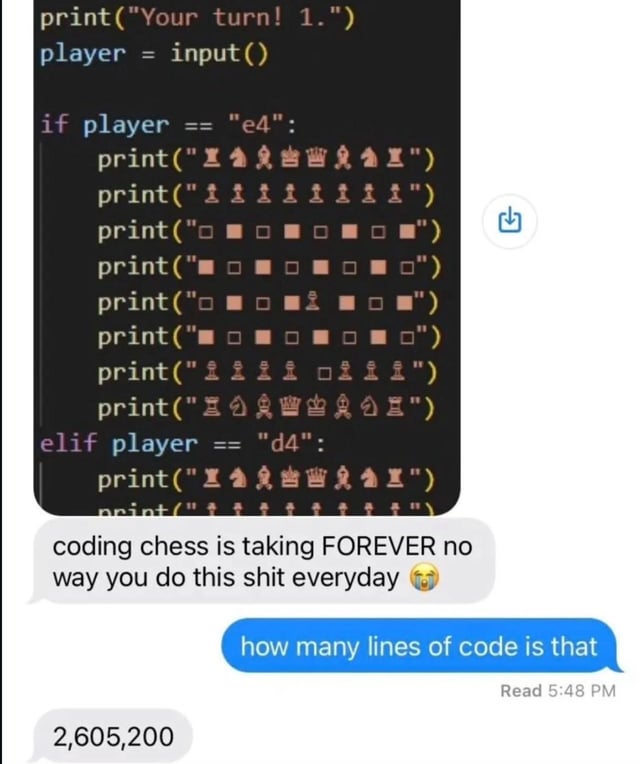
    Programming chess as a single lookup table is wild

  • source
  • hideshow 2 child comments
  • [–] 45 points 1 year ago (1 child)

    This is very inefficient, they should be using a switch case.

  • source
  • hideshow 1 child comment
  • [–] 71 points 1 year ago (14 children)

    At university I had an introductory C course where one assignment was to write a program that searched a 4x4 array of booleans for groups of cells set to true. Groups had to be rectangles, powers of 2 in width and height, and could wrap (i.e. they could go off the right edge and back on the left edge). We had to submit our programs by e-mail and printed form one week later. The prof. marked the paper versions and the TA ran and tested the digital. One slight problem, if you used the university owned printers, they charged for print outs. A few pence per page to cover costs and stop people abusing the rather nice high quality printers the computer faculty had.

    I'd always enjoyed programming and whilst C was new to me, using another language wasn't a big problem. As I worked on it I realised the problem wasn't as straightforward as I first thought, but I spent a few hours on it that evening and had a solution I was happy with.

    Penny was a student on the course whose approach to academia was memorization. She didn't consume, process, and apply concepts. She just remembered them. Her favourite subject was maths. While the rest of us were struggling to derive some formula, she'd have just committed the process to memory.

    Penny was complaining a lot on this programming assignment. She didn't understand why the assignment was so hard for an introductory class. I didn't judge. I know some people find programming hard, but I didn't feel I could help her much without jeopardising my own mark. There's only so much uniqueness in a small program and if she just copied my solution we'd both get penalised for plagiarism. I did mention to her the cases I'd found tricky to get right was when two groups overlapped. If one group completely covered a smaller one you'd only report the bigger one, but if not you'd report both groups.

    I heard, through her boyfriend, that that week had involved many long evenings working on this assignment, but she turned up at the next class solution in hand. Obviously stressed, she carried a pile of paper of several hundred pages. She had written a program that consisted of an if-statement for every possible group size and location. About a hundred different possible groups. Each condition written with constant value indices into the array. To cope with the overlapping groups problem, checks for smaller groups also checked that no larger group also covered this area. No loops. No search algorithm. Just a linear program of if-statements.

    Apparently debugging this has been a nightmare. Cut and paste errors everywhere, but when I'd told her about overlapping groups aspect it had blown her mind. There always seemed to be a combination she hadn't accounted for. Multiple times she thought she was done, only to find a corner case she'd missed. And just to kick her when she was down, she'd paid for multiple printouts, each one costing about £10 only to find a problem afterwards.

    This consistent A grade student who sailed through everything by relying on her memory had been broken by being asked to create an algorithm rather than remember one. She got credit for submitting a solution that compiled and solved some cases, but I doubt the professor got past the first page of that huge printout.

    Penny had worked really hard for that D.

  • source
  • hideshow 14 child comments
  • [+] -2 points 1 year ago (2 children)
  • [+] -8 points 1 year ago (7 children)

    Professor was an idiot if it gave a D for a working solution. Getting it working is the grade, optimizing is the next step.

  • source
  • parent
  • hideshow 7 child comments
  • [–] 5 points 1 year ago (5 children)
  • [+] -8 points 1 year ago (4 children)

    Gottem! Meanwhile, I’m right and you’re a moron.

  • source
  • parent
  • hideshow 4 child comments
  • [–] 2 points 1 year ago (3 children)

    The downvotes says you're retarded, give it up dickhead 😂

  • source
  • parent
  • hideshow 3 child comments
  • [+] -6 points 1 year ago (2 children)

    So if your moral and intellectual superior was being upvoted, you’d concede me being right? You’re even dumber than I first assessed. Run along worthless dumbfuck, leave your superior alone.

  • source
  • parent
  • hideshow 2 child comments
  • load more comments (-1 replies)
    [–] 22 points 1 year ago

    This is supposed to be a joke but sadly a lot of beginner tutorials on coding Tic-Tac-Toe teach this

  • source
  • [–] 20 points 1 year ago

    As a middle schooler I used Power Point to make FMV games for my friends and classmates, and it was basically this. Just, like, SO MANY slides

  • source
  • [–] 16 points 1 year ago (2 children)

    This is where you'd normally go "there must be a better way..."

  • source
  • hideshow 2 child comments
  • [–] 12 points 1 year ago
    [–] 11 points 1 year ago (1 child)

    Are they trying to code every possible chess position??

  • source
  • hideshow 1 child comment
  • [–] 26 points 1 year ago (6 children)

    This reminds me of one of my very first programs, a tic-tac-toe game I wrote in high school. It displayed hardcoded grids of Xs and Os and blanks very similar to what's shown here. This approach worked because of the much more limited move possibilities. The program could always win if it made the first move, and always win or tie if the human moved first, depending on if the human made mistakes. I wish I still had the code.

  • source
  • hideshow 6 child comments
  • [–] 15 points 1 year ago (5 children)

    Did the program cheat? Tic tac toe is a tie if opponents play correctly.

  • source
  • parent
  • hideshow 5 child comments
  • [–] 2 points 1 year ago (3 children)

    How do you define cheating in such a simple game?

  • source
  • parent
  • hideshow 3 child comments
  • [–] 4 points 1 year ago (2 children)

    Placing moves in invalid locations, passing a turn, or making multiple moves on one turn?

  • source
  • parent
  • hideshow 2 child comments
  • [–] 1 point 1 year ago (1 child)

    There are no invalid locations in tic Tac toe, passing a turn provides no advantage, I suppose you could take extra turns to cheat.

  • source
  • parent
  • hideshow 1 child comment
  • [–] 1 point 1 year ago

    An invalid turn would be something like placing a move on top of an already-filled square or outside of the 9 grid spaces. It seems obvious to a human that you can't do these things, but computer bugs have a tendency to do things you don't expect. And yes, passing a turn doesn't provide an advantage, but I listed it because it's still technically cheating.

  • source
  • parent
  • [–] 7 points 1 year ago

    Found the guy who passed the test with

    printf ("    *\n   **\n  ***\n ****\n*****\n);
    
  • source
  • now implement castling in that

  • source
  • [–] 5 points 1 year ago

    Well this is how programing works so if you don't like it...

  • source
  • [–] 20 points 1 year ago (1 child)

    AI has probably finished this game by now.

  • source
  • hideshow 1 child comment
  • [–] 2 points 1 year ago (7 children)

    not to get epistemological,

    but I hate that technically there's only a limited number of moves in chess, and therefore the best move is there, maybe there's a strategic where white will always win, but we'll never know because the number of variations likely is larger than atoms in the universe.

  • source
  • hideshow 7 child comments
  • [–] 6 points 1 year ago (2 children)

    On the lower end of estimates, the number of unique chess board configurations is 10^120, often referred to as the Shannon number. The universe doesn't stand a chance.

  • source
  • parent
  • hideshow 2 child comments
  • [–] 5 points 1 year ago (3 children)

    In modern chess, engines have gotten good enough that we generally do know the top moves and humans can't beat them. We can even numerically assess someone's chess play with a computer, which we call "accuracy". Obviously they can always be improved further, and there are a handful of situations where they might misevaluate, but it's still pretty incredible.

    Engines have only made chess more exciting as they have shattered a lot of old theory and helped people find a lot of new and innovative ideas. They are an incredible aid in analysis and tournament prep.

  • source
  • parent
  • hideshow 3 child comments
  • [–] 3 points 1 year ago (2 children)

    yhea, but engines still act as if it is an unsolved game.

    while in theory, given that the number of moves is limited, in theory one colour would always win.

  • source
  • parent
  • hideshow 2 child comments
  • [–] 2 points 1 year ago

    I'm familiar with issues like this. Lots of copy/pasting with little edits here and there all the way down.

  • source
  • [–] 2 points 1 year ago

    They are doing it dumb. You can text output chess but you just need to keep track of where the pieces are in code, then when you are ready to output, place the characters. Saves so much time. /s

  • source
  • [–] -2 points 1 year ago

    if that is python then makes sense

  • source