you are viewing a single comment's thread
view the rest of the comments
[–] 26 points 1 year ago (6 children)

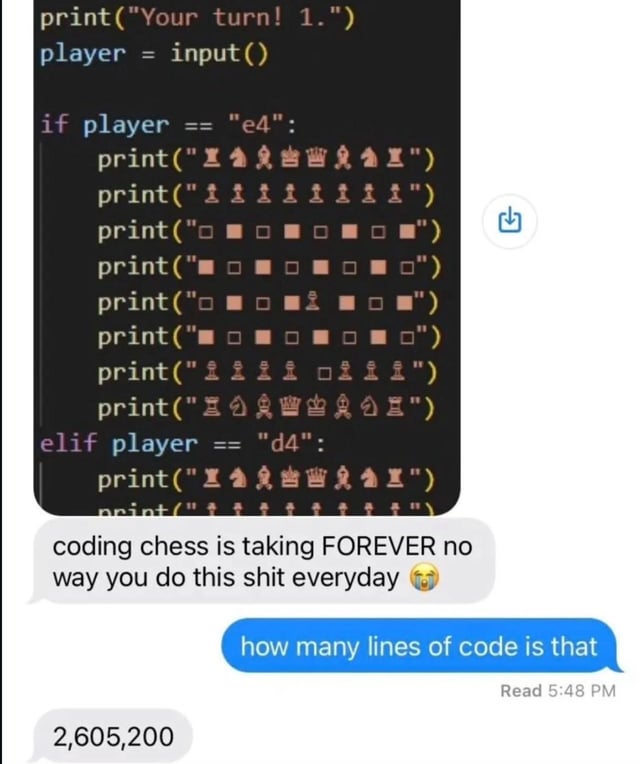
This reminds me of one of my very first programs, a tic-tac-toe game I wrote in high school. It displayed hardcoded grids of Xs and Os and blanks very similar to what's shown here. This approach worked because of the much more limited move possibilities. The program could always win if it made the first move, and always win or tie if the human moved first, depending on if the human made mistakes. I wish I still had the code.

  • source
  • hideshow 6 child comments
  • [–] 15 points 1 year ago (5 children)

    Did the program cheat? Tic tac toe is a tie if opponents play correctly.

  • source
  • parent
  • hideshow 5 child comments
  • [–] 2 points 1 year ago (3 children)

    How do you define cheating in such a simple game?

  • source
  • parent
  • hideshow 3 child comments
  • [–] 4 points 1 year ago (2 children)

    Placing moves in invalid locations, passing a turn, or making multiple moves on one turn?

  • source
  • parent
  • hideshow 2 child comments
  • [–] 1 point 1 year ago (1 child)

    There are no invalid locations in tic Tac toe, passing a turn provides no advantage, I suppose you could take extra turns to cheat.

  • source
  • parent
  • hideshow 1 child comment
  • [–] 1 point 1 year ago

    An invalid turn would be something like placing a move on top of an already-filled square or outside of the 9 grid spaces. It seems obvious to a human that you can't do these things, but computer bugs have a tendency to do things you don't expect. And yes, passing a turn doesn't provide an advantage, but I listed it because it's still technically cheating.

  • source
  • parent