top 94 comments

sorted by: hot top controversial new old
[–] 369 points 1 year ago (29 children)

Every year, we do an employee survey to see how management is doing; like a report card for management. In the last 3 years, mine has come back with the highest company scores for employee engagement, job satisfaction, and project completion rate. I was asked to give a presentation to the other officers and managers about things I do to get those scores.

The presentation was basically one slide that I expanded to 10. It came down to creating the expectation, for the folks who report to me, that a work week is 37.5 hours (our full-time week) and no more. I make it clear that if my team is working overtime, I've failed. If that happens, together we look at their project commitments and reduce the workload, or get training, or whatever is needed.

Working folks to the point of burnout is NEVER a valid solution. Respecting personal time pays dividends to everyone. It's amazing how treating people like adults makes them happier and more productive. It's such a low bar and yet seems so foreign to people.

After my presentation, multiple execs argued thar I'd get more done if I pushed my team harder. Our company President pulled up all of our project completion rates, and asked them to explain the discrepancy. The three who complained the most about my approach were in the bottom five.

Data continually shows people are happy when they have a solid, predictable, work life balance. Happy people are more productive and are willing to do more in the long run. And they stick around, so you don't have to keep looking for new employees. Everyone wins. Yet, there is such a resistance to it by certain people, and I don't understand why.

Tldr: Expecting your people to give up their personal life for work, it's a clear sign that you are a terrible leader.

  • source
  • hideshow 29 child comments
  • [–] 138 points 1 year ago (7 children)

    Yet, there is such a resistance to it by certain people, and I don’t understand why.

    People are emotional driven. It might be something like "I worked 80 hour weeks. If I accept that that wasn't the right move, then I have to admit I fucked up. I'm a good smart person. I don't fuck up. Thus, this idea is wrong and I reject it"

  • source
  • parent
  • hideshow 7 child comments
  • [–] 12 points 1 year ago (3 children)
  • [–] 77 points 1 year ago (9 children)

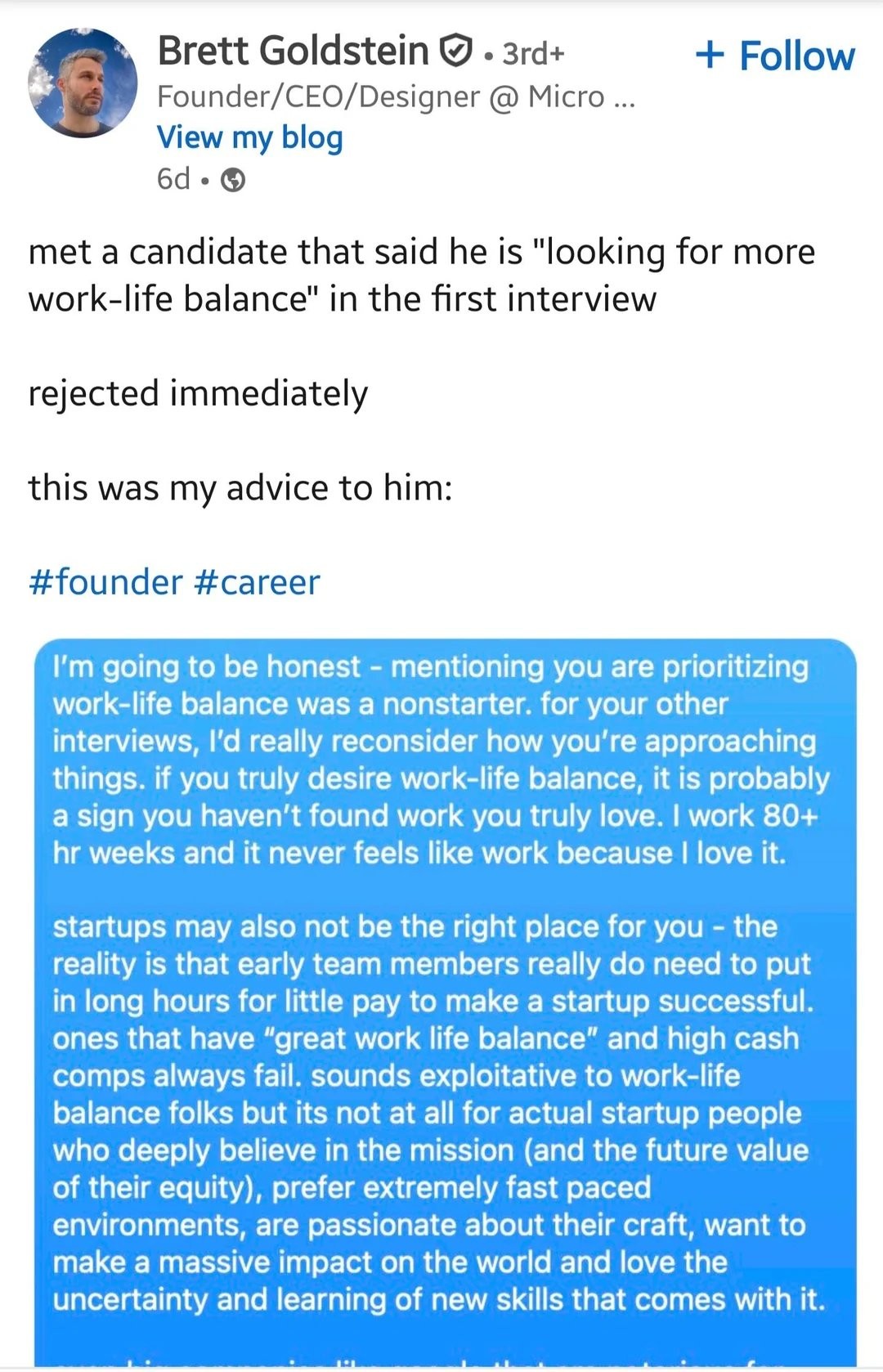
    I make it clear that if my team is working overtime, I've failed.

    Bingo!

    This was my attitude too. If anyone has to work late or weekends, it was a failure in resource allocation, which is a management function.

    The only exception was if people had to get on late night calls with people in other timezones, in which case they were expected to take the equivalent time off at their own convenience.

    Another easy win is bullshit agile daily standups. I made them twice a week, and no longer than 15 minutes and only to cover potential blockers, not status reports. That alone made everyone happier. In one case, the team finished a project that had been languishing for three years in three months and shipped it out.

    It's really about respecting people's time.

  • source
  • parent
  • hideshow 9 child comments
  • [–] 36 points 1 year ago (5 children)

    My last boss totally fucked up my daily stand-ups. I suggested them because, when I started, I found most work wasn't consistently tracked or even discussed. My boss's management style was panicking about everything and panic working while raging that no one else was also panicking about everything (spoiler: I also learned department turnover was high, can't imagine why), so I was trying to help implement any organization whatsoever. She quickly turned my 10 minute stand-ups into 1-1.5 hour slogs where each team member had to give an update on each of their projects, despite having earlier logged it all into the project tracker I created.

    By far the worst micromanager and least competent person I ever worked for.

  • source
  • parent
  • hideshow 5 child comments
  • [–] 14 points 1 year ago (2 children)

    I dont understand how these managers get hired and stay on so long behaving that way

  • source
  • parent
  • hideshow 2 child comments
  • [–] 5 points 1 year ago* (1 child)

    My promotion was fucked by an internal client like this, who’s a manager that keeps failing upwards and sideways. His team members hate him, his VP doesn’t trust him and keeps putting additional managers on his project.

    My team did everything - we saved his project from the edge of the cliff, reached milestones, onboarded contractors, and made the notoriously grumpy VP satisfied.

    Yet that’s not enough, as I’m supposed to make this manchild happy.

    Some people just love drama and panic, and others are too soft to push back on them, as they are uncomfortable with any type of conflict.

  • source
  • parent
  • hideshow 1 child comment
  • [–] 6 points 1 year ago

    My coworkers and I were having issues getting any information from another team to do our job. Since we had a set deadline to finish the work, I set up a Monday/Wednesday meeting schedule to extract the information we needed from that team. My boss and the other team's boss turned it into a two hour update-fest with us and the other team updating our respective bosses, with both teams in the meeting. So fucking pointless, and so far away from what that meeting was supposed to be, it is truly astonishing we were able to get anything done.

    Oh and the other team stopped providing the information we needed to finish when our bosses converted our meeting to update-fest.

  • source
  • parent
  • [–] 4 points 1 year ago

    People requesting you to say orally the same thing you typed in the task tracker that they should see if they paid attention to the tasks that are assigned to them and also notifies them by email really annoys me.

  • source
  • parent
  • [–] 13 points 1 year ago

    The frequency of standups should be determined by the team and blockers should never have to wait till standup to be surfaced.

    I work on a growth product team and we frequently have devs pulled away to work on a feature in a different product. The engineers started losing track of availability of others and what features were going to prod became opaque. We opted to move back to daily standups with status reports as it kept the team informed and thus motivated, and gave an opportunity in several cases to refine approaches from the start.

    There are, of course, other ways to accomplish this, like having a public issue board, but often private conversations don't make it to the issues.

  • source
  • parent
  • [–] 6 points 1 year ago* (1 child)

    Semi-agreed on daily standups -- the regular accountability drives productivity for a lot of people, but I also agree that daily is excessive. We've settled on 3 days/week and it works pretty well for both camps - 2 is probably fine, but 1 I would argue is missing the point.

    Def agreed on 15 minutes, as you say - any longer and you lose both people and the purpose of the check-in.

  • source
  • parent
  • hideshow 1 child comment
  • [–] 1 point 1 year ago

    Flip daily around and it becomes much more useful.

    Instead of everyone reporting what they did, go through the board and look at tickets, with a focus on tickets in hand-over states (waiting for review, waiting for tests, ...). That way the daily can actually help progress stuck tickets.

    At the end, ask if anyone doesn't have enough work and needs new tickets (to catch the potential problem of running out of work).

    Doesn't take more than a few minutes and focusses on the things where the daily can actually help, instead of turning it into the daily exercise of "Yesterday I had a ton of meetings. Today I'll have a ton of meetings. Bye." That kind of stuff is worthless.

  • source
  • parent
  • [–] 18 points 1 year ago

    This is why I didn't stay in management. I had the same attitude as you. I didn't mind working late myself and if someone really wanted to because they had an interesting problem I'd usually let them cut out early Friday or come in late the next day. I got too much shit from other management and C levels about how my team never seemed to be around. I'd ask what was not getting done or what they were expecting that they didn't get. The answer was always just that they didn't see the team in the office when other teams were still there. They could have needed something!

    I got tired of that shit. One of the reasons that I went into business for myself as a one man company. Now I don't have to justify anything but my own existence to anyone except who I directly report to. And the guy I directly report to likes the big ass penalty clause in my contract for terminating it early or without notice because accounting can't get rid of me without taking a hit or giving me time to finish up my projects. I'm judged solely on what I deliver. And I almost always come in ahead of time and with better results than most other teams because I'm not worked like a rented mule.

  • source
  • parent
  • [–] 11 points 1 year ago (4 children)

    Yup. We're humans and when we get tired we make mistakes. I could work a 12 hour day, but in the twelfth hour I'll probably make a mistake that'll take more than 6 hours or to fix someday in the future. If I work 8 hours you get 8 hours of productivity. If I work 12 hours you'll end up getting 6 hours or less of productivity.

    The whole thing about making people work long hours is just about bad managers that enjoy exerting power over people. It's not about productivity.

  • source
  • parent
  • hideshow 4 child comments
  • [–] 0 points 1 year ago (3 children)

    We’re humans and when we get tired we make mistakes. I could work a 12 hour day, but in the twelfth hour I’ll probably make a mistake that’ll take more than 6 hours or to fix someday in the future

    Doctors/nurses/cops/emts/firefighters/pipefitters/welders/fucktard-managers everywhere are gasping in shock and horror.

  • source
  • parent
  • hideshow 3 child comments
  • [–] 1 point 1 year ago (2 children)

    Just because they work it doesn't make it right.

  • source
  • parent
  • hideshow 2 child comments
  • [–] 1 point 1 year ago (1 child)

    Not saying it is. Though I do know from the medical field especially that where mistakes are found is in the handoff or shift change, which is one reason it took so long to see any meaningful change in the way residency worked for doctors. Despite the incredibly long hours, the new docs didn't tend to make mistakes in care during the shift. I think long shifts aren't necessarily the problem, it's when we're pushed to keep working when we can actually feel the fatigue and malaise of the day set in. Maybe the only way (right now, due to the way you work or you die) is to mandate shorter shifts, but I would love to see a culture set up where you work until you start to feel it, and then go home or take a break, however long that break needs to be. That's probably fantasy of the highest order, but hey, why not imagine ways where things could like that and push for them?

  • source
  • parent
  • hideshow 1 child comment
  • [–] 1 point 1 year ago

    Medical work and software development are very different kinds of work with very different difficulties.

    A lot of medical shift work is about being there, not necessarily about doing stuff all the time. There's a lot of standby-duty. It's sometimes physical work, sometimes emotional/social work, sometimes actual brain work (researching stuff). It's quite a lot of different types of tasks over a shift.

    Software develompent is highly-concentrated brain work without meaningful built-in breaks. You spend all day staring at a screen, doing high-level logic non-stop. Humans aren't built for that kind of work at all, so it's really difficult to do that for extended periods.

  • source
  • parent
  • [–] 6 points 1 year ago

    A lot of business types have a very simple view on labor. Time is money, so the more time you get somebody to work the more you earn. Of course it doesn't work like that in reality, but this mentality is spread far and wide.

  • source
  • parent
  • [–] 166 points 1 year ago (2 children)

    Sounds exploitative because it is. Just because work is your entire personality doesn’t mean every one else’s should be too. Fucking tool

  • source
  • hideshow 2 child comments
  • [–] 47 points 1 year ago

    Recently read "Pimp" by Iceberg Slim, and it seems like a training manual for (some) modern managers and executives. Use your recruiting process to select low-esteem, easily manipulated people to be your worker drones, and they will do 80 hour weeks to earn that pizza party.

  • source
  • parent
  • [–] 3 points 1 year ago

    who deeply believe in the mission (and the future value of their equity)

    This is the only proviso for me. Some people wouldn't mind working themselves to exhaustion for a lot of money. Then the question of whether it's exploitative or not depends on the amounts involved and the conditions of equity ownership

  • source
  • parent
  • [–] 140 points 1 year ago (10 children)

    Dude, you're pulling 80 hour weeks for your company. That you own. Expecting the same input from people who will never see as much as a percentage of what you stand to make off of their success is delusional. But I suppose delusion is almost a requirement for these kind of people.

  • source
  • hideshow 10 child comments
  • [–] 73 points 1 year ago (1 child)

    Personally theory.....

    Many startups fail because people try to work 80+hrs per week. Biologically more than about 25-30 hours of work is usually a waste of time. You can occasionally pull a long week but then you need to rest and recover to get back to full productivity. If you push beyond it often, you'll make a shit ton of stupid mistakes that completely nullify all your efforts.

    If you've ever been around someone "working" on hour 70+ during a week you'll know what I mean. A five minute tasks takes them an hour and they generally fuck it up.

  • source
  • parent
  • hideshow 1 child comment
  • I've worked for a few startups (in software). They all failed because their idea was stupid, the executives were technically incompetent borderline sociopaths, and they weren't even good at getting VCs to throw money at them. Some employees worked insane hours while others of us fucked off most of the time and came to work high - it made no difference.

  • source
  • parent
  • [–] 9 points 1 year ago* (last edited 1 year ago)

    Yeah, 100%. This kind of advice can maybe make sense if you're starting a startup, but everyone employed at that stage needs to be on equal ground and well-protected. If they're not, then that can still be fine, but they can't be expected to put as much of their lives into your product. They're contractors you're hiring for some shit-shoveling and maybe it's best to be honest about that.

    The unfortunate thing in tech is that, due to pushing "learning to code" as a universal employment option, there's always a pool of idealistic fresh blood that is willing to crunch for you if you make vague mention of being in it together, when a few people stand to gain the vast majority of the profit if the company's product is successful. By the time the new recruits are old and bitter and burnt out, you can lay em off for poor performance (or cannibalize the company at large) and hire some more doe-eyed interns.

    If you're expecting your employees to consistently work long hours for you, they need to have the same stake as you do. They need flexibility to take care of their mental and physical health as needed. You should encourage them to unionize and collectively bargain for their needs once they come in conflict with yours, because they absolutely will. You can't afford to lose these people, because it's rare to find people that won't get ground into dust doing this because they want it as bad as you. so make it sustainable and more than worth their while. if you can't find these people? maybe your app sucks.

    these types view themselves as above the labor they're hiring because they got there first / had the means to form a company and I fucking hate it.

  • source
  • parent
  • [–] 2 points 1 year ago

    I think what he said about startups is more pr less true. Of course, with startups you're putting in a lot of work to break into or create a new market, and you get a percentage of that company, too. It certainly isn't for everyone, and most people don't want to do it for their whole career. And expecting that kind of attitude from a regular employee is simply ridiculous.

  • source
  • parent
  • [–] 5 points 1 year ago (3 children)

    The vast majority of people who start at the beginning of a startup will receive equity, so they are also co-owners.

  • source
  • parent
  • hideshow 3 child comments
  • [–] 26 points 1 year ago

    Maybe for employees like 1-5. Beyond that is rapidly diminishing amounts of equity. I was employee #49 and got like 40,000 shares options (that I had to buy)

    And even if you are like employee #3, the actual owner and investors get more than you

  • source
  • parent
  • [–] 9 points 1 year ago

    I agree in principle that start up employees can be incentivized better than the usual wage or salary slave.

    There is always a big butt, though.

    Non-capital investors almost always get shares of a lower class that can be denied a share of any future revenue from a sale of the company or god forbid they get real revenue.

    These term “Hollywood accounting” exists for a reason and skepticism about the real value of lower class shares is very valid.

  • source
  • parent
  • [–] 13 points 1 year ago

    Exactly, there is a place in the world for startups burning 80 hr/wk. Just compensate the people who are doing that adequately with equity, and hire risk takers who want that kind of risk.

  • source
  • parent
  • [–] 105 points 1 year ago (36 children)

    "I work 80 hrs for my own business and I expect everyone else to do so...on a regular salary"

  • source
  • hideshow 36 child comments
  • [–] -5 points 1 year ago (33 children)

    No, on a startup salary. Which might be minimum wage (on a 40h basis). His advice is solid: for someone who looks for work life balance a startup is not the right employer. They will be much happier in a big boring established company. If someone is in their 20s, little family obligations, wants to have a high risk high reward experience, go for it.

  • source
  • parent
  • hideshow 33 child comments
  • [–] 21 points 1 year ago (16 children)

    High risk high reward jobs are rarely a good advice for someone trying to establish their own life in their twenties especially if you don't have a safety net. It is like suggesting math PhD students to go after the biggest unsolved problem of the century. It is much more sane to try to do such stuff when you are established in your career. Also I am not sure what is the rewarding part even if the start-up becomes wildly successful best you get out of those are some shares with lots of strings attached, it is not like CEO makes every initial employee a high end partner.

  • source
  • parent
  • hideshow 16 child comments
  • [–] 3 points 1 year ago* (last edited 1 year ago) (12 children)

    I'm at the start of my career and decided to join a startup now. I'm at a point in my life where I don't need to support anyone other than myself, and can afford to work a lot for relatively low pay because it's fun to build something new from scratch. I can afford that this flops.

    In ten years, I'm hopefully in a place where I want/need more stability, free time, predictability, and better pay. Either the startup works out, and I can have that, or I'm hoping that the experience I get working on it will allow me to get a "normal" job when I need it.

    Edit: What's with people downvoting me for saying that I personally have joined a startup because I personally think it's fun and rewarding? Jesus...

  • source
  • parent
  • hideshow 12 child comments
  • [–] 5 points 1 year ago* (9 children)

    Honestly if I am going spend my years on building something from scratch and sacrifice so much for its growth, I would like to have some say on its further development and future course and a fair share of its success too (acknowledgement and financial wise). That rarely seems to happen in startups, apart from top engineers and executives. Even if you come up with ideas that transform the company, best you get is some sort of bonus and maybe sth you claim you have done in your next job interviews.

    If you want such rewarding stuff then work in the academia for somewhat a better salary and much more freedom and ownership of projects you develop and supervise (even as a postdoc).

  • source
  • parent
  • hideshow 9 child comments
  • [–] 2 points 1 year ago (3 children)

    I'm getting cheap options for a decent share of the company as part of my contract, so I will have a say in future development :)

  • source
  • parent
  • hideshow 3 child comments
  • [–] 3 points 1 year ago (2 children)

    well that sounds like much fairer treatment than the experience of many people around me. do those shares come with strings attached?

  • source
  • parent
  • hideshow 2 child comments
  • [–] 2 points 1 year ago (1 child)

    Only string attached is that I'm required to sell them back to the company if I quit. I think that makes sense, since we're not publicly traded, and want all shareholders to be people actively invested in the company.

  • source
  • parent
  • hideshow 1 child comment
  • [–] 1 point 1 year ago (4 children)

    This is the worst advice I have seen in a while. Academia is the absolute worst for salary, with an eternity actuelly not earning anything (or if in the US, having to pay yourself!) plus the stress of constant chasing of funding, politics that make big corporations pale and whims of reviewers that have no idea about your niche. I didn't even consider a post-doc, went straight to industry. Best decision ever.

    Only go to academia if it's truly your passion and you don't care about money for some reason.

  • source
  • parent
  • hideshow 4 child comments
  • [–] 2 points 1 year ago (3 children)

    I am comparing academia to working as an initial employee in a startup though, not to working as an employer in industry in an established firm.

    In this case salary is likely better, you still build stuff from scratch on topics that interest you, you don't work so that some guy can achieve his/her dreams, you have a higher chance of getting credit for the stuff you do (though wouldn't say %100 because yea fucking humans...). It even comes with the same levels of future uncertainty that a startup does lol. That being said as with anything luck is the major determinant here too. If you end up with a group of immature people and a bad PI you may live hell on earth (as you would anywhere). But I believe your chances of ending up with a fun gang of intelligent people is quite high, including the PI.

  • source
  • parent
  • hideshow 3 child comments
  • [–] 1 point 1 year ago (2 children)

    I respectfully disagree. The potential reward in a startup is orders of magnitude higher than academia. The percentage of time dedicated to useful work is higher in a startup (funding proposals suuuuck). The time you start earning money is years earlier in a startup (no need for masters or PhD). I agree about credit (which unless it's Nobel level is almost worthless, and usually the department chair gets the most credit anyway) and luck.

    While I don't regret my years in academia, it's only because it helped me land my first industry job which would be super difficult without that background. Academia itself as a career path was a big no for me after my first two published papers.

  • source
  • parent
  • hideshow 2 child comments
  • [–] 1 point 1 year ago* (last edited 1 year ago) (1 child)

    My experience in startups is quite limited, it is some 5-6 friends who applied early on worked and got disappointed. It seems to me that if you are not a founding member, even if the startup makes it through (against quite bad odds), you don't get rewarded enough for working quite a lot for a low salary. Even in one case a friend of mine who came up with quite a good idea that was useful to the company got sacked later on without a second thought or a thank you, let alone a share or a bonus (because of bad financial situation). Also the politics drama (that is abundant in academia yes) also exists for startups on a higher level. Where there are rich shareholders and funders, you are always at the whim of politics between people. Many startups go under because of political decisions by shareholders to stop supporting a certain sector (or even a shareholder being assassinated during some sort of gun fight, in Canada, yea this is a real experience). So that is not special to academia, politics unfortunately exists in any place humans do. It is surprising that it is also so entrenched in academia but yes it is.

    Proposals, oh man, nowadays that is the same level of bullshitting involved in AI determined industry interviews, I completely agree. However, if your group is of medium+ size and your PI has some sanity, then odds are you have some project administrator that writes the proposals mostly but I do realize that is not the generality in research groups.

  • source
  • parent
  • hideshow 1 child comment
  • [–] 2 points 1 year ago (2 children)

    I'm not suggesting they do it, I'm saying if they do it they should demand a lot of equity.

  • source
  • parent
  • hideshow 2 child comments
  • [–] 5 points 1 year ago (1 child)

    Well then that startup will likely move to the next candidate (among hundreds) with their ten stage interview. I can understand owners and leads of startups wanting to work their ass of to lift their company and dreams off the ground. But if they expect a regular employee to do the same for a low salary and barely any extra benefits then they are delusional. If they use sentences like "we are a family", "this is our dream", run.

  • source
  • parent
  • hideshow 1 child comment
  • [–] 3 points 1 year ago

    Yep. Add "work hard, play hard" to the list.

    But yeah, at least in tech one of the motivation tools for employees is equity, even post-IPO you get RSUs and some form of ESPP. If you don't offer big equity for an early stage startup why would someone work for you instead making mid 6 figures at a FAANG?

  • source
  • parent
  • [–] 38 points 1 year ago (3 children)

    People used to start family's in their 20s, cunts like this CEO are the reason they can't and we've developed this garbage mentality.

  • source
  • parent
  • hideshow 3 child comments
  • [–] -2 points 1 year ago (2 children)

    People can start a family in their 20s today, but not working for a startup. For instance, getan engineering degree, a job in a big company with a good union (IG Metall is the one im familiar with) and you can start a family at 25. That won't get you a yacht like a startup could, but it will give you stability and a very comfortable life.

  • source
  • parent
  • hideshow 2 child comments
  • [–] 6 points 1 year ago (1 child)

    startup gets you a yacht if you are the lead engineer or the one who starts it. if you are one of the initial employees maybe you get some shares that you can't cash right away and a somewhat a better position and possibly a thanks.

  • source
  • parent
  • hideshow 1 child comment
  • [–] -1 points 1 year ago

    I know personally people with a 3 digit employee number at a company (hard to call it startup at that point) who are millionaires. Anything pre-IPO is serious money, the first 100 employees usually in the high 7 figures.

  • source
  • parent
  • [–] 20 points 1 year ago (9 children)

    Yeah, started out like that. First employee in a startup (when I started it was me and the four co-owners). I helped build that thing up from the ground. I created the whole IT and software development aspect of the company. I did so for the salary of a supermarket worker, even though I was department lead with 7 people under me at the end. Yearly bonus was a €50 Amazon voucher.

    I helped raise the company from 5 guys up to 50 in 3 continents. Never got anything for it.

    Boss threw a big hissy fit when I didn't want to come into the office during lockdown even though it was against the law to do so.

    After I handed in my resignation, the boss never even talked to me once.

    Working at a startup is not high risk high reward. It's high risk, high work, no reward.

  • source
  • parent
  • hideshow 9 child comments
  • [–] 17 points 1 year ago (5 children)

    Anyone who thinks there's reward in it for the workers is naive. Unless the worker gets paid in undilutable shares of the company, all the reward goes to the owner. And unless an owner pays me like an owner, I'm not going to give half a shit about the company.

  • source
  • parent
  • hideshow 5 child comments
  • [–] 12 points 1 year ago (2 children)

    And unless an owner pays me like an owner, I'm not going to give half a shit about the company.

    100%

    These startup bros got real "I need an army of desperate folks who can be paid in motivational speeches to make my dreams come true because I bring nothing to the table." Energy lol.

  • source
  • parent
  • hideshow 2 child comments
  • [–] 1 point 1 year ago

    If you don't get undilutable shares, why on earth would you work for a startup??? Unemployment has been at an all time low for the last what, 20 years? Plenty of jobs out there, the only argument for a startup is the lottery ticket.

  • source
  • parent
  • [–] 2 points 1 year ago (2 children)

    You are exactly the person this advice would have been great for. Only accept the low salary if you get a big chunk of equity in the company: that's the big reward part of the equation. Otherwise you could have been working for a boring multinational going home by 17:00 and have a house with a picket fence by now.

  • source
  • parent
  • hideshow 2 child comments
  • [–] 4 points 1 year ago (1 child)

    Yeah, I was young, it was my first real job in the field and I didn't have the experience to do better. It would have been a decent job for the first year or so, just getting my feet wet in real-life work to find a better job afterwards.

    But idiot me drank the kool-aid that the owners were talking all day ("It's good that you are here, you'd never make it in a corporation", "Remember all the benefits you have here, like e.g. being able to take vacation on only 1 month's notice", "Corporations are so evil, they'll rip you off" and so on) that I was too afraid to look for something better.

    Wasted 7 years there. Then I moved to a corporate job, doubled my salary and have never looked back. Corporate work environments are so, so much better than startups.

    I received a few job offers for tech lead at startups and therelike, sometimes even with higher pay than I had at a corporate job, but I'll never ever join one of these mini-dictatorships in a startup again. Just far too much power concentration in a single person.

  • source
  • parent
  • hideshow 1 child comment
  • [–] 91 points 1 year ago (7 children)

    I'd only be willing to put in long hours for little pay at a startup if they agreed to give me shares in the company when I left.

  • source
  • hideshow 7 child comments
  • [–] 46 points 1 year ago (3 children)

    Yeah they talk about equity but were they offering it to this position?

    Also, fuck that dude regardless.

  • source
  • parent
  • hideshow 3 child comments
  • [–] 13 points 1 year ago (2 children)

    I worked at a startup for a couple of years in the '90s. The equity was "we'll take care of you". Spoiler: they did not take care of me.

  • source
  • parent
  • hideshow 2 child comments
  • [–] 5 points 1 year ago (2 children)

    That is always the case, you get a very generous part of the equity, which at that time is worth nothing, with the hope that in a number of years you can cash out and move from a dingy basement to a tropical island.

    If they don't offer a this very generous equity, run away immediately.

  • source
  • parent
  • hideshow 2 child comments
  • [–] 7 points 1 year ago (1 child)

    And then they either water down the equity you have or get aquihired or some other bullshit.

  • source
  • parent
  • hideshow 1 child comment
  • [–] 1 point 1 year ago

    Aquihired means immediate vesting of all your equity and you can cash out in the short term (usually no later than 1 year, often immediately) sometimes with the condition that you stay employed for a certain amount of time if you are high enough.

  • source
  • parent
  • [–] 78 points 1 year ago

    If you work 80+h and it doesn't feel like work, then maybe playing golf and eating out doesn't magically turn into work just because you write it off as work expenses.

  • source
  • [–] 65 points 1 year ago* (2 children)

    "No no, you don't understand. You shouldn't have a family, you have to flog yourself to death for this startup company that's making a Gym Membership app. If you don't neglect your kids to vibe code a scheduling system then you just don't deserve a job and you and your family should just die"

  • source
  • hideshow 2 child comments
  • [–] 15 points 1 year ago

    Bro, if you don't believe in GimLyfe, maybe success isn't for you.

    You should really consider having the grindset to be a self-starter in our face-paced family, instead of having a real family.

  • source
  • parent
  • [–] 62 points 1 year ago

    Massive impact on the world. Lol. Says the guy who makes another SaaS bs solution.

  • source
  • load more comments
    view more: next ›