Just an FYI if you encounter any with the blue/pink moisture indicator beads rather than this orange/green kind, I wouldn't put those near anything you intend to eat out of.
The cobalt chloride indicator is somewhat poisonous.
Just an FYI if you encounter any with the blue/pink moisture indicator beads rather than this orange/green kind, I wouldn't put those near anything you intend to eat out of.
The cobalt chloride indicator is somewhat poisonous.
An impressive entry for sure, but on the other hand I spy a flower on your table to brighten up the room, and that's not dull at all.
Got me. That's in a Tobacco bottle I chopped the top of for a single-flower vase. It has a hummingbird I designed, cut and frosted on, along with a hemp wrap around the top. Far too exciting for this crowd.
Wife and I are still fighting despite my insipid little gift. :(
Maybe try giving her some of your desiccants.
Sounds like "receiving gifts" might not be her love language.
Have you tried Klingon?
Be careful that you don’t mix in any of the oxygen absorbing packs. Those ones contain iron, which I unfortunately learned after my dog ate one. I haven’t tried microwaving them but I’m guessing that the iron filings would get pretty spicy in there.
As a rather dull man I find it quite exciting! I actually live in a very humid place, last year I lost massive massive amounts of aspen oyster mushrooms I dried thoroughly dried and packed in plastic ziplocks, many with 2 ziplocks, they all went bad. Like 40 pounds dried I kid you not, a week of foraging during the solstice (their big flush here,) all ruined.
I have other problems, heating with wood, condensation and humidity mildews clothes, especially if I leave for work for days at a time.
I was wondering if there is some cheap thing I could use for dessicant going forward? I don't buy new shit that has silica in it often so that's not an option.
After months of lemmy lurking, this is the comment that broke my heart enough to join. Sorry for your loss. Ziploc bags are terrible for long term food preservation.
I don't forage mushrooms but buy them from a local grower then dehydrated them and store them in mason or wire bail gasketed jars. This works fine, they last as long as you would expect dehydrated food to last (1 to 3 years if you observe food storage rules, longer if you allow sight/smell/texture breakdown to guide you).
Light exposure is important as well, keep them away from direct light or in the dark (a cabinet) as much as possible.
I'm more of the "how did our ancestors handle feeding their families before modern conveniences" camp but there are the "throw a bunch of money at things labelled 'prepping' and hoard all the things we don't eat in a normal day" camp.
Things I've seen people do in the latter to extend how long they retain quality is adding oxygen absorbers (different from silica) to the following:
These are a bit overkill and definitely beyond your "cheap" request. Having 10 years of dried mushrooms would be... unappetising and detrimental to storage economy.
Plus you risk killing off local communities and depriving other foragers for the year when you don't follow the 10% rule (don't take more than 10% of what you see from a location).
I forage, just not mushrooms or from the carrot family. Knowing how and where to find something with a stash to keep you two years in case of a bad harvest is all you need.
Thank you for the information, it is much appreciated and I will record it for further reference.
I do follow wildcrafting guidelines generally, never take more than a third of a stand if it's at all threatened or slow growing, and leave some of the healthiest looking ones.
But that's not the case with these mushrooms. First of all, I live in nowhere, national and state forest everywhere, and a handful of hicks and others that live there. The woods is vast, beyond vast, there are almost no people that go off trail as I do, let alone off their atv's. Also, by the time mushrooms are harvestible size, they dropped most of their spores. You can also carry them in a mesh bag to let more come out.
But there is no shortage of spores, I can assure you.
How often do you need one?
Been awhile! I used to make my own black powder, too exciting for this gang, so I'd throw one in the jar. I've had other chemistry experiments I've used 'em for as well. Dude that separated and dried his laundry pods in this comm got me thinking about it.
What if I needed a desiccant pack and couldn't make one?!

When you say you made your own black powder, did you make the salt petre too? I have a lot of questions, and I believe your answers could well be dull enough for this group.
They used to make salt petre, since replaced with ammonia derived explosives and fertilizers, turned into nitric acid then explosives and the like, by suspending a canvas sheet off the ground, covered from the rain, and putting manure, straw, and rancid piss on it and turning it for months. The salt petre would accumulate under the canvas.
They used to pay people for their piss, and it's the source of the saying, so poor they don't have a pot to piss in.
Anyway it's like 80% of black powder if I recall, most of the rest sulphur, and a bit of charcoal, that is the actual fuel. The salt petre provides a kind of stored oxygen for the reactio as I understand it, and sulphur makes it happen.
Now I know what you are going to say, they used bat guano to make it, much from chile, and that's true, it was easier that way then the more traditional way but they were running out and the industrialists put a bounty on making something like ammonia.
A frenchman almost did it passing steam over burning charcoal, in an open environment or something and horribly disfigured himself. Then some german figured to in a closed environment to pass steam and air under great pressure in the presence of a catalyst like platinum, or something like that.
You can use them if you 3d print to dry filament, well not to dry but to keep them dry.
I should do something similar. I buy a lot of electronics and 3d print filament, and I get a bag with every item. I started collecting them, because I often need some, but now I have a bucket full.
I find putting them into a baking tray and baking them or air frying them at the lowest setting for an hour or two gets them dried out much more than the microwave method.
Why does it look hella moist inside that jar? Isn't that the shit that absorbs moisture? Or is this actually the stuff that absorbs O2 (and not the dissicant)? 🤔
do you need to cut them open? tbf they look prettier this way, but i just keep them in their own paper bag, in a sealed plastic bag
No need to cut them open, but I wanted to make custom-sized packs. You can always nuke the little packs for little needs. But, ya know, I'm a man with man-sized needs.
If you're gonna nuke 'em immediately before use anyway, do you even need to store them in a sealed bag?
I currently have mine in an uncapped mason jar on my desk, for convenience as I clean house and collect the ones I have lying around in random disorganized places.
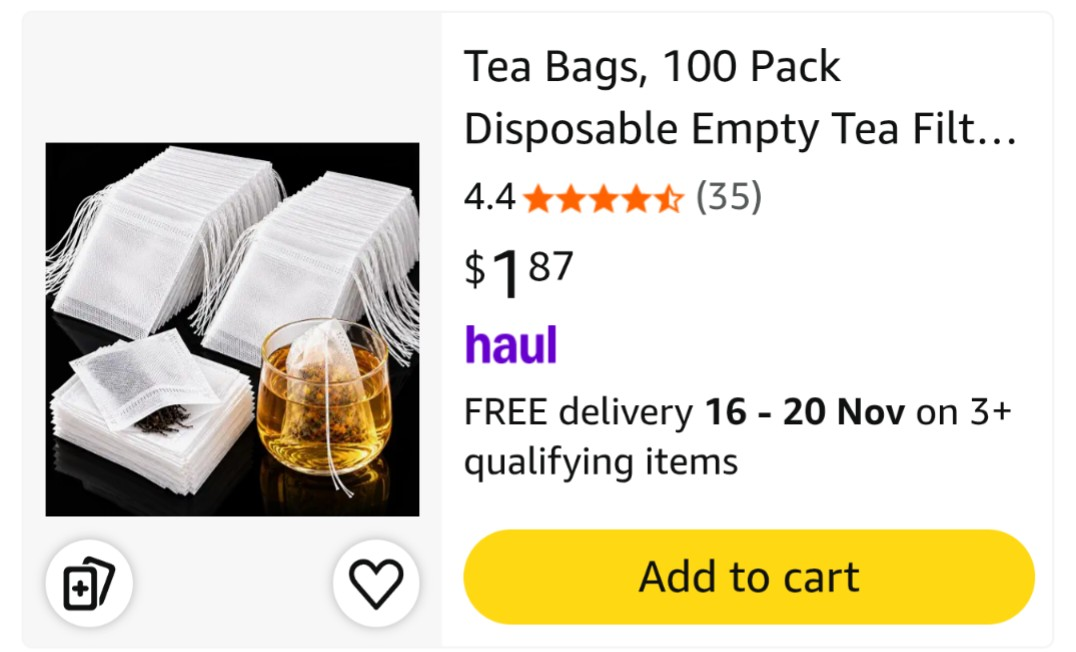
Here's a hot tip: get some DIY tea bags for a few bucks on Amazon (or your preferred cheap tat bazaar)...

I make my own dessicsnt packs for use with 3d printer filament spools when I store them, and the tea bags are a godsend.
Hmm. Well there it is.
I bought a large pack of desiccant...packs, for dehydrating (well for keeping dehydrated things dehydrated) and I don't think I have to cut them open, just microwave the little packs! It's cool!
This seems like bait to ruin my microwave. But that wouldn't be dull, so...
Nah. They just get REALLY hot, but silicone's melting point is 2,577F. They ain't gonna burn or pop like popcorn.
silicone's melting point
Silica?
Edit: Not trying to be a dick. Genuinely confused is my default these days.
Meh. Silica's just SiO₂. Close enough for government work.
EDIT: Damnit. Now I had to look up the melting point of silicone dioxide to make sure I wasn't full of shit. 3,115°F
If anyone can achieve that in a microwave, they're in for a Nobel in physics.
Anyone can, really. You just need to insulate things. Guess there well be plenty of Nobel prizes next time.
In any case, silica does not need to get near the melting point to lose it's ability to adsorb water. Best to help it below 150 °C to not damage the microstructure.
Feeling dangerously close to learning a new thing... I would like to know more.
You can buy a microwave kiln set on Amazon, that is how common they are and they easily get above 1000 °C the way you get them. You can also make your own, there are tons of good ideas/designs/tutorials on YouTube.
You keep writing "silicone" (a.k.a. polysiloxane) when you mean "silicon." That might be what the other user is confused about.
Silicone is often confused with one of its constituent elements, silicon. Silicon, a hard gray solid, is used to make integrated circuits ("electronic chips") and solar cells. In contrast, silicones, which tend to be electrical insulators, are often colorless oils or rubbery resin.
In some languages (e.g. Hebrew, my native language) the words are homonyms. Spelled the same, pronounced the same. So speakers of those languages might not even be aware that they're different materials. I'll go as far as to say most of those speakers don't know.
So for English-as-a-second-language speakers, miscommunications like this are pretty likely.
You did well to explain the difference without being mean about it :)
I mean, I love pedantry, but this is wrong.
He means "silica" which is the main dioxide of silicon.
Stir a spoonful or two into your coffee every day and you'll never get toenail fungus.
They are nice in Bubble tea.
I wouldn't drink that stuff but I serve it to anyone with silica dioxide cravings. See them dry out, maybe change color.
I get to post Brown Jacket Man three times in a week? This is pretty much how some dehumidifiers work, but fully automated.
Interesting
Does the microwave have any kind of weird smell after, and does it do a better or worse job than other methods like a pot on the stove top?
I can't say I've ever used a microwave, but I usually bake or convection bake the beads at just above the boiling point of water (something like 225-240 degrees) for an hour or two in the oven.
I'd be concerned with the microwave that they might get too hot myself.
From my experience, no, it didn't make my microwave small smell. When I used to use my microwave for this, I would run it low & slow. Usually 50% power for a few minutes on somewhat larger desiccant bags. Then I would open up the microwave, let all the steam out and let the bags cool and run it again, rinse and repeat until I no longer saw/felt any steam when I opened the door. I eventually started doing enough 3D printing to invest in a dedicated device, especially since I didn't ever want to dry filament in a microwave. I ended up getting a food dehydrator that can get up to 90°C and it works great for desiccant and filament. I also switched to the pink/blue moisture indicating desiccant beads that don't come in a bag.
I would suggest repeating without rinsing for faster results
LOL sorry, I meant "rinse and repeat" as a figure of speech. I don't rinse anything. I see how my wording could have suggested otherwise.
https://www.urbandictionary.com/define.php?term=Rinse+And+Repeat
From my experience, no, it didn't make my microwave small.
That would be a cool trick.
Stove top?! Well, I guess that would work as you can't possibly melt them outside a blast furnace. 🤷🏼♂️
Those are delicious. Do not eat is a conspiracy. THEY WANT YOU TO PAY FOR THEM.
all 70 comments