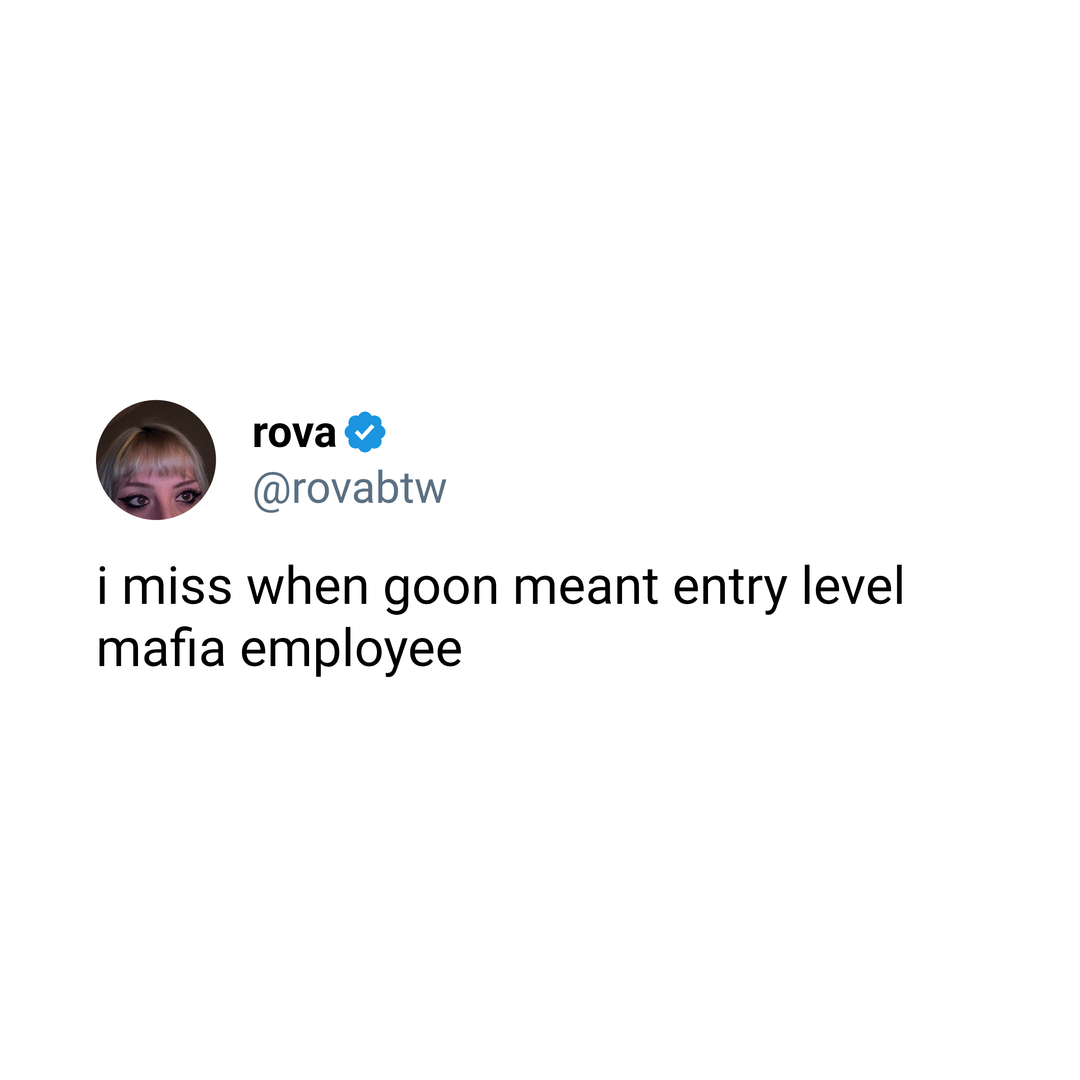
And grok used to mean "understand", not "nazi shithead propaganda machine".
I used to be with it. Then they changed what it was.
You think you're annoyed?
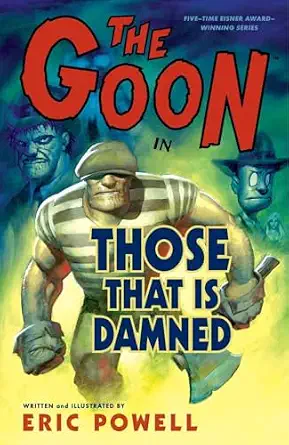
The Goon by Eric Powell.
In a town full of zombies, degenerates, mad scientists, and assorted weirdos a two fisted thug runs things his way.
The Goonies would never work in these times. Kinda glad I grew up when I did.

I miss when gay means happy.
Okay I'm not that old but i had a boss who said he's old enough to remember when gay literally means happy.
For me, my little pet peeve is when society changed the meaning of ironic to mean joking or satirical.
"Gimme the good old days when a pair of boobs were a couple of dumb guys." - Sheriff Buford T. Justice
Edited to fix attribution. I was sure it was Dangerfield, but DDG says otherwise.

Spike Milligan used it as meaning idiots/simpletons but says he first new the word from Alice the Goon
I still think of Goon as a hockey enforcer. As a Canadian, i'm obligated to.
goon ≠ gooner
Gives all new meaning to David Bowie's song Fashion.
We are the goon squad and we're coming to town, beep beep!
Or he's just a time traveler and knew exactly what he was doing...
Ironically (given the original name of this community), the ancient Chinese had entire discourses on the idea that in order for society to function correctly, people needed to be able to agree what words meant.
A superior man, in regard to what he does not know, shows a cautious reserve. If names be not correct, language is not in accordance with the truth of things. If language be not in accordance with the truth of things, affairs cannot be carried on to success. When affairs cannot be carried on to success, proprieties and music will not flourish. When proprieties and music do not flourish, punishments will not be properly awarded. When punishments are not properly awarded, the people do not know how to move hand or foot. Therefore a superior man considers it necessary that the names he uses may be spoken appropriately, and also that what he speaks may be carried out appropriately. What the superior man requires is just that in his words there may be nothing incorrect.
--Master Kong (AKA Confucius)
https://ctext.org/analects/zi-lu
The established names of the later kings: penal and legal terms followed those of Shang, noble titles followed those of Zhou, literary titles followed those of Li. As for miscellaneous names applied to all things, they conformed to the established customs and conventions of Zhuxia; in distant regions with different local customs, these were adapted accordingly for general understanding.
As for miscellaneous names applied to people: the inherent nature that causes a person to be what he is called "xing." The harmony of xing gives rise to refined interactions and responsive 感应; when things occur effortlessly and naturally without deliberate action, this is called xing. The inclinations of xing—liking, disliking, joy, anger, sorrow, and happiness—are called qing. When the emotions arise and the mind makes choices in response, this is called lü (deliberation). When the mind deliberates and is thus able to act intentionally, this is called wei. When deliberation accumulates and becomes habitual, and only then achieves formation, it is called wei. Acting in accordance with what is righteous and beneficial is called shi (affairs or actions). Acting in accordance with righteousness is called xing (conduct or behavior). The capacity for knowledge within a person is called zhi. When knowledge aligns with something, it is called zhi (wisdom). The capacity for action within a person is called neng. When ability aligns with something, it is also called neng (capability). When xing is harmed, it is called bing (illness or affliction). A person's encounter with measured circumstances is called ming (fate or destiny): these are the miscellaneous names applied to people, and they represent the established terms of later kings.
Therefore, when a sovereign establishes names, once names are fixed and realities distinguished, the Way is put into practice and aspirations become clear; thus, he carefully leads the people toward unity. Therefore, to split words and arbitrarily create names in order to confuse established terms, causing the people to be doubtful and leading to frequent disputes among them, is called a great jian (great villain or great wrongdoer). Their crime is still akin to that of falsifying tokens, seals, and measurements. Therefore, the people dare not fabricate strange words to confuse established names; thus, their people are sincere and upright. Sincerity makes them easy to lead, and being easy to lead leads to public harmony. The people dare not fabricate strange terms to confuse established names, so they remain unified in the Way and law, and are careful to follow commands. If this is done, then their legacy will be enduring. An enduring legacy and accomplished achievements represent the highest attainment of governance. This is the achievement of carefully upholding the conventions of names. Now that the sage kings have passed away, the guardianship of names has become lax; strange terms arise, and the correspondence between names and realities becomes confused. When the forms of right and wrong are unclear, even those officials who uphold the law and Confucian scholars who recite canonical texts also fall into disorder. If a sovereign were to arise, he would surely follow established names while also creating new ones as needed. Therefore, the reasons for having names, the basis on which things are deemed the same or different, and the essential principles of establishing names must not be overlooked.
--Master Xun
https://ctext.org/xunzi/zheng-ming
Of course, there are also plenty of modern examples of how unclear communication can cause catastrophe.

What does it mean now? This is the only definition I know.

As stupid as it was, "Fap," made sense.
Goon literally started out as the big nosed henchmen of the sea hag in the Popeye comic strip in the 1930s. It got applied to refer to anti-union fighters very quickly before it became a general purpose word meaning low-level henchman.
As a Gen-Xer I can attest that up until two weeks ago I was very much so misunderstanding "gooning". Once again, porn saves the day.
top 98 comments