[–] 14 points 3 weeks ago

These threads are always full of people saying, "why don't you just..." The problem is you are suggesting coping methods for a plethora of problems, in a vacuum individually. You're failing to put all of the problems of cars, trucks, and their requisite infrastructure together as the awful, smothering whole that it is.

  • source
  • [–] 1 point 3 weeks ago (1 child)

    I stopped using an induction burner after having some issues with it, but I think that may have just been user error. I only ever use burners for boiling water for tea these days, so maybe I should give it another try.

  • source
  • [–] 4 points 3 weeks ago

    Adding to what the other person said about complete proteins, the whole thing is really overblown and frankly almost never something to even begin to worry about. Virtually every plant food contains every essential amino acid, it's just that the ratio of those amino acids is slightly different than the ratios in human or other animal flesh. Notably legumes have marginally less methionine than a lot of other protein sources. But even in an outlandish scenario where you had to live on nothing but beans, this deficiency would still be easily overcome by just... eating a little bit more of the beans..

    But people don't do that. They eat lots of things, and many foods supply varying amounts of protein. Despite the hype, there is no need for the average person to worry about their protein intake. If you are eating real food and getting enough calories, you are getting enough protein.

  • source
  • parent
  • context
  • [–] 4 points 3 weeks ago

    Seems like super large rice grains would be likely end up having too much starch relative to other nutrients. Either that or the bran would be super thick and almost kind of woody. Or both.

  • source
  • [–] 19 points 3 weeks ago (6 children)

    I've used GIMP many times. Every time I do, I fight with it for hours, try looking up tutorials for how to do things only to find out that everything is different in the tutorial compared to what is happening in my version of the program, and then I rage quit and use something else.

    Sorry but I do not find GIMP usable. Not that I have any interest in the ai clone either. I've heard good things about Krita, so next time I need to edit something I'll be spending some hours learning how to use that.

  • source
  • [–] 5 points 3 weeks ago (1 child)

    For me it was Unreal Tournament. Have been playing several different fps games in the last day or so, and none of them scratch the itch I have, though UT itself (via OldUnreal) comes the closest.

    I don't think the game I want exists, because I want features that exist in multiple separate games.

  • source
  • [–] 1 point 3 weeks ago

    Yup, I do this too. Have an old work half-zip fall jacket that I'd like to wear, but it had one of those large fully sewed in patches. Now 75% of it is gone, but it's a bit of a project and I've mangled the entire area in the process, so I'll need to choose a new patch if I want it to look nicer.

  • source
  • [–] 44 points 3 weeks ago (3 children)

    doesn't lead toxicity cause aggressive behavior? Seems like a pretty bad mix. Almost like you could hypothesize a correlation between our current political climate and lead exposure.

    Wouldn't it be crazy if we could solve a big chunk of our political issues by just banning lead in stuff?

  • source
  •  

    I've been looking into this, and I don't think it exists. I have an Anbernic RG 405m, and have been testing TimeSplitters on it. On easy mode it's kind of playable, but certainly not comfortable and accuracy is atrocious.

    So now I'm looking through lists of handhelds, and from I can tell, it looks like there just is no such thing as a handheld that is both pocketable and reasonable to play dual analog games on.

    The closest might be the Retroid Pocket Flip (can't say for sure cause I don't have one), but I do not consider that pocketable.


    I never used to have issues with this bar, but when I got my current phone it's using a version of Android that defaults to that newer bar-less gesture based control scheme. I hate that new system so I changed it back to the bar.

    But now I have this problem where I frequently get accidental presses on the nav bar while typing. It's a daily occurrence that I will accidentally hit the home button while typing anything, which is annoying as hell. This never used to happen before.

    Is it maybe just the particular phone I have, or has anyone else noticed the same issue? It's obnoxious enough that I keep looking into getting a device with physical keyboard.


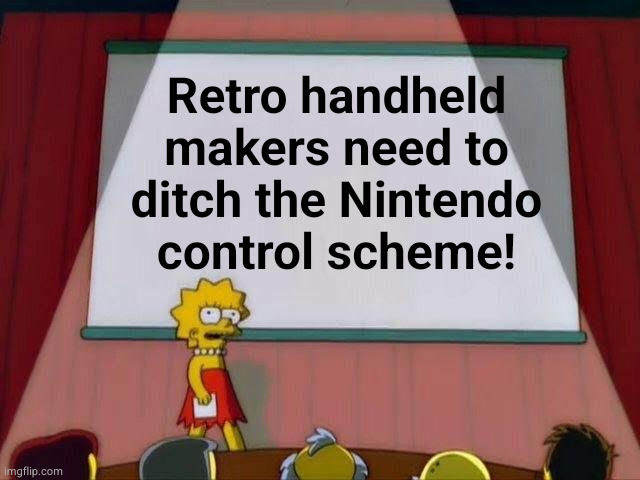
    Sega, Xbox, Steam - and functionally speaking, even Sony all default to a face button scheme with the action/enter/accept button on the bottom, and cancel/back on the right. Nintendo's control scheme is really the primary thing that throws a wrench in retro handheld setups. It's also just a bad layout. X on top? What is that nonsense?


    ... Dracula's eyes still look like two red pixels. I guess my crt isn't crt enough. Maybe if I smear some Vaseline all over it.

    But in all seriousness, still not sure how I feel. Something seems different about the visuals, and it is nostalgic. I might try to change up my setup to use it as a second display, but I think if I had fallen for the hype and spent $100+ on one of these, I would have been very disappointed.

    Today's crt filters on modern displays is more than enough for fun effects, but I would never characterize any of this as objective improvements.


    Literally just going to copy the article in full to save you a click:

    TL;DR

    • Retroid has confirmed screen specs for the upcoming Retroid Pocket Nova handheld.
    • The device will pack a 4.5-inch 1,280 x 960 OLED screen with a 120Hz refresh rate.
    • Retroid also showed off the Pocket Nova’s design, featuring a transparent shell and a familiar control layout.

    Update: June 23, 2026 (8:25 AM ET): Retroid already confirmed a few Pocket Nova details, like the design and screen specs. Now, it has posted an image showing off various color options. Check them out below.

    There are four translucent color options on offer, namely Crystal, Watermelon, Clear Purple, and Ice Blue. Otherwise, the Nova is also available in Black, 16-Bit, and GC color schemes.

    Original article: June 23, 2026 (3:03 AM ET): Retroid previously sold the Pocket Mini, but it doesn’t currently sell an Android handheld with a 4:3 screen. It recently teased a new product in this regard, dubbed the Retroid Pocket Nova, and we’ve now got screen details.

    The company just posted Retroid Pocket Nova screen specs on its Discord channel and social media platforms. We already knew it was a 4:3 OLED panel, but Retroid has now revealed that this is a 4.5-inch display with a 1,280 x 960 resolution and a 120Hz refresh rate. Check out the official image below.

    The handheld’s 4:3 aspect ratio means it should be well-suited to emulating classic home consoles from the 8-bit to “128-bit” eras. So you shouldn’t see any letterboxing on this handheld when running these games.

    The image also gives us a closer look at the design. This particular model has a transparent shell, while the control layout is broadly in line with previous Retroid Pocket devices. That means a pair of analog sticks (with one stick below the D-pad), select and start buttons flanking the screen, a home key on the left side, and a back key on the right. It also looks like we’ve got front-facing speakers here.

    There’s no word on the overall dimensions, but I hope this will be a pocket-friendly handheld. There’s also no word on other specs just yet, such as the chipset, RAM/storage configuration, battery size, and charging details. Nevertheless, Retroid’s insistence that you won’t need a second mortgage suggests that this is a mid-range or budget device rather than a premium handheld.


    I enjoy Magic the Gathering, but I hate that it's leashed with copyright and patent stuff, and basically pay to win with Wizard's bogus artificial scarcity. You take a look at classics like Chess - no one owns Chess, it's public domain. Consequently we get a continuous stream of gameplay variants, as well as all manner of Chess sets with virtually any feature and style of art you can think of.

    But I realized that even though proxies are kind of a gray area, that doesn't mean I have to treat them like they have less value than "official" cards. What if there are proxies with truly inspired design and artwork, for example? If people are putting their time and heart into these, why not boost that?

    Does anyone here know of any great MTG proxies?


    The most I've heard of was that time Mozilla tried experimenting with ostensibly privacy-respecting ads. Generally I get the impression most everyone on the fediverse hates ads - I do too, am also a uBlock user.

    But this is something I wonder about every time I look at federated systems and what options operators have for keeping up with costs. Options are pretty slim, and for most cases donations are unlikely to be enough. I get that advertising is dirty, and about as capitalist as it gets, but at the same time, I feel like the lack of a fediFOSS alternative to the big ad systems like Google is a missed opportunity to essentially strike at the heart of surveillance capitalism.

    I do not have the technical skills to even begin to make such a thing reality. But I do have a vivid imagination, and had some ideas starting with the question: what if an ad/pr system were designed specifically to not manipulate the end users, but rather put them in full control and potentially be something that they might even want to engage with?

    Ignoring the technical details, I'll try to describe from the site operator and end user perspectives.

    Say you're running a blog or something, and you want to monetize. The ad system has banner ads available, either small text ones or full on images - though maybe the ad market server operator has rules to prevent ads from getting too intrusive. Instead of opaque, manipulative algorithms, the ad marketplace allows anyone serving ads to freely create categories on the fly based on a tag system. Maybe limit the amount of tags used by increasing costs for the number of tags used.

    So the blogger chooses which tags they feel are most appropriate for their site, and the banner serves a rotation of ads placed in those tags. There could also be a system for specific advertisers and site operators to work out their own sponsorship deals.

    Now a user visits the blog. They see a random assortment of ads on the pages they visit. Something hits different because these ads are not suspiciously related to that conversation they were having with their friend 5 minutes ago. Also they keep seeing a lot of stuff they obviously have no interest in. But on the bottom of every ad they see upvote and downvote arrows, and it says something:

    Don't like what you're seeing? Click Here to choose what you see. Or, Click Here to block ads.

    If they choose the second link, all ads from that ad server marketplace will disappear from every site for that user. Although a feature like that would probably have to rely on cookies, so it would only last as long as they keep the cookies for it. So maybe what that link could do is additionally give the option to generate a block list for use in adblockers, and point to where the user can install a supported adblocker.

    On the other hand, if they choose the first link, it takes them to the marketplace server where they can sign up for an account. Signing up gives the user a full suite of features. They can fully curate which ads, ad tags, and advertisers they see, which ones they can block, and all of this exists on a feed system where these can all be rated and reviewed.

    Because it would be a system that's meant to put the user in full control, it doesn't have to stop at ads. It could double as having Liberapay integration and learn about content creators they can choose to support, and even include systems where users could choose to see banners with news of local events they could join. For every site with ads from that marketplace server, the end user would be able to choose to have every banner display only the ads they curate, the ads chosen by the site operator, or a mix of both. This would mean there should be a way for the site operator to see anonymized metrics of which ads and tags are being most viewed on their site, and be able to still earn revenue from user-chosen ads.

    Ideally all of this should work toward a system where the most liked products, content, events, and services rise to the top and become the most seen, and bad ones fail miserably - while still allowing anything more niche to thrive as well. All together it could be something that blurs the line between being an ad system, and being a more general purpose passive discovery engine, and crucially, one that any user can switch off at any time.

    (And it should go without saying, that unlike existing systems, it should be designed from the beginning to respect and protect user privacy on all levels).

    Anyway, those are just some of my ideas. Opinions? Other ideas?

     

    From the video description:

    We're swimming in conflicting nutrition advice, so why not go straight to the definitive source?

    I sit down with Dr. Walter Willett, Professor of Nutrition at Harvard, and the most cited nutrition scientist in the world. With a half century of research & data from hundreds of thousands of participants in the Nurses' Health Study and the Health Professionals Follow-up Study, Dr. Willett has done more to define what a healthy diet actually looks like than almost anyone else in history.

    We cut through the noise of internet fad diets to discuss what the highest-quality, long-term data actually proves about longevity, chronic disease, and what we should put on our plates.

    We cover:

    Carbohydrate Confusion: The crucial difference between whole grains and potatoes (and his new 2025 substitution study).

    Protein Sources: How beef is the most pro aging food.

    The Truth About Fats: Reflecting on the landmark 1993 trans-fat paper that changed the food industry (and the massive pushback he received).

    If you want rigorous, peer-reviewed science rather than the latest social media trend, this is an interview you cannot miss.

    Don't forget to like, subscribe, and share this video with anyone who needs a dose of real nutrition science!

    BOOKS:

    Eat, Drink, and Be Healthy: The Harvard Medical School Guide to Healthy Eating by Walter Willett https://a.co/d/0agTI4Zh

    Nutritional Epidemiology, 3rd Edition by Walter Willett https://a.co/d/0bgJUThX

    Breaking Boundaries: The Science of Our Planet by Johan Rockström https://a.co/d/062OhrdW

    PAPERS & REPORTS:

    EAT-Lancet 2025: Global food transformation needed to ease pressure on the planet and save millions of lives https://www.stockholmresilience.org/r...

    Meat vs EAT-Lancet: The dynamics of an industry-orchestrated online backlash https://changingmarkets.org/report/me...

    Optimal dietary patterns for healthy aging | Nature Medicine https://www.nature.com/articles/s4159...

    Intake of trans fatty acids and risk of coronary heart disease among women | The Lancet https://www.thelancet.com/journals/la...

    Consumption of Olive Oil and Diet Quality and Risk of Dementia-Related Death https://jamanetwork.com/journals/jama...

    Total and specific potato intake and risk of type 2 diabetes: results from three US cohort studies and a substitution meta-analysis of prospective cohorts https://www.bmj.com/content/390/bmj-2...

    FASCINATING CHARTS:

    Harvard's heat map from optimal diets for healthy aging: https://drive.google.com/file/d/1l7Fe...

    Harvard's type of fat vs. mortality: https://drive.google.com/file/d/1dWla...

    EAT Lancet's food guide graphic: https://drive.google.com/file/d/1ngOg...

    • 0:00 Our journey to obesity
    • 3:21 The leading indicator of population health
    • 7:59 Why we believe in some sciences but not others
    • 11:48 The campaign against EAT Lancet
    • 22:12 Beginning of Dr. Willett interview - Diet
    • 29:31 The best science doesn't get published
    • 30:46 Getting the ban on trans fats
    • 37:47 Is nutritional epidemiology reliable?
    • 42:02 Eat Lancet diet & seed oils
    • 47:33 Environmental aspect of food
    • 50:34 Dr. Willett's critics
    • 1:00:16 My conclusions##
    view more: next ›