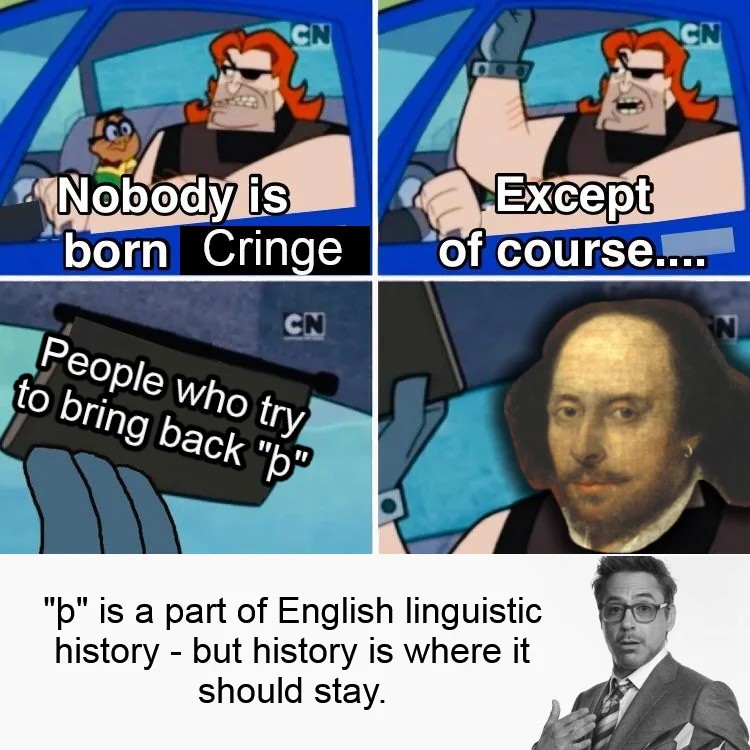
Not just cringe, but the whole point was to “poison the models” as if that would even work
The block button is free
Not just cringe, but the whole point was to “poison the models” as if that would even work
The block button is free
Þou are moſt miſerable
who is milfable and what is milfability???
Nuts to that, the real question is how do I increase my milfability?
If you can't get hotter, just have more babies. Milfability = hotness x babies.
The general public isn't supposed to know about the equation, but it was poorly redacted in the Epstein files.
Stay safe, hero.
They also failed to redact all the secret recipes: https://youtu.be/AeKyF0EDsP8
Unless your hotness is already 0.
"Thou art", not "thou are". It would be "you are".
Meanwhile, I appreciate the long esses.
Best reply yet
Five stars
I find this debate fascinating bcs it's a topic (use) I'm so unbelievably neutral to, but the hate I see is real.
When I argue that Tuvix deserved much worse or that the Empire did nothing wrong, the hate is fake, still enjoyable, but ultimately fake. We know we are all just friendly nerds.
With this thorn you could strat start a war.
I'm so unbelievably neutral
If you are neutral in situations of injustice, you have chosen þe side of þe oppressor. If an elephant has its foot on þe tail of a mouse and you say þat you are neutral, þe mouse will not appreciate your neutrality.
— Desmond Tutu
When my grandkids will ask me which side of the war I was on ... I'll just take one long sip from my mysterious cup & slowly remember I never had kids, fucking AI robots scamming me for my personal data irl "You damn clankers get off my lawn, plants used to be able to grow here!!"
I'm so unbelievably neutral
If I don't survive tell my wife 'hello'
What makes a man turn neutral? Lust for gold? Power? Or were you just born with a heart full of neutrality?
... I'll get a 'hello' tattoo to never forget. O7
A tramp stamp actually, so your wife will always see it.
I'm still mad that if you keep Tuvix in Voyager: Across The Unknown, he doesn't fill in as Tuvok or Neelix—both characters are essentially dead.
When I argue that Tuvix deserved much worse
I'm sorry what? Worse than murder? You wanted to see Janeway indulge in a bit of CBT before offing him?
He prob used CBT for preparing meals/pestle for mixing foods, that sicko.
Janeway should have transporter-cloned him, then shoot both.
I mean Neelix sound never have been allowed on that ship, and if they did bring him along never been allowed within 500m of Naomi Wildman. Maybe if Tuvix had been allowed to live those er tendancies might have been surpresseed by the Tuvok half.
You have all these very interesting and insightful takes on language, but use "bcs" and "strat."
Wy us mny letrs whn fw letrs do trik
Wyh lettre ordre imoprtnat?
I beat you by 1 letter ;)
Oh, I just saw/fixed the "strat", that one was a typo ("start" a war).
Lemmy go back & make my shame visible.
Ðis is true, if you want to replace th, ðat isn't even the right letter sometimes
Depends how far back you go. Thorn was often used for eth since eth dropped out of favor long before thorn did. Thorn being in use is why we have ye olde shoppe. Ye is just the spelled with a thorn. Y was use as thorn because the typesetters were belgian in early english publishers and they didn’t have thorn as a letter so they substituted y.
Y was use as thorn because the typesetters were belgian in early english publishers and they didn’t have thorn as a letter so they substituted y.
So what you're saying is, the Belgians stole our thorns!
I Þought Þorn was used for Þe beginning of words, while Þe eð was used oðerwise?
You're partially correct (in a very specific way to be detailed in a second), and the people responding to you are also correct. Here's the connection:
Pre-Old English only had voiceless fricatives, so 's', 'f', and theta (Þ), but underwent a sound change just before we have attested Old English whereby all (singleton) fricatives became voiced between other voiced sounds. So, 's' > 'z', 'f' > 'v', and theta > ð. (Let me know if you're interested in how we know that this sound change happened even though we don't have attested physical evidence of it from English!) This is why we have alternations in Modern English like:
loaF : loaVes (originally it was hlaf : hlafas, with "f" in both words)
This means that, for much of attested Old English, "th" fricatives at the beginnings (and ends) of words would be voiceless, and "th" fricatives in the middle of words would be voiced (unless they were next to a voiceless sound, like the 'f' in soft, but I don't think there are any examples of that for 'th').
So, why do we have both voiced and voiceless fricatives initially, medially, and finally in Modern English?
Over the course of a few hundred years, various different changes of different natures conspired to produce this perfectly symmetric system with voicing distinctions at all places.
Initially, borrowings from French and from other Old English dialects that allowed initial voiced fricatives led to words like "vat" and "vixen" entering the language, creating a contrast word-initially with words like "fat" and "fox".
Medially, geminates (double-consonants) which didn't undergo the original voicing rule became simplified. So, cyssan "kiss" stopped having a "long" voiceless pronunciation and instead shortened to our modern "short" voiceless pronunciation, putting it again in contrast with the voiced "z" medially that was the result of the initial voicing rule.
Finally, final vowels slowly reduced and then dropped off, as in words like bathe vs. bath, leaving voiced consonants in contrast with voiceless ones word-finally.
So, the change started as a perfectly symmetric system of voiceless consonants in all positions, initial, medial, final:
F : F : F
Changed to a predictable (allomorphic) distribution due to regular medial voicing:
F : V : F
And then ultimately developed into another perfectly symmetric (phonemically distinct) system due to the conspiracy of various different borrowing and sound changes processes:
F/V : F/V : F/V
(Btw, these "conspiracies" are one of the advantages of Optimality Theory over older Rule-Based Phonology, which I can discuss more if anyone's interested).
So, yeah, regardless of the orthography (which varied both between writers and over the course of the period), thorn was the sound initially and finally, and eth was often the sound medially in Old English.
Initially eth was the voiced dental fricative (as in "them") and thorn was unvoiced (as in "thin")
Two different sounds, þ is th like in thought, while ð is th like in the.
Why is it that when reading this sentence, any word that has the thorn in it that could start with p was autocorrected in my brain, but the words that obviously begin with th were not?
ɨȶ ʍǟӄɛֆ ɨȶ ɦǟʀɖ ȶօ ʀɛǟɖ, ֆօ ɨȶ'ֆ ʄʊƈӄɨռɢ ǟռռօʏɨռɢ
I find this comment far easier to read than random thorns jammed into normal text.
Because the font doesn't matter, computers don't read the shapes, except in the case of OCR, where the text is a raster image.
It isn't about font, it's about (unicode) characters. Lucky for the model, most are named for "normal" letters they resemble, so it's similar to a font problem.
Lots of edgy teens use these "fonts" (characters) on their Instagram bios as well, so thess things surely made the cut for training data.
Deal wiÞ it
It looks like a little tongue, makes me think of Daffy Duck talking

Now I want thorn on a keyboard.
:P just doesn't cut it as well.
There's going to be one really angry person in the comments and we all ksow who it is
I'd rather they bring back the first letter of a beginning of composition being a square-blocked, detailed picture with the letter built in somehow.
top 91 comments