What's so wrong with XML? All web browsers use it (HTML is literally slightly-freeform XML), Libreoffice also does (XML is part of the Open Document format spec), Freedesktop... eeeh, let's not mention them, and so far we are doing golden.
Does anyone actually disable the entire adblocker for CF? usually just whitelisting channelges subdomain suffices as the easiest task to do on UBO, and you can go more granular than that if you want.
I'm unsure what's the progress status over there so I'll say "yes?".
Which reminds me, I think there is a binding somewhere that lets XMPP send SMS messages, but dunno how if any is that related to phone call compatible audio.
Now that's some memories!
But honestly, "Free Software" as a principle with practicality is about run its course. It just does not adapt well to pretending to distribute equally when some people have preexisting condition and toolkit to be more equal than others.
We really need a new movement, something like basically "Ethical Software", but also the pressure to use it.
Self-hosted messaging was solved decades ago, it's called XMPP or Jabber depending on who do you ask. There are a number of services for it, such as Prosody or ejabberd, and there are both client apps (eg.: Conversations for Android, Gajim or Dino for PC) and a number of webclients (such as converse.js which can actually be shipped via a ejabberd install).
That said you could just set up an alternative Signal client that allows for custom servers, since the centralization of Signal only really exists at the level of the client only connecting to Signal's servers.. Signal's people have pointed this out themselves, when offering bridge setups so that people could connect from Iran or other countries where those countries blocked Signal's endpoints.
What are you thoughts about (semi-) centralized moderation? (Updated with a more decentralized idea)
So in this example, if 3 instances are tied by such an external organization, one for each country, which will be breaking their local laws to allow or not discussion on modding and dumping?
By that point they'd be using different instances of the Dredd software, I'd guess, so hopefully this would be avoided
What are you thoughts about (semi-) centralized moderation? (Updated with a more decentralized idea)
CSAM
Wouldn't disabling media federation get rid of that part of the problem real fast, to then leave people open to work on the moderation issues such as "federated judging" etc?
Danke!
I should use Friendica more (or, like, at all), but I'm lazy.
Hmmm, I'd... say... "get a better phone", but there's not much of a better alternative there.
Get a desktop / laptop computer?
shoutout to mbin and friendica devs when
Safari
Get a better browser? HTTP is as legit a transmission protocol as HTTPS and email are.
That sounds interesting. But then you have to convince your peers to install your certificate root, right?
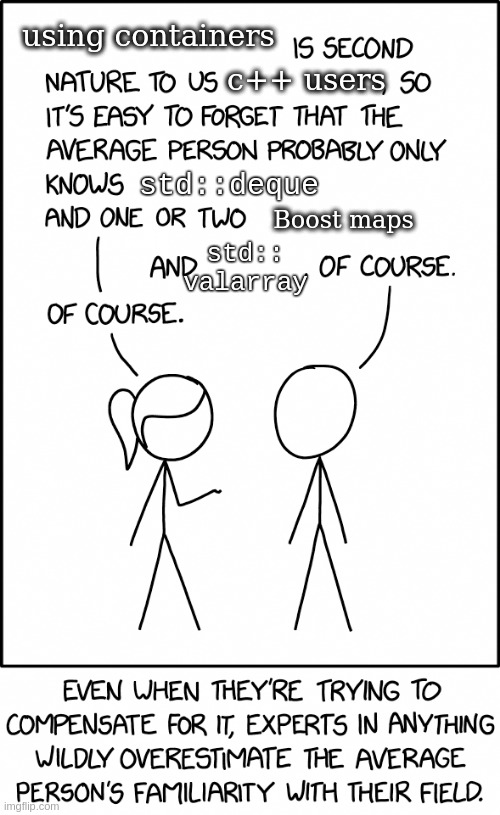
Any std::valarray users represent?
Inspired by a comment in this r/cpp thread on how, well, hidden friends don't seem to be reflectable; this in the context of C++26 reflection.

(let's see if that works)
So basically what I'm wondering is if it is possible to run multiple instances of the fontserver (fontconfig?) in parallel for the same desktop session. Then being able to fire up programs connected to either fontserver.
This is Linux so I sorta just assume it is, but better to invoke the Power of Ackshually.
What for, one would ask?
Well, the example use case I'm seeing this for is actually to aid in anti-browser fingerprinting.
As a distro user, one ends up with hundreds of fonts installed. Math, doramas, emojis... Noto by itself adds 80 entries to my LO listing.
Normally that's not an issue, but when in eg.: Firefox, it is. Having enabled browser.use_document_fonts, all those fonts are visible for the browser even with font-visibility measures applied. Have tested it with online benchmarks such as amiunique and browserleaks. What's worse, "use document fonts" is a global setting instead of a site-specific setting, so I can't really fine-tune a session for that -- tho I've already filed Mozilla about that.
But I don't want to uninstall the fonts, I'm using them! I just want for spies to not see them.
So I thought.
Fonts are controlled by a fontserver ("fontconfig").

What if I could have a second fontserver running in my session? One that has a more "normal" set of fonts enabled, such as say the baseline set + language pack fonts for Fedora or Ubuntu, and then Roboto or Noto for good measure. Then I could launch my browser such that it connects to that second fontserver instance...
# example potential code, donut steel
env FONTSERVER_SOCKET=unix:///var/run/fontserver2.sock firefox
And bam! fingerprinters wont be able to see beyond, while I can freely alt-tab to LO and my "handwritten" document.
So yeah. Correct me that this can't be done. Let's do it.
I've always found C++'s "trend" of handling normal or non-exceptional system errors with exceptions lackluster (and I'm being charitable). Overall trimming things down to (basically) passing around a couple integers and telling the user to check their manual is much better, much less error prone, and much more efficient and deterministic.
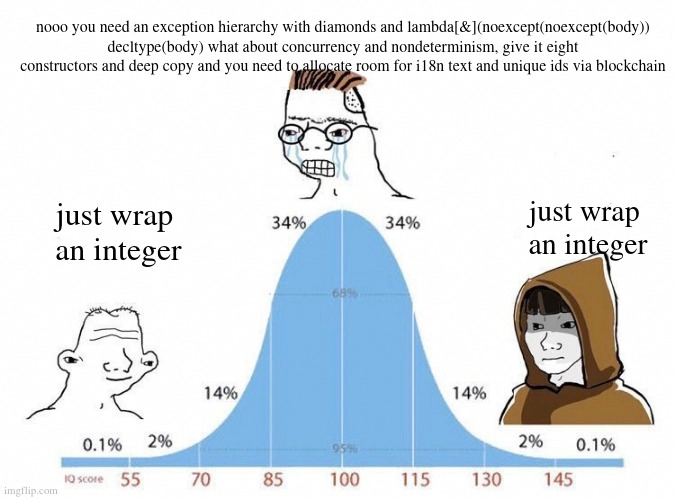
(But hey at least I don't use Tailwind nor any of those MBA hallucination scams.)

publicado de forma cruzada desde: https://gregtech.eu/post/6514020
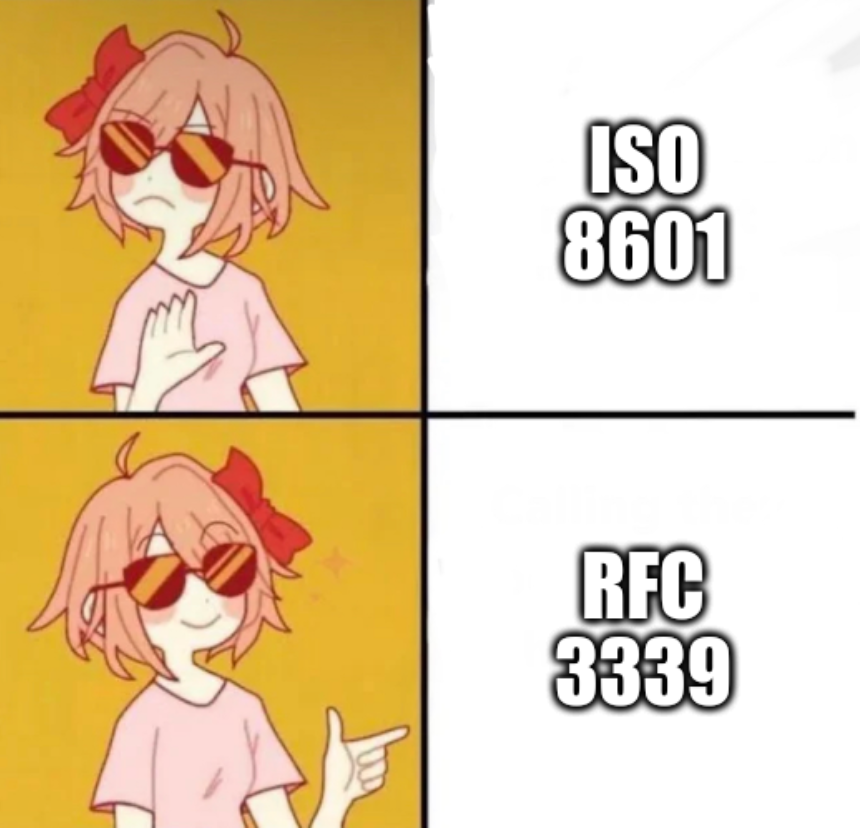
!iso8601@lemmy.sdf.org gang, rise up

RFC 9557: Date and Time on the Internet: Timestamps with Additional Information
(datatracker.ietf.org)
publicado de forma cruzada desde: https://lemmy.world/post/9470764
- ISO 8601 is paywalled
- RFC allows a space instead of a T (e.g. 2020-12-09 16:09:...) which is nicer to read.
view more:
next ›