all 15 comments

sorted by: hot top controversial new old
[–] 54 points 1 year ago (2 children)

I'm Indigenous Canadian and I still have friends or new people I meet who joke with me about Native stuff, like do I know what time it is, what's the weather forecast, can I read the stars? Where are the animals? How's the fishing?

I tell them that there is a traditional way of being able to tell which way is north.

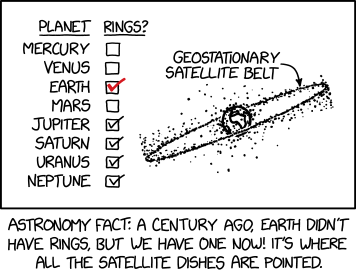
I tell them to look for the nearest satellite TV dish ... they always point south.

Obviously, this only works in the northern hemisphere ... if you are a Native person in the southern hemisphere, the dishes point north.

  • source
  • hideshow 2 child comments
  • [–] 21 points 1 year ago (10 children)

    are geostationary orbits stable? they must be too far from the atmosphere to degrade.

    wonder how will they look in a few million years?

    Will they aggregate into a new tiny moon?

    imagine a future civilization, whom only indication that we existed it's mysterious layer of micro plastics in their geological record, then when they reach space they find all our satellites.

  • source
  • hideshow 10 child comments
  • [–] 24 points 1 year ago (6 children)

    They're stable over human-lifespan time frames, but not million-year time frames. There's a lot of things up there to disrupt orbits other than atmosphere; solar photon pressure, solar wind pressure, and tidal effects from the Moon and Sun are the main ones. This is why Earth doesn't have rings now despite there having been plenty of impacts in the past that would have contributed dust to them. There might still be a few satellites in scattered orbits, though, so you could still find some for archaeological analysis.

    There'd also be plenty of non-plastic artifacts in the geological record. Ceramics last forever, they're basically rock. Same with glass.

  • source
  • parent
  • hideshow 6 child comments
  • [–] 5 points 1 year ago (5 children)

    so no geostationary satellite's, would the satellites placed on a Lagrange orbit be more stable?

    follow up question, how hard would it be to find a dead satellite in a Lagrange point?

    let's use James Webb, would it show on a survey? or we could only find it if we know exactly where it is?

  • source
  • parent
  • hideshow 5 child comments
  • [–] 8 points 1 year ago (4 children)

    would the satellites placed on a Lagrange orbit be more stable?

    Probably not, it would still be perturbed over time by those forces (not Lunar tides, though, so perhaps a little more stable).

    Orbital dynamics are really a lot more jumbly and chaotic than intuition might suggest, over long timespans. The current arrangement of the solar system only seems stable because it's had billions of years for all the really unstable stuff to get shaken out. Unoccupied regions of space are usually unoccupied because there's some mechanism that disturbs anything that tries to hang around there long-term.

    Finding defunct satellites would probably not be too difficult for a civilization at our level. They're small, but they're always nearby so there's plenty of opportunity to catch them in surveys. You probably wouldn't want to use the James Webb, though, for a couple of reasons:

    • James Webb is in the Earth-Sun L2 point, so to observe objects in the vicinity of Earth it'd have to point toward the Sun. That would wreck its ability to keep itself cool, which is vital for an infrared telescope, and blind the optics if you weren't being extra careful when pointing it.
    • James Webb is designed to look at distant objects with high resolution, so its field of view is very small. It's like looking through a straw, you're going to have a hard time catching things that you don't already know where to aim for.

    Something like the Simonyi Survey Telescope is better suited to this. It's designed to have a wide field of view so that you can regularly blanket the sky with photographs, then compare the photographs from different times to see if anything's moved relative to the distant stars. Those moving things are likely to be stuff like asteroids and satellites.

    Ironically, geostationary satellites would be the hardest type to detect like this since they don't move relative to the distant stars. But since they'll get pushed out of geostationary orbit over time by the perturbations I mentioned, that future civilization will still be able to find them if they're still somewhere nearby.

  • source
  • parent
  • hideshow 4 child comments
  • [–] 2 points 1 year ago (3 children)

    Sorry, I meant the James webb as a target, not as a telescope to do the survey.

    and would a survey by Simonyi be able to detect something so small like the James Webb?

    I doubt it, but when it comes to astronomy things have so much precision that I would not be surprised if it was trivial.

  • source
  • parent
  • hideshow 3 child comments
  • [–] 3 points 1 year ago (2 children)

    Oh, I see. I think James Webb wouldn't be a good target, either. The L2 point isn't stable at all; once James Webb loses station-keeping ability it'll just be a matter of years before it's drifted off and fallen into a generic solar orbit. That'll keep it quite far away from Earth, I doubt it'd be detectable to telescopes with our current technology.

  • source
  • parent
  • hideshow 2 child comments
  • [–] 2 points 1 year ago (1 child)

    that's what I feared, so "space artefacts" wouldn't be a thing for a future civilization. :(

    One story I can't write

  • source
  • parent
  • hideshow 1 child comment
  • [–] 3 points 1 year ago

    No, you're over-generalizing from a special case. The vast majority of the satellites we put up are orbiting close to Earth, the L2 point is only useful for a handful of scientific probes. Same with the L1 point, where Sun-observing satellites get placed.

    The satellites orbiting in LEO and MEO will have their orbits decay due to atmospheric friction over the course of thousands or millions of years and will be gone. But HEO and GEO orbits won't have meaningful amounts of atmospheric friction to deal with. Those are the ones that may still be around in a million years. They won't be in the same orbits, though - they're going to be perturbed by the other forces I mentioned. So nothing will really be GEO any more at that point.

    Wait long enough and they'll probably all end up scattered, their orbits will become elongated enough that either they'll dip into the atmosphere or get far enough out for the Moon to give them a fling out into solar orbit. But a civilization at our level of capability will probably still be able to find a few of them orbiting Earth after a million years.

    They may also be able to find a few things left on the Moon. It'll be hard to spot them against the Lunar surface after a million years, everything will be eroded by micrometeors and covered in dust, but since they've been clued in to the existence of a prior civilization they'll probably look harder for such things earlier on than we would. And if you want to give them a little boost to help things along, it's not inconceivable that something with writing on it could last a million years on Earth if it gets buried in exactly the right way - a page from a children's textbook would have all sorts of important Lunar sites marked on it. I'd look into how various "deep storage" companies around the world use old salt mines as places to store archives of data for customers, your future archaeologists could find one of those and it'd be an absolute jackpot.

  • source
  • parent
  • [–] 6 points 1 year ago (1 child)

    My understanding is they don’t degrade like low-earth orbit but still require station keeping to maintain their precise location, so as they run out of fuel they get moved to a β€œgraveyard” orbit that’s out of the way. At much larger time scales I think the orbits can still get unstable but I don’t think earth’s atmosphere contributes much to that.

  • source
  • parent
  • hideshow 1 child comment
  • [–] 3 points 1 year ago

    As far as I understand there aren't actually that many satellites in geo stationary orbit, when compared to Leo at least.

  • source
  • 32 comments in c/xkcd@lemmy.world view that post
    [–] 84 points 1 year ago (24 children)

    Hey I am into this! Check out this site I built for tracking satellites!

    https://spacebook.com/explorer

  • source
  • hideshow 24 child comments
  • [–] 29 points 1 year ago (5 children)

    It is comforting knowing that our planet is protected by a dense layer of floating garbage. πŸ«‘πŸš€πŸ—‘οΈ

  • source
  • parent
  • hideshow 5 child comments
  • [–] 31 points 1 year ago (3 children)

    Your use of the word "dense" there is a little misleading. At the default view the scale of each satelite pixel looks roughly 20km wide.

  • source
  • parent
  • hideshow 3 child comments
  • [–] 16 points 1 year ago (2 children)

    Indeed, that's a joke I'm always saying, that every sat is the size of rhode island

  • source
  • parent
  • hideshow 2 child comments
  • [–] 2 points 1 year ago (1 child)

    Well Rhode Island is famously tiny so I doubt it's a problem

  • source
  • parent
  • hideshow 1 child comment
  • [–] 2 points 1 year ago

    Hah, if satellites were actually that large... It still wouldn't actually be a problem. It's really hard to grasp just how far things are apart up in geostationary orbit, there is a truly immense amount is space. There's plenty of elbow room for thousands of Rhode Islands floating around up there, no reason to worry about collisions.

  • source
  • parent
  • [–] 14 points 1 year ago (1 child)

    Whats the difference between the thin green horizontal ring and the wide orange horizontal ring that is slightly tilted?

  • source
  • parent
  • hideshow 1 child comment
  • [–] 15 points 1 year ago

    Green is active, orange is debris or dead sats. When a GEO sat runs out of life / power / fuel the operators are supposed to move it out of the main corridor to make room, so often they are in the same ring but higher or lower

  • source
  • parent
  • [–] 13 points 1 year ago (3 children)

    I'd appreciate if I could use your website without advertisement cookies. Would you mind complying with EU cookie law?

  • source
  • parent
  • hideshow 3 child comments
  • [–] 4 points 1 year ago (2 children)

    I'm not familiar, what is the law, that we cannot use authentication cookies or google/twitter analytics cookies?

  • source
  • parent
  • hideshow 2 child comments
  • [–] 13 points 1 year ago (1 child)

    The 'cookie' law is (mainly) the ePrivacy Directive, that requires websites to get a user's informed, specific, and affirmative consent before storing or accessing non-essential information on their device.

    To comply a website must inform users about their cookie usage (who is using it, why, and how long they are stored, I think) and allow users to easily withdraw their consent at any time (though there's no requirement to easily decline).

    Actualy looking at the site, it already might be? I'm not sure, I don't remember the specifics of the law. But there is a banner pop up and you do inform cookies are used and why, and there's an easy way to withdraw consent.

  • source
  • parent
  • hideshow 1 child comment
  • [–] 9 points 1 year ago (3 children)

    Thats so cool! Looks loke the most popular orbit aligns with the equator. Why is the wider "belt" around that line going over and under? Like

         .
        ..
       ...
    ------
    ...
    ..
    .
    

    You know what I mean?

  • source
  • parent
  • hideshow 3 child comments
  • Making an educated guess as a layperson, besides some satellites that are geosynchronous but not geostationary, I'd assume those are primarily old geostationary satellites in graveyard orbits - when they're EOL, satellites in those orbits are supposed to perform a small boost out of them, usually adding a few hundred km to their orbit's radius (GEO is about 36,000km in altitude, so a few hundred km is relatively small). Then, without station keeping, I believe they should naturally precess around the Laplace plane, which will range between roughly Earth's equator and the ecliptic plane (the plane of Earth's orbit). At GEO altitudes the Laplace plane is about 7.2 degrees inclined from the equator. I believe that would mean, starting at the equator with an inclination of 0 degrees, these satellites should precess to about 14.4 degrees and back to 0 over several decades (excluding other perturbations, of course).

    I found this online which would seem to confirm at least the mechanics: https://amostech.com/TechnicalPapers/2013/Orbital_Debris/ROSENGREN.pdf

  • source
  • parent
  • [–] 3 points 1 year ago (2 children)

    I’ve bookmarked this website. That’s so cool. One of my new favourites now. Thanks for making it.

  • source
  • parent
  • hideshow 2 child comments
  • [–] 11 points 1 year ago (1 child)

    Wow thanks! If you like this, on Monday I'm planning to release an update that will let you rewind the viewer all the way back to 1959 and see the first launch of Sputnik. Then let it play forward to today sped up so you can see the growth of satellite counts. Also a new public API to fetch the TLEs from any date. I'm hoping this will let folks do interesting stuff with all that data - maybe AI training or research projects etc.

  • source
  • parent
  • hideshow 1 child comment
  • [–] 3 points 1 year ago (1 child)

    I browsed for a while and then realized, holy shit, they're moving. Is this real-time? Either way, this is awesome.

  • source
  • parent
  • hideshow 1 child comment
  • [–] 10 points 1 year ago*

    Wow thanks so much!

    Yes, so I'm taking every telescope/radio/radar reading I'm allowed to redistribute and then collecting them into a time series database and fetching the most recent reading for each sat into a text file. That's the TLE download in the public API. Then I use Rust WASM to propagate those readings into positions that are synced with the viewer time. This allows us to very roughly forecast where they will be for the next couple days.

    It's cool because it's too much data to transfer over the network, so we only transfer the most recent reading and then calculate positions live in the browser.

  • source
  • parent
  • [–] 15 points 1 year ago (1 child)

    Go near the equator and look at where satellite dishes are pointed. They're not typically straight up, they tend to be pointed pretty far east/west depending on where you are exactly.

    Most countries don't have their own satellites specifically in line with them, they're often all using the same ones.

  • source
  • hideshow 1 child comment
  • [–] 9 points 1 year ago

    This actually got me to check something.

    I used to spend a lot of time in a location where all of the satellite dishes seemed to point towards a major non-satellite broadcast mast. People in the area were, and probably still are, somewhat suspicious, because that's where their regular roof aerials also point.

    However, that mast happens to be largely south, or, you might say equator-wards of there. In the same direction as a ring of satellites orbiting above the equator, perhaps.

    So I've just been on street view to check for satellite dishes roughly an equal distance south of the mast. They also point south. Regular TV aerials point the other way, to the regular broadcast tower.

    Suspicion debunked!

  • source
  • [–] 12 points 1 year ago (1 child)

    I guess we must've liked it.

    Since we put a ring on it.

  • source
  • hideshow 1 child comment
  • [–] 2 points 1 year ago (1 child)

    Isn't there some evidence that Mars also had rings? Or at least there is an unanswered question as to whether its moons came from rings or are headed to rings. Is that not in the same confidence domain we think Earth had rings?

  • source
  • hideshow 1 child comment