all 74 comments

sorted by: hot top controversial new old
[–] 157 points 1 year ago* (3 children)
  • [–] 55 points 1 year ago (2 children)

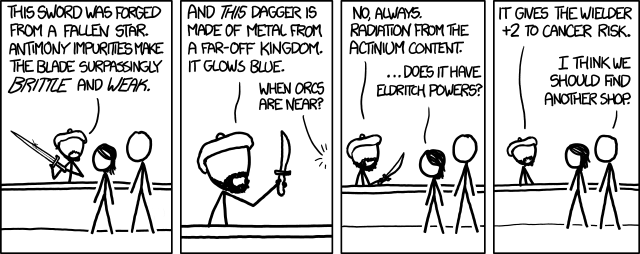
    There's always a relevant xkcd.

  • source
  • parent
  • hideshow 2 child comments
  • [–] 132 points 1 year ago (19 children)

    Cobalt 60 has a half life of 5.27 years. Assuming that a language lost to time is at least 500 years old, the rod should be fairly safe to handle. Heck, even after only 100 years less than 0.01% of the original amount of radioactive material would be left.

    But that aside - One of the items that can be found in the video game series Avernum is Uranium bars, which give you a nice unhealthy glow :)

  • source
  • hideshow 19 child comments
  • [–] 61 points 1 year ago (6 children)

    If it's actively glowing blue, I don't think it's safe to handle.

  • source
  • parent
  • hideshow 6 child comments
  • [–] 50 points 1 year ago (5 children)

    If it's actively glowing blue it means it's under water producing Cherenkov radiation and the water should shield you from the alpha particles.

  • source
  • parent
  • hideshow 5 child comments
  • [–] 11 points 1 year ago (3 children)
  • Ah, I remember this story:

    on September 24, Ivo, Devair's brother, successfully scraped some additional dust out of the source and took it to his house a short distance away. There he spread some of it on the concrete floor. His six-year-old daughter, Leide das Neves Ferreira, later ate an egg while sitting on the floor. She was also fascinated by the blue glow of the powder, applying it to her body and showing it off to her mother.

    What a horrible way to die :(

  • source
  • parent
  • [–] 5 points 1 year ago* (1 child)

    My favorite podcast did an episode about that!

    Highly recommend if you like leftism, and also want to listen to an engineer talk at length about what this blue glowing powder is, the series of bad decisions that led to some scrap collectors finding it, and the even longer series of even worse decisions people made regarding what to do with this blue glowing powder

    You can skip the Goddamn News if you want, discussion of the spicy rocks starts at 20:28

  • source
  • parent
  • hideshow 1 child comment
  • [–] 36 points 1 year ago (7 children)

    Somebody casted Repair on the rod

  • source
  • parent
  • hideshow 7 child comments
  • [–] 45 points 1 year ago (5 children)

    i cast mending on the pile of lead, giving me a solid cubic foot of weapons grade plutonium.

  • source
  • parent
  • hideshow 5 child comments
  • [–] 17 points 1 year ago (3 children)

    giving me a solid cubic foot of weapons grade plutonium

    Briefly

  • source
  • parent
  • hideshow 3 child comments
  • [–] 8 points 1 year ago (2 children)

    hey DM what's the range of mending? as long as it's over a few kilometers i should be fine

  • source
  • parent
  • hideshow 2 child comments
  • [–] 24 points 1 year ago (3 children)

    What if it was stored in a fridge

  • source
  • parent
  • hideshow 3 child comments
  • [–] 29 points 1 year ago* (last edited 1 year ago) (21 children)

    I assume "danger" and "drop & run" would be straightforward enough, but does casting comprehend languages cause the wizard to understand the concept of radiation (or cobalt, or how large a 'curie' is)?

  • source
  • hideshow 21 child comments
  • [–] 21 points 1 year ago (1 child)

    Hmm, I think as a DM I would roll an arcana check to see if the wizard would conceivably have heard of radiation from arcane studies. It's reasonable to assume people with arcane knowledge would be the first to hear about the strange metal chunks that everyone keeps dying around. One of them would have had to have come up with a word, if not some variation on "death cursed"

  • source
  • parent
  • hideshow 1 child comment
  • [–] 13 points 1 year ago (8 children)

    I'd personally translate it to the closest word they have.

    If I decided they didn't have a word that was directly equivalent, in this case I'd use the closest word, "light-emitting".

  • source
  • parent
  • hideshow 8 child comments
  • [–] 3 points 1 year ago (7 children)
  • [–] 11 points 1 year ago (5 children)

    Disease-light might be the best medieval equivalent, actually.

  • source
  • parent
  • hideshow 5 child comments
  • [–] 7 points 1 year ago (4 children)

    "Death-light", maybe? Depending on the intensity.

  • source
  • parent
  • hideshow 4 child comments
  • [–] 1 point 1 year ago* (3 children)

    They have "ray of frost". They can understand "radiation". Not necessarily what is radiating but the word itself is old.

    radiation(n.)

    mid-15c., radiacion, "act or process of emitting light," from Latin radiationem (nominative radiatio) "a shining, radiation," noun of action from past-participle stem of radiare "to beam, shine, gleam; make beaming," from radius "beam of light; spoke of a wheel" (see radius).

    Tldr "radiate" is like 1500's whereas "emitter" is a fairly modern word, from the 1880's.

  • source
  • parent
  • hideshow 3 child comments
  • [–] 1 point 1 year ago (2 children)

    The latin source word is much older than 1500s, but the question is whether they understand what it's about.

    Both the 15th century "radiacion" and the latin "radiationem" are about emitting light and are synonymous with "to shine" or "to glow" (though without the heat connotation).

    None of that conveys the sense of danger and fear of death that the modern word "radiation" means.

    Kinda like how the word "plane" was in use in English in the 1600s and derives from the much older Latin word "planum", but if I'd tell some from 1600s England or from ancient Rome that I took a plane/planum to another country, they'd be utterly confused about what that means.

    The word is the same (or at least very similar), but the concept is unknown.

    So you need to find a concept that's similar to what you want to convey, and then use the fitting word.

    For example, someone from the 1600s might understand the term "flying machine" (which was a well-known word in use in research and "science fiction" at that time).

  • source
  • parent
  • hideshow 2 child comments
  • [–] 1 point 1 year ago* (1 child)

    No, they don't convey the sense of danger, I agree.

    But "light-emitter" would be worse than "it radiates death/evil", imho

  • source
  • parent
  • hideshow 1 child comment
  • [–] 1 point 1 year ago

    You think?

    A light emitter could be quite useful. If I am in a low-tech society, having a device or material that would emit light in the dark could be pretty desirable.

    It might confuse me though, because that "light emitter" doesn't actually emit any light at all. Maybe this ancient society was full of liers or maybe their devices are all expired and broken. Probably their warnings aren't worth anything either.

  • source
  • parent
  • [–] 7 points 1 year ago (9 children)

    That is a really good question...

    I feel like radiation should have some sort of translatable element as a generic radiant danger, but for the rest... if it doesn't make sense without context in the source language, does it make sense after 'comprehend language'? Kinda feels like we need a 'comprehend science' or something if they wanted to grasp the idea of specific elements and units of measure.

  • source
  • parent
  • hideshow 9 child comments
  • [–] 15 points 1 year ago* (8 children)

    Researchers came up with a warning symbol for this exact scenario

    "In the aftermath of repeated incidents where the public was exposed to radiation from orphan sources, a common factor reappeared: individuals who encountered the source were unfamiliar with the trefoil radiation warning symbol, and were in some cases not familiar with the concept of radiation. During a study in the early 2000s, it was found that only 6% of those surveyed in India, Brazil and Kenya could correctly identify the meaning of the trefoil symbol."

    https://en.wikipedia.org/wiki/ISO_21482

  • source
  • parent
  • hideshow 8 child comments
  • [–] 1 point 1 year ago* (6 children)

    This glyph clearly portrays the object with the ☢️ symbol bringing someone back from the dead! We should consume the blue powder inside this metal case, as it's clearly a kind of medicine

    This kind of symbology is never going to work. We know what archaeologists do when they understand the "you will die if you break this seal" message. Ain't no symbol is going to keep a damn human from cracking open the glowy blue box

  • source
  • parent
  • hideshow 6 child comments
  • [–] 3 points 1 year ago (5 children)

    I mean, testing showed it generally got the point across even if people didn't understand why it was dangerous

  • source
  • parent
  • hideshow 5 child comments
  • [–] 2 points 1 year ago* (4 children)

    I'm curious what testing and what people. Unless it's an as-yet uncontacted tribe in the Amazon rainforest, I'm not convinced that they successfully made a universally understood sign of danger.

    And even if the message gets across, I will reiterate: when archaeologists understand that a message says "entering here will kill you," it only makes them want to enter more. Future post-post-apocalypse archaeologists will treat our nuclear waste disposal sites with as much care as a 19th century British scholar would have treated the pyramids. We're a curious bunch. Best we can hope for is that we keep making Geiger counters

  • source
  • parent
  • hideshow 4 child comments
  • [–] 2 points 1 year ago (2 children)

    https://en.wikipedia.org/wiki/Long-term_nuclear_waste_warning_messages

    People have put alot of thought into this exact topic and there's no easy answers

  • source
  • parent
  • hideshow 2 child comments
  • [–] 3 points 1 year ago* (1 child)

    I'm well aware. Personally, I like to think of it from the opposite perspective; what message might we find that someone could have written 10,000 years ago that would convince us not to mess with something? The only proposals that work are ones that involve translating the dangers of radioactivity to new languages. Either that, or bury it deep in a place that isn't expected to be particularly habitable for a few thousand years. Every physical marker is just begging for an archaeologist to discover why exactly they were constructed

  • source
  • parent
  • hideshow 1 child comment
  • [–] 24 points 1 year ago

    This forest of thorns looks really cool, I bet deeds are commemorated here

  • source
  • [–] 46 points 1 year ago

    That’s what you get for not casting it on the “This is not a place of honour” sign near the jagged black obelisks after encountering the colony of glowing cats

  • source
  • [–] 19 points 1 year ago

    It's only glowing blue because there are orcs nearby.

  • source
  • [–] 14 points 1 year ago

    “This is not a place of honour…

  • source
  • [–] 14 points 1 year ago (3 children)

    I'm not feeling creative today so I'll just write "Dildo joke".

  • source
  • hideshow 3 child comments
  • [–] 13 points 1 year ago (7 children)

    I wonder what the damage would be holding it for 15 seconds.

  • source
  • hideshow 7 child comments
  • [+] -34 points 1 year ago* (last edited 1 year ago) (5 children)

    I asked Chat GPT:

    Approximate unshielded dose rates:

    At 1 m: ≈ 5.2×10^4 Sv/h (≈51,800 Sv/h) — fatal essentially instantaneously (seconds or less).

    At 3 m: ≈ 5.8×10^3 Sv/h — fatal within seconds.

    At 10 m: ≈ 5.18×10^2 Sv/h — fatal within tens of seconds.

    At 30 m: ≈ 5.8×10^1 Sv/h — severe, life‑threatening in minutes.

    At 100 m: ≈ 5.2 Sv/h — dangerous; a few hours would produce fatal/serious acute radiation syndrome.

    (For perspective: an acute whole‑body dose of ~4–5 Sv often causes death without intensive medical care; 1 Sv already causes significant radiation sickness.)

    These are conservative, point‑source, unshielded estimates for whole‑body dose from the gammas. Being closer, or in contact, or staying in the field increases dose proportionally.

    Back to me again. I'm sorry my radioactive physics game is weak and I had to speculatively look it up. That's a lot of downvotes, yet no one decided to share the math themselves.

  • source
  • parent
  • hideshow 5 child comments
  • [–] 36 points 1 year ago (2 children)

    You're not getting downvoted. ChatGPT is getting downvoted, and you just happened to be in the way.

    These guys, the 2nd google link after AI, say that a 3540 Ci/130 TBq source would be around 500 Sv/h at 30 cm. Even Wikipedia says 45 Sv/h at 1m

  • source
  • parent
  • hideshow 2 child comments
  • [–] 38 points 1 year ago* (1 child)

    Back to me again. I'm sorry my radioactive physics game is weak and I had to speculatively look it up. That's a lot of downvotes, yet no one decided to share the math themselves.

    I asked my toddler about the radiation and she said "nana" and then with emphasis "nana" once more.

    The downvotes are because our two methods of finding an answer are roughly equally likely to returning a reliable answer.

    Mine is slightly better for the climate, maybe. That will likely change as she grows up and uses up more resources. I'll ask her to do the math on that one later, she is busy eating a book right now.

  • source
  • parent
  • hideshow 1 child comment
  • [–] 13 points 1 year ago (2 children)

    Isn't the blue glow only present under water (or other transparent medium with a similarly high index of refraction)?

  • source
  • hideshow 2 child comments
  • [–] 27 points 1 year ago (1 child)

    It's technically slightly visible in air; if actually visible at all in air it means the level of radiation is ludicrously deadly

  • source
  • parent
  • hideshow 1 child comment
  • [–] 3 points 1 year ago* (last edited 1 year ago)

    It's not so much that it's visible in air, it's just that your eyes have water in them

    So yeah, if you can see Cherenkov radiation outside of a pool of water, then that means the only thing attenuating the radiation is your eyeballs

  • source
  • parent
  • [–] 12 points 1 year ago

    Ok love this one XD

  • source
  • [–] 7 points 1 year ago

    Hopefully there's one of these around: Material Safety Data Sheet for cobalt 60.

  • source
  • [–] 13 points 1 year ago (4 children)

    I am curious where this drop and run source comes from.

    Typically, they're sealed in a shielded box, where you can open a small windows that the gamma say can escape and are used for field radiography when inspecting bridge/pipeline solder. Definitely not a drop and run thing

  • source
  • hideshow 4 child comments
  • [–] 15 points 1 year ago* (last edited 1 year ago) (1 child)

    I am guessing the idea is to induce terror in the holder such that, if they did not intend to hold a vial of Co 60, they would not mess with it further. It conveys the appropriate level of danger, if not an appropriate set of handling instructions.

    Edit: So I looked it up and I misunderstood: if you can read that (especially by the blue glow) then its rapidly killing you. I really don't understand how dangerous some radiation is lmao.

  • source
  • parent
  • hideshow 1 child comment
  • wizard: i cast firebolt

  • source