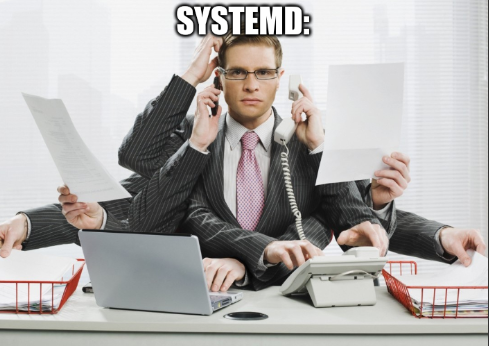
OP when systemd successfully wipes his ass

post
It's almost as if people think systemd is one massive executable rather than a suite of tools
Been using Linux as my main system for about 8 years now. I know nothing but systemd. I have never tried other init systems, so I genuinely don't know what I'm missing out on (if there is any). I don't mind systemd and I really really like services and timers. I use them all the time to automate things, but that doesn't mean I don't hate some things about systemd. One of the things that I'd love to burn to charcoal is that "a stop job for UID 1000..... 1:45 minutes", bitch? I don't have that much time on my hands, reboot right now. What are the things that other init systems have that make them better than systemd?
a stop job for UID 1000..... 1:45 minutes
oh oh and then it changes to 3 minutes something when 1:45 passes! where was that configured mr poettering??
Enable SysRq commands and ALT+SysRq(same as print screen)+B to force reboot
You really shouldn't do that. SysRq reboot is like SIGKILL on steroids. If the OS hasn't flushed and closed every file handle, you can corrupt the shit out of the system. Ask me how I know.
You can skip waiting for services to stop by pressing Ctrl+C eight times within two seconds. If you really need to reboot using SysRq, then at least do a sync (Alt+SysRq+S) before that.
Honestly buttctl has some nice features once you get used to it.
I still stand by my assumption that anyone complaining about systemd has never tried to configure SysVInit scripts before
I like systemd
Awaiting the guillotine...
You're not alone. For most of my career, I've only used Linux to develop software and deploy that software to production. That usually means webservers, databases, iptables/netfilter, and all the other backend processes that glue that together.
Before systemd, I was using sysVInit. Let me say that systemd has been head-and-shoulders above the previous experience in a variety of ways, with a host of built-in features:
- Predictable start-up order of processes
- Configurable inter-process dependencies (for the above)
- Restart on fail
- PID management
- Socket management
- Standard config format (no more copy-pasta init scripts)
- Clearly defined filesystem areas for package managed and user-managed services
- Clearly defined layering of config areas (e.g.
systemctl status <service>shows you exactly what files are loaded) - Solid CLI experience that provides detailed information about every managed service
Bottom line: it's dead simple to add your own stuff, and just as simple to read what packaged software is doing. I also think that using a CLI (instead of poking around /var/run and ps output) is a step up in terms of system administration, given how complex all this can get.
My only contention is the forced use of journald, where my preference would be to use the standard /var/log paradigm for all this, rather than have a doorman to a binary logging database. You can configure it to emit text logs, but that's not the system of record for logging - just a feed.
All that said, container-based solutions have rendered both init systems irrelevant a lot of the time, with tools like Kubernetes providing just about all of the same features. Moreover, cloud solutions tend to lean into cloud-init for host startup configuration and management anyway.
I am more of a hobbyist when it comes to running software on Linux. That said, I usually end up being the guy who installs and manages software on work Linux servers, writes Ansible scripts to standardize configs, and troubleshoot when things dont work. Im not as advanced as you are, but got my fair share of pre-systemd headaches... so yeah, I completely agree with you.
How do you add a custom service to systemd? Let's say /usr/local/sbin/foobar . I can never seem to get it to work, but can do it easily in sysvinit.
https://linuxhandbook.com/create-systemd-services/
In addition to the script you have a configuration file that defines what, when, and how. Each script has it's own config file instead of a 'config line' in /etc/inittab.
It's been a hot minute, but here's what I recall.
Take a look under /etc/systemd/system/ This is a good place to put custom system files.
You'll want to add your new foobar.service file here, then run systemctl daemon-reload or systemctl reload foobar to make systemd load the new config file. Then you can run systemctl start foobar and so on.
The rest is up to you and the published docs for the system file itself. My recommendation is to also try to understand daemons you may already use like nginx, apache, postgresql, etc. Their configs can be found by first running systemctl status <servicename> and to look at the Loaded: line. Most of the packaged stuff is hanging out under /lib/systemd/system.
I love it as well it makes everything way easier. You can even run containers with it if you install quadlet. I just recreated most of my homelab containers using it.
"It is I. Everything."
I've always liked systemd.
I'm learning FreeBSD and the training wheels are off having to learn RC. I should've done this years ago.
On that, anyone know how to pull core temps off a 20 year old Celeron D in OpenBSD? That and my internal PC speaker are the only things I don't have working yet.
Yay another thread where a bunch of script kiddies running a homelab come shitting on a toolset that saved the professionals from the init mess. But they of course know that systemd is bloated and prefer running their node servers in dokker containers on something more lightweight
Are you talking about another thread? Because this one seems like the opposite
Yeah, every other thread with the word "systemd" in the title, just wait
Maybe ten years ago? Today I'm mostly seeing people making fun of systemd-haters
systemd-haters sounds like something that's part of systemd.
It's not, right? Can't ever be sure these days, smh my head
It may also be a reddit thing, I have not ever seen any hate against systemd on lemmy.
This, so much this. Although it's equally old grumpy farts as well as script kiddies. You'll be able to identify the former by their trademark quote "Systemd is the end of / nail in the coffin for Linux".
I wouldn't call them "kiddies" since anyone who was using Linux before systemd probably is middle aged if not older.
systemd was a solution in search of a problem. I saw it that way when it came along and still see it that way. I'm sure as usual that will ruffle the feathers of the zealots and fanatics. So be it. I'm not expressing their opinion on systemd but my own. I don't see how its an improvement sysvinit. I can' do the same things with both and indeed still maintain a sysvinit linux system that works just fine without systemd being involved.
systemd was a solution in search of a problem
Systemd solved lots of problems for me and made things easier so you know... I guess they succeeded.
Such as initscripts being a nightmare to maintain, and insufficient for the complexity of a modern system. Read about it here: https://redlib.privacyredirect.com/r/archlinux/comments/4lzxs3/why_did_archlinux_embrace_systemd/
You didn't realize there was a problem to solve because others, the distro maintainers and developers, worked their asses off to solve that problem for you.
Standard boiler plate response to not having had to ever do this. I started with Slackware Linux and still keep a installation around to keep up with how things work. I solve my own problems and its for that reason You're explanation falls short. In truth it isn't that difficult and it many ways preferable to not hand over control of services to one over reaching controller. I've had systemd hangup where sysv would have just kept on sailing.
Its perhaps because I have so much experience with both that I can truly see how systemd isn't the cure all its purported to be.
Now go back and actually read what I linked. The comments too. And don't dismiss those points just because the old ways work for you.
Why would I go read through another thread someone posted about the same fud? This somehow constitutes proof since it backs up your bias. Its the same old argument without any real examples. Only generalizations. Plus its from a arch post. If you are going to use arch why not just fall back to Slackware for your daily driver? I don't have any more trouble with sysv than I do with systemd. You have failed utterly to present anything compelling to alter my perception of this situation.
who is being forced to use systemd and how are they forcing you?
top 80 comments