all 63 comments

sorted by: hot top controversial new old
[–] 96 points 1 month ago (18 children)

End the microplastic pollution, use glass or metal

  • source
  • hideshow 18 child comments
  • [–] 35 points 1 month ago (13 children)

    My wife is starting to get really irritated with me as I begin my recycled jar collection.

    The problem I foresee is that most of my old salsa jar lids will eventually rust and I'm not sure what to replace them with.

  • source
  • parent
  • hideshow 13 child comments
  • [–] 17 points 1 month ago (7 children)

    Glass recycles, so you could recycle the jar and replace it

    You could also use beeswax wraps, or a silicone sheet and a tie

    If you need the sterility of a sealed jar, I imagine you'll just need to replace them over time

  • source
  • parent
  • hideshow 7 child comments
  • [–] 12 points 1 month ago (6 children)

    Glass recycles

    Not as much as you might think. A lot of places have stopped recycling glass because it's hazardous and there are huge backlogs of recycled glass. Yes it recycles from a material science perspective, but from a logistics perspective there are issues.

  • source
  • parent
  • hideshow 6 child comments
  • [–] 15 points 1 month ago (5 children)

    Over here over 90% of glass put in the recycling is recycled into new glass bottles/jars. The rest of the glass goes into making roads

    You guys having problems recycling glass?

    I struggle to comprehend that the dangers of broken glass haven't been overcome everywhere

  • source
  • parent
  • hideshow 5 child comments
  • [–] 8 points 1 month ago (4 children)

    You're lucky, my area stopped recycling glass years ago. Like I said, there's a huge backlog which makes processing less attractive. Also most recycling seems to be single stream (all recyclables go in one bin and get sorted at the facility), and broken glass contaminates the other recyclables which is dangerous to human sorters and is abrasive to machines.

    I've seen a couple pilot programs pulverizing glass for concrete, but as with lots of recycling (looking at you plastic) in most places it's not as simple as "Just recycle it". Again, more a logistics issue than a material one.

  • source
  • parent
  • hideshow 4 child comments
  • [–] 2 points 1 month ago (3 children)

    I think it may be an issue in your area, also, where do you live? That's such a bad way of recycling...

  • source
  • parent
  • hideshow 3 child comments
  • [–] 6 points 1 month ago (3 children)

    You replace them new lids. Where I live loose jar lids are sold in packs in practically every supermarket. Really not difficult to find at all.

  • source
  • parent
  • hideshow 3 child comments
  • [–] 2 points 1 month ago (2 children)

    For Mason jars that is fine. My issue is with my Mrs Renfro salsa jars I've collected, they are not a standard Mason jar size lid

  • source
  • parent
  • hideshow 2 child comments
  • [–] 18 points 1 month ago (2 children)

    From where I’m from plastic was kind of luxury until 90’s and that’s one of very few things from that country that would be great to bring back.

    Inatead of cellophane bags there were netting bags or paper ones, bottles were all glass that got collected, sent back to factories to be washed and refillled. If one got their hands on plastic bag or bottle, probably somehow smuggled from the West - it was a goddamn status symbol from then on, and you don’t throw your status symbol away. 🌝

  • source
  • parent
  • hideshow 2 child comments
  • [–] 44 points 1 month ago
    [–] 40 points 1 month ago (5 children)

    Buying glass containers was a gamechanger for me.

    One swoop - and it's clean. No grease sticks, it washes even easier than ceramic plates.

    Plastic is a terrible container material for greasy foods.

  • source
  • hideshow 5 child comments
  • [–] 1 point 1 month ago (2 children)

    And then they fall and shatter

  • source
  • parent
  • hideshow 2 child comments
  • [–] 16 points 1 month ago (2 children)

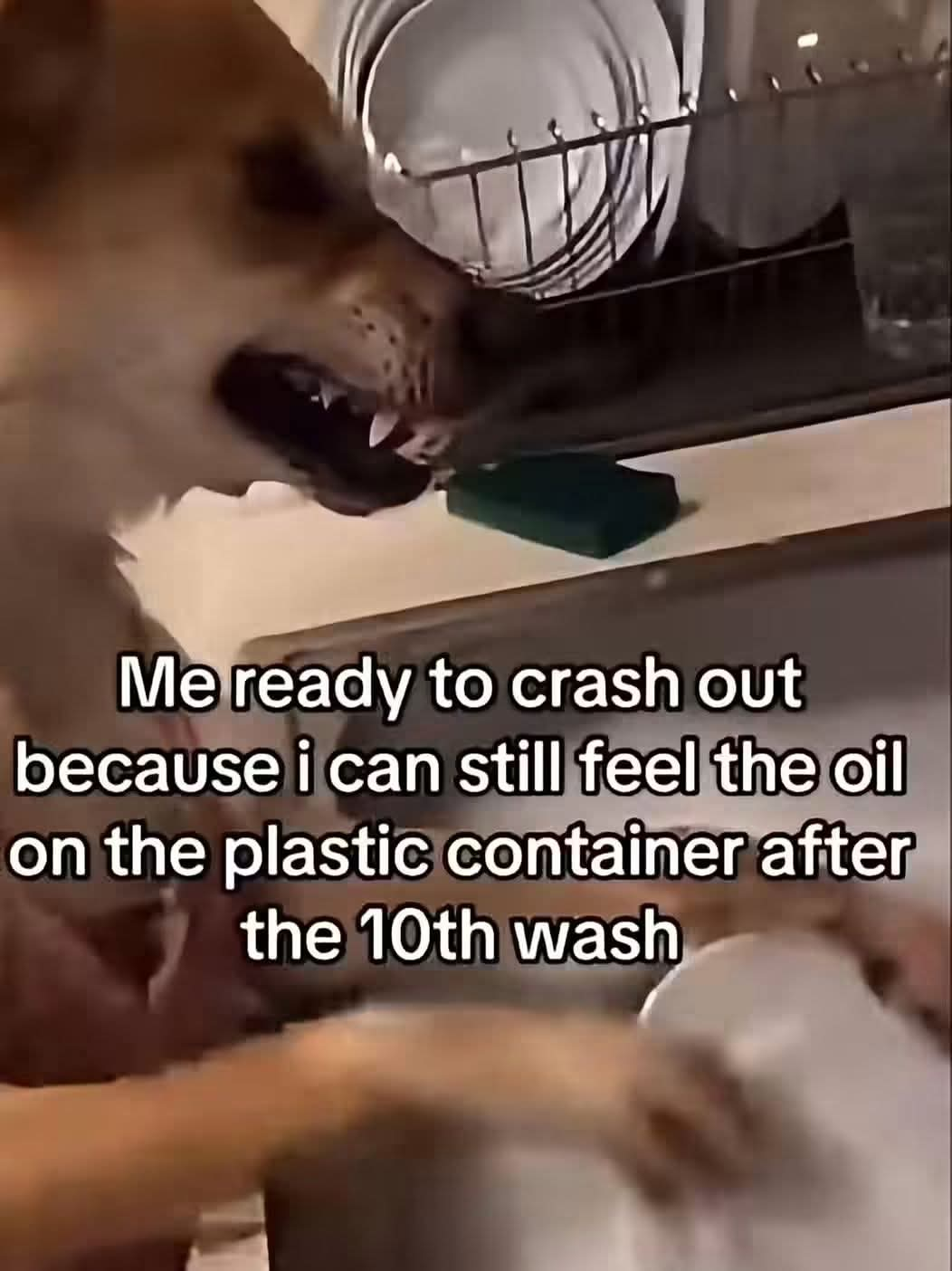
    Everytime i still feel the oil on the container, i'll just wash my sponge and squeeze some a fresh new dish soap and wash with it. Usually clean afterward, it's almost always the grease-soaked sponge.

  • source
  • hideshow 2 child comments
  • [–] 2 points 1 month ago

    I find that it's more effective to put detergent on the dish, scrub with wet sponge, rinse. That keeps the detergent at high concentration at the surface, where the action happens. Detergent on the sponge, on the other hand, tends to migrate away towards the center of the sponge.

    I switched from soaping the sponge to soaping the dish like 10 years ago and never looked back.

  • source
  • parent
  • [–] 29 points 1 month ago

    Either your dish soap sucks ass, or your technique does if washing doesn't get rid of grease and oil the first time.

  • source
  • [–] 14 points 1 month ago* (2 children)

    Should get glass or metal containers (ore sometimes even ceramic) if you can afford it or if you can sneak them into your bag/inner coat pocket.

    I bought some when I could afford it ~five years ago and they're still like new.

    ...You have to take out the sealing band and wash it separately from the lid. So many containers are ruined because people don't take out the seals and the grow mouldy. ;-;

  • source
  • hideshow 2 child comments
  • [–] 1 point 1 month ago* (last edited 1 month ago) (1 child)
  • Can you microwave the metal ones?

    You really shouldn't be microwaving food in plastic. A lot of them claim to be safe for the microwave, which is technically true. However pretty much all plastics degrades and become volatile under a certain amount of heat, and microwave ovens can become very hot in very unpredictable ways.

    Most plastics will start to undergo polymer deformation around 200 degrees and start to release volatile organic compounds, which is a pretty normal temp for your average microwave over to regularly get to.

  • source
  • parent
  • [–] 25 points 1 month ago

    In this scenario I would add some dishwasher powder to some hot water and leave it for a while, the enzymes digest the fats and can be much more effective in some circumstances

  • source
  • [–] 11 points 1 month ago

    Plastic is oil-based. It repels water and bonds with oil. Soap does also bond with oil but you're fighting a much more uphill battle with plastic than with, say, glass or metal. Even with other concerns about plastic aside, if this bothers you, start looking for glass.

  • source
  • [–] 8 points 1 month ago

    That's when it becomes a problem for the dishwasher.

  • source
  • [–] 19 points 1 month ago (3 children)

    Have you considered it is not the dish but perhaps your greasy sausage fingers?

    Food for thought.

  • source
  • hideshow 3 child comments
  • [–] 14 points 1 month ago (2 children)
  • [–] 7 points 1 month ago (1 child)

    I like my fingers deep-fried. Slides right of the bone.

  • source
  • parent
  • hideshow 1 child comment
  • [–] 2 points 1 month ago

    I've dunked half my hand in an active deep fryer before. I was 19.

    I knew what I was doing so it was all coordinated, into the oil, grab the item, pivot 180 directly to the sink and cold water for a couple minutes.

    Lightening fast. Barely had first degree burns. Was perfectly functional the next day.

    It's one of the stupidest things I've ever done, I doubt I could ever pull it off again. NEVER TRY THIS.

    Almost 20 years later I have no idea how I walked away from that intact.

  • source
  • parent
  • [–] 10 points 1 month ago* (3 children)

    Pro tip: use an actual soap bar, the one you wash your hands with. Works way better for oils, and particularly specifically on plastic.

    Where I am, there are also soap bars for household tasks, with a shitload of acid in them. Would probably clean oil even better

  • source
  • hideshow 3 child comments
  • [–] 2 points 1 month ago* (2 children)

    I would expect them to have a shitload of alkalines in them, not acid... Acids dont do much to fat, and bar soap is alkaline...

  • source
  • parent
  • hideshow 2 child comments
  • [–] 3 points 1 month ago* (1 child)

    I started thinking that surely you're right, remembering that alkaline bile helps digest lipids. But, hard soap does in fact contain over 70% fatty acids while ultimately somehow being alkaline.

    And regular soap is also a salt of a fatty acid, just with more additives. Perhaps the 'salt' part is where the alkalinity comes in, but I'm not good at chemistry.

  • source
  • parent
  • hideshow 1 child comment
  • [–] 2 points 1 month ago

    Oil plus alkali = soap.

    The oil/lipid that is included in the soap itself is a fatty acid. But the actual cleaning action comes from the alkaline reaction with oils (including the oils you're trying to clean off).

    All of this is also separate from the general point that dishwashing detergents tend not to be soaps at all.

  • source
  • parent
  • [–] 5 points 1 month ago

    Saw a cool trick on IG, bit wasteful but works if you really want to save the container (I agree we should switch away from plastics - someday..). Piece of paper towel or napkin, drop of dish soap, a splash of hot water, close tight and shake thoroughly so the paper goes all around the inside, remove paper, rinse, wash normally.

  • source
  • [–] 3 points 1 month ago (2 children)

    Dawn directly on sponge, I never have this problem.

  • source
  • hideshow 2 child comments
  • [–] 1 point 1 month ago (2 children)

    its the same taking a bath. after the first swipe, youre wiping with that filth in a steadily increasing amount. the dirt never goes completely away in a tub

  • source
  • hideshow 2 child comments
  • [–] 1 point 1 month ago

    Why do we only have the shittiest of plastic containers? Oh wait, it's because we're poor; I forgot it for a single second there.

  • source
  • [–] 1 point 1 month ago

    My fingers after fried chicken

  • source
  • [–] 1 point 1 month ago (8 children)

    Did you use hot burning water?

  • source
  • hideshow 8 child comments
  • [–] 3 points 1 month ago (4 children)

    Water doesn't get hot enough, that's why i usually wash plastic containers in hot frying oil

  • source
  • parent
  • hideshow 4 child comments
  • [–] 2 points 1 month ago (3 children)
  • [–] 2 points 1 month ago (2 children)

    I would, but there aren't any stores nearby that sells it

  • source
  • parent
  • hideshow 2 child comments
  • [–] 1 point 1 month ago

    I assume you're washing with warm to hot water?

  • source