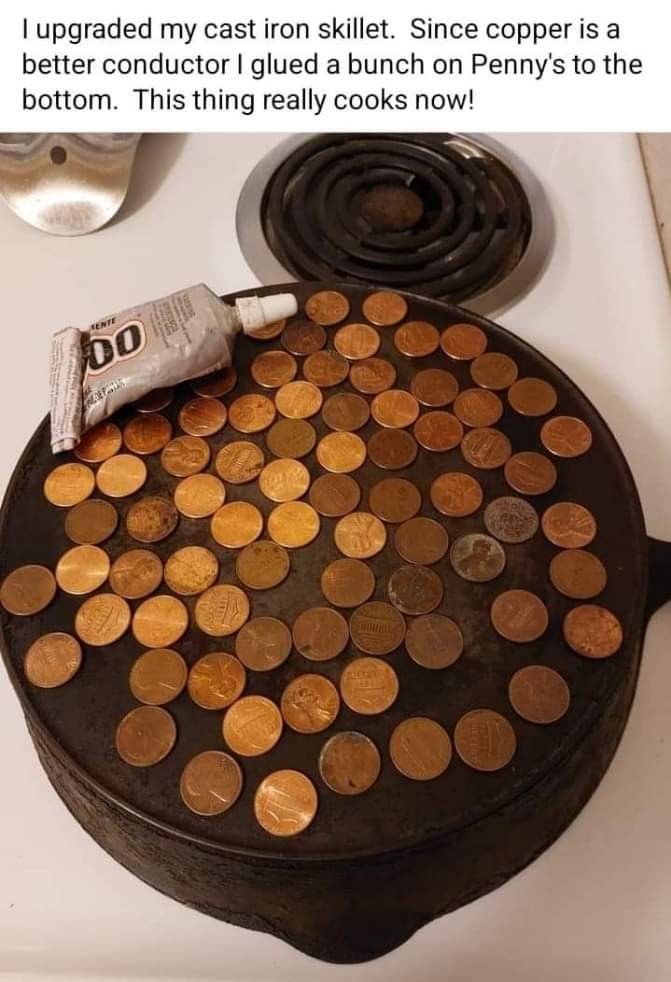
Idiot used super glue instead of thermal paste.
post
Because OP uses their Brain in unusual ways.
Likely using dictation on an iPhone with "Penny" in contacts.
copper-plated zinc
Brass is an alloy where the two metals are melted together, the pennies are a zinc core with a thin copper coating. Think of the former as a chocolate/vanilla swirl and the latter as a vanilla cone dipped in chocolate but ya know, with chemistry magic going on
I can think of two akshullies, but I won't say them.
Look, you either keep these kinda thoughts to yourself, or expect me to politely ask you to indulge deeply all of your brain topic dump tendencies.
So how about them ackshuallies?
I think in this situation, you’d offer a penny for their thoughts?
probably pennies are mostly zinc, and they are still having to heat the pan through the pennies, so it should actually take slightly longer?
mostly zinc tho
Toss it in the dishwasher!
This should make the thermal conductivity worse no?
Yes it would. Adding material generally makes thermal conductivity worse. There is no material with negative thermal resistance, so adding more will always increase thermal resistance by at least a bit.
The only exception is 3D geometries, where an increase in surface area due to the extra material can outweigh the effect of the added material, and lead to a net increase in thermal transfer.
This can lead to a paradoxical effect, where ADDING insulation around a pipe leads to HIGHER transfer than with less insulation material, because the added material increases the exterior diameter, and therefore surface area.
(Heatsinks are also a good example. It is more material than just the component by itself, but increases surface area by such a massive amount that it more than outweighs the added material)
Feeling weird/outed this is a shitpost. Just last year searched for copper bottomed carbon steel pan for this exact reason. Didn't find anything, but I still like the idea. Carbon steel is pretty shit at conduction.
Copper pans exist but they can be a pain to cook with. The high thermal conductivity means they heat up much faster than you expect, so it's easier to accidentally burn stuff, and they also cool down much more quickly once off the heat which can also be annoying. Plus you need to worry about oxide formation and food sticking much more than you do with steel pans.
Also can’t cook acidic foods like tomatoes and vinegar if the copper pan is unlined. Since the copper will leech into the food.
I know but a copper bottom to improve conductivity really helps carbon steel pans which are really bad about getting hot spots. I have a copper plate I put under mine and it works great. You don't want a pure copper pan as it doesn't have the nonstick properties, easy maintenance, and it would also be expensive. But a coper bottom would be nice.
I don't want to contradict your lived experience but I'm quite sceptical that the improvement is real. Adding a layer of solid material between the heat source and the steel can only reduce the amount of energy transferred to the steel, as some will be absorbed by the material no matter how conductive it is.
If you have the materials can avoid taking my word for it. Use a temp gun and check 5 spots or so on a carbon steel pan on the burner. Use a larger pan and smaller burner to exgaerate the effect. Repeat with a copper plate (needs to be at least size of pan bottom, bigger doesn't seem to detract from effect. You'll see much more consistent heating. Works for cast iron too - actually more notable at first and the the effect diminishes somewhat as the thick iron holds onto heat and becomes more uniform (still helps though)
Oh right! I didn't realise you were talking about distributing heat more evenly, that's my bad. Yes I can definitely see that being effective.
Another version that can work is if you have two pans where the bases are both say 5mm, but one of them is all steel while the other is 3mm copper welded to 2mm steel, the copper one should heat up faster than the all steel one. No idea how well copper welds to steel though.
In this case it isn't about improving heat transfer through the bottom of the pan, it's about improving heat transfer across the bottom of the pan.
The heat will travel through the pan more slowly because of the added material, but due to coppers extremely high heat conductivity, the copper base will heat very evenly, even if the heat source is unevenly applied, and therefore evenly transfer that heat through the steel layer.
Those should have been pasted with solder instead, right?
"Now we're cooking with gas!"
I wonder how long this phrase will last..

all 52 comments