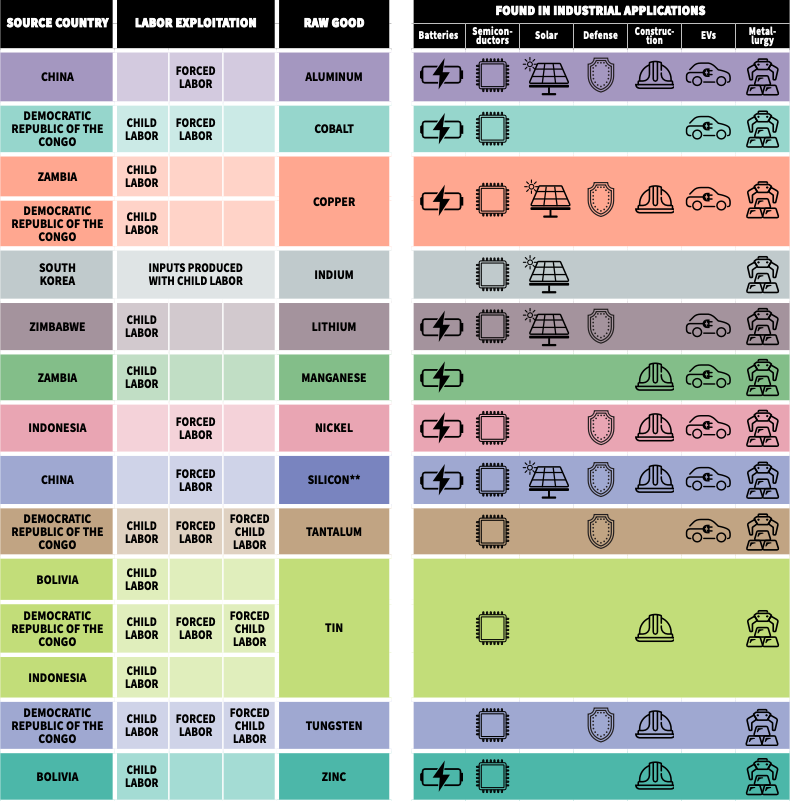
If we're playing the altruism olympics game, everyone is already throwing stones in a glass house as it is, because virtually all electronics and batteries on Earth are made from materials mined by forced/child labor.
comments
Do laptops last longer than desktops?
comment on
Yea...
There'll be no gold coins, or individual programs anymore. Programming will be extinct.
open-slopware calls OpenBSD having a "Permissive AI Policy" and links to this commit as evidence.
Well this is why you have different levels of warnings. Some are just flat out errors, some are strong warnings, others are weak warnings. Of course, at the end, the programmer has to be the one to decide to follow the language server's diagnostics or not.
As far as I understand, the whole draw of Rust is it's very opinionated in its safety. If you don't want that, Rust is just not for you.
OpenBSD doesn't allow it, what are you on about?
https://lwn.net/Articles/1064541/
Thomas de Grivel made clear the chances of accepting code with such a murky copyright situation were effectively nil, and he said on March 23 that he would remove all the LLM-generated code and keep only what he wrote himself.
I am not familiar with Lua at all, but that does just sound like a bad language server. I still don't think the solution is AI, it's just making a better language server.
comment on
Every line of code is a politial statement
I think the glaring issue in the whole discussion is what politics even encompasses. Though it is practically true, the extreme of "everything is political" comes very close to equating politics with philosophical thought.
Not everything is coupled to speaking on policy. Some things just are, unless you consider politics the fabric of reality. Many do, but I disagree. That doesn't mean I have a single political view that differs from those who do, or that we share any view, for that matter. It's a philosophical distinction.
I'm thinking of it sort of mechanically here: there is what is, there is what we think about what is, and there is how we act on both what is and the thoughts. Only the last part would truly be political, and the crux lies in whether we see ourselves as taking that action at any given moment. (Hint: you're almost always taking some action and thought rarely stands alone)
Now saying anything is free from political association is also bogus, but I think it really all comes down to "ceci (n')est (pas) une pipe" type energy and arguing in circles.
On the small scale the good faith approach works. But on the scale of the linux kernel it would have minimal to no effect to ban AI contributions.
For the code quality it's better to enforce proper reviewing and checking of the code instead of banning specific methods of producing code.
Banning AI is as enforceable as banning vscode.
I myself don't use ai in general and I despise the attitude towards ai of some people in the community but I don't think banning ai on this side of the problem has any effect on the code quality and the way things are contributed. I think ai needs to be regulated on a government level. Like removing datacenters or financing of ai companies, which both can also be done on a local government level.
That weather widget redesign looks fantastic 😍
comment on
Every line of code is a politial statement
post title: every line of code is political
comment: the game kirby for gameboy has code written for it which polls the registers for the status of the button inputs
reply: its a strawman (not) argument to give and example of very generic code to (not) showcase the absolutism of a statement that is all inclusive (every) to remove nuance from an argument.
rere: nuance and also, how dare you hint that i want "to look smart". i want to look like a comment but now you made me blush
//== ^.^ ==// the above comment is blushing
[deleted]
Maybe in the future I can get one for cheap in the used market?
With the price of 5 year old framework 13s being what they are I doubt it. You can get a newer thinkpad for half the price.
Even if OpenRC is not widely adopted it is a commitment from Gentoo to build their package recipes in a way that’s portable across different init systems. Keeping options open is healthy and I think one of the coolest things about Linux ecosystem historically was that there were at least two non-halfassed options for most of the system components. This also helps out little guys like BSDs who benefit from portability issues Gentoo package maintainers raise upstream.
I think AI needs to be regulated on a larger scale. The tools need to be restricted if you want to stop people from using them.
Putting up rules against tool use without making access to the tool more difficult are worthless.
Putting up slop PRs doesn't have to be intentional from the authors side.
How would you check commits for AI use if it is not mentioned anywhere? How would you enforce anti-AI rules?
comment on
Every line of code is a politial statement
And what are you trying to make me reveal, then?
comment on
Microslop bringing Defender to Linux desktops. Repeat: Microslop bringing Defender to Linux desktops
They can now ditch the dumpster fire of an OS that is Windows and lobby for the adoption of a corporate choke-point on Linux while continuing to bludgeon the remaining bits of your dignity and soverignity. At least this could be so for enterprise Linux.
comment on
Every line of code is a politial statement
[removed by mod]
comment on
Microslop bringing Defender to Linux desktops. Repeat: Microslop bringing Defender to Linux desktops
On their own machine, maybe not. On their employer's machine, maybe if the employer demands it.
Except they're not? Very few tools are deterministic. Only Mathematics is, and that's only a small subset of tools.
You're free to argue that non-deterministic tools lack value, but that's clearly false: OCR only exists because of lossy training machine learning algorithms. Or, going even more basic, Monte Carlo simulations are by far the most efficient method of testing entire categories of problems that are intractable deterministically.
LLMs can be shitty, as a business practice, due to their unpredictability, but (hopefully obviously) that depends on how it's used.
You're correct but still completely missing the point.
The only way to implement anti-LLM rules is to detect AI-assisted code. That, in and of itself, is a problem because it's impossible to detect good code that was AI assisted. And you don't need rules against slop because it's bad code.
If I'm following it correctly, Linus is advocating for tightening submission requirements before it gets to human review, which directly targets the harms FOSS projects are having under the deluge of slop: it raises the bar so that the slop needs to be good enough to warrant a review, which filters out must of the noise, leaving more of the signal.
Anti-LLM policies are like having closed-book take-home exams: you're left wildly guessing what's cheating (or not). Instead, make the exam open book, but expect better answers.
Linus also says AI is a useful tool, and he is an expert, so we must accept that he feels that way. I don't know if he's commented on the environmental/social/political consequences of AI hyperscalers, but that's a separate argument.
The tech is here. It's impossible to detect. It's foolish to think you can ban it's use
And it can be run locally, so there's no stopping it, even if there was political will to do so. (And with a reasonable economic and ecological cost, no less—ignoring IP/political consequences here, since that's a whole other topic.)
comment on
Yea...
a great way to find joy in programming
I already had that, thanks Linus. Did you not?
comment on
Microslop bringing Defender to Linux desktops. Repeat: Microslop bringing Defender to Linux desktops
[deleted]
comment on
Every line of code is a politial statement
What is it, you just have nothing to say? You were hoping for an attack surface but didn't find one?
comment on
Microslop bringing Defender to Linux desktops. Repeat: Microslop bringing Defender to Linux desktops
clamav works fine on my mums laptop.