I am aware of existing decompilation tools like Ghidra which give you close-to-original pseudocode.

But I think reverse engineering might be a place for ML to shine... After all, you got an empty source file, and a target binary to reach. You can automatically check everything by doing test compilations and comparing with the target binary.

ML is really good for pattern recognition, which is a huge part of reverse engineering. Though at the same time, I experienced firsthand how bad LLMs are in assembly since they don't "think" or have a hard time tracking state machines.

I am aware that a big part of reverse engineering is not getting something that compiles, but rather, figuring out variable names, function definitions and how a piece of software works in general. But I think, with human help, it could help decompilations drastically. What do you think?


Specs:

  • Intel i5-9300H 4c 8t @4.10 GHz
  • GTX 1650 Mobile Max Q
  • 8 gb DDR4

Preferably something barebones and without a desktop environment due to my little available ram. Something built for remote access with moonlight.

I am currently using a minimal fedora setup with standalone KWin (without plasma) and Pegasus launcher but it is kind of holding together with duct tape.

I am open to running debloated windows too, I tried Tiny11 for that purpose but it was painful to use. I gave up while installing the bajillions of drivers.

I might also cook up my own arch install script but that seems like a lot of effort i don't want to go through


This is with HDD and CD-ROM removed. I tried booting with either stick of ram removed and it was still the same

When i turn off quiet boot in the bios setup, I get the following logs:

223M System RAM Passed
512K Cache SRAM Passed
System BIOS shadowed
Video BIOS shadowed
Mouse Initialized
(then it halts here)

I also turned off IDE and IR in the bios, didn't help. Enabled a setting so it beeps when it starts booting the OS but the beep never comes which means it is stuck in POST.

It also can't reach boot device selection menu.

This machine was in pretty bad shape when i got it and I basically had to take it apart and put it back together.

CPU was repasted and there is no way it is overheating since I can stay in the BIOS as long as I want to and the fan kicks on when the CPU starts heating up.

There were apparently PCI diagnostic cards for these machines but they are hard to find where I live. So guesses to which stage boot is failing in is appreciated.


I'd like to call it Fedivision.

I know Lemmyvision exists and it is awesome but it focuses on country instances, whereas Fedivision would be about the fediverse as a whole and would see each instance as a potential contestant. Lemmy, mastodon, misskey, pixelfed you name it.

And yes, unlike Lemmyvision, Fedivision will be about people singing, composing, mixing (sometimes bad) songs, not submissions of songs from original artists. Contestants will be able to sing or play an existing song or submit something they cooked themselves.

I feel like this approach is more compatible with Fediverse in general, as all instances already act like a country: they have their own culture, people, and "laws". Fedivision will be about the culture of each instance instead of countries.

I want to make it a reality, I need help and feedback from y'all. I am not really an artist in any way, so it would be really cool if somebody cooked a poster.

Do you think this is feasible? What would you like to add? Let me know.


Posting here, as this has more to do with the human voice itself than electronics.

I am planning to build a simple human voice synth, but I couldn't find much on the internet. The overall plan is to generate a signal, pass it through about 10-ish bandpass filters and adjust each filter's gain to create speech.

For my source signal, I found this, which seems to be the sound generated by the larynx before passing through the throat and mouth. From what I read online, a relaxation oscillator or a sawtooth wave seems to be a close approximation of it.

One of the things I am struggling to find is the frequency components corresponding to certain phonetics. Though I am pretty sure it is either because I can't find the right keywords or because SEO ruined the internet.

US2121142A is the patent for Voder, the first human voice synthesizer by bell labs. It has a similar structure to what I've been modeling in my head. Should I just use the frequency values here for my bandpass filters or should I use something else?


I don't like acidity in my coffee much. Stuff I get from my moka pot on the other hand was always very acidic.

Recently I bought a bag of very good, beautiful smelling beans from my favourite coffee shop and brewed it on moka pot. The results are still the same, it almost tastes like lemonade. It is undrinkable amounts of acid in there.

I use the 1zpresso Q Air. I tried nearly every grind setting between 1.6-0.9 (chart, please click). Always the same result.

I also tried starting with both hot and cold water. No difference.

I do not tamp my coffee and flatten it nicely by shaking the basket. I don't overfill the basket.

My moka pot is 2-3 years old and I might need to change its gasket, wonder if that has anything to do with it but i doubt it since the gasket still seals pretty good except for a 5-10mL water leak every brew.


I am writing something that needs to verify the practical readability of qr codes which has been painted over.

First thing that comes to mind is to apply Gaussian blur on the image and check if it is readable. Then I could get a "readability score" by doing binary search between blur strengths range [0, n].

I also may do the same with noise, not sure if I should.

Would appreciate if somebody with more knowledge of QR codes help me


Because it is dirt cheap compared to HDDs where I am, I will be storing my movie collection in Blu-Ray. And partially because I think spinny media is cool.

I currently got two secondhand options for the drive:

  • Pioneer BDR-209EBK
  • Panasonic UJ272

The drive will be plugged into my server (6th gen i5-6600, old desktop) via SATA. It will probably only read the disks I write so DRM is not much of a concern.

The disks will mostly be used as archival storage. Most of the time, they will be transferred to SSD a few days/hours before streaming, though sometimes they may be played straight from BD-R

Aside from that, most of the Blu-Ray writing software I found is GUI. So I'd also appreciate something I could control via web or CLI


I take a 2 hour commute to school every day. My Stanley thermos, which was gifted to me by my very consumerist aunt, doesn't keep my moka pot coffee hot for 2 hours.

Although it is a pretty good thermos it seems to be leaking a lot of heat from the metal section near the cap.

Is there any thermos that has every section of it isolated? Like, I shouldn't even be able to tell if there is a hot liquid inside


Hello, I am a person who has only used thread based "social media" their whole life. I never liked platforms such as twitter and instagram and preferred aggregators like reddit, and nowadays, lemmy.

I tried joining twitter once, failed, closed my account and went back to reddit. Same with instagram. Kind of glad that I did not use them.

I recently created an instagram account because my friends use it's messaging feature. And because my generation uses instagram handles like phone numbers of old (i am 20).

I really want an active mastodon account. There are really cool people there and there are some thoughts I can't express with the "forum format".

I mostly repost cool stuff I see, but even after joining a reasonable amount of discourse, and trying not to look like a bot, I am yet to get a workable amount of social circle. Whereas I easily fit into places like lemmy.

what am i doing wrong

edit: Just realized the title looks like a "I wanna be famous" post. It really is not

My profile: https://toot.community/@yogurtwrong


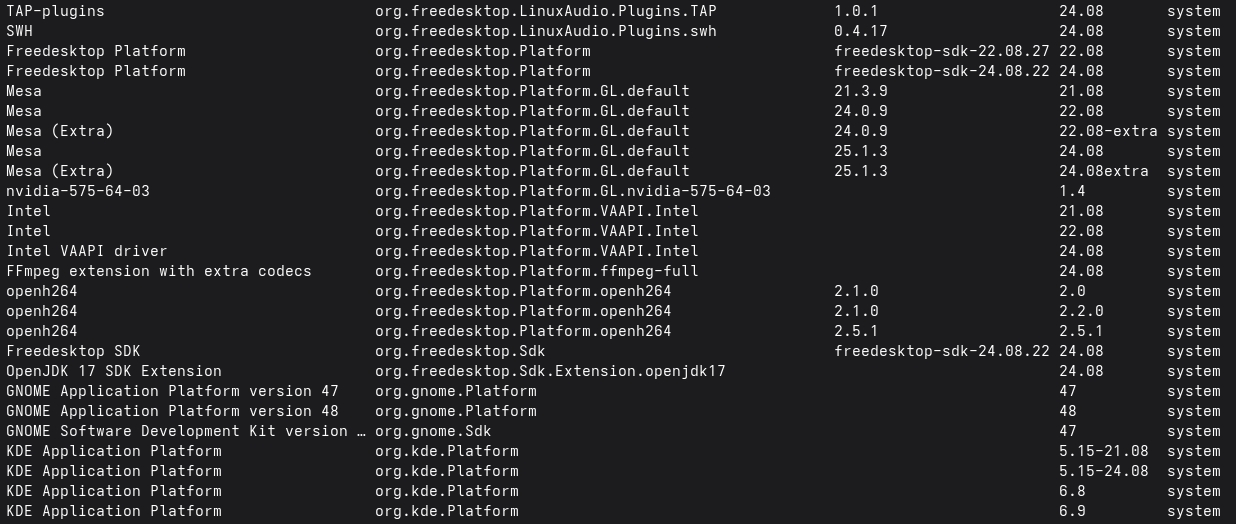
I have 91 flatpaks, and it is my primary way of getting apps. But the (not very shared) dependencies have been bothering me lately.

I was primarily drawn in because Gnome Software has a cool UI and because I wanted the magic of one-click installs. I heard a lot of things about Flatpak and gave it a try.

I have a relatively small 72GB BTRFS root partition with zstd:1 (lowest) enabled. I think disk compression helps with the Flatpak dependency mess, as I only have 60% disk usage currently.

Idk how much extra RAM my flatpaks use, but I don't want 4 versions of the same dependency taking up space in my RAM. Thought about enabling zram to compensate for this. As different versions of the same library in RAM are easy to compress.

I don't think this compression mentality I instinctively adopted is healthy. Make stuff reliable in expense of storage/ram -> compress storage/ram in expense of proc. power

Another thing is slow Flatpak downloads. I have a gigabit connection, and Arch mirrors generally work around 30MB/s with WiFi. Flatpak, on the other hand, hits at max. 5MB/s with its "CDN"

Overall, even though it's kind of ugly, I absolutely love the "don't think about it" mentality of flatpaks. It just works most of the time. I simply use the system package manager for programs that heavily interact with the system (like IDEs, management stuff, and so on)

I am interested in hearing your opinions.
view more: next ›