Food production is responsible for one-quarter of the world’s greenhouse gas emissions.

Eating locally would only have a significant impact if transport was responsible for a large share of food’s final carbon footprint. For most foods, this is not the case.

Greenhouse gas (GHG) emissions from transportation make up a very small amount of the emissions from food, and what you eat is far more important than where your food traveled from.

For most foods — and particularly the largest emitters — most GHG emissions result from land use change (shown in green) and from processes at the farm stage (brown). Farm-stage emissions include processes such as the application of fertilizers — both organic (“manure management”) and synthetic; and enteric fermentation (the production of methane in the stomachs of cattle). Combined, land use and farm-stage emissions account for more than 80% of the footprint for most foods.

Transport is a small contributor to emissions. For most food products, it accounts for less than 10%, and it’s much smaller for the largest GHG emitters. In beef from beef herds, it’s 0.5%.
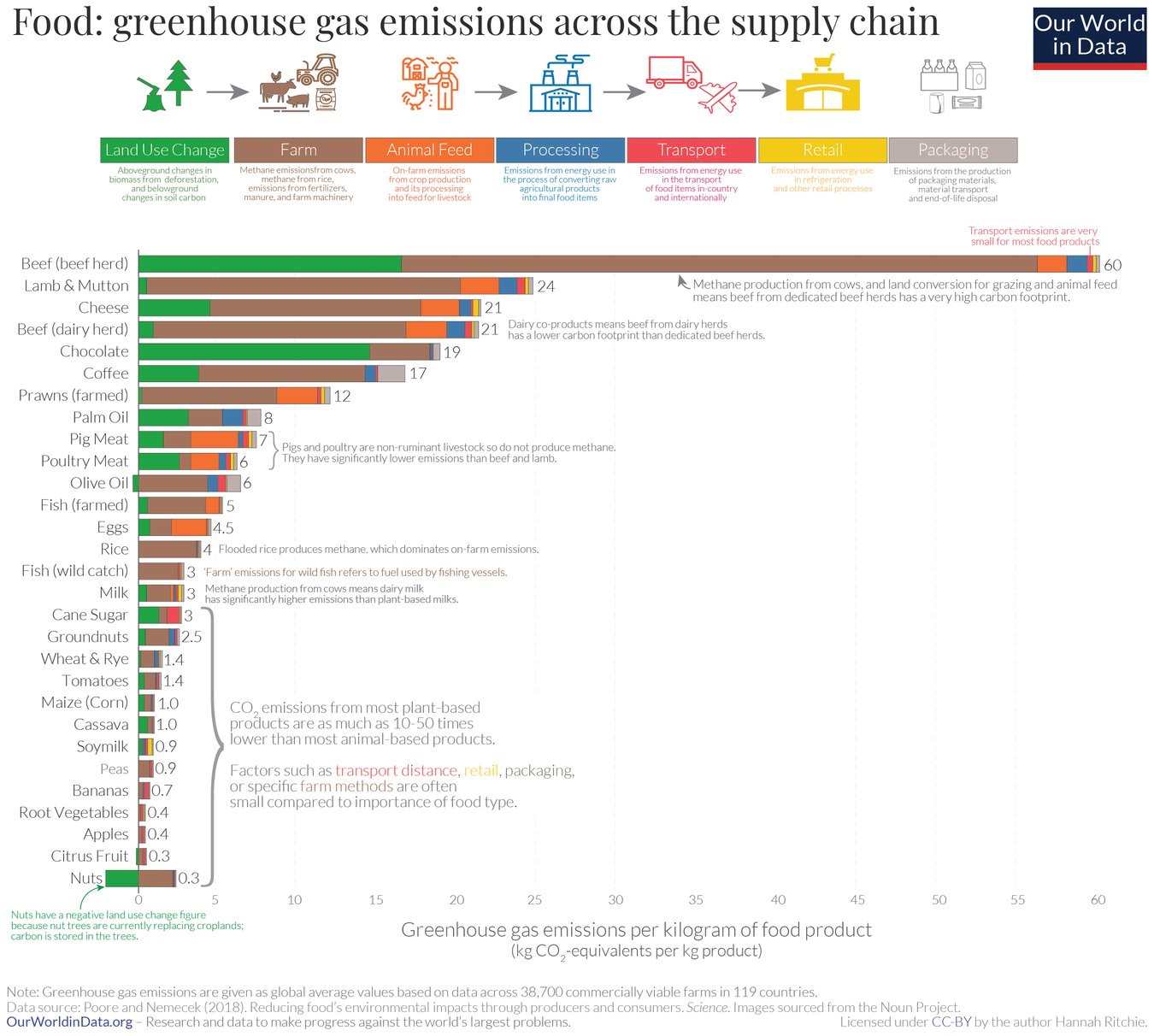
chart

all 37 comments

sorted by: hot top controversial new old
[–] 67 points 5 months ago (8 children)

The concept of a personal "carbon footprint" was popularized by oil companies to refocus attention away from their responsibility for climate change

  • source
  • hideshow 8 child comments
  • [–] 33 points 5 months ago (5 children)

    To keep my carbon footprint low I dont buy from oil companies

  • source
  • parent
  • hideshow 5 child comments
  • [–] 7 points 5 months ago (4 children)

    That one step is the one they were trying to avoid with the rest of this non-sense. You're not going to make up the difference for others not doing the same, with this stuff, or telling others to do this stuff.

  • source
  • parent
  • hideshow 4 child comments
  • [–] 8 points 5 months ago (3 children)

    And now those people are the ones crying about fuel prices while I don't give a shit because I don't even want it.

  • source
  • parent
  • hideshow 3 child comments
  • [–] 1 point 5 months ago (2 children)

    I just refuse to budget more for fuel when its more expensive. Gimme an excuse to refuse to leave the house because I don't have the fuel in my car to drive across town for whatever non-sense and still make it to work until pay-day, I'm going to take it.

  • source
  • parent
  • hideshow 2 child comments
  • [–] 2 points 5 months ago (1 child)

    Suppose I do this too, just that my budget is always zero

  • source
  • parent
  • hideshow 1 child comment
  • [–] 1 point 5 months ago

    I mean, yes, but the point I was making is that most people don't, and so demand doesn't adjust to supply or pricing quite as-it-should. I've got a few more payments to make on the vehicles I have before EV's become anything-like a feasible option for me.

  • source
  • parent
  • [–] 18 points 5 months ago* (last edited 5 months ago) (8 children)

    For many years after I retired I didn't drive at all. I could go a month without using the car. Really was proud of myself for saving the planet.

    Then my health went to hell. I'm always driving to the doctor, and eating a lot of beef (anemic). I'm actually tired of eating beef. But the other option is transfusions, so carbon footprint be damned.

    Give me a couple of years and I'll show how to reduce carbon footprint. It's not going to look pretty thought.

    But as others have said, how much carbon footprint does Bezos yacht have?

  • source
  • hideshow 8 child comments
  • [–] 6 points 5 months ago (2 children)

    I get this. My wife has medical issues and we can't exactly walk everywhere and she can't ride a bike at all comfortably. We actually put a lot of time into finding something that would work and she hurt herself. Granted we were looking at affordable options.

  • source
  • parent
  • hideshow 2 child comments
  • [–] 5 points 5 months ago

    But as others have said, how much carbon footprint does Bezos yacht have?

    This is my conclusion as well.
    I am conscientious about what I use/buy/eat, preferring local products even if they cost a bit more. I like walking and public transport is super convenient.

    As long as I'm not buying Nestlé (as much as I can, I'm still surprised by finding Nestlé products). Fuck Nestlé

  • source
  • parent
  • [–] 3 points 5 months ago (2 children)

    I’m actually tired of eating beef.

    Would beef-liver supplements (like in pill form) be enough iron to replace the beef?

  • source
  • parent
  • hideshow 2 child comments
  • [–] 16 points 5 months ago (2 children)

    Why does the article compare kilograms of food instead of equivalent calorie amounts?

    The study provides data per 100g of protein, which seems like more useful comparison.

  • source
  • hideshow 2 child comments
  • [–] 13 points 5 months ago*

    There are other reasons to buy local-ish. If you're lucky, local farms have stricter labor and environmental regulations, ie use less pesticides and better treat workers, than oversea farmers.

    That being said it make sense to focus on eating less beef and lamb products.

  • source
  • [–] 22 points 5 months ago

    In my mind, local food is more about the economics of supporting small businesses in your community. Sure, eating beans and lentils shipped across the world to your closest whole foods may have a smaller carbon footprint, but your money is still being siphoned to the big businesses in that supply chain.

  • source
  • [+] 9 points 5 months ago (3 children)
  • [–] 11 points 5 months ago

    The problem is the system, not the head count. As AI and automation advances, the capitalist class will have no problem causing just as much ecological damage with a hundredth of the current population.

  • source
  • parent
  • [–] 2 points 5 months ago (1 child)

    People don't produce all that much CO2, and by stewarding (food) forests and tending gardens they can be part of an ecosystem that absorbs more CO2 than they produce.

    If you care enough about the environment to go vegan, you can raise your children to be net positive for the planet.

    That does mean destroying capitalism, including most of the automotive industry, agriculture industry, aviation industry, data centers, and more.

  • source
  • parent
  • hideshow 1 child comment
  • [–] 9 points 5 months ago (6 children)

    Why is every meat called by it's food name (beef, mutton, poultry etc) except for pork... Which is "pig meat"?

  • source
  • hideshow 6 child comments
  • [–] 3 points 5 months ago (2 children)

    What about manflesh? Would this be rated high CO2 content, or low because eating the emitter is probably one of the best ways to get emissions down.

  • source
  • parent
  • hideshow 2 child comments
  • [–] 7 points 5 months ago*

    You can see this directly from the Iran war effects: peaking oil prices and fossil scarcity are harming food production more globally (via fertilizers, pesticides, tractors) than transporting it.

  • source
  • [–] 2 points 5 months ago

    I didn't realise sheep farted so much!

  • source
  • [–] 1 point 5 months ago

    Although I get the point, I can’t help but think this chart would be more effective if the colors were labeled.

  • source