top 47 comments

sorted by: hot top controversial new old
[–] 83 points 7 months ago (13 children)

It's always funny when I can get the exact same drugs for my pets and it costs 10% of the cash price I'd pay for myself.

Like, the trazodone my dog was prescribed post hernia surgery is the same pill as the trazodone I take for insomnia.

  • source
  • hideshow 13 child comments
  • [–] 40 points 7 months ago (9 children)

    Supposedly the meds for pets don't have the same safety regulations as the ones for humans but I'm not sure how much that matters, especially currently

  • source
  • parent
  • hideshow 9 child comments
  • [–] 24 points 7 months ago (4 children)

    It just means that your options are limited for suing over bad products.

  • source
  • parent
  • hideshow 4 child comments
  • [–] 7 points 7 months ago

    the meds for pets don’t have the same safety regulations as the ones for humans

    Depends on the meds. Most medication for animals is from the same production line as humans, its just overflow stock or stuff that didnt meet the quality standards.

    Human medicine is tightly controlled, not by governing bodies, but by the manufacturer. They artificially limit availability to create shortage in human medicine, as this produces the highest profit. How is simple, the stuff that doesnt meet the quality standards gets immediately labeled and shipped as pet medicine (this creates a surplus keeping costs low), but the expiry dates are kept intentionally very short (Which expiry on most medication is mostly a lie, fyi). This ensures constant rollover.

    The rest is stored, unlabled except for a printed internal production run number, to identify when it was produced. Its labled as-needed to control where it is going. This keeps prices high and gives them room.

    This is why 80+% of pet medication is the same quality and standards as human medication, but doesnt have the markup. the ~20% is the actual stuff that didnt meet quality standards. So while you could just use pet medication, without quality testing each vial or dose(in the case of pills), you run the risk of contaminants.


    The solution: Price regulation like other countries do. The problem is the manufacturer has too much control over the pricing. They may still try to reduce production, to control the price, but regulation can fine them over this as well. Its all easy solutions and it all involves preventing corruption.

  • source
  • parent
  • [–] 4 points 7 months ago (1 child)

    I have filled several meds for my pet and for myself at the same pharmacy. Same pill, same manufacturer, same lots.

  • source
  • parent
  • hideshow 1 child comment
  • [–] 1 point 7 months ago

    I have filled several meds for my pet and for myself

    Shhhh, don't give away the secret! Also, kiss your local veterinarian for their wonderful insight into your pet's medical conditions that match yours. It's true what they say: a person often looks a lot like their dog.

  • source
  • parent
  • [–] 2 points 7 months ago

    When I said the same pill, I meant it's from the same manufacturer with the same imprints as the ones I have.

    A pharma company isn't going to set up another production line just for vet meds. At worst they're selling batches that are outside the FDA's margin of error. But I even doubt that since they're not going to want veterinarians to stop buying their products.

    They charge so much for people because they know people will spend it. They know people won't spend $600 on antibiotics for their pets.

  • source
  • parent
  • [–] 1 point 7 months ago (1 child)

    Weird thing is, that at least in Austria it is usually the other way round.

    Drugs for my cat cost me a ton, so I bought human medicine and broke it up to the right dosage - still not perfect, if the pills have milk sugar...

    But even my vet recommended it to me, because they do the same in their practice

  • source
  • parent
  • hideshow 1 child comment
  • [–] 39 points 7 months ago (1 child)

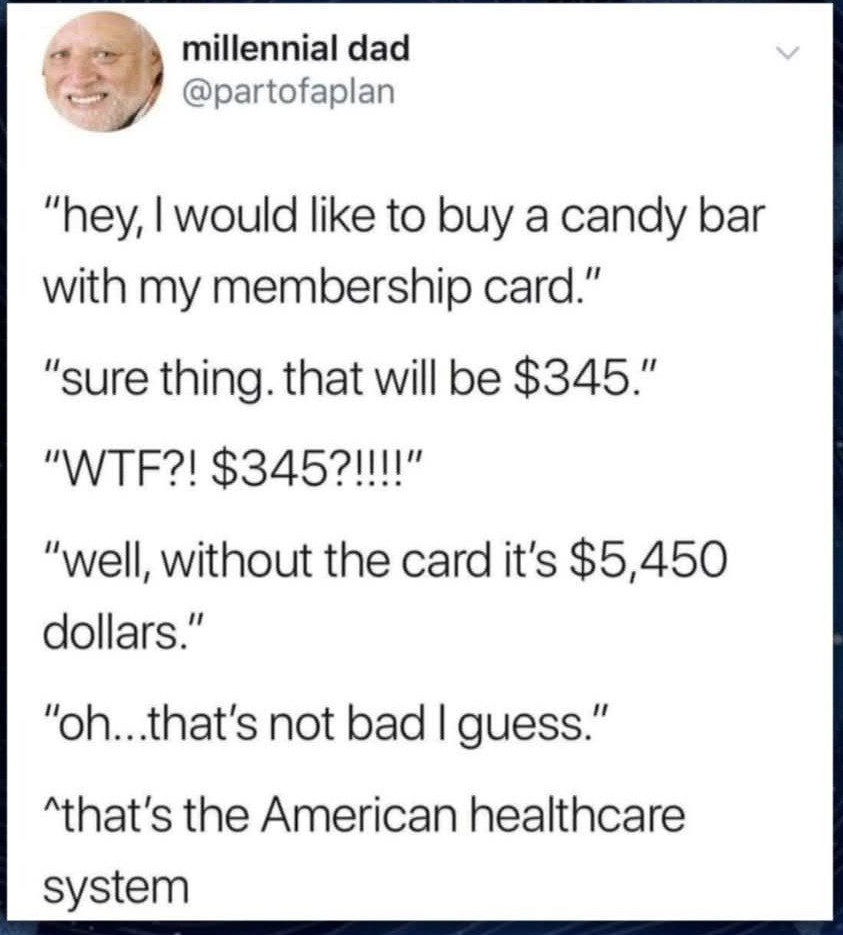
    You: Buys candy bar.

    Membership Card Issuer: "Sorry, but we're not going to pay for your candy bar. You should have asked us before you bought it."

    You: "Why?? I was starving so it was necessary."

    Membership Card Issuer: "Nope. Still should had asked first."

    Next time rolls around...

    You: "Hey, can I buy a candy bar? I'm really hungry but I remember you told me to ask first."

    Membership Card Issuer: "Hmmmm... nope. Sorry."

    You: "WTF. Why?"

    Membership Card Issuer: "You don't need it."

    You: "Uh, yeah. I do need it. I'm starving!"

    Membership Card Issuer: "You're fine. You should walk it off. That will be $20,000."

  • source
  • hideshow 1 child comment
  • [–] 31 points 7 months ago (2 children)

    except the candy bar is something you can’t live without

  • source
  • hideshow 2 child comments
  • [–] 20 points 7 months ago (1 child)

    That's simply not true. You really don't need a, checks notes, heart to live - american insurance companies

  • source
  • parent
  • hideshow 1 child comment
  • [–] 25 points 7 months ago (4 children)

    And from what I understand they have to go to a specific store that accepts the membership card to get the "discount," right? I don't think they can use the membership card in every store.

    Does it also matter if they're in their home state or not?

  • source
  • hideshow 4 child comments
  • [–] 6 points 7 months ago (3 children)

    It can, depending on plan. Mine covers emergencies everywhere in the country regardless of in my state or not. But I better not need a normal dr appointment on vacation.

    Though medication can be pretty easily accessed using a national chain like cvs or walgreens.

  • source
  • parent
  • hideshow 3 child comments
  • [–] 4 points 7 months ago (2 children)

    Thank you for the clarification. So you really have to shop around for the right insurance, I guess? Or maybe it's all tied to your employment. Can you have something from your employer and buy another to cover what your employer doesn't?

  • source
  • parent
  • hideshow 2 child comments
  • [–] 4 points 7 months ago (1 child)

    It’s tied to your employer, you still pay though. So you’re kind of forced into your employers healthcare at a slightly reduced rate. If you can afford supplemental coverage it is an option. You can also pay for private insurance and opt out of your employers, but you are required to carry some coverage and if you do not have any, you are typically forced to accept what your employer offers. And most people struggle to afford private coverage which can be way more expensive, especially so if you don’t qualify for affordable care which is loosely regulated by the federal and state government. It’s a mess…

  • source
  • parent
  • hideshow 1 child comment
  • [–] 19 points 7 months ago (1 child)

    I've gotten to the point where I've seen multiple versions of this tweet, and I believe the discounted candy bar was 8 dollars originally.

    What a time to be alive.

  • source
  • hideshow 1 child comment
  • [–] 12 points 7 months ago

    I'm so glad I live in a country with free candy bars.

  • source
  • [–] 11 points 7 months ago

    And then on the explanation of benefits they didn't even pay for the difference they just "negotiated" it. But you're not allowed to.

  • source
  • [–] 9 points 7 months ago (1 child)

    No the doctor says it costs this much, the hospital double it and says it costs this much, the insurance company says they will only pay this much, the hospital says we'll raise the price but give you the insurance company the difference in a discount so that you can say how much you helped the customer in exchange you tell the customer that all the other places that can do this nearby are out of network. Then insurance raises premiums and deductibles because of all the discounts they are providing their customers.

  • source
  • hideshow 1 child comment
  • [–] 5 points 7 months ago

    No the doctor says it costs this much, the hospital double it and says it costs this much, the insurance company says they will only pay this much

    Doctors dont decide on costs of medications or procedures. Hospitals and Pharmacies do. When a doctor prescribes you a medication, their software only show the MSRP as a guide (and sometimes if your insurance covers the type, depending on the software). Pharmacies, when they order medication, only get to see the suppliers price and supplier availiblity. -- The price you pay is based on the Pharmacies markup from cost, usually around 23-40%, to cover operational costs and profit margins of around 3-17%.

    The really messed up part is that Pharmacies in the US, are locked in by contracts to choose thier suppliers. This lets suppliers charge what ever they want to Pharmacies, and create artificial shortages at any time with impunity. Pharmacies can change suppliers after the contract is up, but, the supply system is so corrupt, its a case of bottom-up corruption. To fix it you would have to re-regulate the system from manufacturer to hospital. Allowing pharmacies to buy direct, prohibit supplier contracts/rebates, and regulating the costs of medications with caps at each stage would solve all of this. However, none of that can ever be done, as long as politicians have a option to make profit from the system too. They dont pay for medication or treatments, you do. They have no incentives to fix the system and every incentive to make it worse, which is why we see just that.

    However, the biggest contributor to the cost from the medications manufacturers, They reap the most rewards. Want a example? Insulin. The cheapest medication in existence to produce, no licensing, extremely plentiful and cheap ingredient costs and scales easily. Its literally a pure-profit medication and one that some people depend on (and they actively prevent cures from being researched via lobbying and paid counter-research). Remember, most pharmaceutical CEO's are multi-millionaires. They are for-profit and they reap all of it you will tolerate without turning them into spaghetti.


    As far as Doctor treatment costs. Doctors generally make very little, even private practice doctors, the "practice" is the same as a hospital, they rarely operate it themselves and they only get to dictate their rates. ofcourse the rates are negotiable and why insured patients generally pay less, than uninsured patients as they cant negotiate with the doctor directly, only the practice which will never budge unless you get a lawyer involved...

    When you are at a hospital however, thats when things get reaallly messy. You have all of the above costs, plus the hospitals surcharges on each of those on top of it. In the US, Hospitals rarely receive much outside funding (and as of 2026, they are receiving the least amount in US history, since treatment regulations existed). They are required by law to treat anyone that walks in the door. Whether they have insurance or not. They eat 80% of the cost of treating most patients in the end, and thats before the hospitals Board gets paid. Remember, hospitals in the US are For-Profit. Who makes up the hospitals board? Retired doctors, Lawyers and Investors. Basically a bunch of old men, that dont have any costs of living...

    So why is it so expensive? Every time a hospital needs to use a vial of Morphine for example, it has to be disposed of at the end of the day (Usually, depends on the hospital). The safety regulations on medicine and equipment make operation costs high, and profits low by design, So the cost per-patient goes up. So every time they have to eat the cost of some one without insurance in the US medical system, the debt goes up.

    Most US Hospitals have more debt than nearly any other industry. It makes it VERY hard to get loans and even harder to maintain operation. Its why most rural hospitals close and most big city hospitals are insanely expensive. Its hard to keep up with the costs of operation, and debt repayments when you rarely make a profit and are constantly taking on debt to pay the board.

    Remember, the bulk of a hospitals real operation cost is paying the board. While they may not make as much as you think, they make far more than they should and get even more through pharmacutical and medical instrument manufacturer kick-back deals. (Remember Prozac and Viagra... most of their marketing budget was spent on this... that is just one example in the last 20 years)

    This is why countries with universal healthcare systems are generally doing better and its cheaper to operate. Germany and AU still have private + public systems, and while they are still as not as good as some European countries, the regulations on medication, and medical equipment prevent the free-for-all of price fixing like the US has.

    The US has one of the worst medical system ratings in the world, remember that. The only things that used to get high ratings was the reconstructive surgery sector. That has even died off from corruption over the last 20 years.

  • source
  • parent
  • [–] 7 points 7 months ago (2 children)

    My kid’s prescription with insurance went from $45 a month to $120 a month. With a discount card, it’s still at $45 a month. Not sure why I have insurance at all.

  • source
  • hideshow 2 child comments
  • [–] 5 points 7 months ago

    Haha! OP thinks Americans know what healthcare costs before hands!

  • source
  • [–] 5 points 7 months ago

    Seriously. I got a med that is $1500, but insurance won't cover it till I meet my deductible. The generic is cheaper, but they won't cover it at all. Cost plus has it for $60 with no insurance at all. Our system can get fucked.

  • source
  • [–] 4 points 7 months ago

    You'll also receive an additional bill for $690 in 3 months after you insurance doesn't cover everything. Also, you haven't met your deductible, so that will be an additional $345 dollars.

  • source
  • That’s shopping at a supermarket these days.

  • source
  • [–] 2 points 7 months ago* (1 child)

    Except if you ACTUALLY don't have the card it's like $50.

    Which is still terrible, but they take whatever they can. Everything is marked up knowing that insurance will pay for overpriced services as long as people pay may more for insurance thinking that they are getting a deal.

    If literally everyone in the US cancelled their health insurance tomorrow, with no exceptions, I guarantee you the hospital's will be charging normal same prices because it's all the money that they can get, they aren't going to just not make any money at all, and insurance companies would go out of business.

  • source
  • hideshow 1 child comment
  • [–] 2 points 7 months ago

    It misses the mark in that there is some candy that actually does cost thousands of dollars and if you don’t eat it and you have a certain condition then you will die. And if you cancel your members card then you won’t be able to afford it and the hospital is only legally required to give you a couple m&ms while you die if you can’t pay.

    If only we had universal candy care, but that would be communism.

  • source
  • parent
  • [+] 3 points 7 months ago (3 children)
  • [–] 2 points 7 months ago

    It's sometimes the opposite. The insurance companies actually have a lot of input on the price the doctor/hospital is allowed to charge, and I've seen it purposefully pushed up or down depending on what tricks the insurance company is trying to use for its balance sheets.

  • source
  • parent
  • [–] 4 points 7 months ago (6 children)

    Candy bars are an indulgence that someone can live without. There are times in someone's life where healthcare is necessary to continue living.

  • source
  • hideshow 6 child comments
  • [–] 26 points 7 months ago (5 children)

    I think you've misunderstood the comparison with candy bars. Many medicines that health insurance companies charge through the nose for are sold for very little, sometimes pennies a dose, in other countries.

    Insulin doesn't actually cost that much to make. Two to four dollars a dose.

    Paracetamol is dirt cheap. In the UK it can bought for as cheap as a penny a tablet, and that's twenty times what it costs to make.

    The insurance companies charge stupid prices for them though, despite them being of similar production costs as candy.

  • source
  • parent
  • hideshow 5 child comments
  • [+] -14 points 7 months ago (2 children)

    If you need paragraphs to explain it, it's not a good metaphor.

  • source
  • parent
  • hideshow 2 child comments
  • load more comments (1 reply)