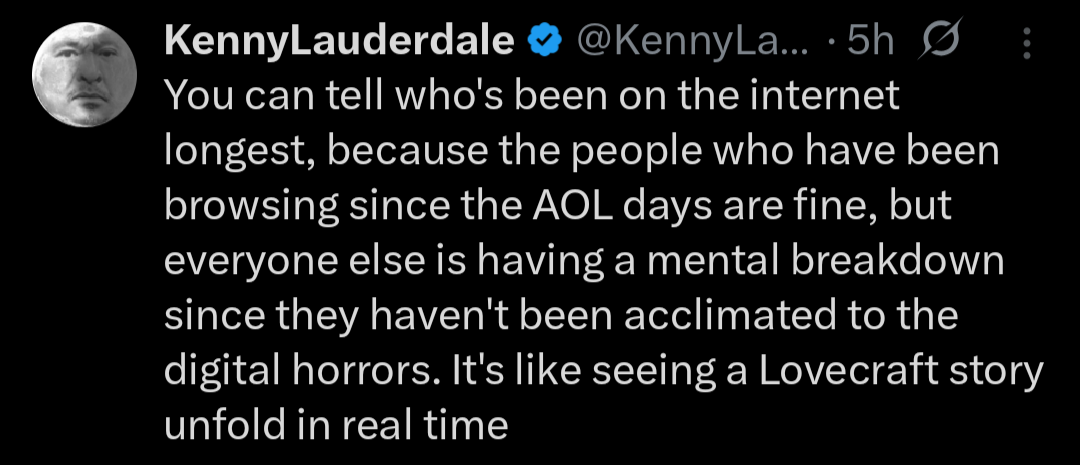
top 98 comments

sorted by: hot top controversial new old
[–] 137 points 8 months ago (15 children)

I'm really confused what this could be referring to.

Because the folks who've been around the longest and remember the early days of the Internet are currently in utter dismay over how their fun international sandbox has become a Black Mirror-esque horror show, while everyone else seems to just shrug and obediently upload their face scans so they can watch AI videos of uncanny-valley cats playing cruel pranks on facsimiles of political figures in-between unskippable ads for applying to be an ICE agent under promises that it'll be like COD but in your own backyard with living, breathing brown people.

  • source
  • hideshow 15 child comments
  • [–] 43 points 8 months ago (3 children)

    Spot fucking on. The people who’ve watched it grow then wither are the most bitter because we saw what it could have become

  • source
  • parent
  • hideshow 3 child comments
  • [–] 31 points 8 months ago (2 children)

    I'll never forget John C. Dvorak's 2006 article from PC Mag, where he argued that we were living in the Golden Age of the Internet, and to enjoy it while it lasts, before it ends up overcommercialized like what happened to radio. I only half believed it at the time, but I see now that he was 100% spot on with that prediction. (Snippet here; can't find a scan of the entire article.)

  • source
  • parent
  • hideshow 2 child comments
  • [–] 13 points 8 months ago (1 child)

    Snippet here; can’t find a scan of the entire article.

    I went digging and found it, it's split across two pages (which was the style at the time) here and here.

    here is the full text to save you a click:

    The Golden Age of the Internet

    06.21.06

    By John C. Dvorak

    How many people realize that we're living in a golden age, the Golden Age of the Internet? It won't last; golden ages never do. Some of it will remain, but there's evidence that much of it is headed for the trash heap of history.

    [ADVERTISEMENT]

    Radio days. The golden age of radio lasted from about 1930 to 1950. It was nothing like radio today. Money was thrown at it. Thousands of great dramas and variety shows were made. Huge news organizations were built. Today, radio consists of right­wingers ranting about liberals, psychologists analyzing moaners-and-groaners, and mediocre music from CDs. We do get all-news stations with erroneous traffic reports, and public broadcasting stations with thoughtful shows on fascinating topics like the art of Gebel Barkel from the first millennium BC.

    Every new technology that widely affects society has a golden age, and we give things a lot of slack. Porn on the Net symbolizes this leeway. But so do podcasting, blogging, free video servers, chat rooms, P2P, free e-mail, and other flourishing services.

    A proprietary, closed Net is coming. A golden age ends either when something new comes along (as with radio's golden age, killed by the advent of TV), the government gets involved, or entropy sets in—usually a mix of these elements. In the case of the Internet, we are already seeing a combination of government, carrier, and business interactions that will eventually turn the Net into a restricted and somewhat proprietary network, with much of its content restricted or blocked. Only a diligent few will actually have access to the restricted data, and in some parts of the world even trying to view the restricted information on the Net will be a crime.

    It's already a crime to post intellectual discussions about copy-protection schemes that are protected by the DMCA. If the American public tolerates that sort of onerous restriction, then it will tolerate anything.

    Continue reading... (page 2)

    Filtering and blacklists now common. Most U.S. government agencies now use filtering mechanisms to keep their own computers from accessing blacklisted Web sites. Third parties maintain these blacklists, and they put whatever they want on the lists. For example, my blog was blacklisted for a while, with no explanation.

    [ADVERTISEMENT]

    Most companies go much further and carefully monitor all network traffic. They can then pinpoint the use of streaming media and other verboten uses of corporate computers and simply block such usages and blacklist the sites involved.

    Even e-mail is lost in the shuffle. The New York Times has a system in place that prevents certain press releases from getting to the reporters.

    Blame spam and porn. Spam, porn, and other forms of questionable content are the reasons for filtering and blacklisting. But increasingly, content that mentions birth control or evolution is blocked. Nazi memorabilia sales and hate sites are also banned. It is folly to think that any government, no matter how progressive, won't be tempted to choke off certain content of which it does not approve.

    This sort of intervention becomes ever easier with the consolidation of the Internet. It's all headed to AT&T; and Comcast. AT&T; has already sold the public down the river by turning over phone records to the government without blinking an eye. Ask it to filter Google results? No problemo!

    Is there anything the public can do about this? Yes—enjoy the Golden Age, while you can.

    Discuss this article in the forums.

    More articles from John Dvorak:

    See John get cranky about technology in his new Cranky Geeks IPTV Show.

    Go off-topic with John C. Dvorak here.

  • source
  • parent
  • hideshow 1 child comment
  • [–] 3 points 8 months ago*

    I've been looking for this article again for nearly two decades. Obviously my Google fu isn't as good as it used to be.

    Thank you.

    (E: That take on Nazi memorabilia, yikes. Don't remember that bit lol. Oh how naïve we used to be...)

  • source
  • parent
  • [–] 22 points 8 months ago (4 children)

    I've been on since BBS's , I was just starting to understand it a little then it expanded to browsers, then there was the FTP's to share pirated software, ICQ to meet people from all over the world it was good.

    Then it went to shit, the only good thing is that torrents have been keeping my media free.

  • source
  • parent
  • hideshow 4 child comments
  • [–] 4 points 8 months ago (3 children)

    I miss IRC. I met really cool people there. From nowadays social networks almost nobody. Not sure what is the difference, maybe it helps that I do not want to link my real person to social networks.

  • source
  • parent
  • hideshow 3 child comments
  • [–] 3 points 8 months ago (2 children)

    Dude, you don't have to miss IRC, you can just hop back in. Its still great. A little less people but once you find a couple of channels its excellent.

  • source
  • parent
  • hideshow 2 child comments
  • [–] 2 points 8 months ago (1 child)

    Just few months ago I came back to my old IRC channels about my hobbies. All empty except the one from my city, that is used only by men to find sex, 0 conversation.

  • source
  • parent
  • hideshow 1 child comment
  • [–] 10 points 8 months ago

    I'm also clueless and don't understand what the OP is talking about - who is having a mental breakdown and why? And aren't the millennials who are the only tech and internet literate generation exactly the people having a mental breakdown over the way the internet is going? I'm so confused, I need more context.

  • source
  • parent
  • [–] 3 points 8 months ago (1 child)

    Statistically speaking, most people alive for the days of the early internet are significantly better off than younger generations. That's my guess, that whoever posted this is comfortably oblivious to the class war

  • source
  • parent
  • hideshow 1 child comment
  • [–] 3 points 8 months ago

    But if you've been around long enough and have been reading and paying attention to history, you shouldn't be surprised because the ruling class is literally doing what they have always done.

    The US has not changed, their ruling class has been raping and eating people and children since its inception, but people ignore that history or aren't taught it because it was done to slaves.

    Slavery never ended, it just changed names and presentation to for-profit prisons.

    Idk if we are desensitized or just not surprised because we could see it coming

  • source
  • parent
  • [–] 140 points 8 months ago (45 children)

    The early Internet had a few simple rules:

    • Never feed a troll
    • Never trust anything written online
    • Never tell anyone your real name or address
    • There are no girls online (i.e. people are not who they claim to be)
    • Online is not IRL

    And most people knew these rules. The proliferation of the Internet has brought a lot of people who don't understand these rules in to the fold and it has made the Internet a worse place. "Normies" seemingly think the Internet world works like your normal social interactions - it does not. The anonymity of the Internet brings out the worst in people. We really need to bring back the rules of the early Internet for the safety of everyone.

    Feel free to comment more rules if you remember any.

    As much as I miss the early Internet though, I genuinely do wish I'd had more protection from the seedier sites. I am not better off for having seen the gore and shock sites.

  • source
  • hideshow 45 child comments
  • [–] 29 points 8 months ago (5 children)

    NGL, I saw the gore and shock as well - stileproject, rotten, marsonline, ogrish, bestgore... and even WPD on Reddit in the early days and it really did give me an appreciation for safety first! in almost everything I have done since.

    The biggest rule was proof/cites linking to legitimate sources, (not conspiracy sites or your friend "Sally" on facebook) or it didn't happen.

  • source
  • parent
  • hideshow 5 child comments
  • [–] 7 points 8 months ago (2 children)

    I learned a few important lessons. Cars, trains, knives, guns, angry people, power lines, and falling are dangerous. Treat them with respect.

  • source
  • parent
  • hideshow 2 child comments
  • [–] 2 points 8 months ago (1 child)

    Yeah I think it's actually pretty healthy and good to see and read and watch horrible horrible things. For most of human history, people were exposed to such things from a young age. It strips away a harmful naivete. I know so many people who, when they see the ICE shootings, say stuff like "I can't believe a human could do that to another human", and I'm like...seriously? People think that atrocities are in the past just because they don't see them. People think that humans have changed or grown up or lost a capacity for viciousness, but it's absolutely still there. Actually watching ISIS slit someone's throat and seeing how the people around them react, or seeing someone kicked to death in the slums, I'm not saying this stuff was pleasant by any means - but it gave me a much more realistic and accurate understanding of humanity and our world. It's one thing to hear about it, it's another thing to see it, imo. The point sticks with you better.

  • source
  • parent
  • hideshow 1 child comment
  • [–] 15 points 8 months ago (4 children)

    The eternal September brought new people without end who never acclimated.

  • source
  • parent
  • hideshow 4 child comments
  • [–] 12 points 8 months ago (8 children)
    • Use a nick (handle, username) that doesn't give anything away

    The people who came after me didn't know that one and started putting their birth year, hometown, etc. into their usernames.

  • source
  • parent
  • hideshow 8 child comments
  • [–] 4 points 8 months ago (7 children)

    One time I was chatting with a woman who told me she was single. I'm still not quite sure if she was, but she had a kid with the claimed ex. However, the ex - or whatever he was - found out I was talking to her and left a voicemail threatening me.

    I don't remember what he said exactly, but I do remember one detail. She and I had only talked online and over the phone. I never gave any really location specific information to her, just my first and last name and phone number. In his voicemail, he said "I will find you. I will Google your ass!"

    Even now, if you Google my first and last name, you get results about some CEO, not me. I've never tried googling my phone number.

  • source
  • parent
  • hideshow 7 child comments
  • [–] 5 points 8 months ago (1 child)

    Yeah, there are people who search for themselves and want an ego boost. I search for myself and hope to find nothing.

  • source
  • parent
  • hideshow 1 child comment
  • [–] 3 points 8 months ago

    Indeed. I know roughly what's going on because back before I cared about privacy I set up a "Google Alert" for my name. Since my tastes developed, I'm glad he's there to distract from anything notable about me.

  • source
  • parent
  • [–] 5 points 8 months ago (4 children)

    I've never tried googling my phone number.

    Send me your phone number and I'll Google it for you.

  • source
  • parent
  • hideshow 4 child comments
  • [–] 5 points 8 months ago (3 children)

    Even better - you give me yours and I'll call you so you don't have to type it.

  • source
  • parent
  • hideshow 3 child comments
  • [–] 6 points 8 months ago (2 children)

    How thoughtful, (202) 456-1414

  • source
  • parent
  • hideshow 2 child comments
  • [–] 7 points 8 months ago (2 children)

    Oh absolutely, I also believe that growing up with dialup was great, it meant that being online cost money, giving parents incentive to monitor the time spent online by children, and gradually getting used to being online.

    I remember asking and being allowed 30 min online, every few weeks.

    It worked well as we hadn't transitioned to an online first society.

    Then later in school there were a few shock sites being sent around, goatse was never huge at my time in school, for me the most prolific shock site around school was lemonparty.

    Even later in school, I started realizing how much gore and weird crap you could find, and a morbid curiosity took over forna few days, I remember finding a picture of a guy who got beheaded after falling on a spiked fence, you could see the head on one of the spikes, and another time when I saw the aftermath of a guy being sucked into a jet engine, that one was quite mild as the result was too abstract and you only saw a red paste, so it never bothered me.

    As it stands now, I think there is a value of mild supervision of kids and teens when online.

    I mean mild in a way that full access is allowed but only on a desktop in a shared space.

    And at 16 they can move their computer into their own room, and at 18 any admin account on their computer that the parents have should be removed.

  • source
  • parent
  • hideshow 2 child comments
  • [–] 6 points 8 months ago

    I'm an elder Gen Z furry. These rules are ingrained in me so hard it took genuine effort to stop defaulting to assuming everyone online is a "he" to avoid accidental misgendering ("they" works just as well).

    I wasn't here for the very earliest parts of the web, but I was just in time to watch it die and remember that it used to be a better place. Still, I often reference the Rules of the Internet today and it sucks seeing how many people just don't get it.

    But I think it's harder to for normies because they mostly cling to the corporate internet, believing it to be their safe haven, when it is, in fact, poison that actively promotes breaking the original rules (especially "don't feed the trolls") that kept people safe for the sake of engagement.

  • source
  • parent
  • [–] 4 points 8 months ago* (last edited 8 months ago) (2 children)

    And most people knew these rules.

    Prior to Gore asking to open up the Internet to the general public, most users were either academics, government employees, or students mostly on newsgroups. That most were on 56k dialup modems, and therefore their time online was limited. Fringers were then really on the fringes, instead of the other way around today. Yes, indeed, there was then etiquette, and in some places was strictly enforced by mods, either in BBS, newsgroups or IRC.

    The proliferation of the Internet has brought a lot of people who don’t understand these rules in to the fold and it has made the Internet a worse place.

    Once access became normalized and widespread as ADSL, which pretty much lowered the bar, most people just went straight online with complete disregard of what dark side they could run into later on, some even only starting the first time getting their web-only email addresses made such as Yahoo Mail or Google, before making their accounts for MMORPGs, online forums, Napster, Myspace, and later Facebook. That in some places, inept people have total disregard for their own online privacy, so bad they ended up being hacked or their personal identity stolen for fraud and other crimes.

  • source
  • parent
  • hideshow 2 child comments
  • [–] 3 points 8 months ago (1 child)

    If someone sends you a link check it VERY carefully and don't click if it isn't exactly what it seems to be. I remember there was one shock site called nimp.org or something, and you could structure the link as [anything].on.nimp.org and it would send them to a shock site of (I think violent? But can't really remember) gay sex video, change the size of your browser window, have it move around the screen so you couldn't close it easily, and play at max volume "hey everyone I'm looking at gay porn". It quickly became a game trying to structure the sneakiest links that would trick eachother, like wikipedia.on.nimp.org , hiding links, tricking eachother into clicking on shady stuff. I learnt to be very careful clicking on things long before rickrolls existed.

  • source
  • parent
  • hideshow 1 child comment
  • [–] 2 points 8 months ago

    I'm 40, and I'm not even sure if I learned these rules in school. I definitely didn't learn from my parents. But somehow, I managed to not get scammed, radicalized (I think), or diddled by predators.

    I dunno how millennials did it, but many of us managed to stay tech/media literate. The Canadian house hippo probably played an important role.

  • source
  • parent
  • [–] -1 points 8 months ago (4 children)

    We really need to bring back the rules of the early Internet

    • There are no girls online (i.e. people are not who they claim to be)

    Nah, I think some things should be left in the past

  • source
  • parent
  • hideshow 4 child comments
  • [–] 3 points 8 months ago (2 children)

    Add I understand it, the real meaning of that line is not exactly what it sounds like. It meant something like "in this anonymous place, only your thoughts matter, not your identity." If an idea was good, it was good, and it didn't matter who had the idea. Very egalitarian.

    Of course, we have since realized that isn't really true. Sometimes it's important to know if a thought is coming from a woman, who has had different experience from a man.

    Still an idea that need to be left behind, but not the one you probably think.

  • source
  • parent
  • hideshow 2 child comments
  • [–] 5 points 8 months ago (1 child)

    Add I understand it, the real meaning of that line is not exactly what it sounds like

    As someone who was around at the time, I think people meant it exactly as said. Partially it was an observation that most online spaces were really male-dominated. Partially it was a "no girlz allowd" sign. A lot of places were extremely hostile to women. The best that someone who admitted to being a girl or woman could hope for is a flood of messages from horny boys. That also made it a self-fulfilling prophecy. Girls would either stay away, or they'd pretend to be male just to avoid the drama.

  • source
  • parent
  • hideshow 1 child comment
  • [–] 65 points 8 months ago (29 children)

    You also never clicked an advert or used your real name.

  • source
  • hideshow 29 child comments
  • [–] [S] 28 points 8 months ago (27 children)

    Please tell me that people aren't clicking ads...

  • source
  • parent
  • hideshow 27 child comments
  • [–] 45 points 8 months ago (8 children)

    Enough are doing it that it's still profitable. Last estimates I saw were 10% who saw an ad clicked one, and 10% of those who clicked bought what they saw

  • source
  • parent
  • hideshow 8 child comments
  • [–] [S] 36 points 8 months ago (2 children)

    That's just hard to fathom for me. Wow.

  • source
  • parent
  • hideshow 2 child comments
  • [–] 11 points 8 months ago (1 child)

    It's actually been dropping over time. It used to be more like 10%, now I see some people celebrating 0.4% conversation rate. What's also been happening in conjunction is the cost has dropped. On like Facebook and stuff now you can serve like 1000 impressions for like $5 or something. I don't know exact numbers on cost there but stupid low like 0.10¢ per clicked ad.

  • source
  • parent
  • hideshow 1 child comment
  • [–] 5 points 8 months ago

    Across a lot of media, impressions are so cheap now they don't even charge for them, just the clicks cost ("CPC" is the charge type, "cost per click"). They track impressions to give advertisers metrics on conversion rates, but they don't charge for them.

  • source
  • parent
  • [+] 9 points 8 months ago (4 children)
  • [–] 11 points 8 months ago (3 children)

    The terms you want to search of you're curious "Click through Rate" and "Conversion Rate". It's actually been falling over time as people get more and more used to ignoring ads or using ad blockers. They vary some for type of product and location of ad (fantasy novels on a book blog are likely to be higher, drop ship Amazon stuff on Facebook are likely to be lower), but yeah, not super high.

  • source
  • parent
  • hideshow 3 child comments
  • [–] 7 points 8 months ago (2 children)

    The thing is, I do not honestly object to ads - the internet has got to be paid for somehow..

    My objection is the way that ads are served. It's the creepy stalking users far and wide across the web that irks me.

    This targeted bullshit. No, no and NO!

    I'm more likely when I am on any given site - to check out an ad that is discrete, static and embedded and shows up regardless of the ad blocker I use.

    That is different.

    At that point, I'm seeing something that another person or business that runs the site has made a decision to advertise, it may be a product or service they like and use.

    The rest of it though.. can rot.

  • source
  • parent
  • hideshow 2 child comments
  • [–] 3 points 8 months ago (1 child)

    Back in the day you could catch malware from online ads. And the pop-ups, the damn pop-ups, so annoying. For me, the final straw was when ads got sound. That got real old real fast, kind of like web pages with embedded MIDIs. I installed an ad blocker and haven't looked back. Any time I browse Internet without a blocker it's a horror show that kills me inside. If ads were reasonably sized static images I could manage it, but advertisers shot themselves in the foot by making their ads so obnoxious and went all-in on tracking. The trust is gone forever. Ads and advertisers can burn in hell.

  • source
  • parent
  • hideshow 1 child comment
  • [–] 12 points 8 months ago (8 children)

    From an actual conversation I had once:

    "What's your problem with adds, I love them. They always recommend things I could actually use. It's genuinely a great way for me to learn about new products or services."

  • source
  • parent
  • hideshow 8 child comments
  • [–] 15 points 8 months ago (3 children)

    Sure. Fundamentally, this is what ads should do. The problem comes from how intrusive they are in pushing their propaganda. And now they’re literally everywhere.

    I remember back in the day before browser tabs when sites would open new windows for ads. And sometimes those ads would open more windows for ads. And some of those windows had sound, or porn, or both. Worse yet, some would open off screen so you couldn’t easily close them. That’s where the term “pop-up” came from in pop-up blockers.

    Talk about whack-a-mole.

  • source
  • parent
  • hideshow 3 child comments
  • [–] 7 points 8 months ago* (2 children)

    Even Youtube is filled with scam ads, trusting ads to deliver you worthwhile results is like trusting Facebook not to sell your data to the highest bidder.

  • source
  • parent
  • hideshow 2 child comments
  • [–] 6 points 8 months ago (1 child)

    Do we know the same people? I asked the two who said this if they actually click on the ads and buy something. You can imagine my horror when they said yes. Meanwhile, I have a Pihole on my network and uBlock on every single browser.

  • source
  • parent
  • hideshow 1 child comment
  • [–] 6 points 8 months ago* (4 children)

    I sometimes do it if it's a company I really dislike. Then I immediately click back, happy in the knowledge that my brief action probably cost that company a tiny bit of money.

    (Side note: I'm an early Internet user.)

  • source
  • parent
  • hideshow 4 child comments
  • [–] 9 points 8 months ago (3 children)

    Are you one of those people that returned empty prepaid junk mail flyers? ;)

  • source
  • parent
  • hideshow 3 child comments
  • [–] 61 points 8 months ago* (3 children)

    I feel the opposite. I’m “C-64 dial up BBS” years old. I’m far, far more concerned with the internet today. It’s become destructive on so many levels. The corporatocracy takeover, the enstupidification, AI, troll farms, bots, outright lies, echo chambers willfully and ignorantly forming realities outside of objective truth…

    The modern internet is an awful conflagration that everyone is trying to manipulate and control while throwing more fuel on it in an attempt to profit from it.

    Goatse is nothing compared the dumpster fire that’s happening.

    I’m not fine with it at all.

  • source
  • hideshow 3 child comments
  • [–] 19 points 8 months ago (1 child)

    I’m that many years old too… 1970 represent!

    I liked it better when it was just random people coming together to talk about whatever random shit you were into. It felt so much more inclusive. Like no matter how weird your hobby was, somebody out there was into it as well… or sharing very funny stories like the creation of overly engineered toasters. Or putting a camera on a coffee pot to check if there was fresh coffee. Or the stories of the BOFH.

    Now it’s too controlled, monetized, enshittified, homogenized, etc. It’s not about people connecting anymore or creating content that people actually want and learn from. With all the AI generated bullshit, it’s likely not even created by people anymore. At least with goatse, tub girl, or lemon party you knew that was actual people… not sure if that’s better or worse actually. But somebody created it for others to “enjoy”… well experience might be a better word here. But you get the idea. It was people coming together because they wanted to. They enjoyed it. Now it’s all scams, rage-bait, and algorithms created to drive engagement. It’s almost like it isn’t fun anymore.

    But there are places that still remind me of the old internet. Lemmy for example. It’s not exactly the same but it shares its DNA.

  • source
  • parent
  • hideshow 1 child comment
  • [–] 6 points 8 months ago

    It certainly was more egalitarian. Geocities or MySpace were kinda examples. Anyone could make their own space, often for free.

    Most content today is crap, and the rest is someone stealing or reacting to that crap, ad nauseam. Though TBF if anyone remembers the early days of youtube or other platforms it was full of stupid stuff too, but it was “lookit me, lol!” for likes rather than ad-riddled garbage that somehow people expect to be taken seriously for.

    Goatse or 2g1c was our clickbait, and nobody tried to sell you anything or make it any more than it was. It was garbage and we knew it.

  • source
  • parent
  • [–] 5 points 8 months ago

    Agreed. Been on FIDO, been on BITNET before I went on the internet - way before the web. Way before the eternal September. People today cannot even start to imagine how the net was back then. Forget "six degrees", maximum distance was maybe three. You basically knew everyone, or you knew someone who did.

  • source
  • parent
  • [–] 35 points 8 months ago (2 children)

    “…the AOL days…”

    That funny feeling when AOL users consider themselves the experienced, wisened ones.

  • source
  • hideshow 2 child comments
  • load more comments
    view more: next ›