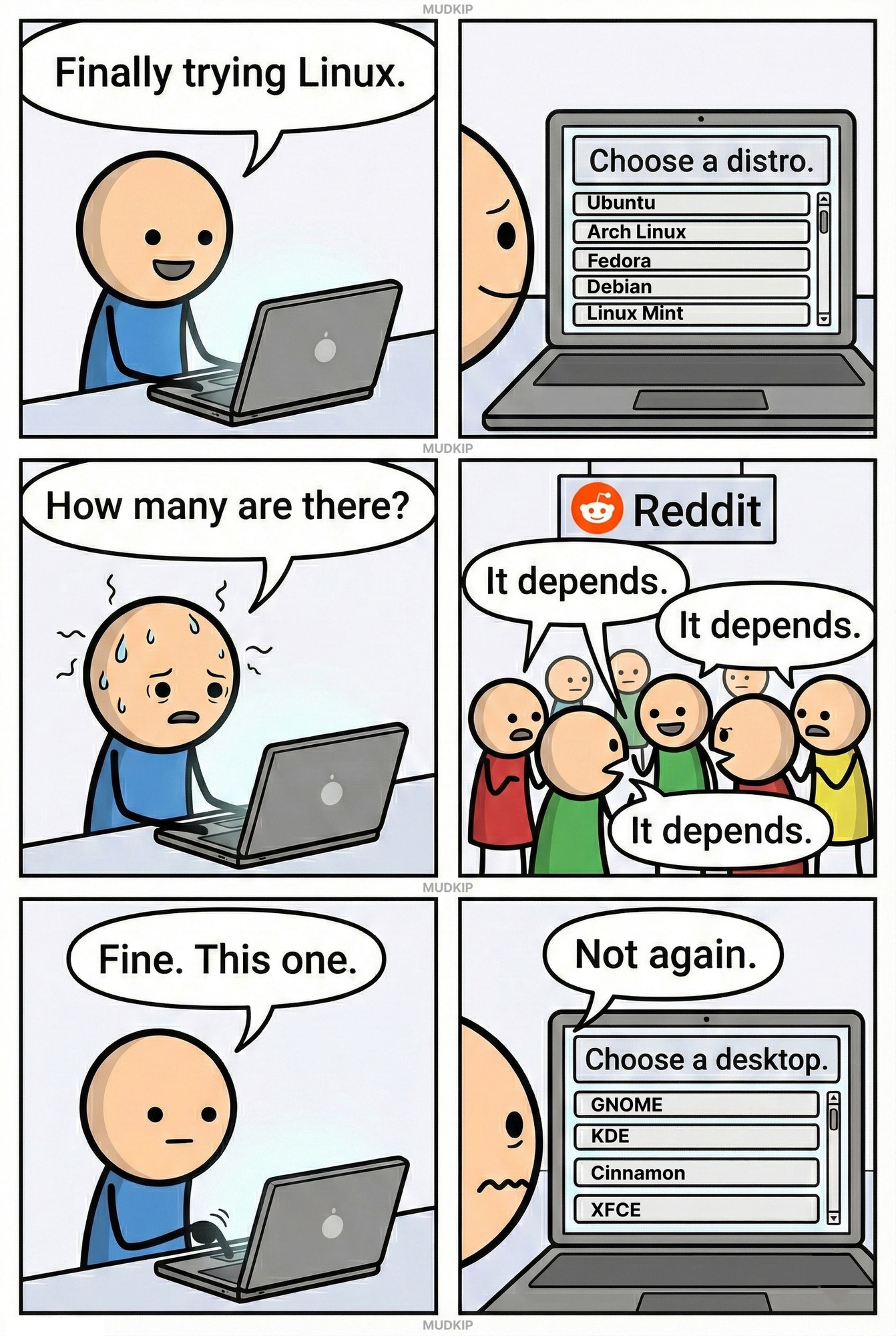
Whatever you use, so when he asks for support, you're in a position to help
post
Fedora if he's not gaming.
Bazzite if he's gaming. Or CachyOS.
I'll give you the secret to easy linux: stick with defaults! Stick with distros aimed at whatever you're tying to do, and you get a whole army of very experienced developers preconfiguring it all for you, for free. Instead of having to maintain breakage youself.
For example, do you want to learn all about debugging AMD drivers? Do you want to get into the intricacies of performant Proton setups, and environment variables, and kernels stuff?
You could just not, and get all that prepackaged!
Here's just a sampling of some pre-configured stuff in my distro:
cachyos/protonplus 0.5.14-1
A simple Wine and Proton-based compatiblity tools manager for GNOME
cachyos/protontricks 1.13.1-1
Run Winetricks commands for Steam Play/Proton games among other common Wine features
cachyos/protonup-qt 2.14.0-1
Install and manage Proton-GE and Luxtorpeda for Steam and Wine-GE for Lutris
cachyos/umu-launcher 1.3.0-2
This is the Unified Launcher for Windows Games on Linux, to run Proton with fixes outside of Steam
cachyos/vkd3d-proton-mingw-git 3.0.r0.g6d97b022-1
Fork of VKD3D. Development branches for Protons Direct3D 12 implementation
cachyos-znver4/mesa-git 26.0.0_devel.216300.02cfc61cc93-1
an open-source implementation of the OpenGL specification, git version
Do I know a thing about how Proton works? Nope. Do I know anything about maintaining an upstream AMD driver for some kind of bug fix? Absolutely not. And I don't have to! It's just there, in sync with the rest of my system through some maintainer's magic.
Fedora if he's not gaming.
Bazzite if he's gaming. Or CachyOS.
Specs are a 9800X3D and a 9070XT. He's definitely gaming.
Or if he isn't, he bought the wrong computer.
No matter what you end up using, make sure he installs RustDesk, so you can easily connect and fix the inevitable problems
Bazzite works pretty well out of the box and with new hardware (n = 1)
I would recommend Linux Mint. Its really simple to work with and basically plug and play. Comes with a solid software selection and built in tools. I personally really like the cinammon and mate editions. Cinnamon has a bit more modern look to it and MATE is a bit more retro.
I heard that Linux Mint doesn't play nice with newer hardware? Or is that only an Nvidia thing
It has to do with LTS kernel (iirc) making it incompatible with certain new(er) hardware. I recommend Fedora KDE.
I ran an older Nvidia card an currently a new amd card on Linux mint without problems. I suggest you try it out first using a live install on a USB stick.
It also doesn't have HDR if that's important to you. I switch into kubuntu whenever I want to watch something in HDR.
Anything Ubuntu-based (and thus Debian-based) may not be the best choice for brand new hardware, as it takes a bit longer for all the drivers to make it into the kernel.
I had to use an AMD provided script to get Mint to work with my ryzen AI 9 370, as the system couldn't drive the built in graphics
First boot had to happen with the "nomodeset" ( no [graphics] mode set[ting]) or it couldn't do any graphics, the screen went black as soon as it got out of the initial text mode
So no, Mint isn't great with very new equipment
My husband is using the non-LTS version of Ubuntu 25.10 with a 9060XT and has driver support and is happy with it. Mint would not support his card at this time according to our research. Bazzite was just a disaster for him -- lots of issues with not sleeping and the immutable distro made it hard to do what he wanted since he uses spinning hard drives for storage and wanted them to automount as well as managing a huge music library housed on a NAS. I think some of the issues were with his older B450 motherboard despite having updated the bios to the latest stable version. I am on older hardware and love Mint. I feel at home on the Debian-based distros though. Depends on your use case and how much you're willing to learn. Protip: Before you leave your friend alone with the system, make sure that it will do normal system things properly -- enter sleep, wake from sleep, reboot, etc since these are the things that will drive an average person insane when they don't function correctly.
I believe you need to be on kernel 6.12+ for the 9070 XT. Mint 22.3 will support that.
Depends. Why does he want to use Linux?
Because he heard that Windows 11 is very stinky, and Windows 10 is no longer supported.
And what does he want to use it to do?
Regular Fedora should be perfectly fine. I'd ensure a separate /home partition and a backup for ease of reinstallation if it gets wrecked. Yes, an atomic distro or btrfs snapshots could do that too, but like you mentioned, there are other considerations for atomic distros. And a separate /home partition eases installation of other distros if Fedora doesn't do it for him for some reason.
He will be doing some gaming (mostly single player stuff, like Minecraft) and will also be doing your normal everyday stuff (schoolwork, internet things, and probably a bit of programming since he is doing CS)
Coming from windows, Linux mint cinnamon will be very familiar to him. It also runs games well, being based on Ubuntu.
Actually, he isn't coming from Windows. He only has an iPad, I think this is his first PC
I vote Fedora as well, I love it having come from windows myself about a year ago. Not a big gamer anymore, but can confirm Minecraft runs well on Fedora KDE Plasma and looks similar to windows. I am a homelabber by hobby and an electrical engineer by trade. I do a bit of light CS and networking/SCADA for in my job. Understanding Unix-based systems is helpful for both realms. If your friend is a CS student and doesn’t have a PC already as a daily driver, this is THE time to get into Linux in my opinion since they are a blank canvas. I’m of the opinion knowing Unix-based systems, like Linux is only going to help you later in your career so might as well learn it now. Haha
Based on what I've heard about Bazzite I'd pick it over Fedora for your friend, but I've always used Debian-based distros so I can't speak from experience.
For new users, I've been recommending Zorin with good success.
would an ubuntu base support something as new as a 9800 well?
A lot of people are going to recommend you mint, I honestly think mint is an outdated suggestion for beginners, I think immutability is extremely important for someone who is just starting out, as well as starting on KDE since it’s by far the most developed DE that isn’t gnome and their… design decisions are unfortunate for people coming from windows.
I don’t think we should be recommending mint to beginners anymore, if mint makes an immutable, up to date KDE distro, that’ll change, but until then, I think bazzite or aurora if you don't like gaming is objectively a better starting place for beginners.
The mere fact that bazzite and other immutables generate a new system for you on update and let you switch between and rollback automatically is enough for me to say it’s better, but it also has more up to date software, and tons of guides (fedora is one of the most popular distros, and bazzite is essentially identical except with some QoL upgrades).
How common is the story of “I was new to linux and completely broke it”? that’s not a good user experience for someone who’s just starting, it’s intimidating, scary, and I just don’t think it’s the best in the modern era. There’s something to be said about learning from these mistakes, but bazzite essentially makes these mistakes impossible.
Furthermore because of the way bazzite works, package management is completely graphical and requires essentially no intervention on the users part, flathub and immutability pair excellently for this reason.
Cinnamon (the default mint environment) doesn’t and won’t support HDR, the security/performance improvements from wayland, mixed refresh rate displays, mixed DPI displays, fractional scaling, and many other things for a very very long time if at all. I don’t understand the usecase for cinnamon tbh, xfce is great if you need performance but don’t want to make major sacrifices, lxqt is great if you need A LOT of performance, cinnamon isn’t particularly performant and just a strictly worse version of kde in my eyes from the perspective of a beginner, anyway.
I have 15 years of linux experience and am willing to infinitely troubleshoot if you add me on matrix.
I use both Mint and Nobara. Nobara is on my gaming rig, and Mint is my daily driver laptop. I agree that KDE is better than Cinnamon, but I do feel like Cinnamon is more streamlined for folks who don't want/need all the bells and whistles that come with KDE.
Also, I read somewhere that full support for Wayland on Cinnamon is slated for this year.
I haven't used Bazzite, but comparing against Nobara, Mint's updater and graphical software store are way more polished.
Also, every once in a while, I find that some application that I need is only distributed as a .deb (such as the AWS VPN Client), so it's nice to be on a Debian-family distro when that situation arises.
I feel like just getting Fedora KDE would be fine. Maybe I will try Bazzite first and see if the atomic-ness is too limiting.
Immutability is a double edged sword. I bricked my drive permissions trying to get Bazzite to let me change my login screen background. Everyone assumes that immutability will prevent these sort of things, but for me, switching to a non immutable distro (Garuda) meant I didn't have to muck about in the more touchy settings because I didn't have to fight the restrictions in the OS anymore.
Right click image > set as wallpaper > both
It would be nice if it were that easy, but the login screen settings are in the immutable portion.
I don't care anymore though, I switched to Garuda and everything works as expected out of the box.
That's just not true I did it with this method on a clients computer three days ago.
Great, maybe they fixed it. Still don't care because I moved on to a great system a few years ago where that didn't need to be fixed.
Right but if the issues are fixed then immutable is the right choice for beginners.
maybe it was a double edged sword years ago.
Look, I'm not going to study immutable systems for other potential problems just to argue with you. I'm just pointing out that sometimes you can't predict what will cause a problem for someone and there are other easy to use options out there, so people can make well-informed decisions.
I'm sure Bazzite is great, I liked it well enough while I was using it, but it wasn't until after I switched to something else that Linux started making sense to me. Bazzite may be harder to break, but for me as a Linux newbie, it wasn't "better" and it felt weird to use in a way Garuda never did.
There are countless documented issues that are fundamental to non-immutable systems, your example is both not a fundamental issue with a design and has been fixed. It's not good info.
Whether you like it or not, "I had trouble with that distro but not this other" is always valid info.
whether you like it or not that's simply false, when the issue has been long resolved it stops being of any real value and actually becomes misleading. If any issues I report are not current I no longer say them unless I'm trying to make a point about the competency of the distro, however, that point wouldn't be valid in your case because immutables were in their infancy until relatively recently.
if I reported that I had issues with adobe flash player on fedora in 2009 it would not be useful info to anyone now, similarly.
furthermore that's not even considering if it was caused by hardware or cosmic rays, if the issue cannot be reproduced it's likely misinformation.
so no, it simply is not the case that all reports are valid or contain useful information for making a decision, in your case it's quite the opposite.
I think you're overthinking it.
I think you're underthinking it.
Overthinking implies an issue with the thought process, can you point to one?
Other than the fact that you are investing way too much time on the opinion of one random person on the Internet...
The easiest thing to point to is that systems are complex. While you are attributing the problem I had to specific programming which may have been changed, the fact is that it could easily be a symptom of a completely different problem. Overlooking common needs? Behind on updates? Accidentally breaking things in the software?
Trying to account for and analyze everything can be a mental trap.
Sometimes you just have to say "ok, that's a data point" and see if of indicates a trend without getting dragged into the black hole of trying to account for everything and resolve it.
I don't care if my leaving Bazzite was justified or premature, the important data point is that it doesn't work for all beginners. Bazzite didn't feel right to me, it felt awkward and forced in a way Garuda never did.
Pointing out that they may have fixed a problem doesn't undo the experience I had. Proving they fixed something specific doesn't undo that problems can and do exist.
I am happy if others love Bazzite, out want great for this beginner.
Fedora is perfect for beginners. Stay away from immutable anything if you're going to be helping support this.
I guess I will install Fedora for him then. What's wrong with the atomic distros?
My PC is the same build and I run Kinoite (also KDE). The only major issue I ran into was figuring out how to get a Windows VM up and running for work stuff, but I eventually got it and now that's working smoothly, too.
The majority of what most people run is available as a Flatpak container, but there's also rpm-ostree if you want to install packages, which functions similarly to dnf. And you still have rpm if you want to install something manually.
As far as AMD driver support goes, everything's been working great. Can't say how it compares to base Fedora, though, but it's probably similar.
Agree except Bazzite is good for the right kind of non-technical person if they have someone setting it up. PopOs is the safe choice though.
The most unpopular here is Ubuntu. It is however very stable and has flatpak like things called snaps that everyone hates because its not called flatpak.
So is fedora. Opensuse. Bazzite. Debian even
So why Ubuntu then?
Fedora is IBM. Opensuse is okay but nothing special. Bazzite, I don't know what that is. I guess everybody has a fringe favorite. Mine is slackware. Debian is okay if you have a bit more experience.
Ubuntu is a simple install with a slick interface and simply works. They get a lot of grief from the distro snobs but for a beginner I can think of no distro better suited.
Ubuntu is a simple install
So is about every os by now. Ubuntu was special back in 2010 maybe. Now, no anaconda installer is the exception if you wannabe the arch btw guy, not the rule
What is the exception by now, is breaking your entire OS with a rust rewrite, forcing a propriatery package format even when the user requests the normal package from the package installer, hiding security updates behind a subscription (even if its just your email), and putting Amazon ads in the OS
When 90% of even niche Linux distros like Rhino, Vanilla or mint or Endeavour or Cachy or even fucking Artix have the same experience as Ubuntu, I'd rather recommend someone an Os that hasn't shown it would go the Microsoft way if it had the opportunity to
Nah. That hasn't happened and you recommend fedora. If you were really worried about a distro going full microsoft you wouldn't have mentioned them.
If you don't decide to even parse my answers, there is no good reason to argue further.
I have shown, that Ubuntu has done practices that go beyond subscriptions for extra Support, instead risking free users security. They have added Amazon ass once. They broke big parts of the os and made debugging harder by forcing a proprietary snap format, going against the decisions of users.
Fedora is IBM.
Sure, Fedora has lots of ties to RedHat, but so?
Ubuntu is Canonical.
Between the two, I know which has done more for Linux and open standards, and I know which is more likely to send your data to Amazon and put ads in your start menu...

top 76 comments