The major premise of Capitalism is risk vs reward. We hit a tipping point though, where 99% of people do not have any capital to risk, and the people who do have the capital have enough to nullify any risk.
Tax the rich.
The major premise of Capitalism is risk vs reward. We hit a tipping point though, where 99% of people do not have any capital to risk, and the people who do have the capital have enough to nullify any risk.
Tax the rich.
In a classic example you have a village with 2 bakeries, one of the bakers came up with a machine to kneed the bread, so he can make more bread and sell it cheaper. This is sort of the story people tell to show how great capitalism is.
But we have reached a point where that one bakery now owns a chain of bakers, adds ingredients to the bread to make it more addictive, skips on actual ingredients needed for bread and replaces them with sawdust, made donations to the current political party so any competition has to jump through hoops to get a bakery license, etc.
Capitalism only works if it's regulated. Unregulated capitalism just becomes feudalism again. In your example, the owner of the bakery chain no longer has to innovate or compete. They simply own something and wait for money to be delivered to them.
Of course, for the government to be able to regulate things, it needs to be bigger and more powerful than the businesses it's regulating. You can't have Amazon being worth 2.3 trillion because it can easily make itself immune from competition and immune from regulators.
A mixed capitalist / socialist economy is the best solution we've come up with so far that actually seems to work in the real world. Only the most insane would want things like fire services to be fully privatized, or for every road to be a privately owned toll road. But, a fully state owned economy didn't really work either. Trying that caused the USSR to collapse, and it caused China to switch to a different version of a capitalist / communist / socialist setup. The real issue is where to draw the boundaries. Most countries have decided that healthcare is something that the government should either fully control, or at least have a very strong control over. Meanwhile, the US pays more and receives less with its for-profit system. In England, they privatized water, and it seems to have been a disaster, meanwhile the socialist utopia of USA mostly has cities providing water services.
Where do you draw the line? Personally, I think Northern Europe seems to have the best results. Strong labour protections, a lot of essential things owned by / provided by the government, but with space for for-profit private enterprise too.
Exactly, this is why strong laws are needed. In the end we (the people) all benefit. Maybe a small example but when the EU started to push for usbc as the only standard, it made things lot better. If you are older and still have a drawer with 15 chargers all with different plugs, voltages and amps you known what I mean. Back in the day before cheap chargers from aliexpress, just replacing a simple charger from the manufacturer could be a pretty expensive thing.
I've been through at least 5 different kinds of phone chargers over the years. Starting with the olde-fashioned coaxial power connector, then going to various versions of USB, and at least 2 kinds of Apple proprietary connectors. Standardizing on USB-C is great. I just hope that they're able to update it in 10-20 years when USB-C is fully out of date.
Agreed. I feel as though capitalism is a good option for things which can have elastic demand. Luxury items, entertainment, etc can all benefit from a competitive market because I have the luxury of not needing to buy them. On the other hand, I do absolutely need food, housing, and healthcare in order to live. Applying supply and demand principles when demand must be inelastic only leads to people getting hurt.
My dream system would be one in which, as a baseline, all human requirements for survival are provided no matter the situation, and where currency is only used for luxuries.
I mostly agree with you, it's just that historically governments have been really bad at producing some necessities of life.
I really wouldn't want anybody other than a government providing clean drinking water. I think they've proven they're great at that, and private industries just mess it up in various ways. OTOH, governments historically haven't been very good at producing crops. It seems like every time a government wants to fully take over farming, the result is a famine. Having said that, farming subsidies, and programs where governments are guaranteed buyers of farmed stuff is pretty great.
It really pisses me off that some of the most right-wing, most anti-government people in the US are farmers, and farmers are absolutely supported by the government. There are certainly some flaws in the system. The corn subsidy being so high is ridiculous, and results in things like high fructose corn syrup being available nearly free, and so it's in everything. OTOH, it's thanks to government intervention that the US is absolutely secure when it comes to price shocks for food items. Almost everything is made domestically. And, while there can be quirks like egg prices being high (which again is due to unregulated / badly regulated monopolies) the overall system is very stable.
Housing is another thing that is iffy if it's 100% government made. The awful apartment blocks of former soviet republics are an example of that. But, unregulated housing construction is even worse. This is one where you need to find some balance between fully capitalist and fully government run.
Mostly though, right now, the governments of the world just need to start cracking down on capitalist businesses that are harming the public. The EU is at least trying, but the results have been mixed. The US was starting to do something under Biden and then Trump took over and... wowza. I think the recent NYC election shows that the population is well to the left of the democratic party establishment, and that cracking down on big business could be a huge win in future elections.
And then uses his immense wealth and contacts to make frivolous lawsuits against smaller bakers trying to make their own machine, knowing full well they will not win in court but will financially ruin the smaller baker and tie them up in litigation for years, then forcing them to an unfair arbitration where they make a shit offer to buy out the competition
And don't forget how one bakery could pay their employees only the bare minimum, cut corners where they can and use the profit to undercut the 'good' bakery until the 'good' bakery goes bankrupt and the 'bad' bakery can simply be a local monopoly and raise prices as they like.
Even in the best case s scenario - bakeries compete making uniform quality products without involving political shenanigans - the price of bread is independent of the cost of production.
What you're looking for as a business is the "clearing price", which is the price at which your (sales * price) generates the maximum revenue.
New capital that lowers per unit cost does not change the price. It raises profit margins. Only when multiple vendors in competition have access to this capital does the clearing price fall.
Capitalists say the free market is king then they go and make laws to stifle and restrict it so they can make monopolies and gouge everyone out of their hard-earned income.
Buy everything up so your choice doesnt really latter because the money ends up in theirs either way. And put hurdles in the way so no one could try to get any funny ideas and make their own thing
Capitalism is an egotistic not an idealistic movement. Capitalists don't become capitalists because they think it benefits everyone, but because they think it benefits them. That's why someone like Elon Musk is only against government subsidies if he's not the recipient.
They are not Capitalists. In fact capitalism is a great idea, it just we don't have it.
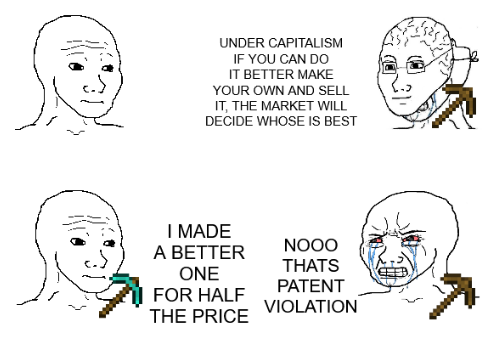
Other way around. They're capitalists but don't support the free market. So they want the factory to be privately owned and run for profit, but they still want the government to interfere with patent-infringing sales.
And I'd argue that capitalism is an inherently bad idea, even in theory. Nobody deserves free rent just for owning something, like land or natural resources. Property manager is a job, landlord is not.
May I introduce you to Georgism?
Please... I beg you. Its really cool I swear T_T
So they want the factory to be privately owned and run for profit, but they still want the government to interfere
We should take a step back and recognize that they want the government to interfere by recognizing and enforcing their ownership of the factory in the first place.
Properly regulated capitalism isn't strictly horrible. The biggest issue we have is that first bit, unfortunately.
-Me, a dirty socialist
Fuck reformism. All my homies hate reformism.
oh see here that refers specifically to militias
Maybe it's Crony capitalism instead?
I think the strength of your intellectual property protection should be inversely proportional to the size of your organization.
A character I design myself or an invention I patent myself should be firmly protected so I can't be bullied out of the market as easily, but a big company should get only fleeting protection.
That's just my take.
though usually stupid and fucky copyright laws have one advantage - if someone bigger than you steals your idea you can take them to court. without copyright laws we'd have giant corporations just taking shit and using their platform to sell stolen ideas without a single cent going to the original creator.......
which happens anyway, but uh, i guess it'd happen more?
honestly idk, let's do a test run of a year without any copyright laws and see if anything changes like at all
though usually stupid and fucky copyright laws have one advantage - if someone bigger than you steals your idea you can take them to court. without copyright laws we’d have giant corporations just taking shit and using their platform to sell stolen ideas without a single cent going to the original creator…
It's very difficult for some small independent creator to take a big corporation successfully to court. Imagine going up against The Mouse or someone similar with a lawyer paid for by your legal insurance. You might as well just not do it at all.
The same thing is even worse with patents. I made a few things that I could patent. But for that I'd have to cough up a few thousands per year, roughly 100k over the life-time of the patent, and in turn I only get the right to sue someone violating my patent. I don't even get the guarantee that my patent is valid.
Patents are designed exactly so that big corporations can use them excessively to suppress smaller competitors while they are too expensive and too uncertain for small inventors to use them.
yeah at first i wanted to say "corporation" and "individual" but that's not an equal playing field at all. So i just switched my woring to "bigger" thinking of idk, a writer in the same field who has a bigger following than you
i didn't even get into the patents part because i'd be ranting about Adobe for hours again, and i already spend too much time thinking about them
edit: but then i said corporation anyway lol, i blame the fact i just woke up when i was writing that comment
The Game Boy alone proves this whole capitalist rhetoric wrong. It was the most successful hand held game system for two reasons, it was cheaper than the rest and it went through batteries slower, otherwise it was objectively the worst handheld game system on the market at the time. Look at the food you are able to eat, the clothes you are able to wear, and the place you are able to live and try to tell me the driving force on those decisions was quality. Capitalism is not concerned with improving anything, that is not the goal of the system.
Is no one going to talk about how a rune pickaxe is WAAY more expensive than a bronze pick?
I like the idea of little guys coming up with things being able to get a head start from the companies with massive budgets
HOWEVER. imo the big company should not be able to patent anything
Copyright and inheritance can’t exist in a capitalist society
Under true capitalism, everyone starts at 0 regardless of their birth and the only way to make more money than someone else is to work more hours regardless of profession. Over saturation of a given market is fixed by the invisible hand where people just move onto something that gives more hours
Under true capitalism, everyone starts at 0 regardless of their birth
Then true capitalism will never exist. At best, it's a Platonic Ideal.
A society where no one has capital and the only way to get ahead is to provide more labour? And you call them steamed hams despite the fact they're obviously grilled?
The ideals of capitalism were to punish the rich land owners/nobles who were wealthy without ever working and empower the workers who were poor despite working for their whole lives
It’s a good lesson to teach that the wealthy would rather rebrand their image than give up wealth
The ideals of capitalism were to punish the rich land owners/nobles who were wealthy without ever working and empower the workers who were poor despite working for their whole lives
Where are you getting this from?
The Wealth of Nations/Adam Smith
Well it's blatant propaganda. Think about it, when people got rid of kings and 'nobles', they didn't take the wealth from them. Those people stayed rich and invested that money into business. The ruling class never changed, they just changed job titles.
There has also never been a system (under capitalism) where peoples wealth is taken from them when they die.
The whole idea that under Capitalism everyone "Starts from 0" is just laughable.
Capitalism was never a punishment for nobles who didn't work, it was a way for them to continue to stay in power, and still not have to work.
The vast majority of wealthy people were born wealthy. The vast majority of people who start from 0 will die with basically 0.
Adam Smith himself was born wealthy.
Very occasionally, someone like a Bill Gates or a Steve Jobs will come along and be successful, but they are the exceptions to the rule. And most of their wealth came from exploiting people.
A few professions could be a path for poor people to succeed, like for example Lawyers, but you have to have the money for Law School in the first place, so most of them came from well off parents.
Capitalism wouldn't exist if it were a fair system.
It’s a good lesson to teach that the wealthy would rather rebrand their image than give up wealth
Hence this part, if you’re looking to change the system then you have to counter the rebrand and set up a system that can’t be undone
the only way to make more money than someone else is to work more hours regardless of profession
Workers aren't capitalists. The whole point of Capitalism is to ensure the ruling class never has to do the actual work. Capitalists make their money by exploiting workers, not working themselves.
Capitalists are people who own the means of production. Working in a capitalist system you will never earn enough to buy the factory. Inheritance is one of the main ways to become a capitalist. Sure some people get lucky but with few exceptions if you are rich the way you got rich was by exploiting other people .
Copyright was a halfway decent idea when it first came out. Give a chance for an artist or inventor to profit from their work for a few years and then it becomes public property. Thanks to corporations like Disney, that has all been twisted, and now it's used as a cudgel to keep others from competing and it takes almost 100 years for something to go out of copyright now (thanks congress).
A system where you do the work and get paid for your value is closer to Socialism than capitalism.
Now compare democracy with both systems.
Democracy is a form of government.
Capitalism and Socialism are economic systems.
You could have a Democratic Socialist system, if the majority of people wanted it.
You could have an Authoritarian Dictatorship that allowed Capitalism.
It's a little more complex because people are used to living under Capitalism and many people don't really understand Socialism and would fight against their own interest to revert to the status quo, as a result some socialist philosophers have suggested not giving people a choice but to accept socialism, a so-called "dictatorship of the proletariat", but even in such a system you could have a constitution that enshrines socialism as the the economic system, while still giving people the ability to vote on everything else.
For example "Private Property" could be abolished. Factories and business could be owned by all of the employees as a whole and the profits shared equitably. After a short time living in such a system it would be unlikely that the majority of people would vote to return power back over to just a few individuals.
This would likely depend on the transition going smoothly. Give people a little hardship and the knee jerk/reactionary response would be to proclaim they were "better off" before.
The main problem with Socialism is that people are so used to having 'rulers', that they simply do not know how to act in their absence. This creates a seeming 'power vacuum'. Unscrupulous individuals can use that fact as a way to assume the roles vacated by the formerly rich and powerful in the name of being a force that maintains the "Dictatorship of the Proletariat", when very often they seem to become dictators themselves.
In my personal opinion, violent revolution will always lead to that outcome. If we ever want to evolve as a society, people must first understand what Socialism actually is and why it's the best choice for the majority of people. We must freely choose it, because it's the right thing to do.
That is made extremely difficult because the rich and powerful like being rich and powerful, and will use every bit of their resources to ensure they stay rich and powerful. It's easier to convince cops to side with them to keep them in power by sharing a tiny bit of their wealth, than it is to convince them to do the right thing, when they aren't even sure what the right thing is.
There is a reason that Education is a political battleground in the US. If people were actually taught the truth, they probably would choose to do the right thing. The capitalists won't allow that to happen if they can help it.
Anytime you see someone trying to cut funding for education, or try to have a whitewashed version of history taught. This is the reason.
This is also the source of "Red Scare" propaganda and fear mongering. 'Keep people scared, ignorant, and confused' will probably be the subtitle of the last 100 years if they make a movie about it in the future, provided the Fascists and/or Capitalists don't win.
Edit: JFK once said "Those who make peaceful revolution impossible will make violent revolution inevitable." I think there is a lot of wisdom in that and I wish people in power would take it to heart, though I know they wont.
Copyright used to have a hard limit in years. Inheritance used to pack a substantial tax.
top 72 comments