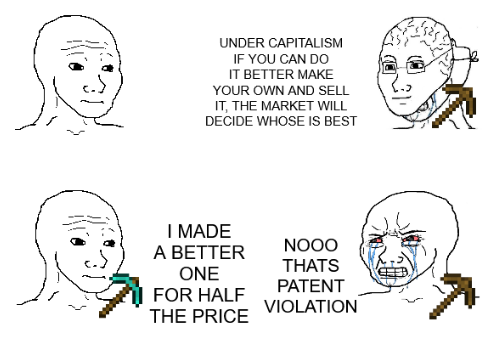
Wojack one: "under capitialisim if you can do it better make your own and sell it, the market will decide whose is best". Wojack two: "I made a better product for half the price". Wojack one: "NO thats patent violation"
you are viewing a single comment's thread
view the rest of the comments
[–] 129 points 1 year ago (21 children)

The major premise of Capitalism is risk vs reward. We hit a tipping point though, where 99% of people do not have any capital to risk, and the people who do have the capital have enough to nullify any risk.

Tax the rich.

  • source
  • hideshow 21 child comments
  • [–] 57 points 1 year ago (8 children)

    Sometimes I get mad about how we in practice have basic income for the rich. If you have a few million dollars, you can park it in zero or low risk investments (eg: high yield savings, bonds) and get free money. Then you can just fuck off and pursue your dreams. No risk. Lots of reward.

    But if you're poor? Well you better take any job for any salary or you're just a parasite blah blah blah. All pain, some risk, little reward.

  • source
  • parent
  • hideshow 8 child comments
  • [–] 29 points 1 year ago

    My ex gets an allowance from his grandparents every week. They also bought him a house.

    He’d get a job for a couple years, fuck around and get fired. Only got through college because I did his homework.

    He has a house, he has a fridge full of food, he can go to restaurants and order out and take weeks off for vacation.

    I worked full time through college, often three jobs. I still have massive student loans. I work two part time jobs, because the career field I went into is collapsing, and I’m not welcome as a trans person anyway.

    I have always worked; he has not. I sleep on a rug and stack of pillows; he can pick out whatever luxury furniture he wants.

    Work is entirely disconnected from reward.

  • source
  • parent
  • [–] 19 points 1 year ago (6 children)

    Rich people also get handed so many free things.

    Put over $100,000 in the bank and they will throw free accounts, low interest credit cards, rewards, free safety deposit boxes, personal concierge services. And that’s just the start.

  • source
  • parent
  • hideshow 6 child comments
  • [–] 14 points 1 year ago (4 children)

    Oh yeah I forgot about that. One of the banks here refunds ATM fees if you have a minimum balance of $2500 (and waives the monthly fee if you have $25,000). Like, my guys, the people who don't have money need that fee waived a lot more. But the bank just wants to make money and that means appealing to rich people.

  • source
  • parent
  • hideshow 4 child comments
  • [–] 6 points 1 year ago (3 children)

    Fortunately it's not hard to find banks who have no fees for those, in the US at least.

  • source
  • parent
  • hideshow 3 child comments
  • [–] 5 points 1 year ago (2 children)

    This one is appealing in that they refund the fee even if it's from some other bank. So you can go to the ATM at the corner shop that charges $3 to withdraw, and get that refunded at the end of the quarter. Most banks don't have fees at their own ATM, but this is no fees anywhere. For rich people.

  • source
  • parent
  • hideshow 2 child comments
  • [–] 12 points 1 year ago (3 children)

    We hit a tipping point though, where 99% of people do not have any capital to risk

    When do you think this tipping point was? Because as far as I can tell this was around the French revolution.

  • source
  • parent
  • hideshow 3 child comments
  • [–] 14 points 1 year ago (1 child)

    In modern economics, a massive change came about in the early 1970s. Productivity and profits decoupled from employee wages, and continued to rise while wages stayed flat. Fast forward 50 years, account for inflation and shifts in technology, and it's easy to see that employee wages HAVEN'T RISEN in meaningful amounts for 50 years. Meanwhile, companies are making more money than ever.

    So, I'd say it was in the 70's.

  • source
  • parent
  • hideshow 1 child comment
  • [–] 4 points 1 year ago

    Hmmm. Good question. I'm not an economist, but I'd say it was around the time Reganomics got started, maybe a little bit beforehand, since I think Reganomics was probably a consequence of the powerful having enough money to out-fund the general populace.

  • source
  • parent
  • [–] 2 points 1 year ago (1 child)

    Not just having capital, but got a hostage situation where their failure would collapse the economy therefore they are not allowed to fail and must be bailed out by the government they paid (often for far less) for earlier.

  • source
  • parent
  • hideshow 1 child comment
  • [–] 1 point 1 year ago

    I don't buy into the "too big to fail" idea for individuals.

    I really think it only applies to banks, mainly because they hold the money of common people. Anyone else should be allowed to fail. Probably the greatest financial policy fuckup of my life was bailing everybody out in 2008 and not holding anyone accountable for their actions. That gets back to risk and reward breaking down. Those companies should have been allowed to fail. The money, workers and demand for services don't disappear, they shift to more stable competitors.

  • source
  • parent
  • [+] 2 points 1 year ago* (last edited 1 year ago) (5 children)
  • [–] 5 points 1 year ago (2 children)

    And it went pretty well, until they bought enough politicians to change it.

  • source
  • parent
  • hideshow 2 child comments
  • load more comments (-1 replies)