post
[H]ow does one look at atoms and say "My God! There must be many worlds than just our one?"
Electrons. You've seen the model of the atom, right? Cluster of balls in the middle (protons and neutrons) and the electrons are little balls that whizz around like little planets around a Sun?
That model is a simplification of the truth. It turns out that it is impossible to pin down where an electron is and also know what it is doing. And if you know what it's doing (you can see its effects), you'll have no idea where it is.
Where they are has to be measured by probability. "It's bound to this nucleus / taking part in a chemical bond so it's likely to be in this vicinity", is about as close as you can get.
There is literally nothing excluding that electron from temporarily being a billion miles away. That's astronomically unlikely, but it's not impossible.
And by some measurement methods, when you do try to pinpoint where the electron is, it can appear to be in multiple places at once.
This can be interpreted as bleed-through from nearby quantum realms, maybe even other universes, where the electron is in one place per nearby universe. One of those places is ours, but we cannot tell which. And by the time we've made any kind of determination, the electron has moved. They never stop.
Photons - particles of light - also do this. All subatomic particles do this.
The more subatomic particles you have in some combined state (as an atomic nucleus, or even a molecule), the lower the probability is that that bound state can be in multiple places at once, but again, it is not ruled out.
But it does mean that the more bound particles an object is made from, the more definite its position appears to be, which is what we're used to at our human-sized scale.
Multiverse and many worlds interpretation are two different things.
The idea of multiverse is that there are many other universes existing in parallel with ours. Either the universes are created through different big bangs, or maybe the universe is constantly splitting into many other universes. This is mostly science fiction.
MWI is one of many competing ideas to help coming to terms with the counterintuitive nature of quantum physics. A particle can be in many places at once when not observed. Once it’s observed, it chooses to stick in one place. MWI is one interpretation of why this is happening.
I'm pretty sure the multiverse theory is baked into the big bang theory and cosmological theories, so I wouldn't necessarily call it mostly science fiction.
Cosmological hypotheses suggest universes with different initial conditions are possible (different space-time geometries, different elementary particle masses, etc.). The big bang theory suggests multiple universes (not just ours) with different initial conditions were formed due to eternal inflation. As the multiverse continues to undergo this eternal inflation, there forms pockets where the inflation has ended and is "hospitable". Our observable universe would be an example of such pockets, but since inflation is eternal, there should be many of these pockets.
I call it science fiction because there’s no real evidence for it. Not yet at least.
Most ideas of multiverse comes from making educated extrapolations of currently known science. But that’s not enough. Scientists must also design experiments which confirms the extrapolation to be correct. This hasn’t been done.
Maybe it’s harsh to call it science fiction. Correct wording is theoretical physics.
Hehe, yeah, it's a bit harsh to call it science fiction, especially this day in age when a lot of new physics lives in theoretical physics.
Cosmological models are very difficult to test given their nature. In many cases they are tested in massive physics simulations. The general test is to simulate the cosmological theory and see if it produces a universe that has the same observable qualities as our current universe once the simulation reaches our present epoch.
Nevertheless, Hawkins had his own reserves regarding his theory due to it not being experimentally falsifiable; but one must understand that rejecting the multiverse theory = rejecting the big bang theory since they are currently coupled.
I admit that I might be dumb, but, how does one look at atoms and say "My God! There must be many worlds than just our one?"
Well, we looked at atoms and found out that the only meaningful way to describe them is with quantum mechanics. This is the most precise and possibly best tested physical theory ever developed. And it says that if an atom starts out in state A, it will then naturally evolve into a state A+B.
Now, A and B are mutually exclusive. So what does that mean? One reasonable way to view it is that it is indeed physically in both states A and B as the theory says. That's ultimately what leads to the many worlds interpretation. The atom is both in state A and state B, and the universe accepts both of the different trajectories of reality that leads to.
This view is equivalent to a number of other ways of view things, all of which lead to the same prediction of physical behaviour for now, so essentially you can just pick your favourite.
great lecture on the concept of superposition: https://youtu.be/lZ3bPUKo5zc
Many Worlds is what’s called “unfalsifiable”, which means we don’t have a way through the scientific method to show Many Worlds to be false.
For one thing, any experiment which demonstrated objective collapse (which aren't just possible in theory, they've actually been performed) would falsify MW.
Seems like it's splitting hairs and saying the "many worlds" part of MWI doesn't count, as that is only a prediction not postulated.
No? I'm not sure how you got that from my comment
I'm taking about the linked page.
I mean, to be fair that is what the linkes page says, but people are misunderstanding the hypothesis everyone calls many worlds (also what the page says) as Many worlds is just a follow up of the theory not the theory itself.
Like Einsteins Relativity didn't say in the theory that we would be able to predict Mercury's orbit, but it comes from it.
Well, under Many Worlds, wave function collapse isn't a real "thing"; it's just an illusion caused by the observer becoming entangled with the wave function. Objective Collapse theories, however, propose a real physical mechanism of wave function collapse. If that's true, and there was found to be a real mechanism of collapse, then MW would be impossible, because the wave function would collapse before any "branching" could happen.
Well, because under Many Worlds, the wave-function not collapsing is the reason there are multiple branches; the wave function is the multiverse. So if the wave function has collapsed into a single, definitive state, then there is only a single, definitive universe.
I think you misunderstand me. I'm talking specifically about the Many Worlds interpretation of Quantum physics specifically, the one originally formulated by Hugh Everett. I'm not talking about just some general notion that "there might be other universes".
It's just an indisputable fact that the MWI requires their to be no wave function collapse, and if you don't understand why, you really have not learned enough about it to be in a position to declare it "unfalsifiable".
If there are many actual physical worlds out there representing all possible states of the wave function simultaneously, then the wave function couldn’t collapse because then those worlds wouldn’t exist. Each possible state of the wave function is a physical world representing that state.
Essentially, yes. I think the important point is that MWI is only concerned with the multiverse that an uncollapsed wave function represents, not any other kind of multiverse that might exist in science or philosophy.
Could you link the experiments which have definitively shown objective collapse and not just an entanglement illusion? Fair warning, I may need to ask for a layman’s explanation of how they proved the collapse was objective and not just the aforementioned illusion.
Here's a reasonably good article about them.. But to try and give a short explanation, the experiments were for a class of objective collapse theories were individual particles collapse spontaneously with a certain probability, and take any particles they're entangled with with them. The probability of any one particle collapsing at any given time is extremely low, but a macroscopic collection will collapse almost instantly, in the same way a uranium atom will take millions of years to decay on average, but a chunk of uranium sitting on a table will make your gieger counter sound like it's full of bees.
The important part though, is that - for reasons that are quite technical - the collapse of the particle actually emits a small but measurable amount of radiation, which is what the experiments were looking for.
To be clear, they didn't find it, which is bad for these theories. But if they had found it, it would have falsified Many Worlds.
So here’s where I think we’re getting tripped up. You’re talking as though detecting this radiation would have falsified Many Worlds; I still think it would not. It would have created an explanatory burden on proponents of MWI, to explain where this radiation is coming from if not wave function collapse. These experiments wouldn’t have been able to prove that the collapse was causing any kind of radiation emission; only that radiation emission was concurrent with it. We could conclude the collapse was the source only if all other sources were ruled out as possibilities.
Ok, well now you've basically argued that falsification in general is impossible, for anything. Just like geocentrists could always add more epicycles to explain the motion of the stars, any theory can add more post-hoc explanations for any observations. This isn't a standard you would apply to anything else, so I don't know why you're applying to MWI.
The parameters of the emitted radiation - particle or wave type, energy level, charge, spin, colour, direction of travel, everything - would be different for every collapse
No they wouldn't, the laws of physics still apply
“objective” in “objective collapse” at face value
And why shouldn't I?
No experiment has been performed that has detected this radiation being emitted, but if it had, it still wouldn’t have falsified MWI.
Yes, but by your standard, nothing can ever be falsified.
I’m quite sure there’s no experiment
You asserting it doesn't make it true.
From within each world: Observers see exactly what CSL predicts - apparent spontaneous wave function collapse accompanied by radiation emission (or not, in this case). The collapse looks completely real and objective to the observers, and there is no experimental way to show otherwise.
Except there is no radiation emission unless the wave-function objectively collapses. That's the point.
Both frameworks ultimately make identical (observable) predictions from within each world
No, they don't. One predicts spontaneous radiation release, and one doesn't.
you had a way to definitively show from within this world that MWI’s other worlds don’t actually exist, then it’d be falsifiable.
literally asking to prove a negative.
By the linked argument, introducing any sort of nondeterminism into classical physics would predict many universes.
If I flip a coin, a classical statistical model would predict I have a 50/50 chance of getting a heads or a tails. I can predict different things will happen as things react to the heads/tails result, and describe different “universes” where each of those outcomes happen.
Do those “other universes” really exist? Or are they simply a figment of my statistical analysis of the situation? That’s the part that’s unfalsifiable.
By the linked argument, introducing any sort of nondeterminism into classical physics would predict many universes.
Not necessarily, objective collapse theories can be non-deterministic without predicting many universes. The extra universes only appear if the wave function never collapses, and stochastic collapses are entirely possible.
If I flip a coin, a classical statistical model would predict I have a 50/50 chance of getting a heads or a tails.
Yes, but critically - under classical mechanics - this is only because you have imperfect knowledge of the system. From the perspective of Laplace's Demon, the result of the flip is 100% deterministic and the chance of it landing the other way is 0. But this is not the case in quantum physics unless a hidden variable theory turns out to be true (and thus any experiment which discovered hidden variables would also falsify MWI)
Do those “other universes” really exist? Or are they simply a figment of my statistical analysis of the situation? That’s the part that’s unfalsifiable.
Well, no. Because you're talking about classical mechanics, where probability is just about imperfect information and isn't part of the underlying ontology. So no, those universes don't really exist. That's completely different from quantum physics, where the wave function actually exists - it's not that the electron only goes through one slit and we just don't know which one: it really does go through both slits.
where probability is just about imperfect information
All it takes to produce the many worlds is the assumption of true nondeterminism that isn’t simply “imperfect information”.
Conversely, if you interpret quantum mechanics as a rethinking of statistics rather than some additional physics for the universe, you can make sense of the world without the need for a multiverse.
All it takes to produce the many worlds is the assumption of true nondeterminism that isn’t simply “imperfect information”.
Incorrect. As I said, objective collapse theories can be non-deterministic without predicting many universes. The extra universes only appear if the wave function never collapses, and stochastic collapses are entirely possible.
if you interpret quantum mechanics as a rethinking of statistics rather than some additional physics for the universe
But you can't. Quantum physics cannot be explained by classical mechanics alone. If it could, we never would have formulated quantum physics to start with.
Incorrect. As I said, objective collapse theories can be non-deterministic without predicting many universes. The extra universes only appear if the wave function never collapses, and stochastic collapses are entirely possible.
Yea, the difference between a classical statistical theory with and without many worlds is whether or not you maintain a state that includes all possible outcomes as you continue your analysis, or restrict the state you are analyzing to one possible outcome from one of your statistical events. The same is true of quantum mechanics.
But you can't. Quantum physics cannot be explained by classical mechanics alone. If it could, we never would have formulated quantum physics to start with.
I’m arguing that quantum mechanics is a rethinking of statistics more so than a rethinking of physics. The world cannot be explained without it.
I think that even if I must consider a state that includes all possible outcomes while doing my analysis of the situation, that doesn’t mean those “alternate worlds” necessarily physically exist in any meaningful way.
Yea, the difference between a classical statistical theory with and without many worlds is whether or not you maintain a state that includes all possible outcomes as you continue your analysis
Yes, but, again, this is only because you have imperfect information about the underlying physical system. The array of possibilities presented by classical statistics are strictly epistemic; the actual real state of the system you're analyzing is always definitive and determinate.
And very, very importantly, this is not that case in quantum physics. The indeterminacy of state in a super position is not just the result of imperfect information; it is a fundamental part of the underlying system. It is not the case that, in the double slit experiment, the electron only travels through one slit, and we just don't know which one. It really really does travel through both. This is fundamentally different from classical mechanics.
I’m arguing that quantum mechanics is a rethinking of statistics more so than a rethinking of physics.
Look, if you want to try and argue that quantum physics isn't physics, I won't stop you, but you'd better have an extraordinary argument, because this is an extraordinary claim. One that rejects the last century of scientific consensus. If you can demonstrate that quantum mechanics is just a different statistical model of classical physics, it would be a revolution in science.
I think that even if I must consider a state that includes all possible outcomes while doing my analysis of the situation, that doesn’t mean those “alternate worlds” necessarily physically exist in any meaningful way.
That's correct, and MWI doesn't argue otherwise. The important part isn't just that these states are possible, it's that they have real physical existence.
Yes, but, again, this is only because you have imperfect information about the underlying physical system. The array of possibilities presented by classical statistics are strictly epistemic; the actual real state of the system you're analyzing is always definitive and determinate.
You are glossing over my point. I’ll try to put it as concretely as I can think of:
Assume for the sake of argument that there is a process in an otherwise classical physical system that is truly nondeterministic, meaning there is randomness that isn’t due to any hidden variable or otherwise incomplete knowledge of the state of the system.
When describing such a system, you will run into the same dilemma of either needing a “wavefunction collapse” or “many worlds” interpretation of your statistics.
And yet this model is not quantum. It is a classical nondeterministic model.
My point being, it’s the existence of true nondeterminism that leads to the “many worlds” idea, not the other strange properties of quantum mechanics.
If you can demonstrate that quantum mechanics is just a different statistical model of classical physics, it would be a revolution in science.
I really, genuinely, think this is not a controversial take. The idea that quantum mechanics is more of a rethinking of statistics than physics comes from my own personal experience studying quantum physics. Most of the time, you take the classical Newtonian mechanics equations (sometimes including “corrections” for relativity), and treat them with the “quantum mechanics” version of statistics, and out pops all the important things you’d like to model, like how electrons arrange into orbitals in an atom. The results of slit/entanglement/bell experiments depend on having an object that obeys quantum statistics, but it can be a wide variety of objects with vastly different physical properties and behaviors (e.g. slit experiments have been done with both photons and electrons).
The important part isn't just that these states are possible, it's that they have real physical existence.
I don’t think there is any reason to believe the “other worlds” needed to analyze quantum systems “physically exist” to any meaningful extent. It’s the same as considering all possible outcomes of a classical truly random event (if you assume there exists true nondeterminism, not simply a lack of complete information).
You are glossing over my point.
I promise I'm not doing it deliberately.
When describing such a system, you will run into the same dilemma of either needing a “wavefunction collapse” or “many worlds” interpretation of your statistics.
Yes, I would agree with that if we're using "wave function collapse" to refer to any truly probabilistic mechanism in a general sense (as, strictly speaking you could have a non-deterministic mechanics without wave functions at all).
But I note the important fact that you don't need both.
My point being, it’s the existence of true nondeterminism that leads to the “many worlds” idea
Well no, it's the existence of true non-determinism without any form of wave function collapse.
I really, genuinely, think this is not a controversial take. The idea that quantum mechanics is more of a rethinking of statistics than physics comes from my own personal experience studying quantum physics.
Well if that's the case, with all due respect, I think you need to study quantum physics more. Because trying to overturn a century of scientific consensus is definitely controversial, at best.
The results of slit/entanglement/bell experiments depend on having an object that obeys quantum statistics, but it can be a wide variety of objects with vastly different physical properties and behaviors (e.g. slit experiments have been done with both photons and electrons).
How, specifically, are you modeling the double slit experiment using only Newtonian Mechanics? How about quantum tunneling?
I don’t think there is any reason to believe the “other worlds” needed to analyze quantum systems “physically exist” to any meaningful extent.
Are claiming that super positions don't actually exist at all? Because, again, you'd better have a solid argument for such a radical claim.
It’s the same as considering all possible outcomes of a classical truly random event
Is it? Hard to say when we're talking about something that doesn't actually exist.
Because trying to overturn a century of scientific consensus is definitely controversial, at best.
I don’t think what I’m suggesting is “trying to overturn a century of scientific consensus”. It’s a mildly different interpretation of the same math, that doesn’t require many physical worlds. It’s also not that uncommon. The “many worlds” idea is not scientific consensus. Go read about interpretations of quantum mechanics from sources other than Sean Carroll.
How, specifically, are you modeling the double slit experiment using only Newtonian Mechanics? How about quantum tunneling?
Both the double slit experiments and quantum tunneling emerge when you apply quantum statistics to any point particle following Newtonian mechanics.
Are claiming that super positions don't actually exist at all? Because, again, you'd better have a solid argument for such a radical claim.
Superpositions are a mathematical tool for describing the statistics of potential measurements.
Here’s an interesting example:
The Bell test about entanglement is one of the best-known proofs that quantum mechanics can’t be explained using classical statistics.
The Bell test is an analysis of the correlation between two entangled particles.
However, that correlation is only notable because we are analyzing the evolution of both particles.
If we analyze one particle, alone, we wouldn’t be able to determine if it is entangled with any other particles (and we wouldn’t be able to model it without the need for quantum mechanics).
In other words, you only need the “other worlds” when you are analyzing a system and trying to predict its behavior. You can completely ignore all information or “other worlds” external to the system you are studying.
Thank you for making the point so cleanly. I was about to piss a lot of people off
Great answer, but it unfortunately is taken seriously. The reason is because it is an "end of the road" hypothesis. It tells you all the weirdness is fundamental and no further thought is required. Just like good old Copenhagen. The unfalsifiability is a virtue here, it's a complete explanatin without the messy testing. Now stop thinking, shut up, and calculate.
To be clear, the reason Many Worlds hypothesis exists in the first place is because it's a possible solution to the calculations. It's not that someone just came up with an idea to get out of doing real work. It's just unfortunate when the universe puts multiple possible solutions out of reach of experimentation. But hey, there was a long time of history where virtually any belief about the composition of the moon was considered unfalsifiable.
The "solutions" are not out of reach. Just do the experiment more than once, like any statistical theory.
The moon thing: yes because it was hard to get to, not impossible in principle. If the moon was in a parallel universe your analogy wouldn't be irrelevant.
but it unfortunately is taken seriously
Why is that unfortunate? It's an extremely well justified theory.
It tells you all the weirdness is fundamental and no further thought is required.
I'm not sure why you say this? If anything, that's a description of Copenhagen, which MWI is a response to.
You can probabilistically prove the many worlds exist, because it implies quantum immortality. Just connect a short-half-life Schrödinger mechanism to a nuclear bomb, and some of you will survive for a statistically impossible number of half lives. That version of you will have proven the many worlds to be true.
I don't think it proves many worlds any more than it proves you have a fairy godmother manipulating quantum states for you. All you've done is shown an unlikely occurrence happened, not what caused it.
All you've done is shown an unlikely occurrence happened...
That's all science is. Collect data, and show how it's unlilely unless your hypothesis is true. Five sigma later, and you've made a discovery.
Collect data, and show how it’s unlilely unless your hypothesis is true.
The quantum immortality experiment doesn't do that, though. The outcome, by definition, always occurs within the realm of random chance. Your environment needs to create an outcome that is extremely unlikely to occur by random chance. The experiment is not repeatable. It makes no predictions about what's going to happen if you try again. It doesn't do anything useful to bolster the many worlds theory.
Your environment needs to create an outcome that is extremely unlikely to occur by random chance.
If you survive 32 half lives, I'd call that extremely unlikely! Give a try.
The experiment, as defined, only leads to your survival by random chance. The experiment does not create any outcome except by random chance so it cannot be used to prove anything.
Every half life you survive is an experiment.
The chance you'll survive a half life is exactly the same whether MWI is real or not. It doesn't give you any useful information. You have no way of distinguishing between being just that lucky or MWI being true.
That's not the case with other experiments. If you assume your hypothesis is correct, the chance of the experiment being successful is higher than the chance of it happening by random chance if your hypothesis is not. That's a key difference.
If you want to know why it's taken seriously:
https://m.youtube.com/watch?v=kTXTPe3wahc
Tl;dr: you need to actually understand the physics at play that lead to serious consideration of the many worlds theory. It's not the pop-sci it gets painted as. It's much more specific.
This was mentioned (not fully, but enough to get some of the ideas) recently in an episode of PBS Space Time
As far as MWI itself, my understanding is that it comes from simply taking the same math that works for atoms (as you say) and applying it to everything - the observers of a quantum system, the earth, the whole universe. I think it really comes down to the question: If Everything is a wave function, what would it look like from the inside? And MWI pops out of trying to answer that.
And the other interpretations of quantum mechanics don't even seem better to me, requiring arbitrary conditions for a state to collapse to a single value for example. That feels to me like an entity of the type Occam meant.
I don't understand how it's any more outlandish than thinking that we can be aware of everything that exists, or that everything exists in a straight line through time, never branching. Maybe it's a lack of understanding on my part, but it seems the sum total of what we have discovered through science, or even through imagination, only illuminates a very small subset of reality. We can only measure with the instruments we can imagine and build, and with our own limited senses. So I wouldn't jump to believe, nor to label unbelievable.
If you want to go into depth on this, I recommend you look up Sean Carrol talking about the subject - or read his book Something Deeply Hidden, if you're up for it - he's one of the best science communicators I've heard and a strong proponent of many worlds.
But to try to summarize it in very short: the "multiversal" behavior is already baked into quantum mechanics - a particle can be in two places at once, as in the double slit experiment - just at a very small scale. Traditional quantum physics postulates that there's some mechanism by which this behavior is cut off before it reaches the macroscopic scale (wave function collapse). Many Worlds just asks "Do we actually need this postulate? What would it look like if we didn't have it?" And the answer is, it would look like the universe we experience, just with a multiverse along side it.
Doesn't Carrol have a reputation for being rather crass or am I thinking of someone else?
Two points:
-
The MWI/Everett interpetation is the simplest interpretation of quantum mechanics—other interpretations have to add additional assumptions to prevent it from happening.
-
The most common version of the MWI is actually an interpretation of an interpretation (i.e., Bryce deWitt’s reinterpretation of Hugh Everett's 1957 thesis), but many of those who subscribe to deWitt’s interpretation (including deWitt himself) don’t seem to grasp how it differs from Everett’s. Everett’s thesis makes no explicit reference to multiple worlds—just a single wave function that can be measured in different bases to produce multiple versions of each observer, each of which perceives a different version of the universe. For Everett, the wave function was ontologically prior to the material world, so his universal wave function was a complete explanation as-is. But for deWitt (and for most people), the material world is ontologically prior, while the wave function is just a tool for describing its behavior. So by their reasoning, those multiple perceived worlds must all really exist as parts of the wave function in some sense.
If we sufficiently torture the word "simplest".
The MWI/Everett interpetation is the simplest interpretation of quantum mechanics—other interpretations have to add additional assumptions to prevent it from happening.
How is the existence of an infinite amount of other worlds a "simple interpretation", that seems like a literal infinite amount of assumptions
Put it this way: is the idea that the stars in the sky are dots on the inside of massive solid sphere more simple then the idea that they're all just other suns very away? The simpleness of a theory isn't determined by how many objects it predicts.
Calling Everett’s interpretation the “many worlds interpretation” is like calling a particle’s wave function the “many particles interpretation”—it’s not wrong, but it makes it sound like you’ve got a multitude of separate things when you’ve really just got one thing of a different kind.
MWI is not simpler than other interpretations. It's more purely mathematical and thus simpler if you ignore experimental physics, yes. But if you consider physics an empirical science, the interpretation has to get pretty complicated to explain why all outcomes of an experiment happen, but only one is ever observed.
It doesn't require fewer assumptions or ad hoc collapse mechanisms, it just moves those to a place where they're harder to see.
The interpretation has to get pretty complicated to explain why all outcomes of an experiment happen, but only one is ever observed.
But they are all observed, that's the point.
By who? If I measure the spin of an electron in a superposition of up and down, I only ever get one result, up or down.
By the versions of you in each branch.
But which one am I? You postulate that "I" am somehow split into endless copies upon observation, but also "I" am only one of those copies somehow chosen at randomly according to the wave function distribution. So "I" see all outcomes of the experiment but "I" also only see one of them?
This is where it stops being simple to me.
What you are describing is essentially another facet of The Vertiginous Question - why am I me instead of someone else. Importantly, this is a problem that exists regardless of whether MWI is true or not, so the lack of simplicity already exists, like it or not.
Before you were born, the future contained the creation of a vast number of conscious beings, but only one of them would be "you", seemingly chosen at random.
The branching of the observers wave function is exactly the same situation.
It's a question about Philosophy of Consciousness, which is well and truly outside the purview of Quantum Physics. From the scientific perspective it's perfectly logical and sufficient to say that "there is one observer who will split into many, each of which will have its own perspective that is unaware of the others".
I think you misunderstood, it's not the Vertiginous Question, it's simply about describing an experiment.
I perform an experiment to empirically investigate something, this process depends on me subjectively experiencing the result of the experiment. Before the observation, the system is in superposition, afterwards it appears to not be in my subjective experience. Collapse theories have to add a postulate that something happened upon observation to change the system. MWI has to add a postulate that some mechanism placed me in a certain branch of the possible outcomes. Neither is necessarily simpler than the other.
Whether other versions of me with their own subjective experience observed something else or not, you need to add that postulate. Their observations are irrelevant empirically, and saying "you actually observed all outcomes" is just factually wrong from an empirical viewpoint.
this process depends on me subjectively experiencing the result of the experiment.
All results of the experiment will be experienced by a future version of you.
MWI has to add a postulate that some mechanism placed me in a certain branch of the possible outcomes.
No, this is definitely the Vertiginous Question. The "mechanism" that puts you in a certain branch is the same one puts you in a certain body. Are you also going to demand that neuroscientists answer the Vertiginous question before they can say that other people exist?
you need to add that postulate.
That "postulate" already exists if you believe in consciousness in the first place.
“you actually observed all outcomes” is just factually wrong from an empirical viewpoint.
Literally the opposite: empiricism requires objectivey, trying to insist that only the things that you personally subjectively experience counts is as far from that as you can get.
Many Worlds isn't taken seriously because there's "proof" of other universes - it's taken seriously because it's actually the simplest explanation mathematically. The equations of quantum mechanics naturally lead to superpositions (particles existing in multiple states). MWI just says "what if we don't add extra rules to make those superpositions collapse?" It's like if you have a math equation that gives you 5 answers, and instead of creating a complicated rule to pick just one answer, you just accept all 5. Thats why physisists consider it - parsimony.
None.
It is, however, actually simpler than other theories, in that if you just let quantum mechanics do it's thing without extra (unknown) parts to limit it, it produces many worlds. So, by Occam's razor...
Specifically:
Quantum systems are in more than one classical state at a time, unavoidably. You can see this in the double slit experiment. Even if you send a single particle at a time through the slits, it passes through both and creates the interference pattern. (There's also ways to formally prove that making quantum mechanics normal would require fate, or faster-than-light trickery which would actually be worse than fate)
Early physicists were very confused by this. The Schrodinger's cat was used as a thought experiment meant to illustrate how that's absurd, and it was decided there must be something that causes quantum states to "collapse" to one state before they can cause any trouble.
That's not definitely wrong, and it's still debated in versions by modern theorists, but it turned out not to be necessary. The reason for that is that if a part of a quantum system becomes entangled with something outside of it, the interference will no longer happen, and it becomes indistinguishable from multiple slightly different copies of the same system.
Per rule 9, could you provide a source for your interpretation of the double slit experiment, specifically that “there is no sort of wave collapse” and “the photons absorbed by film or eyes were just not impacting the surface because they were absorbed elsewhere, causing less friction between the photons and changing the patterns on the surface.”?
This appears contradictory to the standard quantum mechanical explanation for the interference pattern, which is that the wavefunction of the photons passes through both slits, interfering with itself and changing the probability of detection or interaction at specific points along the film/sensor.
The effect isn’t unique to photons and has been observed with electrons, atoms, and even large molecules. As long as the slit size and spacing are comparable to the wavelength of the particle wavefunction it’ll work.
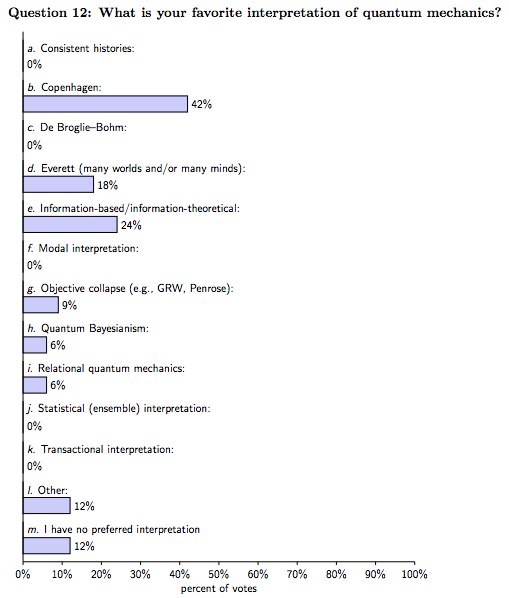
The photon wavefunction being a superposition of position states that self-interact, and then collapse into a single state/location when interacting with a non-quantum object are fundamental to quantum mechanics, and are part of the reason this experiment is such a great introduction to QM. The many worlds interpretation of wavefunction collapse is not fundamental- it’s one of many interpretations for what the math of QM means and not even the most popular amongst theorists (that’d be the Copenhagen Interpretation).
No, it's not. Exactly one photon (or electron) still arrives. You can refer to Wikipedia for this one. And refer to the no-go theorems if you're trying to push a homebrew hidden variable theory.
The Schrodinger thought experiment was intended to point out the ridiculousness of observation theory being applied in quantum theory, not an attempt to prove it.
Yes, which is why they had to come up with collapse, and later multiple worlds theory. Just not doing QM isn't an option.
Okay, cool, whatever. Maybe go write a paper about that. I'll even read it so you don't have to bother actual peer reviewers.
Your first sentence is a rule 1 violation (“be respectful and inclusive”), could you amend or remove it? Criticize the ideas (preferably with sources) but not the person. Thanks!
And the comment I replied to violates rules 3, 6, and 9. Why am I being singled out?
Edit: I am incorrect, my apologies.
You are not being singled out. I’ve given the author of the other comment a warning with the opportunity to fix the rule violation with an edit, same as you. In both cases, the comments will be removed if they aren’t addressed in a reasonable timeframe.
I don't know where to start. There are so many things wrong with this comment that I'm confused as to how you even became confident enough about these falsehoods to write them. Where in the world did you get this idea of the Double Slit Experiment?
Just to be clear, what you are saying is literally that Quantum Physics in general is false, which flys in the face of the last century of science. This is literally flat earth tier
Crackpots seem to fundamentally misunderstand how science works, and mistake a hunch (maybe the photon has just been absorbed somehow, or it's like friction somehow) for a discovery. They also seem to think everyone else who's looked at a problem is stupid. In both cases, I kind of get it, because there's cultural forces promoting that - we're told you're allowed to believe whatever you want about metaphysics without needing to support it, and we're told that certain individuals can see a persistent problem and come up with a billion dollar idea to solve it all on their own.
Hopefully I'm not breaking any rules by guessing a diagnosis here.

https://arxiv.org/abs/1301.1069
Effectively there is no current consensus on the issue, though Many Worlds and String Theory are widely regarded outside their adherents as non-falsifiable and therefore not legitimate theories.
Essentially the proponents of the theory have created beautiful math that fit their view, but absolutely nothing in the real world that can show that it is a more valid theory than any of the other theories which have equally elegant math to back them.
though Many Worlds and String Theory
String Theory has nothing to do with interpretations of quantum mechanics.
are widely regarded outside their adherents as non-falsifiable and therefore not legitimate theories.
Only by people who don't understand them.
Essentially the proponents of the theory have created beautiful math that fit their view
No? Many Worlds has nothing to do with math. You seem to be getting your criticisms mixed up. To be blunt: if you can't even remember what your criticism is actually meant to apply to, you should probably read into it more before commenting.
top 99 comments