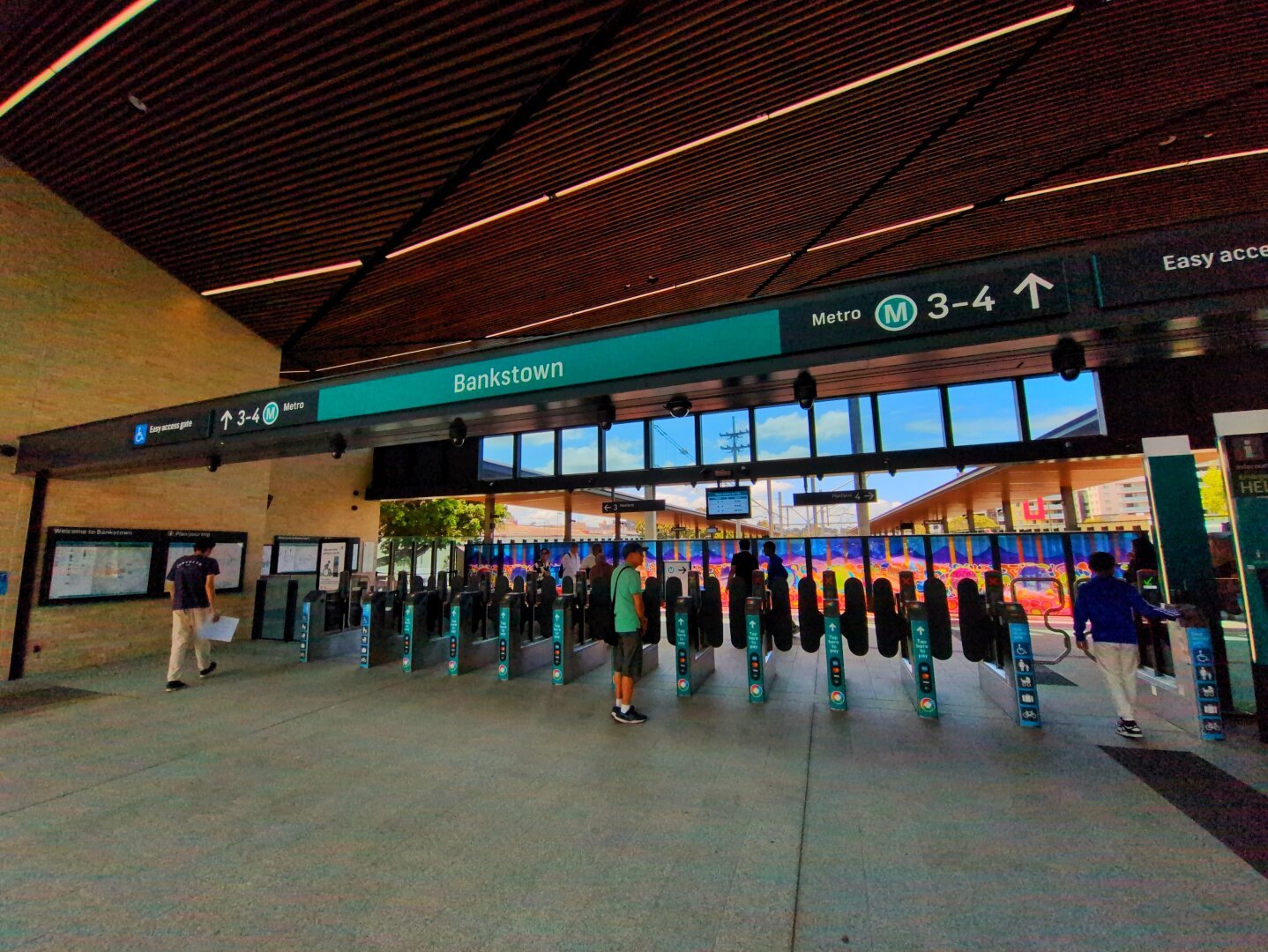
The very shiny new Bankstown metro station, on the Southwest Sydney metro that opened last Friday.

Unfortunately, the destinations on the train didn't come up, but they say "Bankstown".

#Bankstown #WesternSydney #train #metro #rail #railway #TrainStation @fuckcars@lemmy.world

The entry to the new metro station, with a timber roof over the concourse.

all 15 comments

sorted by: hot top controversial new old
[–] 5 points 3 days ago (14 children)

How much does the subway cost?

Its actually shocking how expensive subways are in the US compared to Japan or Korea, and they're like 15-30 cents per ride in most of China and Kazakhstan and 40-80 cents in vietnam where it exists.

  • source
  • hideshow 14 child comments
  • [–] 4 points 3 days ago* (1 child)

    One end of the metro to the other takes about 90 mins and costs AUD$8.28 during peak hour. Around $5.80 in offpeak

    iirc there are also daily and weekly travel fare caps

  • source
  • parent
  • hideshow 1 child comment
  • [–] 1 point 2 days ago

    @48954246 @alcoholicorn Bankstown is a suburb ~12 miles/19 km southwest of downtown Sydney. The line then continues under Sydney Harbour, and runs ~28 miles/45km northwest to Tallawong. It runs every ~4 minutes on peak, ~7–10 mins on weekends, the full length of the line.A trip from Bankstown to Tallawong costs A$5.79 (US$4.05). There's a daily fare cap covering all modes of transport (train, metro, bus, light rail, and ferry of A$19.30 on weekdays, A$9.65 on weekends, and A$50 per week.

  • source
  • parent
  • [–] 4 points 3 days ago* (last edited 3 days ago) (5 children)

    There's a common pattern with public transportation projects in North America in general.

    When a project is built city planners use the opportunity to widen streets, roads, build or upgrade bridges, and do this all in a effort to not diminish the amount of lanes previously available to vehicle traffic. Something even adding a new lane where one did not exist beforehand.

    This means when new stations go in, or there is any above ground transit corridor, a good chunk of the cash gets funneled into "car centric initiatives" as opposed being solely allocated for the transit line.

    In the area I live we have a tram line that went in not to long ago. It has both above and below ground sections. Along the whole corridor the city street was repaved, and at the street level routes the street was completely reconfigured and widened. This includes sidewalks, benches, planting, landscape, curbs, mediums, traffic lights and signaling, electrical, and storm water. The costs ballooned obviously.

    It's almost like city planners were working on the assumption the public was still going to choose to drive, as opposed to take the new transit line. So all efforts and funds were put to work in a way not to inconvenience drive in the slightest.

    So in the end the project costs are higher, and the public does not question all the shiny new car infrastructure, but then proceeds to ask why the transit line was so expensive in the end.

  • source
  • parent
  • hideshow 5 child comments
  • [–] 1 point 2 days ago* (last edited 2 days ago)

    @NarrativeBear @alcoholicorn Somettimes it ends up reallcated as a bike lane; that ends up end and starting back up near intersections which tend to share lanes with a right turn lane or other spots that make the car (truck in most case legally - but most are SUV's) centric.

  • source
  • parent
  • [–] 0 points 2 days ago

    what makes it even worse is that you can totally design with the assumption that people will still drive, without making it horrible.
    Just design for people to drive to metro stations! A lot of the suburban washington DC metro stations are like that, and while yes obviously it's not great it's a hell of a lot better than having suburbanites continue to drive downtown.

  • source
  • parent
  • [–] 1 point 3 days ago (3 children)

    I always find it crazy to see people paying per ride. Around here, the norm for everyone using public transport regularly are monthly tickets.

  • source
  • parent
  • hideshow 3 child comments
  • [–] 1 point 2 days ago (1 child)

    Kuala Lumpur and Bangkok are all per ride, super easy to use though

  • source
  • parent
  • hideshow 1 child comment
  • [–] 1 point 2 days ago

    for tourists maybe, but for commuters monthly tickets (or fuck it, get a yearly one) are completely 0-thought in a zone system.
    Buy the right ticket at the start of the period and never worry about it unless you need to go somewhere else.

  • source
  • parent