Getting these two after eachother is fate

Getting these two after eachother is fate

True except for calorie. Metric typically uses Joules, which is good because it's just the product of force (N) and distance units (m), instead of requiring a conversion factor.
Found out recently that a fluid ounce of water doesn't weigh an ounce, and that makes me mad
A pints a pound
I think that's all we got
Unfortunately, due to inflation, a pint is usually minimum £5, if you're in London then expect it to be heavier.
This is how I found out that Americans don't even have full pints.
The UK doesn't want to give up pints of beer because they're bigger than a half liter.
American ones are smaller.
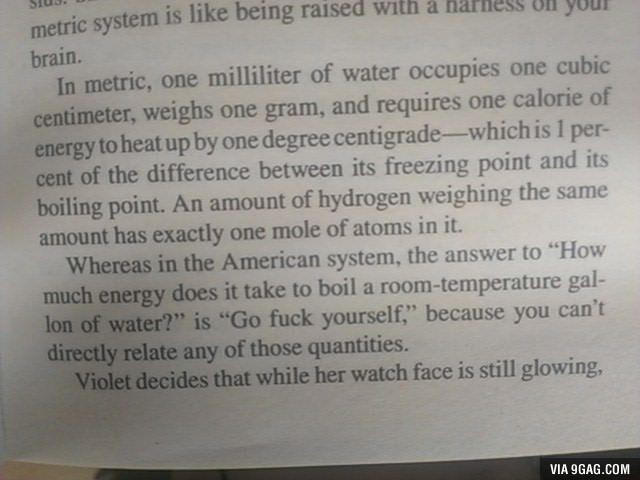
Wild Thing by Josh Bazell, in case anyone was wondering what book that is.
Violet
Huh. I must have missed this book in A Series of Unfortunate Events.
Did she undelete her account?
When I learned the consistency (synergy?) between metric measures, I thought that was so amazing.
In the olden days sciencey types and engineers kept fact books listing such relations. They had a specific name that escapes me.
Before handheld calculators, they also kept books of pre-calculated mathematical operations, so they were used to having numbers books around.
In the olden days sciencey types and engineers kept fact books listing such relations. They had a specific name that escapes me.
Likely a "CRC": CRC Standard Mathematical Tables, which is probably the same book as the pre-calculated mathematical operations you mentioned. It has a lot of good mathematical stuff in it such as basic formulas, trig functions, log tables, integral and differential functions, and formulas up through around Fourier analysis.
If we were doing that thought exercise where you can take a "go bag" back in time to build science up more quickly, a CRC and a slide rule would probably be in mine. I'd probably throw in a prism and as compact of a microscope that uses a mirror as a light source as I could get away with; both for showing small stuff living in water and for showing what couldn't be manufactured yet (depending on when I went back). I wouldn't waste space in the bag for anything dealing with the imperial system.
“Better still learn mental math, you won’t always have an answer book in your pocket!” — 1500’s teachers
a gallon of water boils in 10 minutes on a whirlpool electric range in turbo mode
Why call Imperial Units the American system? It's the British Empire's fault. And the UK still uses it. Like so much they say weird ass shit like "I weigh 12 stones."
US Customary Units and Imperial Units are not 100% the same, so calling the former the American system makes sense.
The UK is metrifing. But it takes time to make these shifts. Most hospitals will ask for weight in kg but usually have a calculator available. Charts and information leaflets have kg. Lift weight limits are in kg (usually then represend by people) Baby's weight is given in grams but usually the next question is what's that in old money. So the systems are all in kg but mentally we are in stones.
My favourite part of the metric system is that with it’s water weight being 1-1 with volume; measuring liquids is super easy with a scale.
Liquids as in water specifically and not other liquids.
It still works fine for most liquids used for cooking and baking.
If 20 % error is okay, sure. And yes, with cooking it does not really matter. But simply using mass instead of volume fixes this anyway and is more convenient.
Nah, it’s still good for others if you know the relative density.
Vodka for example, at roughly 0.9x works. Most other liquids are somewhere just above 1 so it is still pretty accurate.
I can't remember what book this was from, it was a medical thriller about an ex-con in witness protection IIRC. I think it also includes him sending an intern to check on "the LD50 of falling out of a window"
We need to go deeper, america needs to come up with new time measurements too. Everything must go!
One mole of hydrogen-1 isn't 1 gram because of the binding energy of protons and neutrons. One mole of hydrogen-1 is about 1.008g
You know that water being exactly 1kg and 1l is specific to one pressure and temperature combination?
Mole is a number of particles, not a volume. A mole of hydrogen-1 will always have the same mass regardless of temperature or pressure
The point is that you do not have that precision. But it absolutely is good enough for pretty much everything. A 0.8 % error is often well below measurement error. Like in any mass balance in a chemical system, say a refinery or whatever. You can ignore argon and all other gases except N2 and O2 in air for the same reason in almost every application.
But even if we apply the same logic, 1.008 is "incorrec" too, it is 1.00794.
And that is incorrect too, not because of higher precision, but because of binding energy. Two separate hydrogen atoms (2 H) have slightly more mass than one hydrogen molecule (H₂) because forming the H–H chemical bond releases energy, reducing the system's mass according via E= m*c² That extends to every single compound. They all have different atomic masses in them.
I think the point is made.
6.022x10^23 particles if I remember correctly.
To be fair, it would be the same answer even if we used the metric system.
Yeah, but in one the math is super easy and you don't need to throw in 6 conversion factors.
Okay, then, how much energy does it take to boil 1mL of water from room temperature? (Note that I said "boil," not raise it to 100°C.)
We will assume that room temperature is 20° C. The heat of enthalpy is 2257 kJ/kg, or 2.257 kJ/g. As stated previously, the amount of energy to raise water 1 degree is 1 cal, which also equals 4.184 J. So,
(100-20) × 4.184 + 2257 =
80 × 4.184 + 2257 =
334.72 + 2257 =
2592 J rounded to the nearest whole number. This will leave you with a dry pot.
Now show me the process using Fahrenheit, fluid ounces, and foot-pounds.
It's about 1 BTU per fluid ounce per degree Fahrenheit, so:
128 fl oz × (212 - 68)°F × 1BTU/fl oz•°F = 18,432 BTU
Add in the enthalpy of vaporization:
7.5 BTU/fl oz × 128 fl oz = 960 BTU
So, about 19,392 BTU.
I'm cooking pasta for dinner, and I didn't do any calculations. I just put the water in the pot on the stove, and waited for it to boil. Which was kind of the point of my question. Metric is all neat and elegant, but that's irrelevant in daily life, because if I did have to calculate the energy requirement, I'd have to look up the enthalpy value, because it's not memorable, as well as figuring in the actual atmospheric pressure to determine the actual boiling temperature. It makes all the sense in the world to use SI where it matters (e.g. science experiments), but customary units persist because in so much of daily life, it doesn't matter.
So your argument is we don't need this in everyday life. Sure, that's sort of true, but I guarantee this was necessary in making a stove that would work in your area. But also true is that if it doesn't matter that much in day-to-day life, then the only reason to keep such a clunky system is familiarity.
Also, 1 BTU is the amount of energy to raise the temperature of 1 pound of water 1 degree F. So your calculations are already off by a factor of 128. Given the world doesn't need you to know the numbers for water to boil, that doesn't affect much, but perhaps the vastly higher number for heating the water versus the amount of energy to get the water to vaporize should have clued you in that something was weird. It's easy to tell in metric because most of the dimensional conversion values are 1 or factors of 10.
There are people who like to dismiss the value of knowledge because it isn't important in their daily lives. This is only true if you live in a hut where the only sources of force are human, animal, or fire, or there is someone unseen that you rely on who has used those tools extensively to provide you a life where knowing that isnt necessary. Raising the bar with ridiculous conversion calculations every step of the way makes understanding these concepts more difficult for the layperson and makes the field harder to enter.
NOOO!!!
America has its own laws of thermodynamics!
cryingwojak.jpg
top 50 comments