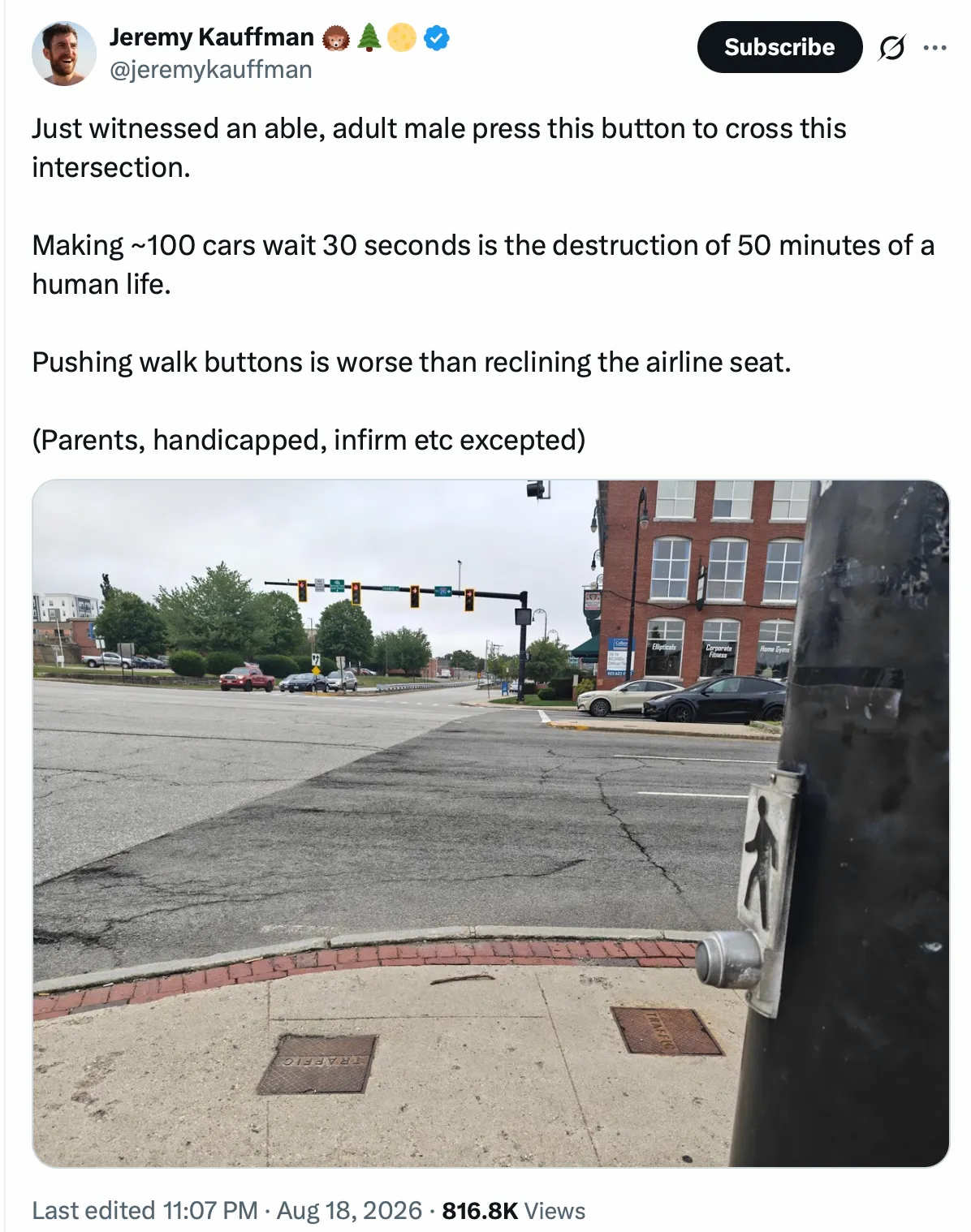
I'm surprised that such buttons even exist in the US.
post
I have become convinced that people get addicted to speed. One of the fastest ways to make some people's blood boil is simply making them drive a little slower; even if it's so marginal that it can't actually possibly affect when they arrive at their destination they become furious.
The US loves to have wide, straight roads with great visibility and no obstacles on which cars could easily, safely do 80MPH (in the absence of other drivers of course) but with artificial limits of 30-40 miles per hour that everybody obviously ignores because - hey, just look at the road, it's begging for people to go faster. The Netherlands by comparison generally does a great job of managing drivers' expectations by adding artificial curves, places where cars have to gently swerve, setting trees along the roads that give a feeling of constraint and not "wide open place to floor it", etc. Of course you still see people here losing their minds because they have to wait for pedestrians to cross once the light turns green, but it's not as bad as my experiences in the US.
Addiction to speed is a part of it. I think being trapped in a car actually creates a lot of psychological issues. Another one that doesn't get mentioned enough IMO is claustrophobia. All these psychological issues are probably big contributors to road rage.
Car gave people power, the larger it is, the greater the power felt. It is a great way to see if people will addicted to power and abuse it.
I think the stronger effect is the opposite. When humans use tools with fluency, they temporarily become part of the body plan. You feel it when a hammer or a sling become "part of your body," and it feels good. A person in a big vehicle doesn't feel claustrophobic, they feel like a giant metal juggernaut.
One aspect i never see talked about is that you literally feel like you're going slower in a car, a big part of which is because the outer parts of your field of view are blocked so you only see the things that are moving relatively slower:
Very true, and it has a much stronger effect when there's nothing around you. When you're in a large Asian/European city with tall buildings and narrow roads, everything feels closer so a small amount of speed feels like a lot. On massive American roads where everything is spread out (like the one in the photo), a lot of speed doesn't feel like very much.
I have a more metaphysical take on it: One's level of suffering is proportional to the distance between where one's body is located, and where one's mind is. It applies in a lot of different scenarios, and I think is kind of the secret behind the mindfulness movement. (If your mind and body are in the same place, you are much happier.)
The way that this applies to cars is in two ways: 1) The driver's body is physically located in a torture chamber, essentially. Sure, they put in a cushy recliner, and an entertainment system, but those can only do so much to mitigate how awful it is to drive. 2) The speed of the car promises a quick trip, so the driver's mind is already at their destination, and the separation makes them miserable and furious.
Yeah, yeah, that's pretty woo-woo. It's just a metaphor for the impatience drivers feel because, in their minds, they're already walking in the door, they're already ordering food at the restaurant, they're already kissing their spouse, they're already answering work emails, or whatever it is they have at the destination. And you, pedestrian, you are directly responsible for keeping them from it.
But I notice the real effects myself. Last weekend, I went up north to my vacation spot, where I've found that riding my bicycle to the beach is subjectively much faster than driving. It's almost like teleporting! Objectively, it takes longer, but when I'm riding my bicycle, I'm mentally on the road riding my bicycle, so the trip doesn't even register as part of the beach experience the way driving does.
Often their mind is already at a destination that they hate (work), making it even worse.
I do believe you're absolutely correct in essence, even if the mechanisms are subject to debate.
I switched to only getting around by E-bike 90% of the time, and the effect you describe regarding bicycle trip time subjectivity is absolutely real.
Taking 45 minutes to go 15 miles away feels a lot faster and relaxing than the 20 minutes it would be by car. People wave at you and you at them, that's still a thing!
About the only time the American psyche is confronted with the prospect of mindfulness and driving, is during the now nearly mythical "road trip" and even that experience has long since been reduced to listening to nav voice as you drive fast from point to point.
I don't think speed is the main factor, I think it's entitlement. With public transportation, you might have to go somewhere specific to get your ride, rather than it being just outside. Then you wait til a certain time, share the ride with others, the path and speed arent in your control so it may not be the most efficient route. With a car, you can go when you want, where you want and how you want. Until you know, others get in the way. If something is making you drive slightly slower, you now have less control.
I also think driving in general is an unpleasant experience. For most of the time driving, you are staring at asphalt, concrete and other cars, nothing is fun to look at. You have to focus constantly and any distractions become annoyances. Because of cars everything is so far away it always requires the car to do ANYTHING. For all the supposed freedom, you are constantly being told what to do. This is the speed limit, this is a stop sign, this is your designated lane, you have to yield. At every point you run into people and the more you run into the less you can do what you want. And those people can act like don't understand rules, aren't paying attention, interpret the rules differently, think they don't apply to them, know they can get away with it because the rules aren't heavily enforced or they are selectively enforced. Sometimes the rules don't always make the most sense, they are the way they are so it's easier to assign blame to someone in a insurance claim or court case. Or sometimes the rules make sense for someone else, but not your entitlement machine.
Counterpoint: Motorcycles, ebikes.
Way more control exists, but you never see motorcyclists suggest bicycles and pedestrians shouldn't be allowed to use the street too.
Maybe its something to do with the dynamic where ignoring the rules risks your safely instead of others or the isolation from the environment a car driver experiences.
definitely satire
everybody knows an intersection like this has at least a 90s light cycle
I definitely don’t want my life in the hands of someone that can’t afford to be 30 seconds late to wherever they are going.
I press the button every time, and if there's a break in the traffic, I cross before it changes.
I also recline my seat on the plane as far as it goes. I don't have any problem with others doing the same.
This HAS to be satire
Par for the course, it would seem.
State Libertarian Party leader charged for disorderly conduct after fender bender
Jeremy Kauffman, a former Free State Project leader who now chairs the New Hampshire Libertarian Party, is facing criminal charges stemming from an incident where police say a fender bender in a Manchester parking lot prompted Kauffman to fight “several people” and yell racist epithets.
I agree...
but not in the way the Twitter OP expects.
For the majority of intersections, if you don't press the button (or more often, don't press it in time), you don't get the walk light. Doesn't matter if the parallel car traffic has a green and all cross traffic is blocked, if you didn't press it beforehand, it stays on the red hand and skips your turn.
I say the buttons should not be there to "beg" for crossing permission. They should be used to say, "Hey I'm in a wheelchair or carrying a heavy can you give me 15 extra seconds?" And it should not need to be pressed beforehand.
the length of the pedestrian's signal may be adjusted longer as well, especially for crossing wide multi-lane and divided roadways.
Ah, so like in Europe
Europe's a big place. I don't have anything resembling that here in Romania. You mean like in the Netherlands?
France too, in cities the buttons is mostly just switching on a speaker to announce when it's green for pedestrians for the visually impaired or if you like "ding ding" sounds
Honestly fuck the button entirely, we live in the modern era, you can use human detection technology to detect people waiting to cross
There's plenty of places that have that
exactly, the button should just be a backup if the detection fails
There should also be a light to indicate that you're detected, and ideally a change in the sound signal as well (because the signal has a sound so blind people know when it's green, right?)
Plenty do instead a mechanical actuator, as it's not uncommon for people who are blind to also be deaf, but very rare for anyone to be insensitive to touch
Literally a tiny dial under the crossing button, attached to a motor, that begins spinning very slowly (like 5-10 rpm) when the light is green
I ignore crossing signals at intersections that don't turn the walk sign on by default
I've been honked at for it. nothing worse. hasn't actually happened in a while now, but my reaction would definitely be a lot more aggressive towards drivers if they did it to me now
I hit these buttons in both directions whenever I get to an intersection. The more stopped cars in the city, the better.
Awww he's upset his broom broom had to go wait wait
Not 50 minutes of human life; 50 minutes of carbrain life. There's a difference
In my city, crosswalks, even with the flashing lights mean NOTHING. Less than nothing really because it gives people a (very) false sense of security.
The infrastructure is the true waste. I mean, the least they could have done was make it a fucking circle....
basically every single signalized intersection has been replaced with a roundabout in my town over the years, and it's so fucking nice, both for drivers and normal people.
Everything flows smoother, people pay more attention, and the physical shape of roundabouts means 1) you basically only have to process one thing at a time 2) you never have to worry about head-on collissions 3) you ALWAYS get pedestrian islands at the crossings.
How dare we let the elderly, children, and disabled cross streets! They’ll get away!!!
Hint of misandry too, implying it's not manly to follow traffic safety laws. Dude probably has personal hygiene too and Mr. Jeremy Kauffman would point out washing one's butt is gay.
Starting to think this entire community is satire
all 84 comments