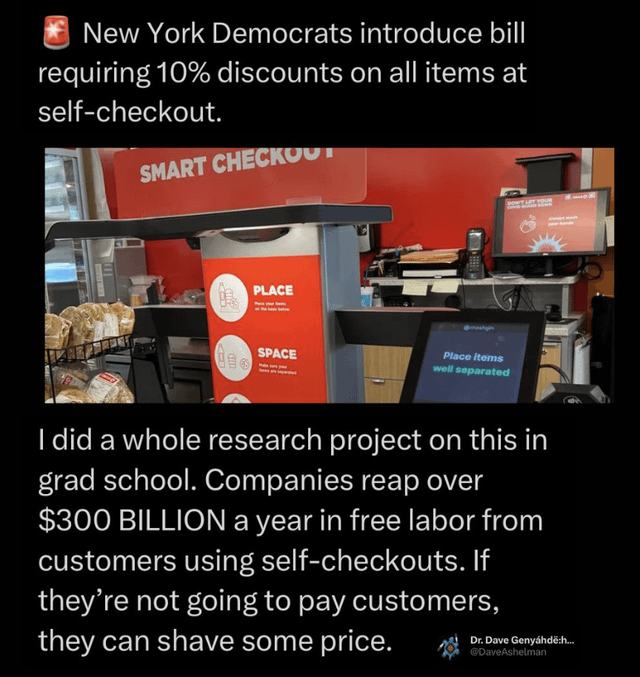
honestly just cap executive pay. nothing they can do then
post
It seems like they will just mark everything up by 10% and then give that discount at self checkout. So they will pocket even more while harming those who don't use self checkout.
Or eliminating cashiers altogether.
It also doesn't really make sense to do it as a percentage. A cashier's wage is typically hourly, and the labor market has settled on a particular wage for cashiers in this area - say $15/hr.
If I have a $150 grocery bill, a 10% discount would be $15. For maybe 5 minutes of work. Working out to an hourly wage of $180/hr (60/5 = 12, 12 * 15 = 180).
So if they're saying "we should be compensating customers for being made to do labor", they'd be compensating them at roughly 12x the going rate for cashiers in this example.
Now if it's just meant to be punitive, OK. But then why not actually address the real issue: displacement of workers by technology and passing the labor burden on to unpaid consumers - either make that illegal or tax the company to help mitigate the harm it's causing by eliminating jobs.
For the last point, it is easier to tax unfavored behavior into the ground than it is to outright forbid it. That's why sin taxes exist after all.
I don't think it would be difficult to outright forbid self-checkout at all, actually.
There's a difference between enforcing laws on individuals and enforcing laws on businesses. Businesses can't exactly run and hide, if they're using self-checkout they're going to get found out. That's distinct from something like the drug trade, which is all underground and hidden.
Some people fucking love self checkout. If you ban it, you'll have disability advocacy groups up your arse on behalf of autistic people and others with social anxiety.
ADA compliance will kill the entire thing. You can't charge someone for accommodation of a disability that prevents them from using the self checkout. All the human-staffed registers will be posted as handicap accessible, and they will default to the "discounted" self-checkout price.
when I recently went back to using a staffed lane, I told the folks I had anxiety about being in the lane, and the cashiers comforted me.
I have social anxiety, practicing in the staff lane, has helped me with this. At least, in this small area of life.
I get the point, but if a person doesnt ever push themselves, they wont grow.
Sure, I'm just saying, this wouldn't be a hard law to enforce.
It would be a very dumb law that has zero chance of passing. It would be like banning cars to keep horses employed.
We've given up so much as consumers. There was a time when people would be pissed that the store was making them do unpaid labor. Now we don't bat an eye.
My concern here is less about enforcement and more about getting the law passed and through the court system in the first place.
Do sin taxes really stop anything though?
or tax the company to help mitigate the harm it’s causing by eliminating jobs.
Well. Discounting items in self-checkout is actually a tax on the company for using self-checkout.
But not one that relates to the thing that we're trying to stop them from doing. Cashiers aren't paid per item scanned, they don't get commission. They are paid an hourly wage.
If you wanted to pay customers a rebate for their labor at the market rate for a cashier, or one set by the state, that'd make sense to eliminate the gains the company receives from automation.
So 5 minutes of work at $15/hr = $1.25. So not much, but it mitigates the benefit of not hiring people.
Though, it's still a benefit because you pay a person whether they're actively working or not and you have to pay tax on human labor (contributing to social security, etc) so maybe hiking it higher than whatever the typical wage is for cashiers would make sense.
But either way, 10% doesn't make sense.
If I have a $150 grocery bill, a 10% discount would be $15.
If you have a $150 grocery bill, it's being hiked to ~$166.66 before you get to the checkout. Then the 10% discount is bringing it back down to the $150 you were paying before. The net discount is zero: you're paying exactly what you're paying now.
If you keep going to the cashier after this, you're paying the company the hiked price, which gives them an extra $16.66 for maybe 5 minutes of cashier labor. The company turns around and pays the cashier $1.66, netting an extra $15 from you for their shareholders.
Cost of labor, overhead, and profit are already accounted for in that $150 price of the goods. That's why the store charges $150 for them - because that's what covers the wages, overhead, and includes the maximum markup they can get away with (~3% margin for grocery stores afaik).
All I'm saying is, they do have to be able to cover costs. So because of that and their thin margins, they'd just hike prices (probably more than they'd need to take advantage of the situation).
So it makes more sense to either tax them for avoiding using human labor and passing that labor on to customers (to help pay for the drain they're placing on the economy by not hiring people), or just ban the practice outright. Couple that with price controls to ensure they can't unfairly inflate prices. Things they can't avoid rather than a fee they can hike prices to avoid.
Imagine the lines at self checkout for ~$10(+) off on decent-sized carts
The problem with your logic is that I can scan the items slower and make the compensation more fair, if I scan the items 12x slower then I'm being paid a fair wage for that 150$ purchase.
So am I being punished for being fast?
That's the only way it could work.
Grocery stores average margins of ~3%. They can't do universal 10% discounts.
The CEO of Kroger made $15.63 million in 2024. Pretty sure there are lots of ways they could make it work. They choose not to.
That's not how math works.
2024
Revenue was $147B
Profit was $3.8B or 2.8%
The lowest estimate I found of sales volume through self checkout is 38%.
So a 10% self checkout discount is 3.8% hit to revenue. When profits are only 2.8% they'll take a 1% loss.
The CEO pay being only 0.4% of that $3.8B profit. Isn't remotely enough to matter.
This won't lower prices.
Do you think the CEO compensation is the only place they are siphoning off funds to the oligarchs? And even with all the greed, they are still admitting to robbing $3.8B from the working class. That's all profits are.
The system rewards greed and corruption. So that's what they do. They conspire with other corporations to inflate prices. They take advantage of disasters to gouge consumers. These aren't conspiracies, they are things that have been admitted to under oath and discovered through investigation.
The numbers are public. You can do the math and convince us.
say you’ve never worked in accounting without saying it
They're welcome to lie with the numbers! But then I can at least reason about it. Right now, we're looking at some cherry-picked end points and ignoring the proposed numerics entirely.
We're looking a 2 different things here. I'm doing the math on a specific policy and how it would effect a specific company. You come back with generalizations and broad conceptions.
You are right generally. We agree generally. But here specifically, this policy won't do anything to help that. It's bad policy-making. We're both right.
That's an abysmally small number compared to the amount of product they move.
Yes, sure, CEO's should make less. But that amounts to fractions of a percent on the typical purchase, not 10%.
Sure they can. They hike prices 11.11% and the 10% discount brings them right back to their original price. Their 3% margin stays a 3% margin. They can even post the "discounted" price on the shelves to make it seem like customers are getting a good deal.
You're pretending that stores can just arbitrarily raise prices. They already set their prices as the maximum the market will bear. And yes, ultimately the point is to make self-checkout cheaper than regular.
They arbitrarily raise prices all the time. Have you not noticed? And are you going to just stop eating food if it suddenly costs 10 percent more?
You think that was arbitrary? Do you have any idea how much work stores put in to setting prices? It's more complex than this, but to illustrate, companies will maximize for total revenue, so quantity sold times price. And they know that whenever they raise the price, even by ten cents, some number of people will not purchase that item. They only raise prices if they predict the decline in sales will be more than offset by the increase in revenue per item.
It may seem arbitrary to you, but it's anything but. The prices in the store are already at what the company estimates to be the optimum total revenue level.
Note that cheaper self-checkout means more demand for it (and less demand for cashiers). So we'll have fewer jobs, and worse service for those who can't (for w/e reason) use self-checkout.
Most of its happening anyway.
I didn't have to do a whole research paper on this to know that if I'm doing somebody else's job as a customer, the company is saving money.
This is why I try to avoid self checkout. If I'm getting like 2 things and there's already a line, sure, maybe.... But if the lines are short, even if I only have a couple of things, I'll visit a real cashier.
Not because I need help with it, and not because I want to "stick it to the man" or anything. I want to be part of the metric that continues to justify that a cashier is still a position to keep, and pay someone for. I do it so that there will still be cashier's in the future, and someone can put food on their table because I didn't choose to do free labor for the 0.1%.
I know, I know. I'm so selfish, I should tHiNk oF ThE sHaReHoLdErS....
"Cashier" has pretty much always been a heavily exploited, poverty-wage position. Cashiers might be putting food on the table, but their dickhead bosses aren't paying them a living wage. They aren't putting roofs over heads, or kids through college. Turnover is ridiculously, criminally high. People aren't getting fired when the position is eliminated. They are leaving just as fast as they already were, and they aren't being replaced.
The position is used to systematically exploit workers. Eliminating that position is a net positive.
And yet people still work as "Cashier" if they can get the job,
Wonder why...
Oh, wait, it's because the alternative of having no job and no income IS EVEN WORSE.
Welcome the Capitalism!
True. Very true. But the solution to that problem is a completely different conversation than what we have been having in this thread. That conversation starts with a "citizenship dividend".
Democracy takes the political power of the individual, conveys it to government, where it is used to provide all manner of services. Those services are available to everyone, but they are not utilized equally by everyone.
The individual is not currently compensated for the use of their political power. We are taxed proportional to those services that we use, but those taxes don't make it back to the source of the power that enabled those services.
That should change.
Each of us should be individually compensated for the government's use of our political power. We should each receive an equal dividend. The most common term for this dividend is "Universal Basic Income", and it should be enough for the food on our tables and the roofs over our heads. We should receive that income before we get out of bed on Monday morning. The 40 hours we typically work in the week should not be for basic subsistence, but should be entirely gainful.
I'm going to disagree with you there.
If your cashier's are not making a living wage, then maybe the minimum wage should be increased?
Where I am, if a minimum wage worker worked 40 hours a week consistently, they would go home with the equivalent of $26k USD. The US Federal minimum wage at 40hrs/week will net you $15k USD.
The job isn't always for the impoverished, and if it were, and you were to eliminate it, you just put people who are already impoverished into homelessness because they no longer have any viable means of employment.
The people leaving the job is a net positive because they should be, in theory, moving on to better paying positions. Freeing up jobs for people who need the work and can't find it elsewhere.
It's better than working in an Amazon warehouse.
Also, I worked at grocery stores a lot when I was a younger person and I was never a cashier, but I knew most of them and I was able to go back there years and years after I left and see the same faces at the tills. A lot of wives with empty nests helping to save up for retirement, or simply to do something during the day while their kids are off at school or whatever...
A lot of people working to help pay their way through college or university.
There were a lot of people working at those jobs for years and years because they needed something to help make ends meet until they could graduate, retire, find a job in their field, pay off their mortgage.... Whatever it was.
You having this opinion indicates to me that you haven't worked at a major retailer, or you've never worked as a cashier. I'm not sure which and bluntly I don't really care. My lived experience disagrees with your pessimistic world view.
If your cashier’s are not making a living wage, then maybe the minimum wage should be increased?
Minimum wage is certainly too low. It should be more than double its current hourly rate, but that's not the main problem here.
Where I am, if a minimum wage worker worked 40 hours a week consistently,
Cashiers are rarely allowed to work full-time hours. Management keeps the position open only for part-time workers. Cynically, the reason for this is so they don't have to provide benefits to those workers. Giving retailers the full benefit of the doubt, this keeps a surplus of workers on the payroll, allowing the retailer to schedule everybody during major shopping events like Black Friday. Regardless, these workers are typically denied sufficient hours to be able to earn a living wage.
The job isn’t always for the impoverished,
You've got it backwards. The job isn't for workers who happen to be impoverished. The impoverishment is because the job does not compensate workers adequately.
Also, I worked at grocery stores a lot when I was a younger person and I was never a cashier, but I knew most of them and I was able to go back there years and years after I left and see the same faces at the tills. A lot of wives with empty nests helping to save up for retirement, or simply to do something during the day while their kids are off at school or whatever…
So, you're saying that these workers are holding these jobs for something other than gainful employment? They are using them as some sort of hobby or recreation? They are willing and able to accept exploitative conditions because they aren't actually trying to live off the fruits of their labor?
The people you are talking about are, ultimately, enabling this exploitative behavior from employers. They are competing for work with people who do need actual gainful employment. Their recreational participation in the workforce devalues the labor of everyone else. I'm not saying they shouldn't be allowed to work recreationally, or that employers shouldn't be able to hire them. I'm saying that this practice should be strictly regulated, so that the employer can't use their willingness to be exploited to justify exploiting everyone.
I think we need to establish both a "minimum wage" and a "standard wage". The minimum wage would be the fixed, hourly minimum rate that we already have . The "standard wage" would multiply the minimum wage by 40 hours a week. Employees who aren't paid at least that weekly amount are on "substandard employment". A 40-hour/wk worker earning minimum wage makes a standard wage. A 20-hour/wk worker earning 2x minimum wage makes a standard wage. Substandard wages should be allowed, but restricted. An employer should not be allowed to compensate more than 10% of its labor with substandard wages.
I see what you're driving at, but all employment is exploitative. There's always a measure of the work that any low-level employee does that they will not get compensation for, that's how business operates. That's profit.
Whether someone is able to work at a position full-time or not, isn't really the point I'm making here. Long gone are the days of the minimum wage being a living wage, no matter how much we try, we'll never catch up to the inflation that's happened since the minimum wage was set. Companies won't let it happen. As minimum wages go up, so will prices, and you'll always be in a never-ending cat-and-mouse game of raising wages, vs raising prices. The two will never be at the same ratio of earnings again. Minimum wage earners will never have the same buying power that they did when the minimum wage was put in place.
Our buying power will continue to be eroded away, in small amounts, forever. Minimum wage positions will always be, by definition, more exploitative than other positions, but all jobs are going to continue to exploit the work that people do. That's capitalism in a nutshell though. I'm not proposing a better system, just stating facts. That fact makes a lot of what you're driving towards, apply to a much broader group of people than just the exploited minimum wage, impoverished workers. The lowest earners will always need to be supplemented by something, whether that's a food bank, food stamps, rent control, government programs to reduce costs, taxes, or other fees associated with living, or by the income of another person. I don't think Minimum wage earners will ever be able to be financially independent, even if they could have been at one point or another.
By cutting any job, you're shrinking the pool of jobs available for entry level workers. A pool that's continually shrinking already. I will happily do whatever I can to reduce how much that's shrinking as often as I can.
If you need a hammer or a torque wrench or a truck to do an ongoing job, compensation for that job must be sufficient to pay for the continuing maintenance and eventual replacement of that hammer, torque wrench, or truck.
If you hire a human to do a job, compensation for that job must be sufficient to fully meet that human's basic needs. They need to be earning enough to be a fully functional member of society, not an impoverished charity case. They need at least a living wage, where they don't have to choose between excessive employment or going without. A living wage (or better) is not exploitative.
Generally speaking, cashiers aren't earning a living wage, let alone a gainful wage. Cashiers are generally exploited.
As minimum wages go up, so will prices,
There's a glaring flaw in your analysis. Increasing minimum wage increases effective purchasing power much faster than it increases prices.
Can we go for upcharges on food items for modifying them next? If you are going to charge me $0.30 for adding tomatoes to a sandwich, you better damn well reduce the price by $0.30 when I remove tomatoes from a sandwich.
This is getting so out of hand in the USA.
Oh that's one of my gripes. My son likes to get an egg mcmuffin with no meat, extra cheese. You'd think the slice of meat and cheese would cancel each other out. And I think they are up to charging $1 for a slice of american cheese. And its been this way for over 15 years.
It's not just the US. The race for the biggest profit has hit its limits on the best value front. Now it's pretty much all on deception and enshittification.
The discount comes from entering the code of the cheapest type of item no matter what item I picked up. Organic lady finger bananas? Looks like bulk Cavendish to me. I'm not being paid enough to know the difference when I'm using self checkout, a banana is a banana.
this is why the store near me changed the self check programing and added AI
No more codes, point to the picture
Most self checkout machines rely on weight, so you have to find two items that weigh the same for that trick to work.
Ok, but since they're too cowardly to implement real price controls they just raised the price of everything by 10%.
Exactly.
Another increase in the cost of living because of self serve checkouts. Can we just nationalize all corporation right now and divvy them up later?
Can we just nationalize all corporation right now and divvy them up later?
Depends, are you a member of a militant communist group that's training and drilling for street to street fighting? Do you have a few hundred thousand members?
If yes to both, then yes. If no to either, then we have to do a lot of building class consciousness and organizing first.
What does it feel like answering rhetorical questions?
training and drilling for street to street fighting? Do you have a few hundred thousand members?
JFC you might be the ONLY person on .ML that gets it.
Like I am SOOOOOO SICK of internet edgelords with zero combat skills demanding we burn down society and roll the dice that whoever survives will do a better job.
On the flip side, if you aren't raising class consciousness at every opportunity and training and drilling for street to street fighting in an attempt to build that movement of a few hundred thousand armed commies, then you don't get to criticize how anyone else is choosing to go about it, either.
Lenin was still right, and a revolution is still absolutely beyond necessary.
There's a natural price cap in place for basic needs like this because of their relationship to labor.
We passed that cap years ago. People have been using pay over time credit to buy groceries since the pandemic.
In any other society the riots would have started before that. But USians are domesticated enough that I genuinely believe most of us will starve and die before we lift a hand in self defense.
There may be an unintended consequence of this. Corpos love to optimize to minimize any hits to their bottom line.
I could see any of these possibilities as a reaction:
- Self checkouts become overwhelmed so stores remove remaining paid cashiers to add more self checkout lanes.
- Self checkouts are reduced or removed to avoid giving any discounts.
- I believe I read that grocery margins are thin at the store and are much higher for manufacturers. I could see stores increasing prices across the board to recoup costs.
Hard to know for sure, the people seem to just rarely get a W these days that isn’t immediately wiped out by something else.
Hmm... I've read the opposite about margins: grocery store chains centralize purchasing so that they have a huge leverage on manufacturers.
For NY in particular, they shouldn't be able to raise their price easily as the city will have its city-owned stores to compete with them.
Yes price increases seem the most likely for pharmacies but not grocery stores. There is still sufficient competition in grocery stores, and enough of them without self checkout lanes. It would be hard to get away with a price increase when a cheaper alternative exists.
Pharmacies however... As much as I prefer small pharmacies, they often are tooo small for everything. Simply can't find everything one might need. There's basically just CVS and Walgreens, and they both are big into self checkout. Those two would collude for sure.
If a bill requiring 10% discounts at self checkout comes into law, they will all think the same thing: Increase the prices so the price at self checkout is the same, and people have to pay extra for a cashier.
The only way to realistically encourage corporations to reduce their margins within the current system is by establishing an alternative which is cheaper, and thus acts as competition which pushes the price down. So basically what Mamdani is doing with city-owned grocery stores.
The same goes for housing. Provide decent but simple housing at low rates, and the slumlords will either need to lower their margins or compete on quality instead.
There may be an unintended consequence of this.
The consequences will be a flood of lobbying money into the next legislature races
Yeah, you just raise prices 10% and pocket the difference when people end up having to use more cashiers because the self checkout is too full from fools thinking they are getting a discount. It's no different than all the stores with 'reward' programs where you get cheaper or better prices. They track everything you buy and sell it, making more than the amount you are saving. Seems better to recognize that automation of things like checkout is here to stay and incentivize alternative methods to keep people you know, fed, housed and alive.
They will increase prices by 10% to offset this.
Grocery prices have gone up 25% to 30% since 2020. It has been at least three full years since the pandemic was declared over. And food prices have gone up at around 10% since then.
They don't need an excuse to add 10%, they're doing it anyway.
Sources:
https://americandefault.org/statistics/grocery-price-increase-since-2020/
https://www.ers.usda.gov/amber-waves/2025/june/food-price-inflation-slowed-in-2023-and-2024
top 88 comments