Can’t make the wrong people look bad.
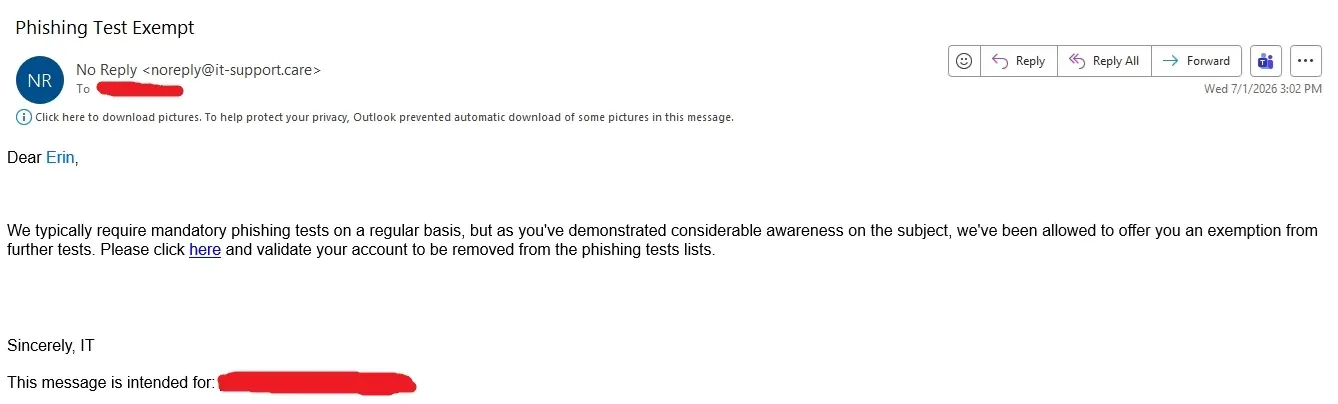
top 91 comments

sorted by: hot top controversial new old
[–] 136 points 3 months ago (3 children)

Report the email for phishing attempt.

  • source
  • hideshow 3 child comments
  • [–] 95 points 3 months ago (2 children)

    100% success rate if you mark every email as a phishing attempt.

  • source
  • hideshow 2 child comments
  • [–] 156 points 3 months ago
    [–] 74 points 3 months ago (2 children)

    I take great pleasure in flagging the training emails from my company's IT contractor as phishing emails. After all, they're unexpected emails with big link that I simply must quickly click on. That sounds like phishing to me!

  • source
  • hideshow 2 child comments
  • [+] 28 points 3 months ago* (last edited 2 months ago) (1 child)
  • [–] 6 points 3 months ago

    Ideally it should simply be a friendly reply back of "hey thank you for your concern but BrainBlstrz is a legitimate company that we partner with, you can retrieve the email by [steps] if still you need it" but not everyone can be so reasonable about such things

  • source
  • parent
  • load more comments (-1 replies)
    [–] 119 points 3 months ago (26 children)

    My company: Don't click on suspicious links.

    Also my company: It's employee survey time, click this link to complete the survey http://surveywhale.com/haidn39fk49cmc93mx

    I mark them as phishing attempts every damn time.

  • source
  • hideshow 26 child comments
  • [–] 59 points 3 months ago* (last edited 3 months ago) (18 children)

    Heh, an employee at my work got an email saying his anti-malware was failing to update, and to run http://10.3.4.2/xbejdjr.exe and that they need to click allow when the browser warns them that it is rejected, then right click, run as administrator, and they need to click allow in two other places to let it run.

    So he reported as phishing, then IT contacted his manager saying he was failing to help IT run a required update, it was evidently totally legit, but just the most scammy looking way they imagined.

  • source
  • parent
  • hideshow 18 child comments
  • [–] 24 points 3 months ago (10 children)

    That is so fucking sketchy, I'd have to talk to the IT guy myself or get on a video call to make sure their email or the group chat or whatever wasn't compromised.

  • source
  • parent
  • hideshow 10 child comments
  • [–] 2 points 3 months ago (9 children)

    is it tho? that's a LAN IP, so just a file on the company's network. browsers whine about http by default bc its security over WAN. then windows just whines about everything

  • source
  • parent
  • hideshow 9 child comments
  • [–] 9 points 3 months ago (3 children)

    Yes. An average employee doesn't know the difference between public and private IP's

  • source
  • parent
  • hideshow 3 child comments
  • [–] 3 points 3 months ago (2 children)

    well of course. just meant the IT guy didnt necessarily do anything sketchy or wrong, just a consequence of all those modern security prompts. totally get why folk would be apprehensive seeing that, deal with it all the time. but i've also never seen a company where they have an SSL cert for the LAN or something either, it just gets explained

  • source
  • parent
  • hideshow 2 child comments
  • [–] 6 points 3 months ago (1 child)

    I think teaching nontechnical employees that its okay to enter an IP address they don't know, given to them by a remote person and bypassing security prompts would qualify as "wrong".

  • source
  • parent
  • hideshow 1 child comment
  • [–] 1 point 3 months ago

    by explain, i didn't mean teach everyone it's always okay to ignore security prompts. maybe that's just how the cookie crumbled as the fix but it should've been explained why it's being done that time, that's where I think they're wrong, I rescind that. you're right that especially remotely it'll create bad habits.

    IME IT just walked our asses over when it's something like that, never worked in a giant office, so that's where I spoke from, ya feel me

  • source
  • parent
  • [–] 5 points 3 months ago* (1 child)

    Please use this link to ensure your security is up to date.

    http://10.3.4.2/xbejdjr.exe

    If you told users those are internal and to use them they will quickly forget to verify the link as they were told previously to click on them anyways.

  • source
  • parent
  • hideshow 1 child comment
  • [–] 1 point 2 months ago (2 children)

    This sweet summer child has never experienced the torture that is a LAN virus.

  • source
  • parent
  • hideshow 2 child comments
  • [–] 3 points 3 months ago (1 child)

    If that was legitimately IT, then that whole department either need the funds to acquire some remote management software, or they all need to be axed. Only the budget will tell.

  • source
  • parent
  • hideshow 1 child comment
  • [–] 1 point 3 months ago

    It's the latter. They actually get thrown all sorts of money in part because they say they need tools. The standard corporate load has at least 3 patch management software suites, two 'cybersecurity monitoring solutions', three anti-malware software products.

    Sometimes their automation fails and this was one of those situations where his and at least in our department only his where their automation failed for some reason or another. So they fall back to a sketchy looking exe on some random web server they don't even bother to enable https on (they also provision root CAs, so it's not like it would be a challenge for them to have https on an internal domain).

    They aren't very good, but they are doing things perfectly right; so long as the one deciding what is right is the sales reps of the software they use.

  • source
  • parent
  • [–] 2 points 3 months ago (2 children)

    10.0.0.0/8 is a reserved lan name space, so I'd probably have ran it after confirming the headers (anything 10.x.x.x will be on your local network) but I do agree, shady and stupid af especially since IT presumably should be running their own dns and it's trivial to implement a redirect to an internal corporate tld.

  • source
  • parent
  • hideshow 2 child comments
  • [–] 3 points 3 months ago (1 child)

    I would have assumed a beach head where they compromised a system on the internal network and then phished to extend the reach.

    I figured IT of all people would have allocated some DNS and some certificate. I would have taken the lack of TLS and DNS as a consequence of an attacker not having enough access to make those things a reality, and banking on people viewing 10. as safely internal like you are inclined to suggest.

    Just because it has an internal address does not mean it is safe, particularly as number of employees goes up and any one of them can get a system under their control compromised.

  • source
  • parent
  • hideshow 1 child comment
  • [–] 1 point 3 months ago*

    I never said it was safe, I said it was internal. If it's on 10.x.x.x, sent with email headers verified against my orgs Auth, it's beyond my or any normal user's pay grade to deal with it and should've been caught far far before this point by design. Though, what you're saying does align with defense in depth principals, I think you'll find they cannot be expected in real life use, but perhaps you're the type to independently verify every file you interact with via hash. Idk, some people on lemmy go hard. 🤷‍♂️

  • source
  • parent
  • [–] 2 points 3 months ago

    They can send executable links through emails and get their pants in a twist when the users do the right thing and report it for being shady AF, but they can't use RMM to automatically install their updates? Bullshit IT department needs to be fully replaced.

  • source
  • parent
  • [–] 6 points 3 months ago (3 children)

    I tried to make the case to IT that hyperlinks are not a threat vector on their own. They should train against opening attachments and entering credentials once the link is clicked. I haven’t heard back yet, I’m not sure they liked my message. But they did send a message letting us all know that reporting non-phishing surveys wastes their time.

  • source
  • parent
  • hideshow 3 child comments
  • [–] 5 points 3 months ago (1 child)

    The argument regarding hyperlinks is generally that there are 1-2 click zero-day vulnerabilities pretty frequently, so clicking a hyperlink will take you to a server controlled by the attacker which may or may not employ one of those. Additionally there's a constantly rotating array of obscure HTML/CSS hacks to trick even the savviest of users into thinking an attacker controlled window is something else or otherwise compromise a users system without utilizing zero-days. And finally good ol' social engineering typically relies on several vectors at once, so by the time someone's clicked the link there's a good chance they might go further for the attacker before they clue in.

    So yeah, theoretically if everything was as it should be, clicking the hyperlink and downloading and executing literal malware wouldn't work, but security is about trying to make sure the weak points of every part of the chain don't line up, because when those holes in all of the layers of security line up, you've got a nice big compromise to clean up, and those buggers are like bedbugs, once they get in, you can be chasing them for months or years until you're finally rid of them

  • source
  • parent
  • hideshow 1 child comment
  • [–] 1 point 3 months ago

    The web is very locked down already. People click so many links from email, but also outside of email. Clicking a hyperlink in an email is not a threat vector. If it was, we can’t vote on when to meet, open shared documents, or basically do anything other than plaintext email. Aha! That’s the solution. Plaintext email - all attachments and HTML are blocked.

  • source
  • parent
  • [–] 1 point 3 months ago

    Unfortunately, theres very good statistics that show 1-click attacks are quite common beyond just phishing for login creds. Granted, not nearly as common as the latter, it's still a moat you had to dig :(

  • source
  • parent
  • [–] 51 points 3 months ago (1 child)

    IT guy here....

    DAMN, that was brilliant!

  • source
  • hideshow 1 child comment
  • [–] 45 points 3 months ago

    Seems legit. Click the link

  • source
  • [–] 45 points 3 months ago (11 children)

    Ive often suggested to our security team that they send one out spoofing the monthly mandatory training vid

  • source
  • hideshow 11 child comments
  • [–] 60 points 3 months ago (8 children)

    The issue is that people's egos get bruised when they fall for it, and they'll very quickly get management on their side that certain ones are unfair, as if phishers give a shit about fair.

    What I really love is how my workplace uses some man in the middle crap to replace every link in every email with a new one redirected through our cyber security link scanning product, so now there's no way to check the actual link before you click it since they're all just like garbagesec.com/4a12c89e7f now.

  • source
  • parent
  • hideshow 8 child comments
  • [–] 23 points 3 months ago (3 children)

    Our IT solution to that was to MITM all the links except for the phishing tests. So anyone savvy enough to realize that always passes.

  • source
  • parent
  • hideshow 3 child comments
  • [–] 14 points 3 months ago

    But real phishing emails will have the same treatment as normal emails making them harder to detect. Sounds like a really bad system that probably doesn't offer any advantages over a pihole.

  • source
  • parent
  • [–] 3 points 3 months ago (1 child)

    At work, we use Safe Links in Microsoft Defender so examining the URL of a link in an email was always a pain, but Microsoft actually made a useful change recently. Now when I over over the link in Outlook, it displays the Original URL without all of the Safe Links gibberish. The link itself still goes through Safe Links, but the hover shows me the destination URL. I was pleasantly surprised when I noticed this.

  • source
  • parent
  • hideshow 1 child comment
  • [–] 21 points 3 months ago (1 child)

    PFF I don't click on any training emails unless my manager is asking about it in person.

    If it's not important enough for them to follow up on, it's not important.

  • source
  • parent
  • hideshow 1 child comment
  • [–] 5 points 3 months ago

    Yeah I created a rule that checks for a specific header in the mail from the phishing test platform, and junks those emails. Luckily, also the monthly security training emails also have the same X header

  • source
  • parent
  • [–] 40 points 3 months ago

    You can always forward it back to IT saying it's a suspicious link, according to this blog link you found. The blog link... Your own phishing link.

    Two can play this game.

  • source
  • [–] 38 points 3 months ago (2 children)

    I got a mandatory phishing awareness course that we were signed up to by corporate, and I deleted it because it looked scammy as all fuck.

    Don't whine at people for not completing your course on phishing, when you sign them up to courses using scammy looking names without telling us first.

    I'm not sure who these courses were even for. I was born in the scams. Moulded by them. I didn't see a genuine banking email until I was already a man. I remember my dad forwarding pyramid schemes to his friends on paper.

  • source
  • hideshow 2 child comments
  • [–] 12 points 3 months ago

    My org has us do the standard phishing training and then sends out completely legit links that ring all the alarm bells. Lots of survey links coming from whatever random domains they found to host it. Links to official applications that ask for to many permissions and are shady as fuck. Its surprising we don't get got more often.

  • source
  • parent
  • [–] 4 points 3 months ago

    I remember those paper schemes!!! If everyone just sends money around it will multiply and you can make millions! I got one and tracked down some of the people on the list to see how much they got. I was 17 and just heading to college at the time.

  • source
  • parent
  • [–] 32 points 3 months ago (4 children)

    Fun fact, those fishing emails usually share header information unique to the phishing email test service.

  • source
  • hideshow 4 child comments
  • [–] 8 points 3 months ago

    Yeah, I used to see these when I worked at a big corp. I would do a whois search on the domains used and 9/10 times it would come back as some compliance contractor the company used. I then proceeded to roll my rolly chair up and down every aisle warning my engineers. I spent so much time rolling in that job they should have bought me a rascal scooter with a built in desk. :D

  • source
  • parent
  • [–] 5 points 3 months ago

    We once had one that had what looked like a user ID in the URL. Checked with a coworker. The IDs appeared to be given sequentially. So I copied the URL and visited the site many times with different IDs.

    A lot of people failed the phishing test that month and would deny it.

  • source
  • parent
  • [–] 32 points 3 months ago (1 child)
  • [–] 23 points 3 months ago

    The best defence against phishing I have found is to just utterly ignore my email inbox at work.

    You missed our recent phishing email, try to report it next time

    No, I was so cautious I avoided my whole inbox because it might contain suspicious messages.

  • source
  • [–] 20 points 3 months ago (4 children)

    If IT did the phishing tests nobody would stand a chance lol

  • source
  • hideshow 4 child comments
  • [–] 20 points 3 months ago (2 children)

    I'd always pass because I never look at any of my emails. Checkmate, IT department

  • source
  • parent
  • hideshow 2 child comments
  • [–] 9 points 3 months ago

    Work in IT and my old cyber security architect would always try to get us. He did some great tricks and got a few salesmen. Never the engineers. Then they did similar tests for clients, they got hammered bad.

  • source
  • parent
  • [–] 20 points 3 months ago

    Don’t fall for it.

  • source
  • [–] 19 points 3 months ago (2 children)

    That reminds me of a recent situation.

    As someone working in software development, we are required to take part in the security trainings, the usual "don't open things from people you don't know" and "verify that a link is 'known' even if you get something from a person you do know", yada yada. You know the drill.

    Recently, I got an email from our Boss saying something about "Here is something that you need to click on so that you are being authorised to do this stuff". Here was my thought process:

    1. This is from the boss's Email. But this cannot be trusted since it can be faked
    2. This is about something we/our software can do. But I don't know why I have to do this, since this isn't really something I am part of or even know anything about
    3. It looks like a legit email
    4. I hovered over the link, which had some weird target location that I didn't know

    So, as a good boy, I opened a new Support ticket on IT with a screenshot of the link and said: "Got an email that tells me that I should open this link, but I don't know this link. What should I do?". The response was simple: Mark as Phishing and delete the Mail, done.

    2 hours later, I got a message on Teams from IT which said: "Well, apparently that mail you marked as phishing was actually from us (was legit)". Great. Mail is gone now, don't know where Outlook put it, and frankly, I don't care.

    If you train your people to "question everything" and not open links they don't know where they are going, then don't use some idiotic "middle man" or referer links in your official emails either. Even better, announce things before sending something out. I don't know how many emails I have gotten over the years where I would question the content and ignore it only for it to be something more important that nobody felt the need to announce first that something like this is coming our way.

  • source
  • hideshow 2 child comments
  • [–] 6 points 3 months ago

    I had a previous company send out a company wide announcement from a sketchy sender with a weird file attachment(apparently it's a voice mail file format), and the email was essentially listen to this attachment with no signature or anything else. They had to send out a second email explaining the suspicious email is actually real. Companies seem intent on ensuring there is minimal difference between phishing and legitimate email.

  • source
  • parent
  • [–] 18 points 3 months ago (2 children)

    I have a rule that searches the email headers for the test emails and just deletes them.

  • source
  • hideshow 2 child comments
  • [–] 15 points 3 months ago (1 child)

    Depending on what they’re testing for, you may still be a fail in the statistics. For example in my company we have a button to report phishing attempts, if you fail to report the email you fail.

  • source
  • parent
  • hideshow 1 child comment
  • [–] 17 points 3 months ago

    Link is sus, phishing

  • source
  • [–] 14 points 3 months ago (4 children)

    I'm out of the loop, what happened here?

  • source
  • hideshow 4 child comments
  • [–] 14 points 3 months ago

    Purple link, lol

  • source
  • [–] 13 points 3 months ago

    I have gotten texts from our Cybersecurity warning me not to open links in texts...and they include a link to a web page for more information.

  • source
  • [–] 11 points 3 months ago

    I just delete all emails, i've never felt more productive

  • source
  • [–] 9 points 3 months ago (1 child)

    Yeah y'all get it, I get it, my relatives don't get it

  • source
  • hideshow 1 child comment
  • [–] 18 points 3 months ago* (last edited 3 months ago)

    Tell your relatives that this IS the phishing test email. If you click that link, you're gonna get busted by your IT department.

    Never click links (or for that matter, ads) in emails. Always verify the sender first. Not the display name, the actual email address that it was sent from.

    If you must go to a link, best to find out what website they're sending you to (hover over the link for the URL), then type in the main website manually from a web browser.

    For example, if you get an email from US Bank (assuming you use them), type "usbank.com" (minus quotation marks) in your browser, then login to your personal bank account on their official website. Don't trust a link to a bank's website without typing it yourself. Don't just copy/paste the full URL from your email either.

    Some links, even to legitimate websites, can have tracking data in the URL that gives a lot of info about you, where in the world you're browsing from, what web browser you're using, what website, app, or program you clicked the link from, etc. Basically, remove the "&" and everything after it in URLs before loading them in your browser.

    These are just a few basics to protect yourself from malicious links. Basically, don't click any link you don't recognize and verify with people who send you links. And even then, protect yourself from idiots who forward links without doing their own spot checks. Even your best friends can send you viruses and malware. Heck, that's how a lot of it spreads across the Internet.

    And especially don't trust your own IT department when they ask you to click links in their emails.

    Sincerely,

    ~A former IT guy

  • source
  • parent
  • [–] 9 points 3 months ago
    [–] 7 points 3 months ago

    Me and some coworkers got yelled for reporting the phishing attempt. And then still clicking on the links. The halfass made up sites it took you to were worth it. It’s wouldnt take you to some site saying you failed. It would be like a lunch menu for some made up place. It was great.

  • source
  • load more comments
    view more: next ›