Yep. It's candy UBI, and I'm for it!
Ha, this article is good. I'm upvoting; "So that settles it...." :)
Same here; this is my new wrong answer to why it's called football: the ball is about a foot long!
This is the correct response.
Lol, those guys looking at the one guy holding on. Simultaneously thinking he's a wimp, and also wishing they were doing that. And then there's that dude trying to straddle the inside of a pipe. Amazing.
I felt similarly about it being slow to get going. I thought it had some of the most intense individual scenes in the series though! Especially
Tap for spoiler
the ceremony between two sea gods, where I was just certain someone was going to get sacrificed, but they didn't!!
I'm amazed at how reasonable this whole discussion has been; bravo everyone. To stretch things a little, I'll point out that Days of Shattered Faith has some political-science fiction!
(mostly /s; I enjoyed that whole series and I'll be interested in your review :)
Do they want someone to test a new name? I'm tired of waiting.
I have a reminder on my calendar for surgeon pizza rats day every year. I don't know what, or why, but I have it.
I don't know what that means, can anyone explain it?!
Its right there next to Wyoklahota
I've been experimenting with foldable 3d prints for tall thin walls in some game organizers. (Bigger pictures below.) The principle here is sort of similar to a living hinge, but not designed to flex too many times. Just fold once and be a reasonably stable structure.
Here are some individual pictures of the designs I've made, for corner support of some game organizers. Below, I have explanation and the design/dimensions that I use.


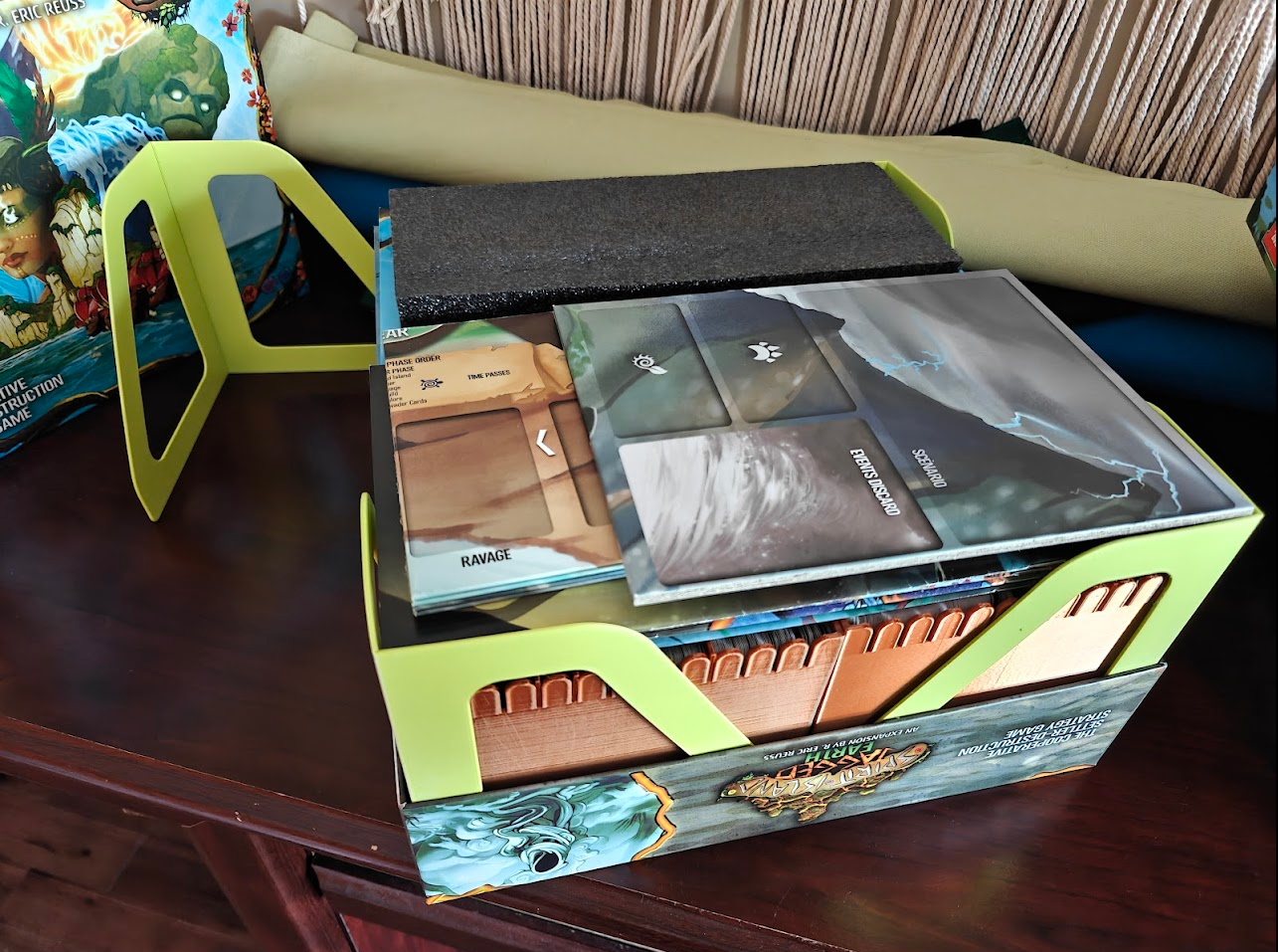
Overview
I haven't seen this type of design too often before, so I thought I would share what design and dimensions worked for me. Here is an overview:
-
I design what I call the Wall as an outline, with some cutouts to reduce material. This is the part that prints flat and will fold up.
-
I apply a chamfer to all edges, to help with removal from the build plate.
-
I make a Y-Profile for the fold line grooves. The profile is vaguely Y-shaped, with a short rectangular base and an angled top. (Picture below; the Y-profile is labeled "cut out groove" there.)
-
I use the Y-profile to cut away material from the wall to make those grooves.
-
I print these in PLA (the pictures are matte PLA, because that's what I had). I guess PETG might be more sturdy, but honestly the PLA was so good that I haven't bothered with PETG.
Here is a picture, which I'll explain below.

Design Details
The top of this picture is an edge-on view of the wall (green horizontal lines) and the Y-shaped profile (labeled "cut out groove"). I use the following dimensions:
- wall thickness: 1.5mm
- wall chamfer (not pictured): .5mm
- Y-profile base height (a): 0.3mm
- thickness remaining below Y-profile (b): 0.4mm
- angle of Y-profile sides: 40 degrees from horizontal (45 didn't fold as well)
- Y-profile base width: (pi/2) x a x 1.1 (=.52mm with other dimensions above)
That last measurement, the width of the Y-profile base, is what the bottom part of the picture is about. The key idea is that width is going to be, roughly, 1/4 the circumference of a circle with radius a. So, I computed that amount, and multiplied by 1.1 to give 10% extra width.
With these dimensions, the part that folds is 0.4mm thick (dimension b in the pictures), then there is a 0.3mm clearance (dimension a), and the two arms of the "Y" fold together. In my first trials I used 45 degrees for the Y arms, but found that I got a better fold making them a little wider (so, lowering the angle from horizontal, to 40 degrees). This basically gives a little extra tolerance for variations in the physical print.
Conclusion
I hope this helps someone! I think it's a neat technique, and I'm a little surprised that I haven't seen it used anywhere else. I've seen various designs for living hinges, which are roughly the same principle, but designed to flex repeatedly. Searching around, I found one foldable cube on thingiverse. But otherwise I haven't found any models using this kind of design.

view more:
next ›