Bender is one of the co-authors (alongside Gebru) on the stochastic parrots paper! An amazing voice in anti-AI critique
yea that one netflix doc had Yud and Soares on it which i wasn’t a fan of but ultimately the doc balanced their doomer opinions out with Timnit Gebru
The DN team has been hitting it outta the park with bringing in leftists analyzing the AI techno-fascist corporations.
I’m glad to see the anti tescreal movement gain more momentum
I urge you to read beyond the headline. The author intentionally buries the lede; it is too obscene to be taken seriously if stated flat. I agree with your statement.
This piece is not some ad homenim attacking the character of these prominent AI safety figures, using this attack on their character to claim that their work on AI safety is wrong/incorrect/invalid because of their sex cult.
This is about exposing the power dynamics which core leaders of AI safety groups which are highly influential across tech in SF. These persons fetishistically prefer simulated rape, and are bonded together by this preference.
All of the main content of rationalism is a trick. Every time Yudkowsky’s writing explains some trick your brain can pull, it is the magician showing you his sleeves while he palms a card: it is meant to convince you that whatever trick he is about to do next is impossible, and to prevent you from figuring out how it was done or ever believing it had happened
For the Rationalists in the audience: The purpose of explaining Pascal’s Mugging was to make you think you had figured it out so that you would believe you were too smart and well-informed to be Pascal’s Mugged, and to make it impossible to convince you that it had happened to you later once it had.
CNC = consentual non-consentual. I.e., pretending to SA as a fetish.
See the "Brangus Unchained" section of the posted writing.
Core leaders for MIRI, Lighthaven and the community fetishistically prefer simulated [SA]. They are bound together by having hobbies and secrets in common. This seems to be an important form of social tie in this group. They promote their sexual interests and recruit for their sexual events so prominently because these are the things they care about and believe in. These people are some of the most influential, if not the most influential people in AI Safety.
"The study doesn't show it removes the ability to do hard things" Again, who exactly are you arguing against? Nobody said this... Neither the press release nor I
"People who used AI for ten minutes before performing difficult tasks actually performed better than those who did not."
I'd gently encourage a quick re-read of the paper, as the statistic results directly contradict your claim. Here's experiment 1 (fraction math problems):
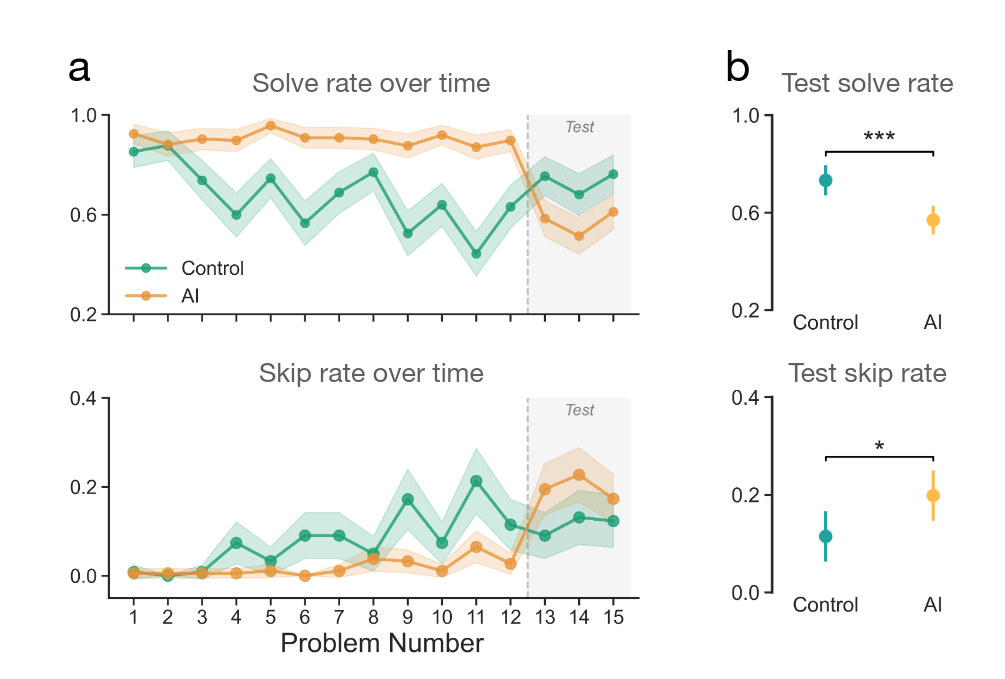
The solve rate measures the rate at which the participants correctly solved the problem, and the skip rate measures the rate at which the participants chose to skip the problem rather than inputting an answer. We observe that with AI assistance (i.e., the first 12 problems), participants in the AI condition were significantly more likely to solve problems correctly and less likely to give up compared to the control participants. However, when the AI was removed, their performance dropped and they were also less likely to persist with problems (as seen by the increased skip rate). Here's experiment 2 (same fraction problems, but with an added pretest):
Finally, experiment 3 (SAT-style reading comprehension):
To clarify, people who used AI did worse than the people who never used AI on the test.
"The title heavily implies that just ten minutes of AI usage makes difficult tasks harder to perform, which is not what the study showed or concluded" and Again, just to make sure we aren't proceeding on a misunderstanding here, the headline says "persist", which means to refusing to give up. The definition of persist is not that of perform. Further, I suggest you re-read the research paper. The abstract directly states, "impairment of unassisted performance"
"The conclusion the researchers drew, which is up for interpretation, was that prolonged AI usage may potentially impair people’s ability to perform harder tasks without assistance." I think you may be confused about how experimental studies work in research. In the experiment, when they controlled the variable of AI assistance, the experimental results showed statistically significant results proving the hypothesis that test solve rate of the control group was greater than the test solve rate of the AI group.
Imagine a world where a company invents an Automated Robotic Sculpting Arm.
You don't need to hold a chisel or hammer anymore. You simply stand in front of a block of marble and speak to the robot using natural language: "Sculpt me a realistic human torso, slightly leaning forward, capturing a sense of tension."
A novice steps up to the machine. They have never touched clay, never studied human anatomy, never felt the resistance of marble grain, and never made a mistake that chipped off an irreplaceable nose.
The robot chisels out a figure in seconds.
A veteran sculptor walks by and points out: "The muscle attachment at the collarbone is anatomically impossible, and the weight distribution makes the statue structurally unsound—it will tip over in a high wind."
The novice replies: "No problem! I don't need to know anatomy or physics. I'll just refine my prompt!"
So the novice turns to the robot and says: "Fix the collarbone so it looks anatomically correct, and adjust the weight distribution so it won't tip over."
Could you please explain in further detail why offloading cognitive labor is equivalent to reducing physical labor? Cognitive and physical labor are two different things: you need to struggle through a challenging problem to build structural thinking capacity for higher-order thinking; skipping fraction math isn't just saving physical energy but skips building the schemas needed for calculus, linear algebra, and so on. Using a drill over a screwdriver just saves your arm muscles, and it doesn't condition you to expect wood to screw itself together without your input.
Forgive me, but i’m not understanding why you find the headline to sensationalize or over state the actual findings of the study. The abstract of the paper directly says:
we provide causal evidence for two key consequences of AI assistance: reduced persistence and impairment of unassisted performance.
I’m struggling to discern a meaningful difference between “erodes your ability to persist at hard things” and “reduced persistence of unassisted performance”. Forgive me for not understanding but I would appreciate your explanation. The paper's very own conclusion actually uses the term erosion:
Here, we show that AI interaction can result in significant impairments in independent performance and persistence – capacities that are foundational to life-long learning. If brief exposure produces measurable erosion, the cumulative effects of daily AI use over months or years may be profound and difficult to reverse
I found a definition of erosion: "the gradual loss of something as a result of an ongoing process". Trust can erode and be rebuilt; soil can erode and be restored.
I agree that 10 mins of foundation model assistance likely doesn’t “permanently damage your brain or destroy your ability to think for yourself”. However, in my reading of the Berkeley news piece, I find no claim of this specific kind. Does the text of the press release explicitly claim the duration of effect is long-term or lasting? Does it explicitly claim the the erosion is permanent? Again, I find myself confused what you are arguing against.
Maybe you’re misunderstanding—you’re saying exactly what the interviewee says:
TIMNIT GEBRU: Well, so, you know, I have been warning that this kind of discussion about the fictional superintelligent machines that don’t exist and the so-called existential risks that they pose has been a ploy for regulatory capture. And I feel like when I saw this meeting announced, with self-policing and self-regulation and relying on the goodwill of these companies to self-regulate, and I — my first thought was that they got what they wanted. You know, this is what they wanted, instead of being held liable through existing laws
Relevant reading for anyone curious about this in some more depth:
- https://karlbode.com/ai-doomsday-panic-is-completely-out-of-control/
- https://pluralistic.net/2026/09/12/god-in-the-box/#llms-are-fake
And this podcast where Gary Marcus breaks it down https://www.youtube.com/watch?v=es4FfRU8saQ&t=96s
Finally, Timnit Gebru with a broader criticism of the powerful men of tech: < https://www.democracynow.org/2026/10/1/timnit_gebru_ai>
To reel in the very broad question you have to the relevant topic (the AI "torture" chamber):
How do we know humans experience pain You experience pain and know what this is like. It would be a little absurd to think that your friends and family don't experience this as well (obviously excluding persons in vegetative state) How can we be certain an LLM doesn't experience pain Philosophers mostly agree that LLMs aren't conscious, despite not agreeing on what exactly consciousness is or, relatedly, what causes consciousness.
A computer computing the forward pass of a model is merely a Von Neumann machine following serial instructions one-by-one manipulating discrete (non-continuous) data. The brain is a parallel, distributed computer with dynamically changing neural structure operating on continuous potentials. LLMs do not replicate this nor do they come close to an approximation sufficient to replicate the causal powers of our brain, thus they are not sufficient for understanding and experiences in the capacity that humans (or other sentient animals) do.
yea activation steering is not prompting but all things considered the meme still captures the absurdity of believing a program is in pain merely because it outputs human like language mimicking what one in pain says and thinks
I don’t think anyone thinks the turing “test” implies machine thinking anymore. Check out the philosophers publications: https://scholar.google.com/citations?user=NHcVwwMAAAAJ
There’s some in my opinion very significant open issues in the philosophy of ethics and consciousness that make AI ethics an important area of research.
i’m so incredibly annoyed by the fact that my previously favorite hosting provider digital ocean decided to fund this ridiculousness… any favorite alternatives anyone can offer?
Could you explain what feelings you have about AI, and how you see these feelings as opposing. If you are just uncertain about AI (holding no opposing views), I think you would want to research more. Maybe if we knew more about your teams at your work, and what is being developed. You could honestly just spend an hour a week working on standardizing coding agent availability and licensing/subscriptions, and leave it at that. Either they weren't looking for someone who was a machine learning engineer, or whoever promoted you is clueless to what AI actually means.
Thank you so so much for pointing out ROCmFP4. I have been tinkering with my RDNA 3 framework on llama. I was struggling with ROCm llama.cpp and have been using vulcan in the meantime. I know there’s some issues on the llama.cpp github to try and fix my issue (UMA stuff), but haven’t come across this specific project. Gonna try it out
… if you have the ram (with fast enough bandwidth)
MoE models are pretty magic on my laptops 32gb ram. 24 tok/sec on DDR5-5600 using Gemma 4 26B-A4B is so much faster than a dense model
UMich research cited in the article estimates a carbon dioxide emissions per year (using constant mileage typical per year) break even time between EV and ICE SUVs to be 1.6-1.9 years.
Promising. But, is carbon dioxide emissions the only environmental impact? Humanitarian impact (e.g. rare metal extraction labor conditions)? I’m not an environmentalist researcher/academic. I wonder how accurately just one emissions prediction portrays the full picture.
Fair enough. Let me quickly go through the one-liner, command-by command
# Joined by `&&`, bash runs these commands in sequence (as if run individually in shell), but exits/stops execution early if any command fails (return nonzero)
TMP_DEB=$(mktemp --suffix=.deb) && curl -sSL "https://support.brother.com/g/b/downloadend.aspx?c=us&lang=en&prod=hll2465dw_us&os=128&dlid=dlf106036_000&flang=4&type3=10283" -o "$TMP_DEB" && sudo apt install -y "$TMP_DEB" && rm -f "$TMP_DEB"

# Going command by command:

# First, we create a local variable in the shell, named `TMP_DEB`
# We assign the value to `$(...)`. This stores the string output (to stdout) of running the command `mktemp ...` to `TMP_DEB`
# `mktemp` creates a temporary file and prints its name, which uses the name template `tmp.XXXXXXXXXX`
# `--suffix=.deb` flag appends `.deb` to the name template
TMP_DEB=$(mktemp --suffix=.deb)

# At this point, we've created a temporary file, and saved the name to a variable in bash
# Next, we download the file using curl. `-s` makes output silent, `-S` shows errors in output, and `-L` follows redirects
# note the url doesn't end in `.deb`, implying that we will be redirected by the web server to the file path. without -`L` curl will download a page that stores the redirection response from the web server, not the .deb package
# `-o "$TMP_FILE"` forces curl to store the downloaded file to the tmp file we created
# note the quotes around the variable expansion. `$TMP_FILE` would also resolve the string stored in the variable, but we use quotes to avoid string globbing (google this)
curl -sSL "https://support.brother.com..."

# Next, we install the package with apt
# note: we use the string stored in the variable `TMP_DEB`, the filepath to the temp file we created, and downloaded the deb package
# `-y` flag skips the confirmation question "install package [y/n]: `
sudo apt install -y "$TMP_DEB"

# Finally, to clean up we delete the tmp file
rm -f "$TMP_DEB"
view more:
next ›