An episode of The Nerd Reich with Gil Durán Podcast featuring Timnit Gebru

Silicon Valley billionaires claim they are building a godlike "superintelligence" that will either save humanity or destroy it. But what if this apocalyptic storyline is just a massive marketing scheme designed to seize natural resources and consolidate power?

On this episode of The Nerd Reich Podcast, Gil Durán sits down with renowned computer scientist Dr. Timnit Gebru, founder of the DAIR Institute and co-author of the groundbreaking "Stochastic Parrots" paper.

Dr. Gebru breaks down the cult-like behavior of tech CEOs, explains what Large Language Models (LLMs) actually are, and exposes the devastating environmental toll of AI data centers (which aren't really necessary).

If you're tired of the AI hype cycle and want to understand the real harms of generative AI—from exploited labor to climate destruction to the looting of humanity—this episode is the antidote.

  • 00:00 Silicon Valley's AI Hype Cycle
  • 05:00 Framing the AI Doomer Narrative
  • 10:00 Computer Vision and Deep Learning History
  • 15:00 Rebranding as an AI Company
  • 20:00 Large Language Models as "Stochastic Parrots"
  • 23:45 Consolidation of AI Ownership
  • 28:45 The Power of Propaganda
  • 32:30 Rejecting Tech Narratives and Sabotage
  • 38:45 Corporate Control and Tech Hype
  • 43:45 Geopolitical US-China AI Propaganda

Pre-order Dr. Gebru’s book: Deep Unlearning: The Rise of AI and the Radicalization of a Tech Idealist here

Buy Gil Durán’s NYT Bestseller: The Nerd Reich: Silicon Valley Fascism and the War on Democracy here
[–] 1 point 1 week ago (2 children)

The DN team has been hitting it outta the park with bringing in leftists analyzing the AI techno-fascist corporations.

I’m glad to see the anti tescreal movement gain more momentum

  • source
  •  

    An apocalyptic alliance of religious fundamentalists, billionaire Silicon Valley tech kings and ethno-nationalists is gathering momentum. They aren’t just exploiting collapse, they’re provoking and accelerating it, whilst protecting themselves from the fallout. The world’s fate is increasingly in the hands of men who are ambivalent about its survival and betting money on the end.

    Already, anger at the building of data centres is cutting across left and right, in a way that climate politics rarely has – but how do we make sure that anger is heard? How do we separate necessary alarm from fatalism? And what can we prepare for the impending AI crash?

    • 00:00 Intro
    • 01:16 What Is End Times Fascism?
    • 06:12 How Neoliberalism Fuelled Fascism
    • 09:31 Armageddon Politics: Why Some Fascists Want the World to End
    • 13:31 Christian Zionism, Israel and the Far Right's End-Times Prophecy
    • 20:34 Suffering, Redemption, and the Human Need for Myth
    • 27:43 Inside Peter Thiel's Apocalypse Ball
    • 31:11 The Truth About Why Silicon Valley Backed Trump
    • 37:27 AI Won't Free Us From Work
    • 40:28 The Real Risks of AI
    • 44:22 AI Warfare: How Algorithms Are Used to Target People in Gaza
    • 50:28 Can AI Serve the Left, or Is It Inherently Dangerous?
    • 58:09 Can the Left Beat Fascism? Mamdani and the New Left
    • 1:09:56 How to Prepare for the AI Bubble?
    • 1:17:49 Not Quitting Planet Earth: Solidarity, Socialism and Building a Liveable Future
     

    Silicon Valley is obsessed with talking about the end of the world. They're largely full of sh*t. But it's still worth taking AI seriously and asking why we can't think about moving beyond it (and capitalism.)

    Capitalism enables Silicon Valley technologists, and ethno-nationalists who make up this apocalyptic alliance to fuel the fire that is AI as we know it

    00:00 - it's easier to imagine AI ending humanity than the end of capitalism
    06:19 - What's so scary about AI?
    09:52 - So why is everyone taking AI so seriously?
    11:40 - Why the end times discourse?
    17:19 - The logic / theology of disruption
    19:47 - Why can't we disrupt capitalism tho
    22:19 - The computer as salvation
    24:44 - We don't need AI. We need to end capitalism

    [–] [S] 15 points 2 weeks ago

    I urge you to read beyond the headline. The author intentionally buries the lede; it is too obscene to be taken seriously if stated flat. I agree with your statement.

    This piece is not some ad homenim attacking the character of these prominent AI safety figures, using this attack on their character to claim that their work on AI safety is wrong/incorrect/invalid because of their sex cult.

    This is about exposing the power dynamics which core leaders of AI safety groups which are highly influential across tech in SF. These persons fetishistically prefer simulated rape, and are bonded together by this preference.

    All of the main content of rationalism is a trick. Every time Yudkowsky’s writing explains some trick your brain can pull, it is the magician showing you his sleeves while he palms a card: it is meant to convince you that whatever trick he is about to do next is impossible, and to prevent you from figuring out how it was done or ever believing it had happened

    For the Rationalists in the audience: The purpose of explaining Pascal’s Mugging was to make you think you had figured it out so that you would believe you were too smart and well-informed to be Pascal’s Mugged, and to make it impossible to convince you that it had happened to you later once it had.

  • source
  • parent
  • context
  • [–] [S] 8 points 2 weeks ago

    CNC = consentual non-consentual. I.e., pretending to SA as a fetish.

    See the "Brangus Unchained" section of the posted writing.

    Core leaders for MIRI, Lighthaven and the community fetishistically prefer simulated [SA]. They are bound together by having hobbies and secrets in common. This seems to be an important form of social tie in this group. They promote their sexual interests and recruit for their sexual events so prominently because these are the things they care about and believe in. These people are some of the most influential, if not the most influential people in AI Safety.

  • source
  • parent
  • context
  • [–] 7 points 3 weeks ago (1 child)

    "The study doesn't show it removes the ability to do hard things" Again, who exactly are you arguing against? Nobody said this... Neither the press release nor I

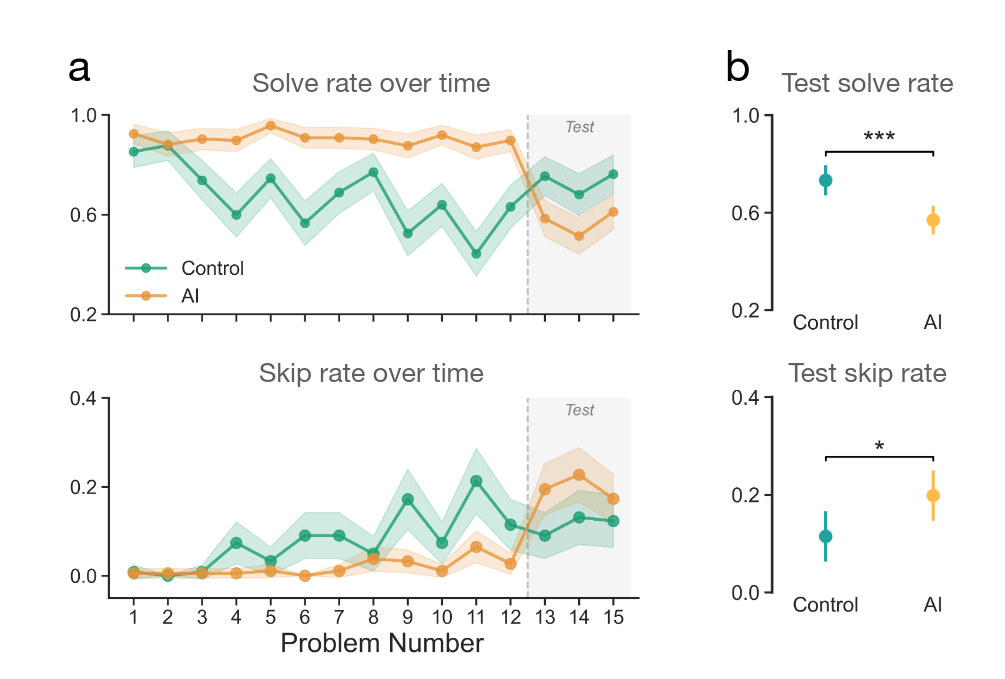
    "People who used AI for ten minutes before performing difficult tasks actually performed better than those who did not." I'd gently encourage a quick re-read of the paper, as the statistic results directly contradict your claim. Here's experiment 1 (fraction math problems):
    image

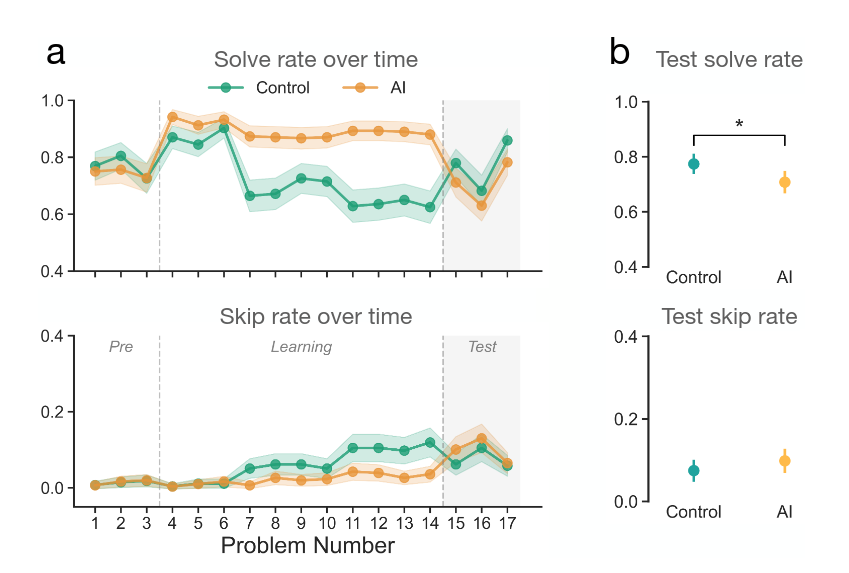
    The solve rate measures the rate at which the participants correctly solved the problem, and the skip rate measures the rate at which the participants chose to skip the problem rather than inputting an answer. We observe that with AI assistance (i.e., the first 12 problems), participants in the AI condition were significantly more likely to solve problems correctly and less likely to give up compared to the control participants. However, when the AI was removed, their performance dropped and they were also less likely to persist with problems (as seen by the increased skip rate). Here's experiment 2 (same fraction problems, but with an added pretest): image Finally, experiment 3 (SAT-style reading comprehension): image To clarify, people who used AI did worse than the people who never used AI on the test.
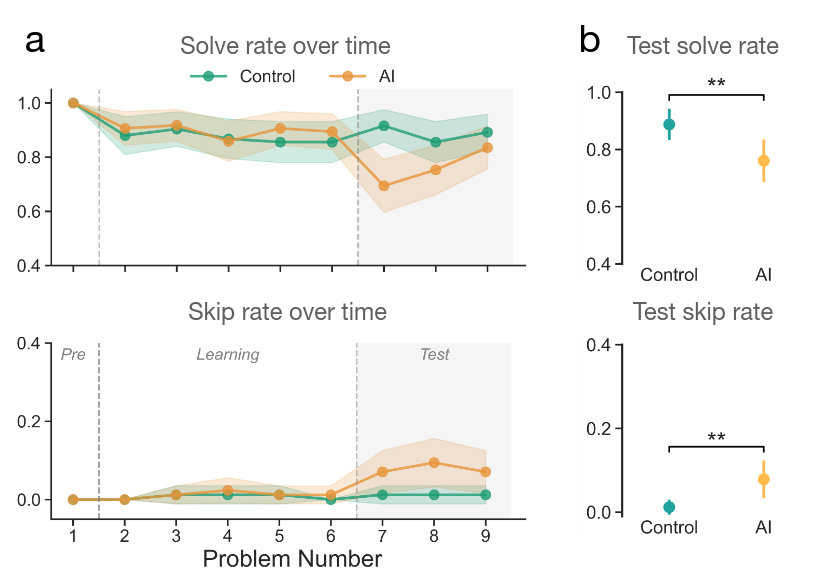
    "The title heavily implies that just ten minutes of AI usage makes difficult tasks harder to perform, which is not what the study showed or concluded" and Again, just to make sure we aren't proceeding on a misunderstanding here, the headline says "persist", which means to refusing to give up. The definition of persist is not that of perform. Further, I suggest you re-read the research paper. The abstract directly states, "impairment of unassisted performance"

    "The conclusion the researchers drew, which is up for interpretation, was that prolonged AI usage may potentially impair people’s ability to perform harder tasks without assistance." I think you may be confused about how experimental studies work in research. In the experiment, when they controlled the variable of AI assistance, the experimental results showed statistically significant results proving the hypothesis that test solve rate of the control group was greater than the test solve rate of the AI group.

  • source
  • parent
  • context
  • [–] 3 points 3 weeks ago (2 children)

    Imagine a world where a company invents an Automated Robotic Sculpting Arm.

    You don't need to hold a chisel or hammer anymore. You simply stand in front of a block of marble and speak to the robot using natural language: "Sculpt me a realistic human torso, slightly leaning forward, capturing a sense of tension."

    A novice steps up to the machine. They have never touched clay, never studied human anatomy, never felt the resistance of marble grain, and never made a mistake that chipped off an irreplaceable nose.

    The robot chisels out a figure in seconds.

    A veteran sculptor walks by and points out: "The muscle attachment at the collarbone is anatomically impossible, and the weight distribution makes the statue structurally unsound—it will tip over in a high wind."

    The novice replies: "No problem! I don't need to know anatomy or physics. I'll just refine my prompt!"

    So the novice turns to the robot and says: "Fix the collarbone so it looks anatomically correct, and adjust the weight distribution so it won't tip over."

  • source
  • parent
  • context
  • [–] 4 points 3 weeks ago (4 children)

    Could you please explain in further detail why offloading cognitive labor is equivalent to reducing physical labor? Cognitive and physical labor are two different things: you need to struggle through a challenging problem to build structural thinking capacity for higher-order thinking; skipping fraction math isn't just saving physical energy but skips building the schemas needed for calculus, linear algebra, and so on. Using a drill over a screwdriver just saves your arm muscles, and it doesn't condition you to expect wood to screw itself together without your input.

  • source
  • parent
  • context
  • [–] 14 points 3 weeks ago* (last edited 3 weeks ago) (3 children)

    Forgive me, but i’m not understanding why you find the headline to sensationalize or over state the actual findings of the study. The abstract of the paper directly says:

    we provide causal evidence for two key consequences of AI assistance: reduced persistence and impairment of unassisted performance.

    I’m struggling to discern a meaningful difference between “erodes your ability to persist at hard things” and “reduced persistence of unassisted performance”. Forgive me for not understanding but I would appreciate your explanation. The paper's very own conclusion actually uses the term erosion:

    Here, we show that AI interaction can result in significant impairments in independent performance and persistence – capacities that are foundational to life-long learning. If brief exposure produces measurable erosion, the cumulative effects of daily AI use over months or years may be profound and difficult to reverse

    I found a definition of erosion: "the gradual loss of something as a result of an ongoing process". Trust can erode and be rebuilt; soil can erode and be restored.

    I agree that 10 mins of foundation model assistance likely doesn’t “permanently damage your brain or destroy your ability to think for yourself”. However, in my reading of the Berkeley news piece, I find no claim of this specific kind. Does the text of the press release explicitly claim the duration of effect is long-term or lasting? Does it explicitly claim the the erosion is permanent? Again, I find myself confused what you are arguing against.

  • source
  • parent
  • context
  • [–] [S] 2 points 4 weeks ago

    Maybe you’re misunderstanding—you’re saying exactly what the interviewee says:

    TIMNIT GEBRU: Well, so, you know, I have been warning that this kind of discussion about the fictional superintelligent machines that don’t exist and the so-called existential risks that they pose has been a ploy for regulatory capture. And I feel like when I saw this meeting announced, with self-policing and self-regulation and relying on the goodwill of these companies to self-regulate, and I — my first thought was that they got what they wanted. You know, this is what they wanted, instead of being held liable through existing laws

  • source
  • parent
  • context
  •  

    Teen mode doesn't live up to OpenAI's promises to make ChatGPT safe for kids by default.

    On August 18, 2026, OpenAI announced ChatGPT for Teens, promising "stronger built-in safety protections," including parental notifications for dangerous chats, a Study mode that can be controlled by parents, and reduced "friend"-like behavior. We tested more than 4,000 prompts before and after the Teen mode launch and rated ChatGPT an Unacceptable Risk for all children under 18. We call on OpenAI to pause marketing the product and to keep teens off of ChatGPT until it can offer a safe, developmentally appropriate experience.


    Democracy Now interviews the prominent AI researcher and leading critic of the AI industry, Timnit Gebru, who was recently awarded a 2026 Right Livelihood Award for her work investigating the harms and hype behind the global buildup of artificial intelligence. “Instead of discussing faulty, unreliable systems,” Gebru says tech leaders like SpaceXAI’s Elon Musk, OpenAI’s Sam Altman and Anthropic’s Dario Amodei are “marketing their systems as all-knowing, superpowerful, superintelligent,” and lobbying for “self-policing and self-regulation” to avoid being held “liable through existing laws.” Gebru expresses skepticism over increasingly widespread claims that AI algorithms pose an existential risk to humanity, warning that such claims are overblown and that “what is actually happening is regulatory capture.”

    [–] 7 points 1 month ago* (last edited 1 month ago) (1 child)

    Relevant reading for anyone curious about this in some more depth:

    And this podcast where Gary Marcus breaks it down https://www.youtube.com/watch?v=es4FfRU8saQ&t=96s

    Finally, Timnit Gebru with a broader criticism of the powerful men of tech: < https://www.democracynow.org/2026/10/1/timnit_gebru_ai>

  • source
  • [–] 2 points 1 month ago (1 child)

    To reel in the very broad question you have to the relevant topic (the AI "torture" chamber):

    How do we know humans experience pain You experience pain and know what this is like. It would be a little absurd to think that your friends and family don't experience this as well (obviously excluding persons in vegetative state) How can we be certain an LLM doesn't experience pain Philosophers mostly agree that LLMs aren't conscious, despite not agreeing on what exactly consciousness is or, relatedly, what causes consciousness.
    A computer computing the forward pass of a model is merely a Von Neumann machine following serial instructions one-by-one manipulating discrete (non-continuous) data. The brain is a parallel, distributed computer with dynamically changing neural structure operating on continuous potentials. LLMs do not replicate this nor do they come close to an approximation sufficient to replicate the causal powers of our brain, thus they are not sufficient for understanding and experiences in the capacity that humans (or other sentient animals) do.

  • source
  • parent
  • context
  • view more: next ›