top 100 comments

sorted by: hot top controversial new old
[–] 237 points 6 months ago (100 children)
  • [–] 96 points 6 months ago* (last edited 6 months ago) (93 children)
  • [–] 269 points 6 months ago (92 children)

    For the lazy who don't want to look it up

  • source
  • parent
  • hideshow 92 child comments
  • [–] 101 points 6 months ago (58 children)

    It feels so out of the blue, so unnecessary. Like the writer had been bored. It's difficult to imagine that this didn't jolt readers out of the story, even at the time.

  • source
  • parent
  • hideshow 58 child comments
  • [–] 73 points 6 months ago (47 children)

    Languages change. Moron, idiot and imbecile used to be medical terms. Gay used to simply mean happy and excited. A fag used to be a term for a cigarette.

    I really doubt it would have appeared in a mainstream children's book if it were seen as at all offensive.

    Words like "bugger" and "damn" used to be extremely offensive curses. Now they're often used as very mild expressions of annoyance to avoid using the serious ones.

  • source
  • parent
  • hideshow 47 child comments
  • [–] 45 points 6 months ago (11 children)

    Fag still is a term for a cigarette...

  • source
  • parent
  • hideshow 11 child comments
  • [–] 2 points 6 months ago (9 children)

    I had always heard that it originally meant a stick to be used for kindling and was adapted to smoking once the tobacco trade was a thing. Probably complete horseshit because no internet when I was a kid, but I never bothered to look it up.

  • source
  • parent
  • hideshow 9 child comments
  • [–] 8 points 6 months ago (8 children)

    A faggot originally meant a bundle of sticks or twigs, and they were used to light fires, but I don't think this has any relation to "fag" as in cigarette. Etymonline says of the latter:

    British slang for "cigarette" (originally, especially, the butt of a smoked cigarette), 1888, probably from fag "loose piece, last remnant of cloth" (late 14c., as in fag-end "extreme end, loose piece," 1610s)

    That meaning of faggot, interestingly, comes from the same root as the Roman symbol "fasces" which is a bundle of sticks from which we get the modern word fascism.

    Another fun fact: there's a traditional British dish called faggots which are a kind of meatball made from offal, somewhat similar to haggis but uncased.

  • source
  • parent
  • hideshow 8 child comments
  • [+] 6 points 6 months ago (7 children)
  • [–] 1 point 6 months ago (3 children)

    Weird I only see removed except for your use of fags in plural. The second is removed in your comment too

  • source
  • parent
  • hideshow 3 child comments
  • [+] 1 point 6 months ago (2 children)
  • load more comments (1 reply)
  • [–] 11 points 6 months ago (16 children)

    Exactly. I started reading The Fellowship of the Ring again, and it takes some getting used to that "queer" is used in a completely different way than nowadays.

  • source
  • parent
  • hideshow 16 child comments
  • [–] 4 points 6 months ago (13 children)

    Queer is a strange one for me, growing up it was a straight up offensive slur for gay people but now the LGBTQ community has embraced it hard enough to give it its own letter.

  • source
  • parent
  • hideshow 13 child comments
  • [–] 4 points 6 months ago (9 children)

    As a Gen Xer, same. I still don't like using the word due to the negative connotation it used to have.

  • source
  • parent
  • hideshow 9 child comments
  • [–] 3 points 6 months ago (6 children)

    I’m 40; “queer” was definitely off-limits and felt very wrong when I was young and absolutely, unquestionably straight. I don’t know when it changed for me, maybe the 2010s?… but now it has zero negative vibes in my mind.

    Perhaps my acceptance around that time that I am, and have always been, quite queer was responsible for that change in my life.

  • source
  • parent
  • hideshow 6 child comments
  • [–] 3 points 6 months ago* (5 children)

    I don't identify with the term, which definitely makes a difference! It was (very successfully) reclaimed from the bigots to empower LGBTQ people.

    Side note, it was nice to see Homer get over his homophobia!

  • source
  • parent
  • hideshow 5 child comments
  • [–] 2 points 6 months ago

    Ahhhh one of my favorite episodes!

    It’s funny—when I was “straight”, I would never have used the word “queer”, even to describe things using its non-sexuality-meaning way. It just kinda… tasted vile to say, or hear, if that makes sense?

    Nowadays, no matter who says it; be they straight, queer, or.. a third thing, it doesn’t taste bad anymore to me. I haven’t heard it used in a derogatory manner since I was much younger (probably due to the reclamation like you said!) but when I imagine someone trying to use it to put someone down, it just seems silly now… like “mhm, sure am, lawl”

  • source
  • parent
  • [–] 2 points 6 months ago (1 child)

    Addendum: when “Homer’s Phobia” was first aired (I think it’s called?) I was quite young and still felt that being gay is bad and wrong (badong), as I was indoctrinated to believe. I still loved the episode and Homer’s emotional maturation (is that a word?) made me feel good to see, yet it didn’t really affect how I viewed being gay at the time.

    Indoctrination is a powerful thing!

  • source
  • parent
  • hideshow 1 child comment
  • [–] 2 points 6 months ago (2 children)

    I thought Q was for questioning.

    Maybe i'm too old, but when I was a kid it just meant different, like the family down the street is rather queer, or we played a game where someobody in the classroom would change one thing, like take off their sweater and when you opened your eyes you had to identify which kid was queer

  • source
  • parent
  • hideshow 2 child comments
  • [–] 1 point 6 months ago (1 child)

    I've always heard it as "queer", and the definition of queer has morphed since then from simply "gay" to "someone whose gender is not easy to define", or sometimes as an umbrella term for anyone covered by the other letters. The whole thing is rather confusing. I'm content to just treat them like any other people.

  • source
  • parent
  • hideshow 1 child comment
  • [–] 2 points 6 months ago

    But my best gay friend prefers "GSM" for gay and sexual minorities. I don't like GSM because that is already the Global Standard Man, but I'm a cis-gendered straight white Christian male, so my opinion don't matter.

  • source
  • parent
  • [–] 7 points 6 months ago (6 children)

    Buggery used to be a crime, now it's a gay way to spend an afternoon

  • source
  • parent
  • hideshow 6 child comments
  • [–] 4 points 6 months ago (4 children)

    I wonder if straight people were ever convicted of buggery with he opposite sex? I wouldn’t be surprised if “buggery” existed solely to persecute homosexuals back then.

    (I was gonna say “non-straight” or “queer” but “homosexuals” read in 30’s English accent sounded funnier to me in my head)

  • source
  • parent
  • hideshow 4 child comments
  • [–] 4 points 6 months ago (1 child)

    Found one example in the Wikipedia article about the buggery act of 1533, though it seems like he deserved it. I'm not clear if he was actually convicted.

    In July 1540, Walter Hungerford, 1st Baron Hungerford of Heytesbury, was charged with treason for harbouring a known member of the Pilgrimage of Grace movement. He was also accused of buggery, as he was suspected of raping his own daughter. Hungerford was beheaded at Tower Hill,[6] on 28 July 1540, the same day as Thomas Cromwell.

  • source
  • parent
  • hideshow 1 child comment
  • [–] 4 points 6 months ago

    Oh, that’s dark D: Rapists for sure deserve whatever extra harsh punishments can possibly be doled out, so that part’s cool at least. But yeah, other than that then, seems like historically it’s pretty much just to condemn gay peeps. D:

  • source
  • parent
  • [–] 9 points 6 months ago (7 children)

    Weren't idiot, moron and imbecile medical terms specifically used by white scientists to describe black people back in the good old eugenics days of the 1920's America? Language changes sure but it often has very racist roots.

  • source
  • parent
  • hideshow 7 child comments
  • [–] 5 points 6 months ago (6 children)

    I've never heard anything about it having a racial component.

  • source
  • parent
  • hideshow 6 child comments
  • [–] 3 points 6 months ago (5 children)

    https://en.wikipedia.org/wiki/Moron_%28psychology%29?wprov=sfla1

    Moron is a term once used in psychology and psychiatry to denote mild intellectual disability.[1] The term was closely tied with the American eugenics movement.[2] Once the term became popularized, it fell out of use by the psychological community, as it was used more commonly as an insult than as a psychological term. It is similar to imbecile and idiot.[3]

  • source
  • parent
  • hideshow 5 child comments
  • [–] 5 points 6 months ago (1 child)

    Once the term became popularized, it fell out of use by the psychological community, as it was used more commonly as an insult than as a psychological term.

    Any term for something that is likely to be a target of scorn or mockery has this problem unless it's so bloodless, detached and clinical that it is effectively only usable as medical jargon and barely has any meaning outside that context. George Carlin once did a bit on this.

    Related is how therapy language seems to increasingly be seeping into literally everything.

  • source
  • parent
  • hideshow 1 child comment
  • [–] 1 point 6 months ago

    All good points. It only stuck with me when I heard it because I personally loved the term moron (it's fun to say and can be really cutting). But I'm also well aware that loads of the words me and my friends used growing up are now (rightly) frowned upon.

  • source
  • parent
  • [–] 5 points 6 months ago (2 children)

    Eugenics was related to racism, but it wasn't the same thing as racism.

    The intellectual ability / disability axis of eugenics was completely different from its skin colour axis.

  • source
  • parent
  • hideshow 2 child comments
  • [–] 22 points 6 months ago (1 child)

    I mean... there's also a famous Agatha Christie's book that used to have the N-word in its title.

    We're viewing these things with our modern eyes. But they didn't have this kind of sensibility those days. It probably felt like using any other word: normal.

    I wonder if our grandchildren will feel the same way about something we say normally today.

  • source
  • parent
  • hideshow 1 child comment
  • [–] 17 points 6 months ago

    I doubt whether the vast majority of British readers would’ve been jolted by it - at the time of first publication. It was a word that had been in everyday parlance that got attached to dark “things” as a describer.

    Here’s the thing though, go forward maybe 15 years again and you have the 1964 Smethwick constituency election. The winner had a, uhh, memorable slogan: “If you want a n***** for a neighbour, vote Labour.”

    It’s worth noting that the “n*****s” in question were, most likely, gonna be from the Punjab. Go figure.

    So, yeah, in less than a generation the word in question went from everyday speech with no overt pejorative meaning to the explicitly racist word it is today. It morphed.

  • source
  • parent
  • [–] 8 points 6 months ago (3 children)

    I wonder if Carlin ever tried sneaking that past the censors.

  • source
  • parent
  • hideshow 3 child comments
  • [–] 44 points 6 months ago (28 children)

    I genuinely don’t even understand what this means. Black people aren’t charcoal black.

  • source
  • parent
  • hideshow 28 child comments
  • [–] 21 points 6 months ago

    If you have never actually seen a person with dark skin that's how you might imagine one. Or so I did when I was a kid, growing up in a bunghole village in the impenetrable forests up in northern europe where the darkest skin I'd seen was that greek girl (not very dark at all).

    My friend is also charcoal black, so that's definitely a possibility too, human skin is amazing, it can be black-blueish, chocolate, white or red (me in the summer).

  • source
  • parent
  • [–] 45 points 6 months ago (21 children)

    In the 1950s ... to average white people who might have never seen a black person before ... they would imagine this

  • source
  • parent
  • hideshow 21 child comments
  • [–] 27 points 6 months ago (20 children)

    I can promise you that the vast majority of white Americans had seen a black person in the 1950s.

  • source
  • parent
  • hideshow 20 child comments
  • [–] 19 points 6 months ago (7 children)

    This is a British book, though

  • source
  • parent
  • hideshow 7 child comments
  • [–] 9 points 6 months ago* (1 child)

    With the war and influx of American GIs in Britain, not to mention their colonies, I stand by my statement for Britain as well.

    What helps in the case of the UK is a larger percentage of their population lives in cities than the US too. Just by the math living in urban areas you're just going to see more people and more people from outside your community will be come in.

  • source
  • parent
  • hideshow 1 child comment
  • [–] 6 points 6 months ago (4 children)

    I don't think minstrel shows with black face were common in Britain?

    It's more likely that white British people took it as "much darker than the skin we're assuming for people" which is enough to make the simile work.

  • source
  • parent
  • hideshow 4 child comments
  • [–] 9 points 6 months ago (3 children)

    You'd be wrong on that I'm afraid:

    The Black and White Minstrel Show is a British light entertainment show on BBC prime-time television that ran from 1958 to 1978. The weekly variety show presented traditional American minstrel and country songs, as well as show tunes and music hall numbers, lavish costuming and often with cast members in blackface.

  • source
  • parent
  • hideshow 3 child comments
  • [–] 5 points 6 months ago

    and that was the problem .... the Brits loved the idea of a minstrel show in black face because it had everything they loved about it ... presenting black people as comical caricatures to be made fun of while also being presented and performed by white people ... because they never thought of hiring and paying for actual black people to do these things.

  • source
  • parent
  • [–] 1 point 6 months ago* (11 children)

    I know it's difficult to grasp the idea that the world is larger than just the US. But you'll just have to try.

  • source
  • parent
  • hideshow 11 child comments
  • [–] 8 points 6 months ago* (9 children)

    I mean let's be real minstrel shows are explicitly a western concept, and were huge in the US. Go down another comment and I addressed the UK as well, but really that's going to apply anywhere Americans were during WW2 as well.

    Anywhere that minstrel shows were popular by the 1950s most of those people would have at least seen a black person. America or otherwise.

  • source
  • parent
  • hideshow 9 child comments
  • [–] -2 points 6 months ago (8 children)

    The whole idea of minstrel shows was to mock africans. Seeing a white guy in blackface is not equivalent to seeing a black person.

  • source
  • parent
  • hideshow 8 child comments
  • [–] 7 points 6 months ago (7 children)

    What the fuck are you talking about?

    My whole point was by 1950 most white people had seen a black person and that their only idea wasn't a minstrel show

  • source
  • parent
  • hideshow 7 child comments
  • [–] -2 points 6 months ago (6 children)

    What makes you think "most white people" in Europe had seen a real black person in 1950?

  • source
  • parent
  • hideshow 6 child comments
  • [–] 6 points 6 months ago* (5 children)

    Idk maybe all the black Americans actively fighting in some of Europe's most populous countries during WW2 and the following American presence after the war.

    And that's ignoring the interactions between European nations and their African colonies. I'll ignore the human zoos as well

  • source
  • parent
  • hideshow 5 child comments
  • [–] -3 points 6 months ago (4 children)

    Wow. I don't even know where to begin.

    Black US troops (which were segregated from the white troops) did not exactly run around on vacation in the french countryside.

    Most French, Dutch, Englishmen, (among others) did not go to any colony. They stayed home... working their normal jobs. Farming the land, making shoes, sewing clothes, building houses. Etc.

    And while we're just starting to grasp the concept of US not being the entire world. I have to inform you of the next class, which will cover the fact that France and Germany is not even close to "most of europe".

  • source
  • parent
  • hideshow 4 child comments
  • [–] 2 points 6 months ago (3 children)

    Vacationing lol okay, I suppose all of the civilians left when any military was around so they never saw each other, oh wait that's ridiculous.

    I said the most populous countries in Europe. Germany, France, Italy and the UK all had very heavy military presence during and after the war. After is kinda key since soldiers were allowed to leave base and go to the towns.

    Of course there are other European nations they were in too. Of the most populous nations they met the Soviets in Germany, but did not obviously make it to Russia. Not a majority of the Russian population but not insignificant. These troops would interact a bit during the occupation of Germany but that was limited as the cold war intensified.

    In colonies you seem to forget people did travel both ways. Obviously more European based nationals traveled there, but people flowed both ways.

    Btw troops were desgregated in 1948 during a period where the US was expanding military presence across most of western Europe. And even during the war do you think the battlefield was segregated? That's crazy talk

    Certainly some very interesting and interpretive takes though

  • source
  • parent
  • hideshow 3 child comments
  • [–] 0 points 6 months ago (2 children)

    Except for the fact that the vast majority of black soldiers went home and were not deployed in Europe after Germany surrendered.

    What does it matter if they were segregated on the battlefield or not, you think there were civilians on the battlefield?

    Contrary to what you might believe. Natives in the colonies were not exactly rich. Even in France, during the 50's the amount of black individuals was measured in a couple of thousand. Not exactly a lot compared to the roughly 40 million french.

    Your statement was that the majority of europeans in the 50's had seen black people with their own eyes. And that's just not true. I sure plenty had heard about them. Maybe seen pictures. But that's another thing.

    I did not see a black person in real life until i was 16 in 2010 and traveled to Florida. And by then i had already traveled around Germany and France. I do not imagine the probability of bumping into one was higher in the 50's

  • source
  • parent
  • hideshow 2 child comments
  • [–] 2 points 6 months ago (1 child)

    I did not see a black person in real life until i was 16 in 2010 and traveled to Florida. And by then i had already traveled around Germany and France. I do not imagine the probability of bumping into one was higher in the 50's

    I'm sorry, but I doubt this. I live in Germany myself and see several black people a day. Not usually something I track, but this conversation got me thinking so I paid extra attention during my normal commute. Germany does not collect racial demographics for obvious reasons, but France does. They've expirenced roughly a 3% increase in their black population from 2010 to today. Going from 3 to 6%.

    If we assume at least a similar increase I find never real hard to believe. Like I don't really want to just call you a liar, but it's just statistically unlikely unless you avoided urban areas all that time.

    Also this is an interesting read and touches on the exact solider relations I was talking about at least for Germany.

    https://en.wikipedia.org/wiki/Afro-Germans

  • source
  • parent
  • hideshow 1 child comment
  • [–] 0 points 6 months ago* (last edited 5 months ago)

    They’ve expirenced roughly a 3% increase in their black population from 2010 to today. Going from 3 to 6%.

    That's not a 3% increase in black population. That's a 100% increase in the black population. Assuming your numbers are correct. You are today, twice as likely to see a black person in France vs 2010. But we're not talking 2010 are we? We're talking about the 50's

    I'm sorry but you really have nothing to back up your claim that the "majority of europe" had seen them in real life.

    You also seem hyperfocused on Germany and France but i think you're forgetting the other, roughly 40 countries in europe.

  • source
  • parent
  • [–] 9 points 6 months ago* (last edited 6 months ago)

    They « were » in theatre and movie production at the time. Black American weren’t allowed to play a role so they used white male with charcoal and shoe shine

    Fun fact they were some black actor that did black face as a kind of protestation IIRC

  • source
  • parent
  • [–] 6 points 6 months ago

    I'm just spitballing here but maybe back in the 1950s and earlier there wasn't as much mixed race couples or children from those interracial marriages? Like today we have so many shades of "black" that maybe wasn't as popular nearly 100 years ago.

    Just a random thought

  • source
  • parent
  • [–] 3 points 6 months ago

    While skin tones can vary, and in sun drenched parts of Africa, tones can get so dark brown that they look charcoal in appearance, It was just the book being written by a white man, for white kids, in an country where 99% were white that caused them to make the unwarranted comparison.

  • source
  • parent
  • [–] 32 points 6 months ago (2 children)

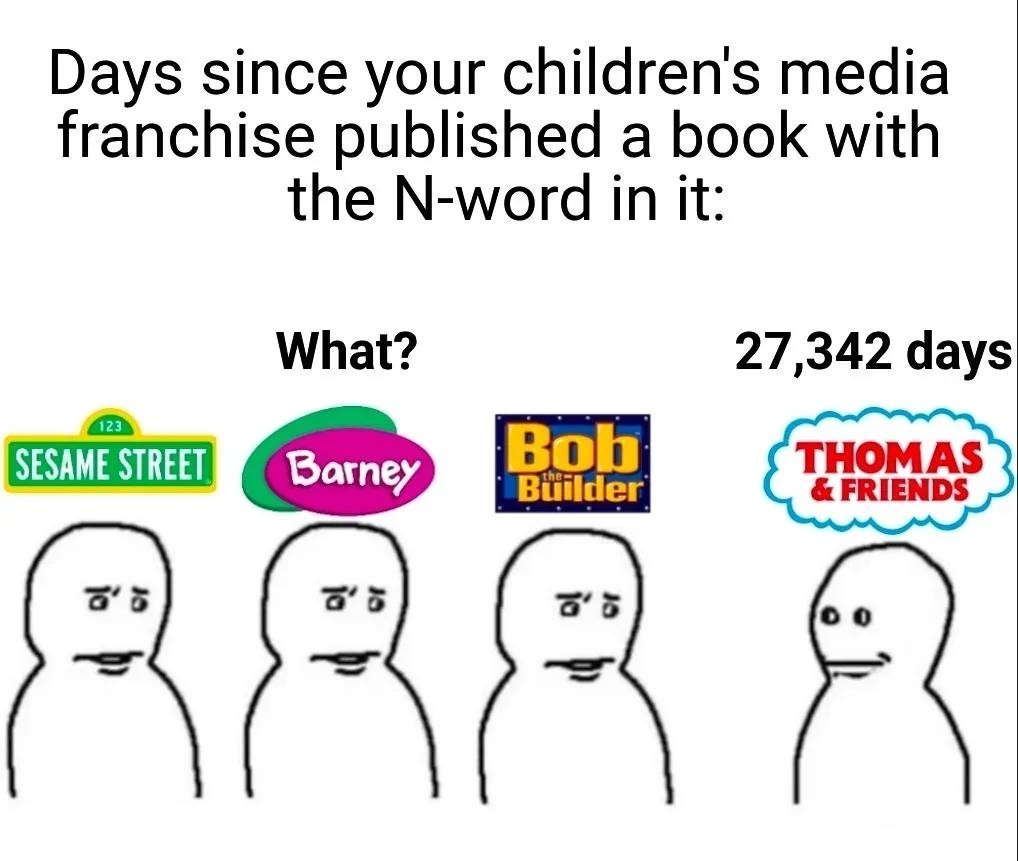
    That author was definitely a Diesel.

  • source
  • parent
  • hideshow 2 child comments
  • [–] 74 points 6 months ago (2 children)

    Unironically a great example for explaining the difference between 0 and null

  • source
  • hideshow 2 child comments
  • load more comments (1 reply)
    load more comments
    view more: next ›