top 54 comments

sorted by: hot top controversial new old
[–] 68 points 8 months ago (3 children)

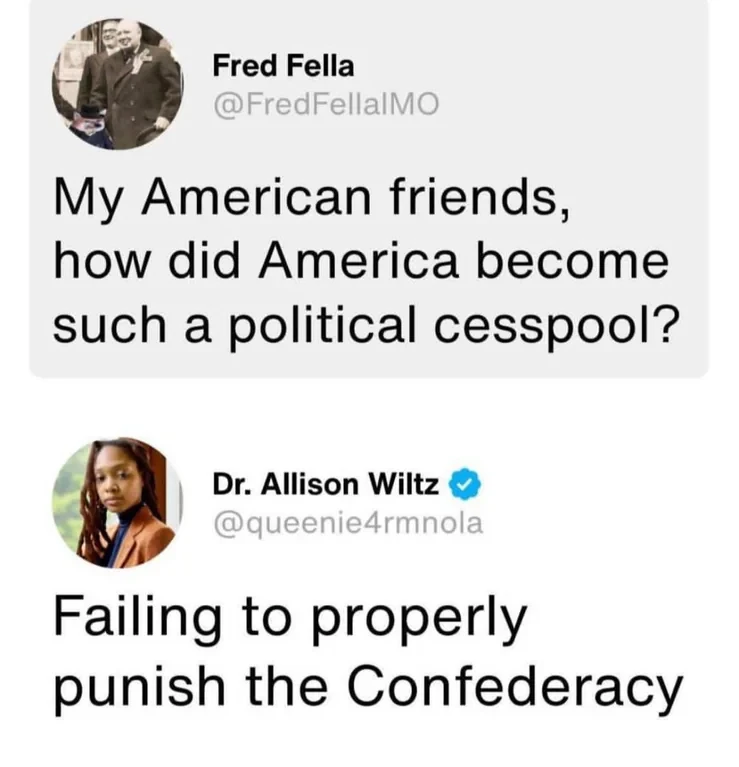
Pardoning the traitors was a huge mistake and we're still paying for it today.

  • source
  • hideshow 3 child comments
  • [–] 16 points 8 months ago (4 children)

    I've always wondered what would have happened if the Confederacy was left to its own devices. Thry had a clear vision, but it was intensely nearsighted.

    Free chattel labour was appealing for a farming economy in 1860, but it's less of a selling point elsewhere. You're right on the cusp of major industrial and trchnological advancement, while clutching to a labour pool that you don't want learning to read and probably wouldn't trust with machinery. You're not moving up the value chain that way.

    So you've got a cash-crop dependent, export centric economy, who is about to be caught with its pants down when other countries start to fire up steam and petrol-powered agricultural equipment. You're also pointing a target on your back as consumers are becoming more sophisticated and concepts like boycotts and sanctions are developing.

    Give it 50 years, and they'd halve their per-capita GDP and either be a weird novelty for slavery tourism, or the "secret sauce" behind sketchy impossibly-cheap clothing and foodstuffs where the vendor doesn't want to proudly boast "made in CSA" on the label.

  • source
  • hideshow 4 child comments
  • [–] 15 points 8 months ago

    The confederacy, left to their own devices, would have started the war at some point or another, because that's what they did. They fired the first shots trying to force the North to accept slavery, wanting to expand slavery into the territories to make new slave states.

  • source
  • parent
  • [–] 14 points 8 months ago

    I think the “the U.S. didn’t punish the Confederacy enough” argument misses a structural piece of the puzzle.

    Whether Reconstruction was too lenient or too harsh, the deeper issue is that our electoral system (first-past-the-post, single-member districts, winner-take-all) structurally favors ideological cohesion and intensity over breadth and compromise.

    In a first-past-the-post system:

    You can only pick one option.

    Minorities with high motivation outperform majorities with lower cohesion.

    Broad coalitions have to cover far more policy ground than intense factions do.

    Turnout advantages go to the side that feels existentially threatened.

    That creates what I’d call a ratchet toward polarization. The system doesn’t mathematically guarantee extremism, but it systematically biases toward it. The “policy surface area” of the broader coalition becomes a liability, while the more ideologically concentrated side benefits from cohesion and turnout energy.

    So when we look at post–Civil War politics, the question might not just be “Was the Confederacy punished enough?” It might be:

    Would any punishment regime have prevented future sectional radicalization inside a winner-take-all electoral structure?

    If the underlying incentive system rewards intense minority mobilization, then over time you’ll tend to see:

    Polarized regional blocks

    Identity consolidation

    Historical grievance becoming political fuel

    That’s not unique to Reconstruction. It’s a recurring dynamic in FPTP systems.

    I’m not saying punishment was irrelevant. I’m saying institutional incentives matter more in the long run than the severity of any single political settlement.

    If you want to reduce extremist drift, you don’t just change policy outcomes — you change incentive structures (ranked-choice, multi-member districts, proportional systems, etc.). Otherwise the same polarization dynamics reappear under new banners.

  • source
  • [–] 26 points 8 months ago (2 children)
  • [–] 9 points 8 months ago* (last edited 8 months ago) (1 child)

    The policing and prison system is a major contributing factor in my opinion.

    In the US, there are many levels of overlapping decentralized police forces. On the state level you've got local city cops, county sheriffs office, state police, highway patrol. Then on the federal level you've got FBI, homeland security, ATF, ICE, CBP, DEA, Marshals, and I've probably missed some more.

    In Australia, we have State police (For example, Western Australian Police (WAPOL) within the state. Whether you're a cop in a small town of 30 people, or on the murder squad, you're still WAPOL and fall under a common chain of command. The state police is centralized. That means there's much less room for baddies to move within the system freely, whereas in the US, a cop that gets fired from one place seemingly moves two towns over and gets another job with another department. While there is a sheriff's office, they don't carry guns and dont effect arrests, they manage the courts and do things like serve court documents. If the sheriffs need to, they call WAPOL for armed law enforcement.

    At the federal level, there's the Federal police, that's it. Within states, the federal police manage interstate and international points of entry like airports, seaports, and other interstate nodes. The border force sometimes have guns, and they do have armed patrol ships, but mostly they work with state or federal police to interdict individuals at airports and such, or with the defence department to interdict boats at sea.

    In the US, the prison system is all over the place, with private prisons, county jails, state prisons, federal prisons, etc.

    In Australia, the prisons are all run by a seperate department, Department of justice (called corrective services in some states). This isn't law enforcement. It's all state-based, there are no federal prisons. If the AFP needs to house a prisoner, they send him to a state prison and the fed pays the bill.

    This includes remand centers for pretrial detention, which are like county jails, but they are still run by the state.

    In the US, quality of incarceration varies wildly from one prison to the next, and theres a financial incentive to keep people incarcerated.

    In Australia, people conviced of serious crimes cannot vote in elections while they are in prison, but when released, their right to vote returns automatically, immediately.

    In the US, the disenfranchisement of incarcerated people varies wildly, with many felons being unable to vote after release until after a certain period has elapsed (seperate from parole), OR on explicit petition of the governer, OR in some cases, they can never vote again. So therefore, punishment effectively continues even after a sentence has been completed.

    The US justice system is a wild, convoluted, decentralized mess, everyone has guns, and there is no incentive to reform prisoners but a political incentive to disenfranchise as many as possible.

  • source
  • parent
  • hideshow 1 child comment
  • [–] 10 points 8 months ago (2 children)

    Punish, and rebuild, for past slaves and the South in general. Coming in full force to liberate and then just leaving things to simmer never works... it seems to be what we do though.

  • source
  • hideshow 2 child comments
  • [–] [S] 23 points 8 months ago

    There was a pretty robust plan. Unfortunately, Andrew Johnson sabotaged it, and then the 1876 Presidential election dismantled the 8 years of hard work President Grant put in and handed the South back over to white supremacists.

  • source
  • parent
  • [–] 10 points 8 months ago (2 children)

    So let's learn from this, and not let MAGA off the hook this time. I'm fact, they need to be punished so harshly, that it will be felt for generations. It needs to be a serious warning to future dipshits to not try it again.

  • source
  • hideshow 2 child comments
  • [–] 2 points 8 months ago (1 child)

    Can't really directly punish people for voting for maga. One can criminally prosecute anyone who broke laws, was corrupt, covered up shit, looked away, etc. and when that net catches people on both sides of the aisle, so be it.

  • source
  • parent
  • hideshow 1 child comment
  • [–] 8 points 8 months ago*

    I'd say it started when they let the slavers deeply ingrain a culture of human exploitation and failed to ever eradicate it, allowing it to adapt and continue to exist well beyond post-abolition and heavily influence today's American business and social culture.

  • source
  • [–] 8 points 8 months ago* (last edited 8 months ago)

    Black Reconstruction in America by W E.B. Du Bois, I highly recommended it, and I feel like it fits this meme.

  • source
  • [–] 15 points 8 months ago (5 children)

    Absolutely. After WWII Germany had a period of de-nazification; the US did the opposite, essentially- half a generation later we were raising monuments to the Confederate leaders.

  • source
  • hideshow 5 child comments
  • [–] [S] 20 points 8 months ago* (4 children)

    The sad thing is, de-nazification was half-assed... and it was still enough to instill a deep and enduring sense of shame in Germany for the Nazi regime.

    By normalizing the condemnation instead of glorification of the previous regime, the next generation saw it with clearer eyes, and asked the questions their parents did not - why did you go along with these atrocities?

    And that was enough. I mean, don't get me wrong, I very much would've preferred more Nazis hanged. But the backlash against Nazism was deep once the next generation came of age, simply because their culture did not normalize apologia for its horrors.

    We didn't even half-ass it. Half-half-assed. Quarter-assed. Decimal-assed.

  • source
  • parent
  • hideshow 4 child comments
  • [–] 6 points 8 months ago*

    I dunno. An awesome sitcom idea could be centred around the Confederated States of America and just above the United States of America is their always friendly and doing good neighbour- oh, wait. That's just Canada and USA already, but depressing humour.

  • source
  • [–] 5 points 8 months ago*

    Citizens United was a fairly important accelerant. But yes, the foundation is absolutely rotten.

  • source
  • [–] 5 points 8 months ago

    Dear Fred, do you want the list in alphabetical or chronological order? Because, like many horrible things that happened in history, it started with the brits "visiting" other places

  • source
  • [–] 5 points 8 months ago

    This is actually true. Very strong theory is that WW2 happened because the allies never occupied Germany after WW1. The population never appreciated that their army actually lost, and therefore the "Jewish & commie backstab" conspiracy was permitted to flourish.

  • source
  • [–] 2 points 8 months ago* (3 children)

    I hear this often, but I'm not really sure how to confidently square that assertion against Versailles, Morgenthau's memorandum and JCS 1067. I'm not saying it's wrong... only that if there is one thing history ISN'T lacking, it's conflict. I wish people would be specific and use historical templates, at least as a starting frame of reference. Some conflicts become cyclical, as every resolution merely sets the stage for the next. Some brutal conflicts are one-and-done.

    What other historical resolutions does the end of the civil war most resemble? Which other historical resolutions are most similar to what people feel should have been applied to the south?

  • source
  • hideshow 3 child comments
  • [–] [S] 9 points 8 months ago (2 children)

    Versailles fell into the trap Machiavelli warned against - to injure an enemy, but not so greatly that you do not need to fear harm from him in the future.

    The Morgenthau plan was morally unacceptable as it was effectively a sanctioned genocide, and rightly rejected.

    The failure is in several parts, though all of which fed into each other:

    1. The old elite of the Confederacy remained, and leveraged their social connections to restore their position of supremacy in the post-Reconstruction South.

    2. The South was allowed to cultivate a post-Reconstruction cultural mythos glorifying slavery and the slaver cause amongst the common people.

    3. The populations which were most resilient to the whole diseased regime, Black folk (on account of, well, knowing goddamn well they were the regime's scapegoat and underclass), were abandoned to the violence of white supremacist dominated state governments after Reconstruction.

    4. The economic system of the US South did not fundamentally change, in part because of #1, remaining an aggressively agrarian society based on the leveraging of the grotesquely undervalued labor of tenant farmers for plantation owners, by the lack of alternatives available for said labor.

    The solution is simple, but requires great political will.

    Hang or expel the elite. Seize their property. Redistribute it. Eliminate ideologues from participation in public life. Reconstruct (ha) the economy according to the standards of the North and Midwest.

    In pre-information age societies, the elite are the primary perpetuators of such cultural mythos. With their absence, the 'Lost Cause' is greatly weakened - not to mention they don't get to spend a century shitting up academia. With the seizure of their property, their kin lack recourse to regain the status of elites. By redistribution of the land, friendly demographics are given firmer economic grounding and influence in their communities. By eliminating prior ideologues of the old regime from participation in public life, a major transmission vector for thinly-cloaked revanchism is extinguished. By the reconstruction of the economy, the essential material conditions which enabled the pseudo-aristocracy is eliminated.

  • source
  • parent
  • hideshow 2 child comments
  • [–] 3 points 8 months ago* (1 child)

    If I'm reading this right, there wasn't an analogue to Nuremberg or the Argentinian exodus? (Or, as I think about it, the anti-nazi-symbols laws?)

  • source
  • parent
  • hideshow 1 child comment
  • [–] [S] 3 points 8 months ago

    Partly - many Confederates fled the country for Brazil. However, this wasn't so much predicated on the punishments the US government was willing to hand out so much as a mixture of spite/prejudice and a desire to keep their 'movable property' (read: slaves). Brazil still allowed slavery at that time.

    The US never seriously considered mass hangings, forced exile, or land seizures from the elites. Even the most famous (and sadly aborted by that traitor Andrew Johnson) redistribution plan, '40 acres and a mule', was predicated on seizures performed during wartime and as with the justification of a failure to pay taxes. There was no stomach to simply dispossess the mass of post-war Southern elites of their land, neither in the Northern elite nor the Northern farming class. The only punishment that was decisively levied, the elimination of former Confederate involvement from civic life (barred from office and barred from voting), was also lifted by that traitor, Andrew Johnson.

    Even the highest ghouls, including Jefferson Davis, the literal president of the CSA, were never convicted for their crimes, much less punished.

  • source
  • parent
  • [–] 1 point 8 months ago

    yup, same with the nazis, yah you got the big boys but a lot of the high to middling officers got away, now todays we see the issues with leting that happen.

  • source
  • [–] 0 points 8 months ago* (15 children)

    Common misconception: that 19th century Union soldiers wore hot pants and crop tops with pink horsetails stuffed in their bussies and fists held high in solidarity with their black brothers and sisters.

    In reality, they were all mostly racist, just the ones in the South moreso. Also, their entire economy was based on slave labor.

    Capitalism guarantees hardship in boom and bust cycles. Humans are easily made to believe that the weak, outnumbered, and different are the enemy. That the same people who can't muster up anything like a respectable rebellion are somehow a threat to the most powerful nation in the world.

    The moment Africans were trafficked to the North American continent, they were guaranteed to be the forever enemy.

  • source
  • hideshow 15 child comments
  • [–] [S] 5 points 8 months ago (14 children)

    In reality, they were all mostly racist, just the ones in the South moreso.

    Okay? How does that dispute the point?

    Also, their entire economy was based on slave labor.

    ... the South's, yes.

    That the same people who can’t muster up anything like a respectable rebellion are somehow a threat to the most powerful nation in the world.

    what.

  • source
  • parent
  • hideshow 14 child comments
  • [–] 0 points 8 months ago* (13 children)

    "America is a political cesspool because the Confederacy wasn't punished properly."

    This point simply doesn't make any sense. What is proper punishment? What punishment did the Union fail to enact that would have saved modern America?

    Yes, the South's, who had the greatest incentive to continue slavery. But, the economy was truly transcontinental. One economy. The North benefitted immensely from slavery.

    Do you think the North would opt for a punishment that would amount to falling on their own sword? Could such a punishment be politically tenable?

    what.

    Human beings "other". It's key to understanding our species. So long as hardship can befall a people, those people will find a scapegoat. To this day, Blacks are only 14% of the population.

    Capitilism + Humans = Political Cesspool

    Punishing the Confederacy, even by wiping them off the face of the planet, would not have changed what America was to become, except by delaying global American hegemony.

  • source
  • parent
  • hideshow 13 child comments
  • [–] [S] 4 points 8 months ago (11 children)

    This point simply doesn’t make any sense. What is proper punishment? What punishment did the Union fail to enact that would have saved modern America?

    The destruction of the pseudo-aristocracy of the South which perpetuated the plantation system; in slavery before the war, and in sharecropping after the war?

    The suppression of Confederates and Lost Cause Mythology, which created an intense countercultural current against the post-war notion of racial reconciliation?

    The entire anti-democratic system of the post-Reconstruction South which created deep divides in the proletariat at a time when labor radicalism was gained strength?

    Yes, the South’s, who had the greatest incentive to continue slavery. But, the economy was truly transcontinental. One economy. The North benefitted immensely from slavery.

    Would you like to remind me which economy struggled during the Civil War, and which economy continued largely as normal?

    Do you think the North would opt for a punishment that would amount to falling on they’re own sword? Could such a punishment be politically tenable?

    In what way would it be falling on their own sword? The South's cotton production was already castrated by Sherman's March and the fact that Britain had invested in growing cotton in Egypt and India in response to the US Civil War.

    Human beings “other”. It’s key to understanding our species. So long as hardship can befall a people, those people will find a scapegoat. To this day, Blacks are only 14% of the population.

    Capitilism + Humans = Political Cesspool

    I've got some really bad news for you about non-capitalist systems.

  • source
  • parent
  • hideshow 11 child comments
  • [–] 0 points 8 months ago (10 children)

    And you believe all of those things were not just possible but could have been sustained? Do you think they could have accomplished all of that without turning the Reconstruction into a generational occupation of the South? And you think it would have been economically viable and that the necessary long-term voter commitment would be there?

  • source
  • parent
  • hideshow 10 child comments
  • [–] [S] 3 points 8 months ago (9 children)

    And you believe all of those things were not just possible but could have been sustained?

    Yes, absolutely.

    Do you think they could have accomplished all of that without turning the Reconstruction into a generational occupation of the South?

    ... what the fuck do you think Reconstruction was?

    And you think it would have been economically viable

    Yes, absolutely. Sharecropping is not actually great for the economy, and the South would remain economically marginal to the USA for decades afterwards.

    and that the necessary long-term voter commitment would be there?

    Yes. The only fucking reason Reconstruction ended in the first fucking place was a deal between the Democrats and Republicans over a disputed election.

    "Hannibal Hamlin is VP when Lincoln is assassinated" is potentially all it would fucking take to extend Reconstruction another 5-10 years, and with greater results in the first 11 years too, for that matter.

  • source
  • parent
  • hideshow 9 child comments
  • [–] -1 points 8 months ago* (8 children)

    First, fuckity fuck fuck fucking fucking fuck cool guys say fuck a lot fucker fuck.

    Yes, absolutely.

    I guess I'll just take your word for it. I just don't see how it would have been possible with almost the complete absence of a strong and expansive federal government combined with a general commitment on both sides to state's rights, and the overall war-weariness of Northern voters.

    … what the fuck do you think Reconstruction was?

    A 10-year military enforcement that was flagging out there towards the end. You'd need to 20 - 30+ years minimum and the creation of a permanent federal admin presence to get to a point where the South's new way of life could normalize. I could talk about this some more but apparently we just say "yes" around here. My fault for not realizing this was a meme community before I posted. For fun, look into what it took to "reconstruct" Germany and Japan post-WW2.

    Yes, absolutely. Sharecropping is not actually great for the economy, and the South would remain economically marginal to the USA for decades afterwards.

    No generational occupation, no long-lasting reform. As wasn't discussed, because what good is conversation, the economics, politics, general belief in state's rights, Northerner's exhausted of war, the fact that the 15th Amendment was supported mainly as strategy for securing Republican political dominance in the South, that Northerners didn't generally favor social integration, all meant what would have been nice to have happened just didn't.

    Yes. The only fucking reason Reconstruction ended in the first fucking place was a deal between the Democrats and Republicans over a disputed election.

    This is you confusing what ought to be with what could have been. My question was very simple: given the the circumstances, what more could have be done? Certainly something, but enough to make modern American less of a "cesspool". Hindsight is fucking 20 fucking fucker 20, fucker fucking fuck shit.

  • source
  • parent
  • hideshow 8 child comments
  • [–] [S] 3 points 8 months ago (2 children)

    50 pages into Race and Reunion and it seriously already calls into question your claims about both sides having a commitment to states' rights and notes the Republican ideological commitment in the aftermath of the US Civil War as strongly in favor of social integration, dedication to freedmen's rights, an appetite for vengeance upon a defeated South, and the strong political hand of the Republicans other than Andrew Johnson's inconvenient ass sitting in the presidency.

  • source
  • parent
  • hideshow 2 child comments
  • [–] 1 point 8 months ago* (1 child)

    Those first few years, the Johnson years, were hopeful times. Circa 1870, things are clearly different. IIRC, middle of the book. It's been awhile.

  • source
  • parent
  • hideshow 1 child comment
  • [–] [S] 2 points 8 months ago* (4 children)

    I guess I’ll just take your word for it. I just don’t see how it would have been possible with almost the complete absence of a strong and expansive federal government combined with a general commitment on both sides to state’s rights, and the overall war-weariness of Northern voters.

    The idea that either side's partisans had a serious commitment to "state's rights", or that Reconstruction triggered 'war-weariness' in Northern voters is absurd.

    No occupation, no long-lasting reform.

    Good thing that Reconstruction literally was an occupation then?

    For fun, look into what it took to “reconstruct” Germany and Japan post-WW2.

    3 years of serious denazification, 7 of restricted anti-Nazi sentiment, and 13 of anti-Nazi cultural pressure?

    This is you confusing what ought to be with what could have been.

    "The 1876 election HAD to be disputed!"

    Okay, buddy.

  • source
  • parent
  • hideshow 4 child comments
  • [–] 0 points 8 months ago (3 children)

    You should read this: https://www.hup.harvard.edu/books/9780674013667

    And, also this: https://www.hup.harvard.edu/books/9780674008199

    And then look into how elections changed after The Panic of 1873, but also as a result of public outcry over a half-dozen or so scandals during Grant's presidency (Credit Mobilier, The Whiskey Ring, The Gold Ring, to name a few). "Weary" is an understatement. In reality, a majority of people in the North were done with the whole thing by '75. They wanted to focus on problems at home and were tired of supporting the South.

    And I'm not your buddy, pal.

  • source
  • parent
  • hideshow 3 child comments
  • [–] [S] 2 points 8 months ago (2 children)

    You should read this: https://www.hup.harvard.edu/books/9780674013667

    And, also this: https://www.hup.harvard.edu/books/9780674008199

    As you wish. I'm picking both of those books up now, I'll read them, and I suspect I'll return with the nagging feeling that you haven't.

  • source
  • parent
  • hideshow 2 child comments
  • [+] -3 points 8 months ago (1 child)
  • [–] [S] 10 points 8 months ago

    Not nearly enough. The cost the Confederates levied for their insane war was borne overwhelmingly by the poor and the middle class, and punishing the poor and the middle class rarely achieves anything.

    Within 20 years the fucking aristocrats had slithered their way back into their pre-war economic position; even less time than that to restore their political preeminence in the South. And they made it exceptionally clear that they regarded the war negatively only because they lost, and would do their damndest to return to imposing Southern norms on the Federal government; and certainly perpetuating the brutal norms of their own backwards states.

  • source
  • parent
  • 50 comments in c/politicalmemes@lemmy.world view that post
    44 comments in c/shermanposting@piefed.social view that post