all 15 comments

sorted by: hot top controversial new old
[–] 41 points 9 months ago (4 children)

I understood "making it" as accomplishing what you were pretending to be, often in the context of self-confidence

  • someone is scared of public speaking and thinks they're no good at it
  • they pretend that they are someone who is good at it, in order to get through situations where they need to do public speaking
  • they eventually just get good at it
  • source
  • hideshow 4 child comments
  • [–] [S] 8 points 9 months ago (3 children)

    That's another angle I didn't consider. So you mean the traits one initially fakes, may become part of their personality (and therefore doesn’t require faking anymore)?

  • source
  • parent
  • hideshow 3 child comments
  • [–] 8 points 9 months ago

    Exactly. A lot of getting good at something is practicing. No one wants to spend time doing something they suck at, especially in public, but rather than practice in private, we can try to trick ourselves into believing we are actually already talented, faking it to get the practice that is needed to build the skill.

    This might also help with mild imposter syndrome.

  • source
  • parent
  • [–] 9 points 9 months ago

    It's often about imposter syndrome. People don't feel like they belong, when really they often are the same as their peers. So if they just pretend like the belong they can keep the facade until their imposter syndrome goes away.

  • source
  • parent
  • [–] 11 points 9 months ago

    They're still faking it because there's always another "it" to make

  • source
  • [–] 8 points 9 months ago (1 child)

    Well then they obviously haven't yet made it!

    No true Scotsman and all that

  • source
  • hideshow 1 child comment
  • [–] 8 points 9 months ago (2 children)

    IF one's doing something, like getting onstage & doing a presentation, is something one has no experience with..

    THEN "fake it 'till you make it" is absolutely-valid advice: you can't gain experience doing presentations, without doing presentations!

    Inherently-inauthentic people, however, are inherently-inauthentic people.

    That is a different category.

    People have to LEARN how to do, how to be, & that requires stepping outside of what one already-has-done.

    How could it possibly be otherwise?

  • source
  • hideshow 2 child comments
  • [–] 4 points 9 months ago* (last edited 9 months ago)

    Well depends, I think some industries just are fake in general,

    Chiropractors, stock traders that aren't using insider information etc...

    But otherwise I suppose it's just how you are "faking it". In IT the obvious joke is that we always just google everything. But at the end of the day that gets you better at knowing what to google, and over time you'll memorize most of it. and it's almost impossible not to start gradually learning the connections of how and why things work.

  • source
  • [–] 3 points 9 months ago* (1 child)

    I disagree; "fake it til you make it" prescribes specific behavior (faking it) for a specific period of time (until you make it) but does not specify what behavior should take place (faking it or not) after that period has been exceeded.

  • source
  • hideshow 1 child comment
  • [–] [S] 8 points 9 months ago

    'Till you make it' suggests to me, one ceases to be fake after success. Which either means they return to their pre-faking state, or the faking becomes part of their personality (and therefore doesn't require faking anymore).

  • source
  • parent
  • [–] 2 points 9 months ago*

    Ah, but that is the great reality--those who "make it" are themselves still faking it, and the real question is: are they really faking anymore, or is this who they really are?

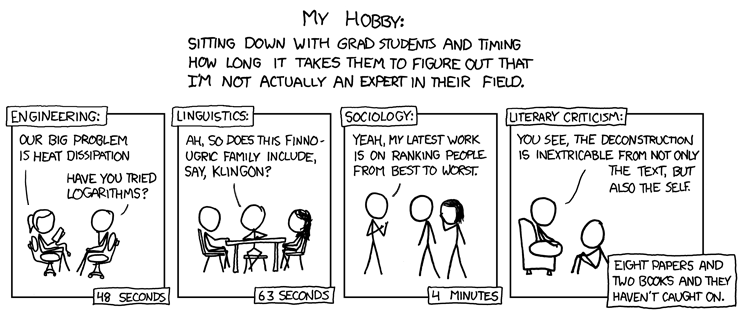
    Relevant xkcd

  • source